Jump to Content
Aragonite Market - Size, Share, Industry Trends, and Forecasts (2025 - 2032)
Aragonite Market Size:
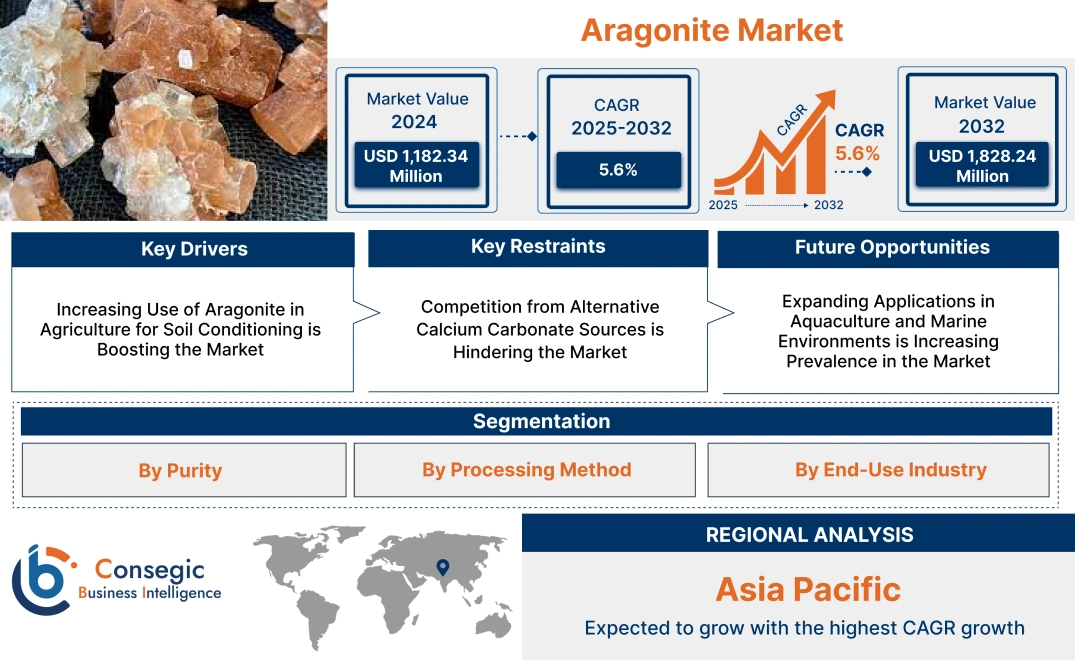
Aragonite Market size is estimated to reach over USD 1,828.24 Million by 2032 from a value of USD 1,182.34 Million in 2024 and is projected to grow by USD 1,227.48 Million in 2025, growing at a CAGR of 5.6% from 2025 to 2032.
Aragonite Market Scope & Overview:
Aragonite is a naturally occurring carbonate mineral primarily composed of calcium carbonate (CaCO₃). Known for its unique crystal structure and high bioavailability, aragonite is widely used across industries such as agriculture, construction, pharmaceuticals, and environmental management. Key characteristics of aragonite include its superior chemical purity, low solubility, and natural abundance, making it ideal for applications requiring calcium enrichment and pH regulation. The benefits include improved soil conditioning in agriculture, enhanced water filtration in aquaculture, and sustainable alternatives in construction materials. Applications span fertilizers, cement additives, water treatment, and pharmaceutical formulations. End-users include agricultural industries, construction material producers, and environmental agencies, driven by increasing demand for eco-friendly solutions, advancements in calcium carbonate-based materials, and the rising focus on sustainable resource utilization.
Aragonite Market Dynamics - (DRO) :
Key Drivers:
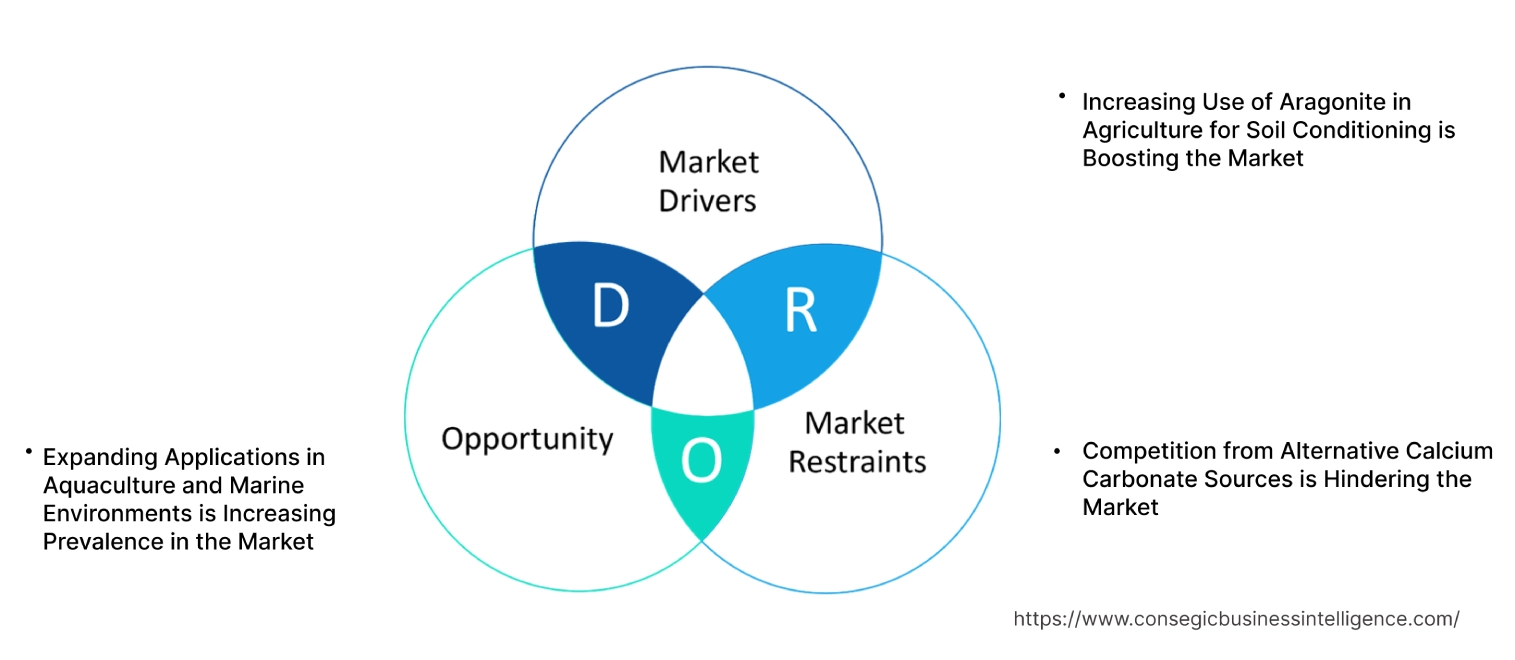
Increasing Use of Aragonite in Agriculture for Soil Conditioning is Boosting the Market
Aragonite is becoming increasingly significant in agriculture due to its high calcium content and natural ability to improve soil structure. Acting as an organic soil conditioner, aragonite effectively balances soil pH, restores calcium-deficient soils, and enhances nutrient absorption for crops. Its granular texture allows for efficient application, making it a preferred option in sustainable and organic farming practices. Unlike chemical alternatives, aragonite promotes healthier soil ecosystems while minimizing environmental impact, which aligns with modern agricultural trends.
The adoption of natural soil conditioners like aragonite is rising as farmers focus on long-term soil health and higher crop productivity. The analysis highlights that aragonite market trends in regenerative agriculture and reduced chemical usage are driving the preference for eco-friendly calcium sources. Aragonite's role in improving soil fertility and reducing reliance on synthetic fertilizers further strengthens its position in modern farming methods.
Key Restraints:
Competition from Alternative Calcium Carbonate Sources is Hindering the Market
Despite its benefits, aragonite faces intense competition from more widely available and cost-effective calcium carbonate sources such as limestone and calcite. These alternatives are frequently preferred in industries like agriculture and construction due to their lower extraction and processing costs. Additionally, their abundant availability in the global aragonite market makes them more accessible for large-scale applications, posing a challenge to aragonite’s widespread adoption.
In price-sensitive sectors, particularly in emerging economies, the higher cost of extracting and processing aragonite limits its commercial viability. Industries often opt for substitutes that can deliver similar calcium enrichment and pH-balancing properties at a lower cost. Addressing this competitive challenge requires increased awareness of aragonite's advantages, such as its higher purity and effectiveness, to differentiate it from alternative sources.
Future Opportunities :
Expanding Applications in Aquaculture and Marine Environments is Increasing Prevalence in the Market
Aragonite is gaining traction in aquaculture and marine-related applications due to its ability to stabilize pH levels and provide essential calcium for aquatic life. It is widely used to support coral reef restoration, maintain water quality in aquariums, and enhance the development of marine organisms like shellfish and fish in aquaculture systems. The natural composition of aragonite makes it an environmentally friendly option for maintaining the ecological balance in marine environments.
Trends in sustainable aquaculture practices and the growing focus on ocean conservation are creating new opportunities for aragonite. The analysis indicates that initiatives to restore coral reefs and expand environmentally conscious aquaculture are driving its adoption as an effective solution for promoting marine biodiversity. As industries increasingly prioritize ecological sustainability, aragonite's role as a pH stabilizer and calcium source is expected to expand across marine and freshwater ecosystems.
Aragonite Market Segmental Analysis :
By Purity:
Based on purity, the calcium carbonate market is segmented into 99.5% purity, 99% purity, and 98.5% purity.
The 99.5% purity segment accounted for the largest revenue of aragonite market share in 2024.
- Calcium carbonate with 99.5% purity is widely used in industries that require high-grade materials, such as healthcare, cosmetics, and personal care.
- This high-purity calcium carbonate is used in pharmaceuticals for antacids, dietary supplements, and calcium fortification.
- Its superior chemical stability, whiteness, and minimal impurity levels make it ideal for applications where product quality and safety are paramount.
- The rising trends for high-purity calcium carbonate in pharmaceutical formulations and cosmetic products, coupled with advancements in purification technologies, have driven the dominance of this segment.
The 98.5% purity segment is anticipated to register the fastest CAGR during the forecast period.
- Calcium carbonate with 98.5% purity is predominantly used in industries such as construction, agriculture, and manufacturing, where ultra-high purity is not critical.
- This segment benefits from its cost-effectiveness and wide availability, making it suitable for bulk applications such as cement production, soil conditioning, and paint manufacturing.
- The increasing use of calcium carbonate in the construction sector, particularly in emerging markets, is expected to drive the rapid aragonite market growth of this segment.
- Additionally, its application in manufacturing processes as a filler and extender further fuel its trends.
By Processing Method:
Based on the processing method, the calcium carbonate market is segmented into mining and beneficiation, chemical precipitation, and solvent extraction.
The mining and beneficiation segment accounted for the largest revenue of aragonite market share in 2024.
- Mining and beneficiation is the primary method for producing natural calcium carbonate from limestone deposits.
- This method is widely used for large-scale production, particularly for applications in construction, agriculture, and manufacturing.
- The cost-effectiveness, simplicity, and scalability of this process make it the preferred choice for producing bulk calcium carbonate.
- The growing opportunities for natural calcium carbonate in the construction sector for cement, concrete, and fillers have further driven the dominance of this segment.
- Additionally, technological advancements in beneficiation processes are enhancing production efficiency and quality.
The chemical precipitation segment is anticipated to register the fastest CAGR during the forecast period.
- Chemical precipitation involves the controlled production of synthetic calcium carbonate with specific purity and particle size.
- This method is widely used in industries requiring high-grade calcium carbonate, such as healthcare, cosmetics, and personal care.
- Precipitated calcium carbonate (PCC) is valued for its superior brightness, controlled particle size, and purity, making it ideal for applications such as pharmaceuticals, paper production, and specialty coatings.
- The rising trends for PCC in premium products and increasing investments in advanced processing technologies are expected to drive significant growth in this segment.
By End-Use Industry:
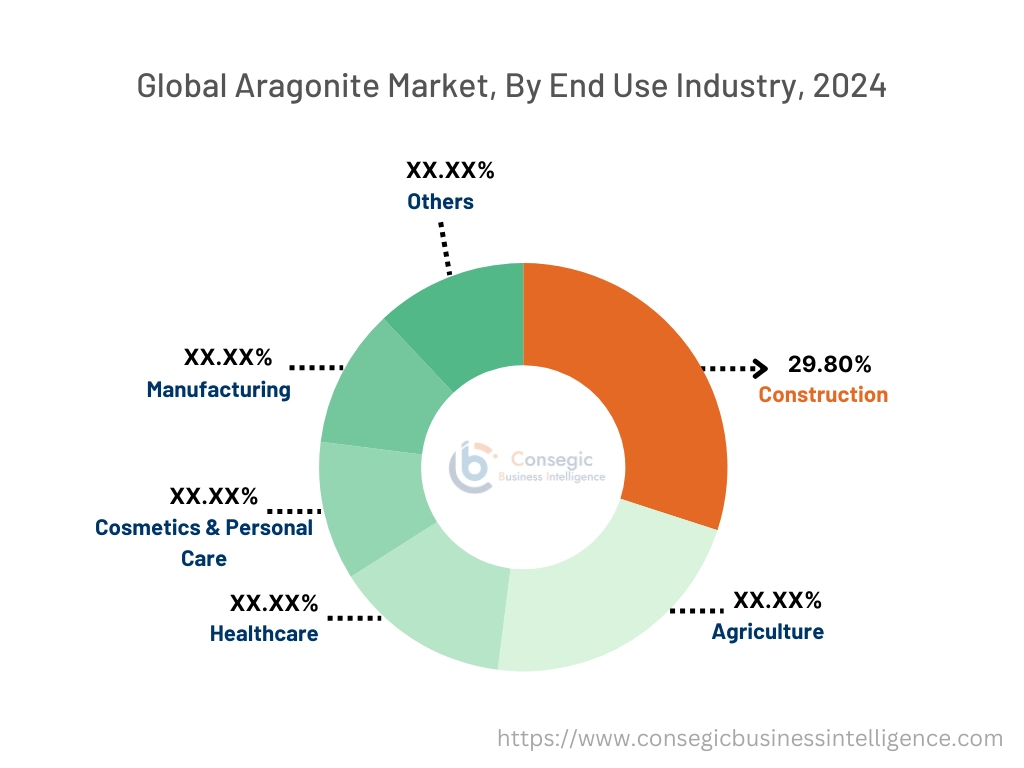
Based on end-use, the calcium carbonate market is segmented into healthcare, agriculture, construction, cosmetics & personal care, manufacturing, and others.
The construction segment accounted for the largest revenue of 29.80% share in 2024.
- Calcium carbonate is widely used in the construction sector as a key ingredient in cement, concrete, and building materials.
- It serves as a cost-effective filler, extender, and reinforcing agent, improving the durability and strength of construction materials.
- The growing infrastructure development and urbanization in emerging economies have fueled the aragonite market opportunities for calcium carbonate in construction applications.
- Additionally, its use as a coating material for enhancing the aesthetics and performance of building products has further solidified the dominance of this segment.
The healthcare segment is anticipated to register the fastest CAGR during the forecast period.
- Calcium carbonate is extensively used in the healthcare sector for its role as a dietary supplement, antacid, and pharmaceutical excipient.
- It is a critical component in calcium-fortified foods, bone health supplements, and medications for acid reflux and indigestion.
- The increasing trends for calcium supplements driven by an aging population and rising awareness of bone health have significantly boosted the adoption of calcium carbonate in the healthcare sectors.
- Additionally, advancements in pharmaceutical formulations requiring high-purity calcium carbonate are expected to drive the segment’s rapid growth.
Regional Analysis:
The regions covered are North America, Europe, Asia Pacific, the Middle East and Africa, and Latin America.
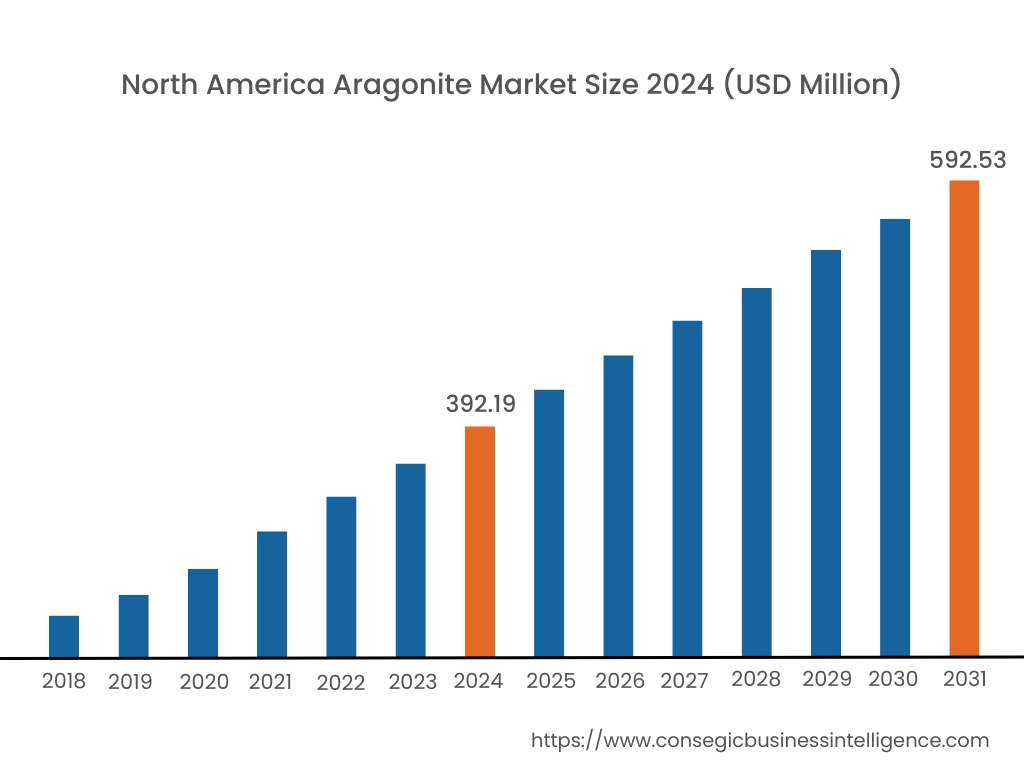
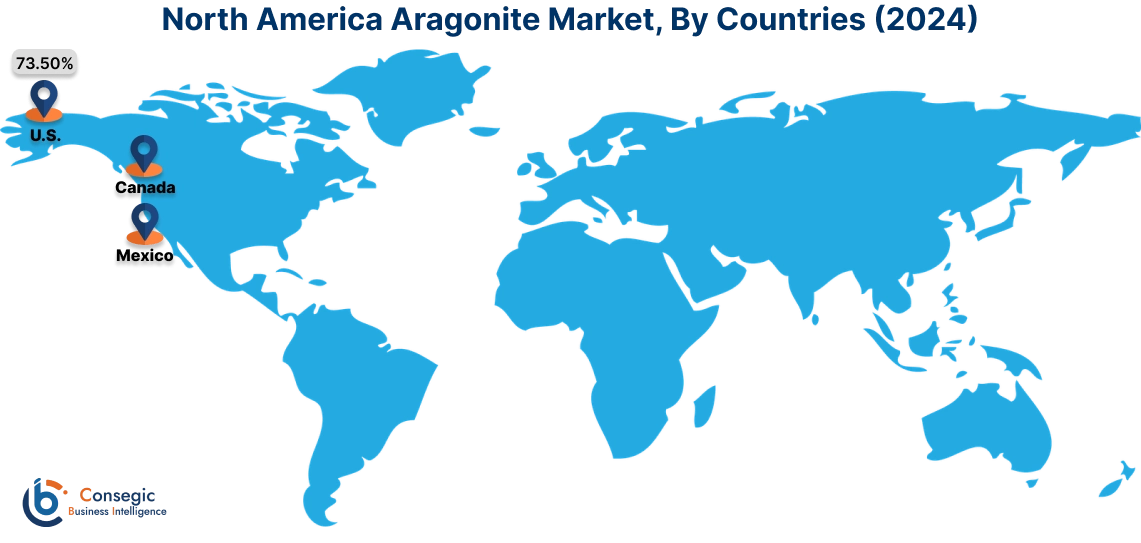
In 2024, North America was valued at USD 392.19 Million and is expected to reach USD 592.53 Million in 2032. In North America, the U.S. accounted for the highest share of 73.50% during the base year of 2024. North America holds a significant share in the aragonite market analysis, driven by its applications in agriculture, aquaculture, and construction industries. The U.S. dominates the region due to the increasing use of aragonite as a soil conditioner to neutralize acidic soils and improve crop yields. Additionally, its use in aquaculture to maintain optimal water quality for marine species further supports aragonite market demand. The construction sector also utilizes aragonite as a filler material for cement and concrete production. Canada contributes through its use in water treatment and eco-friendly material applications. However, environmental regulations on mining activities may pose challenges to supply.
In Asia Pacific, the market is experiencing the fastest growth with a CAGR of 6.0% over the forecast period. In the aragonite market analysis, driven by rapid industrialization, increasing agricultural activities, and rising aquaculture demand in China, India, and Southeast Asia. China leads the market with extensive use of aragonite in aquaculture to maintain water quality and pH levels in large-scale fish and shrimp farms. India utilizes aragonite as a soil conditioner to improve agricultural productivity, especially in regions with acidic soils. Southeast Asian countries emphasize its use in the construction and aquaculture sectors, supporting both economic and environmental needs. However, inconsistent mining regulations and the availability of cheaper alternatives may pose challenges.
Europe is a prominent market for aragonite, supported by its growing demand and analysis in environmental applications and industrial uses. Countries like Germany, France, and the UK are key contributors. Germany focuses on using aragonite as a substitute for synthetic materials in construction and environmental remediation projects. France emphasizes its application in water treatment and aquaculture to maintain pH balance in freshwater and marine ecosystems. The UK sees increasing opportunities for aragonite in agriculture as a natural soil amendment. However, strict EU regulations on mineral extraction and sustainability concerns may limit growth in the region.
The Middle East & Africa regional analysis is witnessing a steady rise in the aragonite market growth, primarily driven by its use in water treatment and construction. Countries like Saudi Arabia and the UAE are adopting aragonite to enhance water quality in desalination plants and aquaculture systems. In Africa, countries like South Africa use aragonite in agriculture to restore nutrient-deficient soils and in mining operations as an eco-friendly material. However, limited infrastructure and technological capabilities for processing aragonite may restrict market expansion in certain parts of the region.
Latin America is an emerging market for aragonite, with Brazil and Mexico leading the region. Brazil’s growing agricultural sector drives the use of aragonite as a natural soil amendment to improve crop productivity. Mexico focuses on its application in aquaculture for maintaining water conditions and in construction as a filler for cement and concrete. The region’s analysis of sustainable and natural resources further supports aragonite market trends for aragonite in various industries. However, economic instability and lack of advanced mining technologies may pose challenges to aragonite market expansion.
Top Key Players and Market Share Insights:
The aragonite market is highly competitive with major players providing products to the national and international markets. Key players are adopting several strategies in research and development (R&D), product innovation, and end-user launches to hold a strong position in the aragonite market. Key players in the aragonite industry include -
- Calcean (USA)
- Sangab Azarshahr (SAZCO) (Iran)
- Omya AG (Switzerland)
- Minerals Technologies Inc. (USA)
- United States Lime & Minerals Inc. (USA)
- Chirag Minerals (India)
- Aragonite Source (USA)
- Astrra Chemicals (India)
- Imerys Group (France)
- Carmeuse Group (Belgium)
Recent Industry Developments :
- In June 2024, a research team at Princeton University developed a bio-based cement alternative utilizing oyster shells, which provide calcium carbonate in the form of aragonite and biopolymers. This innovative cement exhibits 19% greater crack resistance and 17% improved ductility compared to ordinary Portland cement (OPC).
Aragonite Market Report Insights :
| Report Attributes | Report Details |
| Study Timeline | 2019-2032 |
| Market Size in 2032 | USD 1,828.24 Million |
| CAGR (2025-2032) | 5.6% |
| By Purity |
|
| By Processing Method |
|
| By End-Use Industry |
|
| By Region |
|
| Key Players |
|
| North America | U.S. Canada Mexico |
| Europe | U.K. Germany France Spain Italy Russia Benelux Rest of Europe |
| APAC | China South Korea Japan India Australia ASEAN Rest of Asia-Pacific |
| Middle East and Africa | GCC Turkey South Africa Rest of MEA |
| LATAM | Brazil Argentina Chile Rest of LATAM |
| Report Coverage |
|
Key Questions Answered in the Report
What is the projected size of the Aragonite Market by 2032? −
Aragonite Market size is estimated to reach over USD 1,828.24 Million by 2032 from a value of USD 1,182.34 Million in 2024 and is projected to grow by USD 1,227.48 Million in 2025, growing at a CAGR of 5.6% from 2025 to 2032.
What are the primary drivers fueling the Aragonite Market growth? +
The market growth is driven by increasing use in agriculture for soil conditioning, expanding applications in aquaculture, and rising demand for sustainable construction materials.
Which factors are restraining the growth of the Aragonite Market? +
Competition from cost-effective alternatives like limestone and calcite, coupled with higher processing costs and limited awareness, hampers market adoption.
What future opportunities exist for aragonite in emerging applications? +
Aragonite’s role in aquaculture for pH stabilization, coral reef restoration, and marine biodiversity preservation presents significant growth opportunities, particularly in sustainable marine ecosystems.
Overview
Reputation & Certifications


Our Services
- Market Intelligence & Forecasting
- Custom Research Solutions
- Market Entry Strategy
- Competitive Intelligence
- Customer Insights
- Industry Innovation Analysis
- Investment Advisory