What Makes a Factory “Agentic”?
The fundamental change that characterizes agentic factories is automation ➔ autonomy ➔ agency. The conventional approach for manufacturing has been that of a deterministic workflow where everything has been programmed upfront, such as an assembly line process with a predetermined set of actions to be performed. In advanced automation, the workflow still follows deterministic rules. The agentic factory concept relies on intelligent systems that make decisions on their own on how to achieve goals.
The basic concept is of a continuous perception-reasoning-action (PRA) cycle, where the artificial intelligence receives inputs from different sources and makes decisions about what action needs to be taken to meet certain goals. These decisions result in closed-loop execution where the problem is solved independently without any human interference.
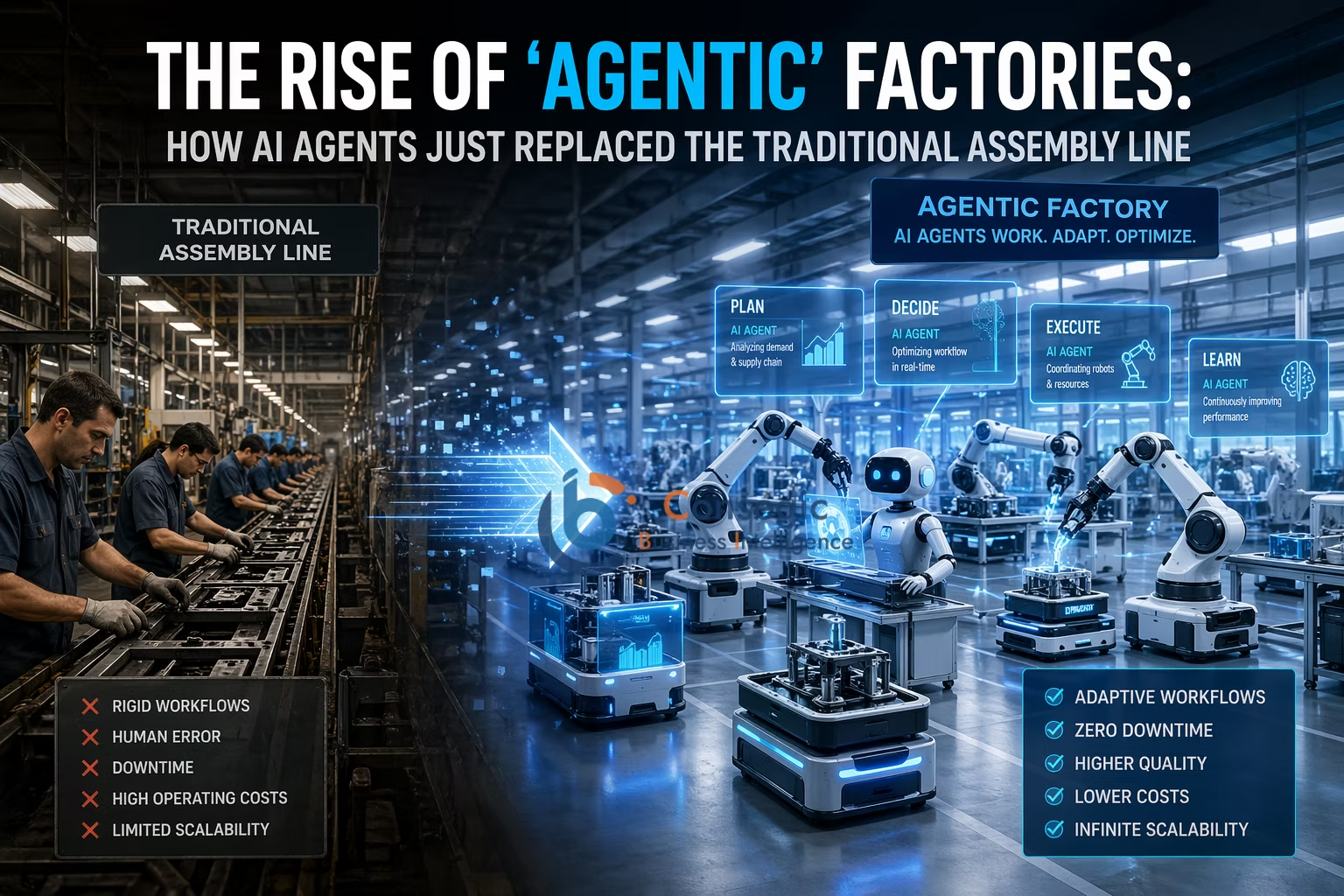
A further important element is that of multi-agent orchestration. As opposed to being controlled through one single entity, multiple intelligent agents interact amongst themselves for production, maintenance, and logistics. The mode of working thus moves from task-oriented (e.g., ‘run machine X’) to goal-oriented (e.g., ‘optimize throughput’).
The driver for this paradigm shift is that of technology stacks, which include elements such as Large Language Models, Multimodal AI, IIoT, and data architectures.
Core Use Cases Replacing the Assembly Line Model
Agentic factories have revolutionized the way manufacturing works through the introduction of adaptable, intelligent networks which replace inflexible linear assembly lines. The area where this concept has made its biggest impact would be in autonomous production optimization wherein AI agents optimize production times, machine settings, and power consumption according to demand, performance of machines, and available supplies. Moreover, there is no need for a pre-planned workflow process anymore and such an approach allows for very adaptable and self-optimizing production environments. Another application where AI has had tremendous impact would be predictive self-healing maintenance wherein machine states are monitored, issues are detected, problems are diagnosed, and automatic repairs are carried out, saving companies huge amounts of money.
Supply chain orchestration is another significant ability, which involves using AI to redirect suppliers, inventories, and logistics when there are disruptions caused by, for example, delivery problems, political developments, or unexpected surges in demand. Meanwhile, quality control transitions from checking to correcting, where visual AI agents spot faults right away and make adjustments in the process flow in real time. Finally, lights-out manufacturing becomes the culmination point of the same transition process, where the factory runs itself using artificial intelligence systems without any human involvement in scheduling and procurement.
The Economics of Agentic Manufacturing: Productivity, Cost, and Scale
The emergence of agentic manufacturing has revolutionized industrial economics through the integration of intelligence into the manufacturing process itself. The early adopters have seen ~15% better machine uptime and ~20% reduced maintenance costs, achieved through the automation of many micro decisions to optimize production and drive throughput. Costs have seen improvements in labour, especially those of repetitive nature, as well as reduction in downtime losses and lower costs of inventory (~20%) as a result of improved demand matching.
Nonetheless, there emerge new cost levers, such as compute, real-time data pipelines, cybersecurity, and governance, which become increasingly important as a risk element in autonomous systems. However, what stands out most is a move away from the expansion of factory footprint towards scaling through intelligent manufacturing using software and digital twins. In essence, this represents a move from capital investment-based manufacturing to software-defined production, where AI could become an entity of digital labour.
Human + AI Co-Production: The New Workforce Model
Agentic manufacturing does not negate human involvement but rather redefines it. While people’s roles are changing from operators to supervisors, from workers to exception handlers, and from managers to agent conductors, who will steer AI rather than perform actions, there has emerged a new intermediate tier known as “AI middle management” where people oversee the activities of agents, step in when necessary, and ensure proper alignment with organizational objectives—an entirely new field: agent management.
As for the allocation of responsibilities, humans are increasingly concerned with strategic planning, innovation, and decision-making, whereas agentic entities concentrate on the implementation, improvement, and real-time decision-making on a massive scale. In this regard, employment opportunities associated with low-skill routine occupations have become less attractive, but the need for professionals such as AI trainers, system designers, and operational experts is increasing.
Nevertheless, this transition poses many challenges, ranging from the expansion of skills divides to distrust in automation and the balance between job elimination and automation.
Governance of Fully Autonomous Factories
Governance forms a necessary layer for agentic factories since AI agents are no longer limited passive actors but have full access and control over manufacturing processes, logistics, and maintenance. Such dynamics make poor governance capable of producing catastrophic consequences on entire industrial networks, thus making governance essential for proper functioning of AI-based technology just like AI itself.
The first issue associated with such an approach to manufacturing is cybersecurity, especially due to autonomous agents increasing attack surface by exploiting vulnerabilities of connected devices and supply chain infrastructure. The next challenge related to governance is controlling AI behaviour and aligning it with business goals to ensure proper performance optimization.
Finally, in relation to governance of AI technology is explainable as many systems function as black boxes, leading to difficulties associated with attributing responsibility for any negative events. For example, who will be blamed for the shipment of faulty products, disrupted supply chains, or safety hazards in agentic factories? This can be achieved through agentic governance levels or managed spaces ("agentic domes") that incorporate policy guidelines into the process itself. Moreover, it is supported by constant surveillance, immediate audit logs, and AI-driven compliance systems.
Conclusion
Agentic factories are fundamentally different from their inflexible predecessors, they embrace AI agents that act independently through perception, reasoning, and decision-making to optimize their operations, maintenance, and logistics. Though agentic factories offer many benefits in terms of efficiency and cost savings, they also pose certain risks for the organization and require additional measures to address them. However, agentic factories do not replace humans but simply change their role from being operators to supervisors and strategists working side-by-side with artificial intelligence. Finally, agentic manufacturing is a stepping stone towards software-driven manufacturing.