The Strategic Crossroads of Global Energy Systems
The current state of the global energy market can be regarded as an inflection point, where 2030 is not going to mark the end but rather serve as a transitional period for the further development of the energy sector. It involves trends such as accelerated technological change, evolving energy policies, and geopolitical shocks. However, these trends are not viewed separately; they represent a balance of competing interests commonly called an energy trilemma.
To start with, the energy trilemma consists of three major issues that cannot be avoided or reconciled with each other easily. Energy security became one of the most important problems after the outbreak of the Russian-Ukrainian war, forcing states to focus on secure energy supplies instead of swift decarbonization of their energy infrastructure. Affordability should also be considered about an energy trilemma, as rising inflation affects the costs of fuels in both developed and developing countries. Sustainable development aims at increasing shares of renewable energy sources.
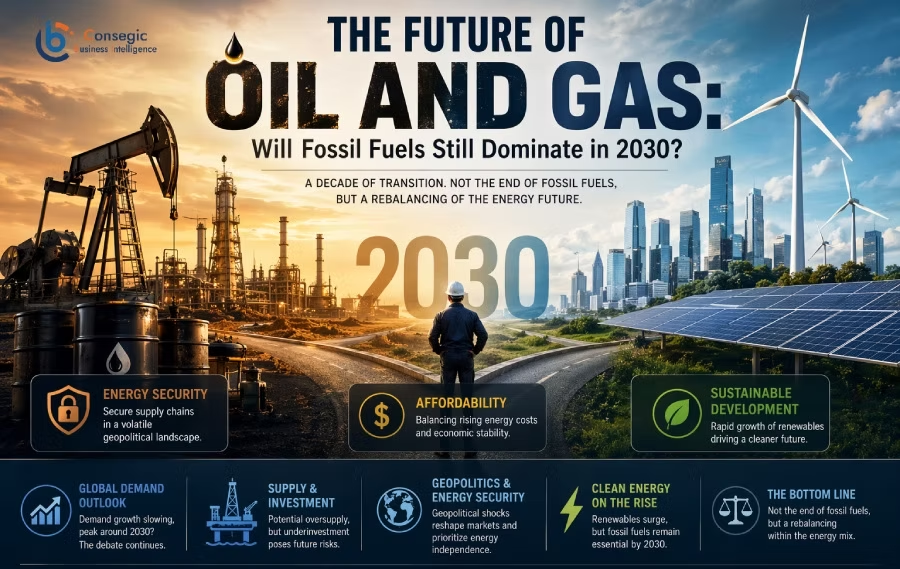
Despite this momentum, fossil fuels continue to be entrenched in the global system. It still generates about 60% of the world’s electricity and represent the vast majority of energy production, showing how vital these sources are to the structure of the current system. However, renewables continue to grow quickly and will satisfy most of the future increase in demand.
As a result, there is an essential conflict between “structural dependency vs. accelerated transition.” As much as renewable energy continues to grow, demand growth and inertia in infrastructure keep fossil fuels entrenched in the energy mix.
Global Demand Outlook: Peak Oil or Prolonged Plateau?
The future prospects of oil demand in the world market will no longer be characterized by growth rates but rather by slowing down. The International Energy Agency (IEA) forecasts that oil demand in the world will amount to about 105-106 million barrels per day in 2030, which will represent a marginal increase of 3.2 mb/d compared to 2023. Nevertheless, this growth will slow down significantly, especially towards the end of the decade.
These changes have led to three different outlooks:
The base scenario presented by the IEA sees demand peaking by 2030, with a slow decline afterward as electrification gains momentum and becomes even more efficient.
On the other hand, corporations like BP (British petroleum) as well as financial institutions such as ‘Goldman Sachs’ see delays in peak oil, with demand continuing to increase until the 2030s.
A “no peak” outlook is seen in more conservative projections, in which demand would continue increasing through 2050
Underlying this resilience are structural drivers: rapid consumption growth in countries like India and China, expanding petrochemical demand, and rising aviation fuel use. At the same time, constraints such as electric vehicle adoption, efficiency improvements, and tightening climate policies are moderating long-term growth.
Ultimately, the nature of the debate has shifted. It is no longer about whether oil demand will grow but rather how long it will plateau before entering structural decline.
Supply Dynamics and Investment Trends in Oil & Gas
The global supply dynamics in the coming decade is characterized by two narratives - surplus and vulnerability. First, growing output capacities in America, Brazil, and other important members of the OPEC+ (Organization of the Petroleum Exporting Countries) bloc should result in total supply hitting 114-115 million bpd by 2030, far above expected demand increases. This results in the expectation of oversupply conditions and forecasts indicating the market might see significant surpluses. Moreover, this oversupply condition hides a crucial structural challenge, namely the lack of investment in oil and gas upstream projects due to ESG (environmental, social, and governance) pressures and discipline on capital allocation. Due to the lack of appropriate investments, the rate of decline could be as high as 8% per year, leading to unexpected shortages in the market and fluctuations in prices.
However, there are some alterations taking place within the industry as well. Specifically, investments in short-cycle projects, such as shale, give more chances during unpredictable times within the market environment. Moreover, LNG (Liquefied Natural Gas) infrastructure construction is booming worldwide as a response to rising global demand for natural gas. At the same time, state-owned national oil companies become more prominent again, holding an increasing percentage of low-cost resources.
Geopolitical disturbances in recent years have added to the complexity. For example, the Strait of Hormuz region in 2026 led to a disruption of about 20% of the oil flow in the world and contributed to the increase of prices worldwide.
The Role of Geopolitics and Energy Security
Geopolitics has changed the global energy situation and made energy a strategic commodity for states instead of an exchangeable one. In 2026, this tendency is especially clear since energy markets have become more prone to geopolitical competition and conflict in the regions. Instability in the Middle East, along with potential clashes between Iran and other countries, including its location at important straits such as the Strait of Hormuz, has caused price instability and revealed the fragile situation in global oil transportation channels. At the same time, the disengagement of Russia and Europe in the energy sector remains relevant since Europe is trying to completely abandon the supplies of energy resources from Russia, which redirect them to Asia.
Simultaneously, the energy transition will come under threat from strategic competition between the U.S. and China. Both powers are now competing for dominance in energy systems via exports of fossil fuel resources, building up LNG infrastructure, and controlling green energy value chains. As a result, another important trend emerges: states are giving higher priority to energy independence than climate considerations. Finally, geopolitical issues are retarding the speed of the energy transition. In times of crisis, countries turn to fossil fuels as a reliable source of energy supplies in order to guarantee national security.
Furthermore, the energy transition can no longer be viewed from an environmental perspective. It has become inseparable from geopolitics and depends upon security issues.
Will Clean Energy Technologies Overtake Fossil Fuels by 2030?
Renewable energy technologies have been advancing at an unprecedented pace; nevertheless, hopes about the full replacement of fossil fuels within 10 years are exaggerated. Renewables are currently the most rapidly growing energy sources and are expected to make up for more than 90% of the increase in global power demand until 2030, their share in the total energy generation has increased to roughly 43%. At the same time, fossil fuels are still dominating the energy supply market as well as in sectors where electricity cannot play a major role, such as transport and industrial production.
Moreover, energy transitions across sectors show great imbalances. While there are many efforts towards making the power grid free of carbon, the transportation system and heavy industries remain lagging behind. In net-zero scenarios, oil demand falls at an approximate annual rate of 2% until 2050, while at present, demand might continue to increase beyond 2030 due to structural obstacles such as poor grid infrastructure, lack of storage facilities, high investment costs, and poor policy frameworks.
It would be fair to say that while renewables will play a more prominent role going forward, but will not substitute fossil fuels entirely by 2030. The process is “additive rather than substitutive” as they develop alongside existing systems.
Conclusion
To conclude, the energy scenario across the globe is about to experience an era of transition rather than revolution. Although the pace of expansion in the consumption of fossil fuels has been declining, that of renewable energy sources has been rising rapidly. Despite all the developments taking place in the energy sector, the dependency on crude oil and natural gas is still deeply rooted into its structure. As far as the next decade is concerned, the world will not observe the termination of fossil fuel supremacy; instead, it will be observing its rebalancing within the energy spectrum.