The Rise of Global Chip Conflict
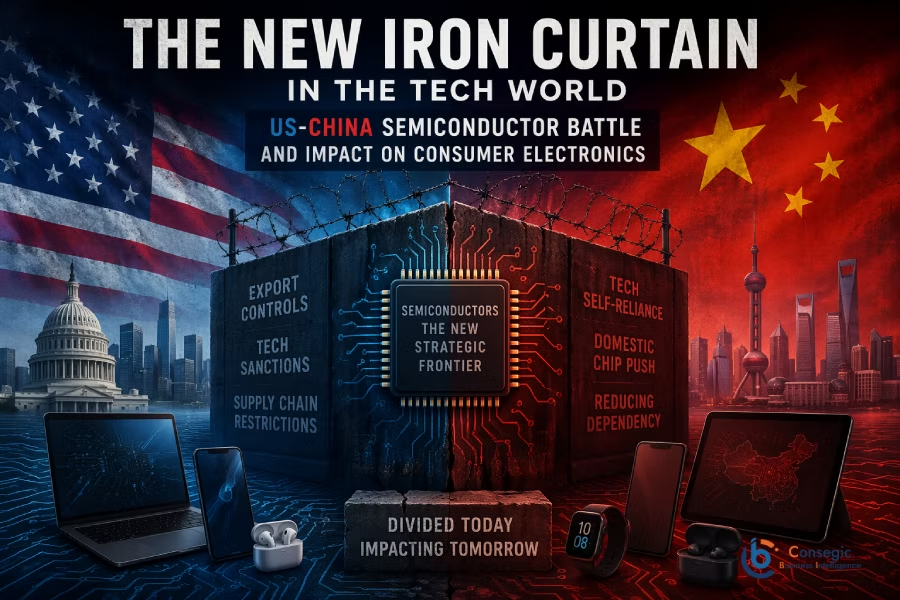
The “Chip War” between China and America developed into “the new iron curtain”, which was responsible for creating divisions within the international semiconductor supply chains through export restrictions and counter-restrictions.
The Chip War between the US and China has grown beyond a bilateral fight, drawing in other allies such as Japan, the Netherlands and Europe and breaking up the Asian and wider semiconductor supply chains.
Covid shortages in 2020-2021 highlighted TSMC dependence, while CHIPS Act led to reshoring and Iranian War chokepoints in 2026 created additional memory shortages.
Global effects hit consumer electronics hardest. 10-30% price surges for smartphones and laptops from AI-prioritized DRAM/NAND, 10-12% shipment drops and bifurcation into US-led design as compared to China-led volume ecosystems. Vietnam and India gained as hubs, but innovation slowed outside elite nodes risking 7% GDP losses long-term.
2019 Export Controls: The Beginning of Restrictions
Beginning from 2019, the US imposed a ban on shipment of any chip made by American companies including NVIDIA and AMD to China, but only in consumer electronics and not in AI products. On the other hand, countries like the Netherlands and Japan banned export of essential lithography equipment necessary for the manufacturing of semiconductors.
China, on its part, sanctioned US company Micron against the shipment of its semiconductors and restricted export of rare-earth elements essential in making magnets in several devices.
Tightened Regulations in 2025
But, the rules of 2025 are strict and with no way out through subsidiaries. However, partial permission is granted for exporting mid-level NVIDIA chips through revenue sharing.
March 2025 saw the Trump administration blacklist dozens of Chinese entities from semiconductor trade, targeting strategic technologies and reinforcing military-use restrictions.
May 2025 saw the Commerce Department restrict EDA software sales from companies such as Cadence, Synopsys and Siemens EDA for use in chip design, thus furthering the isolation of China’s fabs such as SMIC.
China responded with restrictions on US goods such as gallium and germanium, which are used in chips, while stepping up their investments of over $150 billion toward self-sufficiency, thus increasing domestic production but tightening global supplies of memory for consumer products.
2026 Policy Outlook Under the Trump Administration
For 2026, considering the policies of the US government under President Trump, there would be an easing in the exportation of advanced AI chips, but not in huge volumes because of the high taxes imposed on the same.
Under President Trump's second term in 2026, US chip policy balances revenue generation from China sales with tightened security controls amid the Iran conflict and congressional pushback. Expect continued ‘case-by-case’ licensing for advanced AI chips like NVIDIA H200, paired with 25% tariffs and volume caps which account for 50% of US sales, while new restrictions target lithography tools and foreign fabs.
Impact on Consumer Electronics Industry
Disruption in supply chain and increasing prices: The US-China chip war impacts the consumer electronics sector through supply chain disruption and increase in prices of components. As of April 2026, memory shortages drive up prices for smartphones, laptops, TVs and computers, with affect lingering well into 2027.
Rise in cost for all devices: Prices increased by 3-8% in moderate conditions, up to 20-30% for cheaper smartphones that sell at less than $250; cost of adding 16GB RAM to smartphone costs an extra $30; laptops prices increased by 15-30%, which affects brands such as Dell, HP, and Lenovo the most. NAND shortage affects TV screens and cheaper phones as well.
Reduction in the total number of units shipped worldwide: The 2026 prediction states that global shipments will be reduced by 10-12% overall, with sales for computers being the most reduced since there is little need for them and also due to the problems relating to Strait of Hormuz conflict and shipment issues.
Difficulties faced while making high-end smartphones: Large firms like Apple and Samsung get their materials in advance, but this is not the case for smaller firms. The need for the 7nm chip made by SMIC which comes in limited quantities limits Huawei from bringing out any new high-end smartphone.
US dependency on China for manufacturing: About 65% of all firms based in the US use products manufactured by Chinese firms, thus exposing themselves to disruptions in their supply chains due to material export restrictions involving gallium and germanium. There is an effort to localize manufacture via the CHIPS Act, but this leads to higher costs.
Increase in marketing hubs for alternative products: Countries like India and Vietnam are increasingly becoming sites for assembling goods due to their tariff advantages. Over time, this will limit innovation in consumer goods that do not involve AI, as well as cheap storage of data.
The Great Tech Divide and Its Global Impact
The US- China semiconductor war has evolved far beyond a trade dispute, emerging as a defining feature in the modern global economy. This conflict has created a ‘Great Tech Divide’, splitting global technology ecosystems into rivals and disrupting supply chain for semiconductors that are critical for consumer electronics.
Rising prices, less product availability and slower upgrade cycles are some of the immediate effects felt by the consumers worldwide. While industry giants like Apple and Samsung manage to secure resources and maintain stability, smaller firms face huge challenges in terms of sourcing components.
In the long run, the split of the global semiconductor industry in the US- led and China- led spheres risks slowing technological process, especially in non-AI consumer technology.
Ultimately, the world is moving away from a unified and globalised tech economy towards a fragmented and strategically controlled one. If this continues, innovation will become more localised, competition more political and access to affordable technology very limited.