Walk down any supermarket aisle today and something has quietly changed. The boxes, bottles and pouches staring back at you aren't just containers anymore. Some of them know where they've been, can tell you if the product inside has gone bad and can connect to your phone with a simple tap. For a few years, smart packaging have been sneaking into our daily lives, however in 2026 it's not anymore a novelty to luxury product or demonstration but the standard way the world buy and sell products.
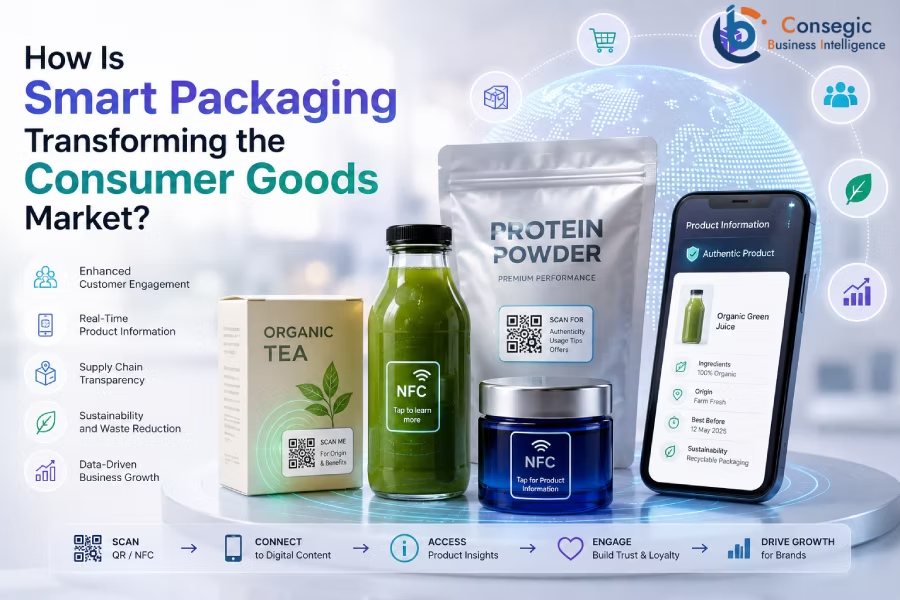
But how this trend is happening and if it is a significant issue for the average customer? The short answer is yes, more than most people realize.
It Started with a Simple Problem
The idea behind smart packaging isn't complicated. Traditional packaging does one job: protect the product and display information. It doesn't adapt, it doesn't communicate and once it leaves the factory, it goes completely silent. That creates problems across the entire supply chain- food gets wasted because nobody knows it's spoiling; counterfeit goods slip through with convincing but fake labels and brands lose touch with their customers the moment the product hits a shelf.
Smart packaging was born as a direct answer to these frustrations. By embedding technology- whether that's QR codes, NFC chips, RFID tags, sensors or even tiny printed circuits- into the packaging itself, brands can keep the conversation going long after the product leaves the warehouse.
Freshness That You Can Actually See
One of the most tangible applications is in food and beverage. Freshness indicators and time temperature sensors are now being built directly into packaging film and labels. These aren't gimmicks. They change colour or display a visible signal when a product has been exposed to conditions that affect its safety- a gap in the cold chain, for instance or a package that's been sitting at room temperature too long.
For consumers, this matters because best-before dates are notoriously blunt tools. A carton of milk labelled "good until Friday" might have been left in a warm loading dock for three hours during transit and technically still be within date but nowhere near its best. Smart packaging bridges that gap. It gives a real-time picture of the product's condition, not just an estimate based on ideal storage.
For brands and retailers, the implications are enormous. Food waste is a massive cost, both financially and environmentally. When products can communicate their actual condition, logistics teams can make smarter decisions about what gets prioritized, rerouted or pulled from shelves.
Counterfeiting Just Got Harder
The global trade in counterfeit consumer goods runs into the hundreds of billions of dollars annually. Luxury goods, pharmaceuticals, cosmetics, electronics virtually no category is immune. Smart packaging is emerging as one of the most effective countermeasures available.
Serialized QR codes, NFC authentication chips and blockchain linked packaging allow consumers and supply chain partners to verify a product's authenticity in seconds. A customer buying expensive skincare can tap their phone to the bottle and get an immediate confirmation like this product left the right factory, travelled through the right hands and hasn't been tampered with. If that check fails, the brand knows immediately where the breach occurred.
Pharmaceutical companies have been early and aggressive adopters here for obvious reasons. The stakes with counterfeit medication are life and death, not just brand reputation.
Packaging That Talks Back to Brands
From a brand perspective, smart packaging is also reshaping how companies understand their customers and they're paying attention.
Traditional packaging research relied on surveys, focus groups and sales data. It was always retrospective. Smart packaging, particularly NFC and QR-enabled versions, creates a live feedback loop. When a customer scans a package for a recipe, warranty registration or loyalty reward, the brand gets real data like which markets are most engaged, which products get scanned most at point-of-sale, how customers are using the product after purchase.
This isn't surveillance for its own sake. When it's done well, it creates genuinely useful experiences for the consumer- a sauce bottle that links to 50 recipes, a skincare tube that recommends complementary products based on purchase history, a wine label that tells the full story of the vineyard. The packaging becomes an extension of the brand experience, not just a container that ends up in recycling.
Sustainability and Smart Packaging: A Complicated but Evolving Relationship
A reasonable concern is whether adding technology to packaging makes sustainability worse. Added components, added materials, added complication- seems more likely to increase waste than decrease it.
This is not the whole story however. Certainly, in the immediate term this can be a barrier as integrating chips and sensors increases the complexity of materials in terms of recyclability. But smart packaging is also proving to be a net positive in several areas. Reduced food waste alone has a significant environmental impact globally, food waste accounts for a substantial share of greenhouse gas emissions and anything that extends a product's usable life matters. Smart inventory management enabled by RFID tagging also reduces overproduction and over ordering throughout the supply chain.
The packaging industry is also actively working on the materials problem, developing printed electronics that use biodegradable substrates, NFC antennas made from paper and sensors that can be composted. It's not solved yet, but the trajectory is heading in the right direction.
What Comes Next
The pace of change is accelerating. The cost of NFC and RFID technology has dropped significantly in recent years, bringing it within reach for mid-market consumer goods brands that couldn't have justified the investment five years ago. Printed electronics- where sensors and circuits are essentially printed onto packaging material rather than attached- are moving from lab prototypes toward commercial viability.
There's also a broader shift happening in how people relate to the products they buy. Post-pandemic, consumers became significantly more interested in supply chain transparency. Where was this made? Who handled it? Is it actually what the label says it is? Smart packaging speaks directly to those questions.
It won't happen overnight and not every category needs a chip embedded in its box. But the gap between "dumb" and "smart" packaging is going to keep narrowing. The brands and retailers that understand this now and start building those capabilities into their products will have a significant advantage over the ones playing catch-up later.
Smart packaging isn't just changing how products are wrapped. It's changing the entire relationship between a product and the people who make, move and ultimately use it and that's a bigger deal than it might look from the outside of a box.