Background of the Iran Conflict
The war between Iran & US started on February 28th when the US and Israel together bombarded the Iranian military base and commenced Operation Epic Fury resulting in the death of the Supreme Leader Ali Khamenei. In response, Iran attacked Israel and military bases using missiles and drones and sealed off the Strait of Hormuz, causing almost 20% disruption in global gas and oil supplies.
The tension grew further when Iran sealed off the Strait of Hormuz, which is among the most important maritime trading routes across the world. By limiting the maritime route and preventing ships related to the US and Israel from passing through, Iran managed to cause considerable disruption in global gas and oil supply chains.
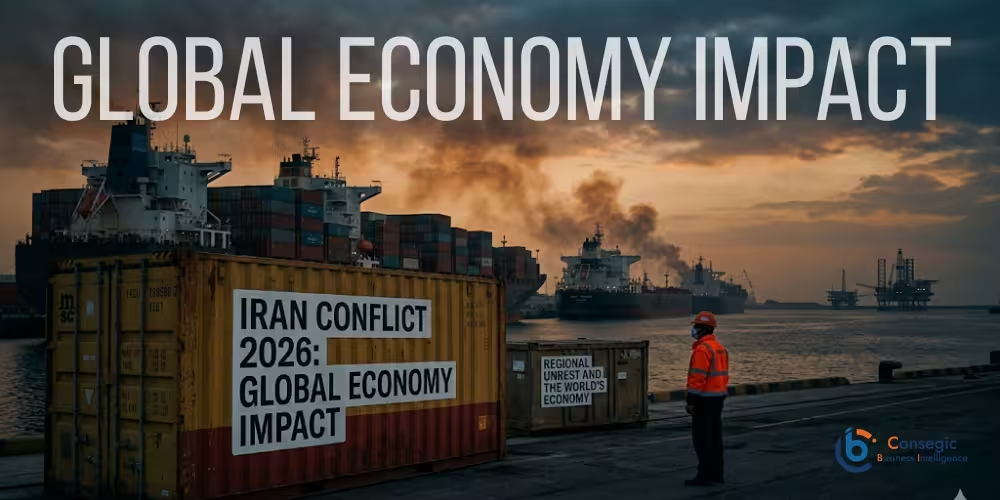
Strait of Hormuz Closure and Oil Supply Shock
The closure of Strait of Hormuz has the largest oil supply shock ever. Iran closed the strait soon after the fight, allowing limited passage with the toll of $2 million per ship while completely banning the US and Israel ships. As of April 2026, the traffic on the route is minimal even after multiple truce attempts.
Iran shut the port on 8 April after Israeli attack on Lebanon, allowing only controlled transits under the IRGC oversight. US President Trump ordered a Navy counter-blockade on April 13 after failed Islamabad talks, stranding hundreds of tankers and slowing pre-conflict shipments.
Brent crude spiked past $120 a barrel, $80 per barrel pre conflict, with outages hitting 13 million barrels daily; prices dipped below $100 just briefly on partial reopening.
After failed Islamabad ceasefire talks, Trump declared US forces "locked and loaded," directing the Navy to intercept vessels entering or exiting the strait, including those paying Iran's $2 million tolls.
Failed Diplomatic Efforts and Pakistan’s Mediation
Pakistan has emerged as a key mediator in ceasefire talks for the 2026 Iran war, brokering a fragile two-week truce on April 8 and hosting high-level US-Iran negotiations in Islamabad.
The recent talks in Islamabad on April 11 and 12 ended without an agreement after 21 hours. US Vice President JD Vance led from the US side while the Iranian side was led by Mohammad Bagher Ghalibaf, Iran's Parliament Speaker and was accompanied by Foreign Minister Abbas Araghchi.
High-level direct and indirect sessions occurred on April 11-12 in Islamabad—the first since 1979—with Pakistan facilitating amid a public holiday and heavy security. No MoU (Memorandum of Understanding) was signed, yet Iranian officials see it as groundwork for more talks, while Pakistan's FM Ishaq Dar called for commitment to the truce.
How Is the Iran Conflict Impacting the Global Economy?
Strait of Hormuz and global oil disruption: Iran’s control over the Strait of Hormuz continues to drive profound shocks to the global economy, with Brent crude prices exceeding $120 per barrel due to the halted 20% of the world oil supply. This has resulted in inflation, spike in crude oil prices, stock market drop, currency swings etc.
GDP loss in Arab nations: Arab nations face $120 to $194 billion in lost GDP as per the United Nations Development Program study released on 30 March. Kuwait and Qatar would potentially shrink 14% of their war drags in April. Iran’s economy is expected to contract over 10% due to infrastructure damage, food impacts, and hike in bread prices by 140%, meat by 135%.
Disruption in gulf aluminium production: Aluminium outputs of around 9% from gulf states face disruption after strikes on Emirates Global Aluminium, rising prices by 8% and affecting autos, aerospace, electronics, packaging and construction.
Global supply chain breakdown: Cargo ships reroute around Africa, delaying pharmaceuticals from India, semiconductors from Asia and fertilizers from Middle East, while air cargo halts entirely. Cost for agriculture, copper mining and food production worldwide has been spiked as Gulf producer supply 45% of global sulfur and 1/3 of nitrogen fertilizers.
Food crisis in gulf nations: The maritime blockade resulted in a grocery supply emergency across the Gulf states which rely on the Strait for almost 80% of their food supply. By mid-March, 70% of the regions food import were disrupted, forcing retailers like to airlift staples, resulting in a 40-120% hike in customer price.
Inflation and recession risk in Europe: Europe is facing inflation exceeding 0.5%, along with industrial cost surges of up to 30%, raising recession concerns in countries like Germany and Italy. This economic strain is directly related to the Iranian conflict which has disrupted the global energy supply by closing the Strait of Hormuz. Meanwhile developing markets suffer currency pressures and growth cuts; India’s rupee and stocks have plunged.
Impact on stock markets: Global stock markets have seen 5.5% decline since the war started with Asian markets facing the most losses due to high energy dependence.
The Global Economic Uncertainty Ahead
The US navy's blockage of the Strait of Hormuz under the order of President Donald Trump in April 13, 2026, intensifies the uncertainties in global economic performance due to the war in Iran, where crude oil prices climb above $120 per barrel and could reach up to $150 per barrel when fully implemented. It is predicted that the growth in global GDP will fall between 2.7 and 3.0 percent.
The Iran crisis in 2026 has transformed from a geopolitical problem to a global economic problem. The Strait of Hormuz has been partly blocked and the supply of energy resources has become limited, resulting in one of the most intense oil shocks in modern times. The increase in crude oil prices has caused inflation, higher production expenses and a reduction in demand for goods from both advanced and emerging countries.
Advanced nations may suffer from recession risks, while emerging economies will face currency devaluation and economic growth problems due to the dependence on energy imports.
Failure to find an alternative solution may cause inflation, lower trade activities and delayed economic recovery.