Every time a customer taps “buy now”, an enormous chain reaction begins behind the scenes. Containers move across oceans, delivery trucks weave through highways and warehouses operate around the clock- yet despite all that complexity, the most costly, challenging and important part of the process is the very last step- the last mile.
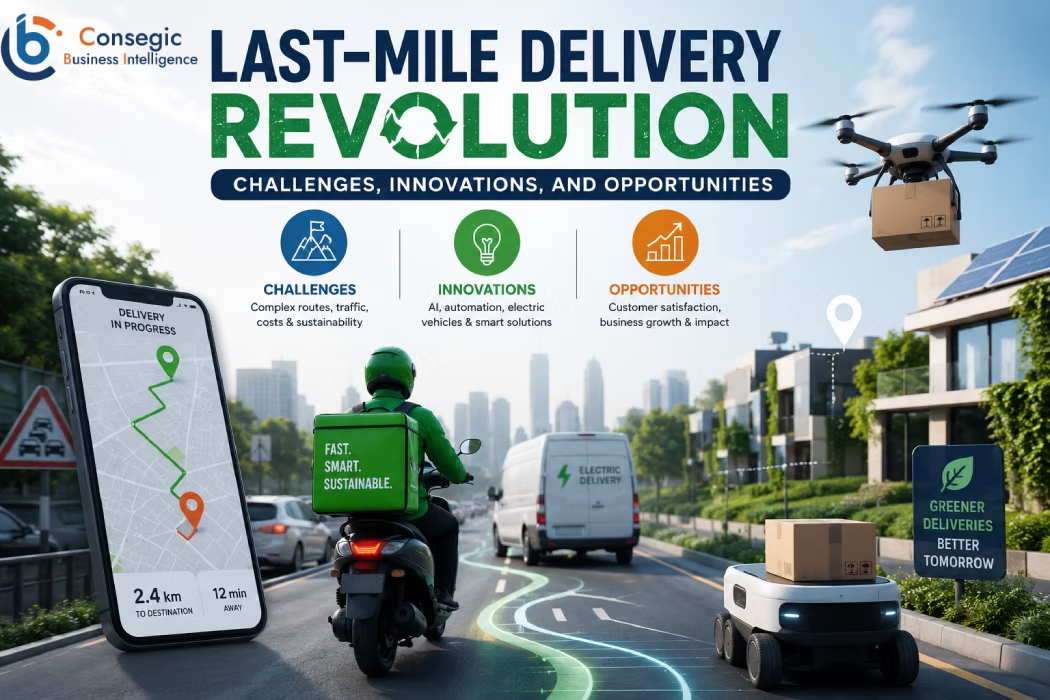
That final journey from a distribution center to someone’s doorstep accounts for nearly 53% of total shipping expenses and is often the exact moment where customer loyalty is either strengthened or lost.
The explosive growth of e-commerce- accelerated during the pandemic and now permanently embedded in everyday consumer habits- has made last mile logistics one of the biggest operational challenges in the modern economy. Global parcel shipments are expected to exceed 161 billion by 2030. Retailers, logistics providers and startups are investing heavily to solve a problem that is not only logistical but also technological, environmental and deeply connected to human behaviour.
The Challenges of Last-Mile Delivery
The last mile becomes difficult because multiple problems stack on top of each other. Delivery density drops dramatically- a truck that efficiently transports hundreds of packages to a warehouse suddenly has to make frequent stops across individuals streets and neighbourhoods. Cities create even more complications- narrow roads, limited delivery windows, gated apartments, unavailable recipients and constant parking shortages. Rural areas face the opposite issue- long distances between homes makes each drop significantly more expensive.
Failed deliveries remain one of the biggest problems in last mile logistics. Studies show that up to 30% of first attempt deliveries fail, creating expensive re-delivery cycles that reduce profitability and frustrate customers. Environmental concerns are also growing as urban freight contributes heavily to city CO2 emissions and governments continue tightening emission regulations. Labour shortages, rising wages and dependence on gig workers make staffing extremely difficult for logistics companies. At the same time, customer expectations for same day and next hour delivery continue to rise across nearly all retail sectors.
Labour continues to be the hardest factor to manage. Delivery drivers are the human face of a company- their professionalism, punctuality and behaviour often shape customer satisfaction more than any improvement elsewhere in the supply chain. At the same time, the number of qualified drivers is shrinking in many regions while delivery demands keep climbing.
The gig economy approach, introduced by companies such as DoorDash and Deliveroo, provides flexibility but also raises growing concerns around worker welfare, reliability and quality control, all of which are attracting closer regulatory scrutiny.
Innovations Reshaping the Segment
The pressure to improve the last mile has turned the sector into one of the biggest testing grounds for logistics innovation. Many of the technologies that once sounded experimental are now becoming practical, scalable solutions.
Companies such as Wing, Amazon Prime Air and Zipline have already completed millions of drone deliveries, mainly for lightweight packages in suburban and rural areas. On the ground, delivery robots from Starship Technologies and autonomous vehicles dropped by Nuro are being used for grocery and pharmacy deliveries in selected cities.
Electric cargo bikes have quickly moved from small experiments to mainstream delivery solutions in cities like Amsterdam, Paris and Copenhagen. Companies including DHL and UPS now use eCargo fleets capable of carrying heavy loads while easily accessing traffic restricted zones where traditional vans suffer.
Machine learning has transformed delivery routine planning into a dynamic real time process. Platforms such as Routific and Onfleet analyse traffic, weather, customer availability and vehicle capacity to continuously improve delivery routes during operations.
Parcel lockers introduced by Amazon Hub, InPost, DHL and regional postal services help solve the issue of failed deliveries. Rather than redelivering undelivered packages to depots, the boxes are stored safely at the locker box location. Delivery networks based on the "PUDO" (Pick-Up and Drop-Off) network take the idea one step further and involve stores and petrol stations for the retrieval of the parcels, increasing efficiency and flexibility.
These developments show that while technical and regulatory challenges still exist, they are gradually becoming easier to manage.
The Opportunity Ahead
Despite rapid innovation, the last mile sector remains far from fully optimised- which creates massive commercial opportunities for companies capable of solving its biggest inefficiencies.
Three major trends are likely to shape the industry over the next five years.
- Hyperlocal Fulfilment Expansion
Dark stores and micro warehouses located within short distances of densely populated areas are transforming the economies of fast delivery. Grocery delivery platforms such as Getir and Gorillas demonstrated the viability of this model and although some aggressive operators scaled back, much of the infrastructure they created is now being integrated into more sustainable systems by established retailers. The combination of predictive inventory system and localised storage represents one of the industry’s strongest attempts at making same hour delivery economically viable.
- Data as a Competitive Advantage
The logistics company that not only understand where a package needs to go but also when a customer is likely to be home, which entrance to use, how long deliveries usually take and what alternative are acceptable- that company can deliver efficiently and at a lower cost. This advantage strengthens over time because every completed delivery produces additional behavioural data that improves future predictions. In the coming decade, the biggest winners in last mile logistics may resemble technology and data companies more than traditional transport businesses.
- Sustainability as a Business Driver
As carbon taxes increase and low emission zones become more common, companies operating electric and highly optimised delivery fleets will gain structural cost benefits over competitors still dependent on diesel vehicles. Customers- especially enterprise buyers and large retailers- are already considering emission performance when selecting logistics partner. Sustainable last mile delivery is no longer simply a branding exercise; it has become an essential requirement for long term economic competitiveness in urban logistics.
Conclusion
The last mile has never been only a transportation challenge. It is the exact point where a brand’s promise becomes a real-world experience, where vast global supply chains narrow down into a single interaction at someone’s doorstep. The business that invest seriously in making that interaction faster, more dependable and more sustainable will not just capture market share- they will shape how commerce is experienced in the years ahead.