The global logistics sector is experiencing one of the biggest transformations in its history- not simply because of a new fuel alternative, but because businesses are fundamentally rethinking how products are transported, how environmental impact is tracked and what accountability means on a global scale.
For many years, the logistics industry followed a straightforward objective- transport goods from one place to another as quickly and affordably as possible. Environmental consequences were treated as somebody else’s problem- noted elsewhere and paid for elsewhere. Today, that mindset has changed dramatically.
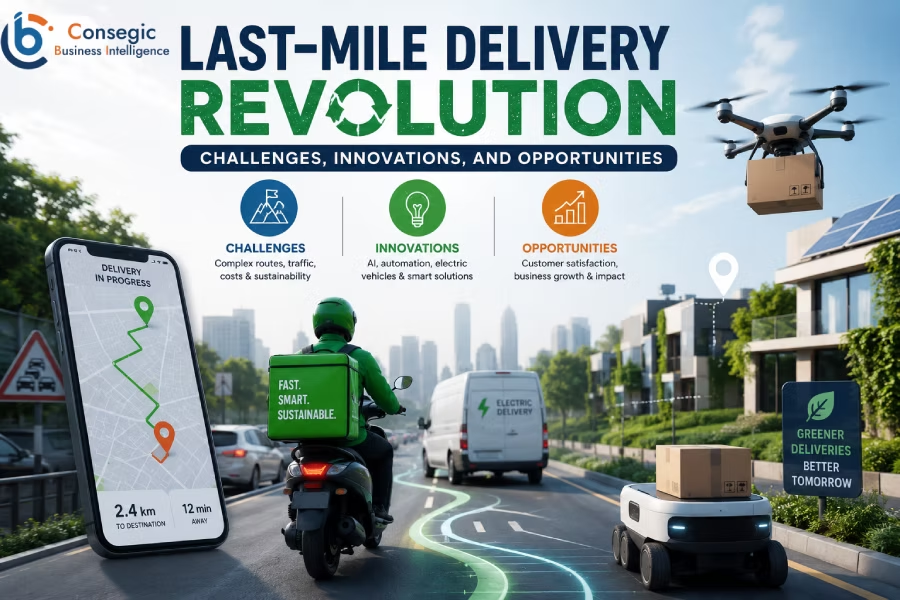
Transportation contributes nearly a quarter of the worlds carbon dioxide emission, with freight logistics accounting for a major portion of that number. As a result, the push towards decarbonisation is no longer just an ethical concern. It has become an economic, regulatory and long-term business necessity.
Green logistics- the process of measuring, tracking and reducing the environmental impact of supply chains- has evolved far beyond corporate sustainability reports. It is now influencing boardroom strategies, procurement agreements and government regulations.
The Electric Fleet Revolution
One of the clearest signs of change can be seen on the road. Fleet electrification- once considered unrealistic for long distance logistics- is now advancing quickly. Major logistics providers and retail corporations have pledged to shift thousands of delivery vehicles to battery electric alternatives over the coming decade. Vehicles such as Tesla’s Semi, Volvo’s FH Electric and a growing number of electric delivery vans from companies like Rivian and BYD are steadily expanding across urban and regional transport network.
The financial case is also becoming stronger. Although electric freight vehicles still involve higher upfront cost, their overall ownership expenses are gradually decreasing as battery prices fall and charging infrastructure improves. Lower fuel and maintenance cost throughout a vehicle’s lifespan are starting to outweigh the initial investment- a shift analysts believe will become decisive across most logistics segments by the end of the decade.
Outside of road transport, the maritime shipping sector- which produces roughly 3% of global emissions- is testing ammonia powered ships, wind assisted propulsion systems and hydrogen fuel cells. While these technologies are still in the early stage of adoption, they hold enormous potential to reduce emissions across some of worlds busiest and most carbon intensive shipping routes.
Route Optimisation and the Intelligence Layer
Decarbonisation is not only dependent on the type of fuel vehicles use. It is also shaped by how efficiently they move. Artificial intelligence and machine learning have transformed route planning, enabling logistics companies to significantly cut down on empty miles- trips completed without cargo- which makes up to an estimated 25-30% of road freight journeys in developed countries.
Modern route optimisation systems now analyse real time traffic conditions, weather updates, local consolidation opportunities and even the carbon intensity of local power grids to design routes that reduce both delivery time and emissions. Companies such as Amazon, DHL and FedEx have reported double digit improvements in delivery efficiency after implementing AI driven logistics systems. In an industry defined by tight margins and massive scales, even minor efficiency improvements can create meaningful environmental benefits.
Sustainable Warehousing and Cold Chain Innovation
Logistics infrastructure is also being built from the ground up. A new warehouse is designed with the net-zero objective at its core – solar powered roof top, energy from renewable energy for lights, rainwater harvesting and even smart building control that can actively adjust heating and cooling as it responds to real time factors. Automated high-density storage allows businesses to decrease the footprint of their warehouses, increasing operational capacity while simultaneously consuming less energy.
The logistics segment in the cold chain is an especially large and interesting sector in terms of both challenge and opportunity. Traditional refrigerated trucks are often equipped with diesel powered cooling systems which are running even if the trucks are in stationary state. New methods using electricity or phase-change materials for refrigeration are beginning to replace the diesel-powered trucks in order to eliminate the environmental drawbacks associated with the cold chain transportation.
Circular Supply Chains and Reverse Logistics
Green logistics is not only focused on moving products from manufacturers to consumers. Reverse logistics- the return journey- is becoming an important sustainability priority as well. The rapid growth of e-commerce has generated huge volumes of product returns, much of which historically end in landfills. Forward looking companies are redesigning return systems to increase reuse, refurbishment and recycling, transforming what was once considered waste into a source of recovered value.
Circular economy principles are now being integrated directly into supply chain planning. Packaging is being for repeated use. Distribution systems are being developed to support product take back programmes. Entire industries- including electronics, fashion and furniture- are shifting towards models that assume product will eventually re-enter the supply chain instead of becoming waste after use.
Regulatory Tailwinds and Consumer Demand
This transition is being accelerated by two major outside pressures: regulations and customer expectation. In Europe, initiatives such as the Carbon Border Adjustment Mechanism, the EU’s Corporate Sustainability Reporting Directive and strict heavy vehicle emission standards are forcing businesses to take sustainability seriously. Similar regulatory frameworks are beginning to emerge in the UK, parts of Asia and sections of North America.
At the same time, corporate customers- especially major retailers and manufacturers- increasingly expect transparent emissions data from logistics providers to support their own Scope 3 reporting requirements. Logistics companies that cannot provide verified carbon data for shipments are gradually losing competitive advantage.
As a result, green logistics is shifting from a marketing benefit to a basic requirement for winning enterprise contracts.
The Road Ahead
The logistics industry shift towards sustainability is still far from complete. Significant challenges remain, including insufficient charging infrastructure, the high cost of green hydrogen and inconsistent regulatory progress across different regions. Smaller logistics firms, without the financial strength of global corporation, face a real possibility of being left behind during the transition.
Even so, the overall direction is clear. Green logistics are not a fringe movement that is being championed by only the pioneers in sustainability, it is rapidly moving into the mainstream. Companies that make the shift swiftly and decisively will not only be doing the environment a favour, they will also be in charge of the direction the world of business takes next. With supply chains becoming greener, environmental consciousness and business prosperity will work together for the first time.