The Global Challenge of Carbon Emissions
The global climate situation is worsening with each new year, with increasing CO2 emissions into the atmosphere indicating the problem. The emissions around the world keep rising due to the increased demand for energy in developing nations, whose industrialization is going through rapid growth. Although there is awareness among all nations about the dangers that loom over Earth, the statistics show how far emissions are from reaching the necessary levels needed to prevent catastrophic consequences. The use of fossil fuels by rapidly developing nations poses additional barriers to reducing carbon emissions on a global scale.
Various climate agreements globally, such as the Paris Climate Agreement, plays a critical role in ensuring that climate efforts are geared towards ensuring that the temperature rise is limited to 1.5°C. It is however evident that the difference between developing and developed countries remains great, especially regarding the former's emission levels.
The finance sector becomes instrumental during this process due to increased investment in green technology and sustainable energy solutions, as well as the use of carbon tax and credits. By the year 2050, the finance market is expected to reach $10 trillion worth of business owing to the increasing requirement for carbon pricing solutions to minimize carbon emissions. This poses great challenges and, at the same time, huge opportunities in the finance sector.
Understanding Carbon Credits: A Market-Based Solution
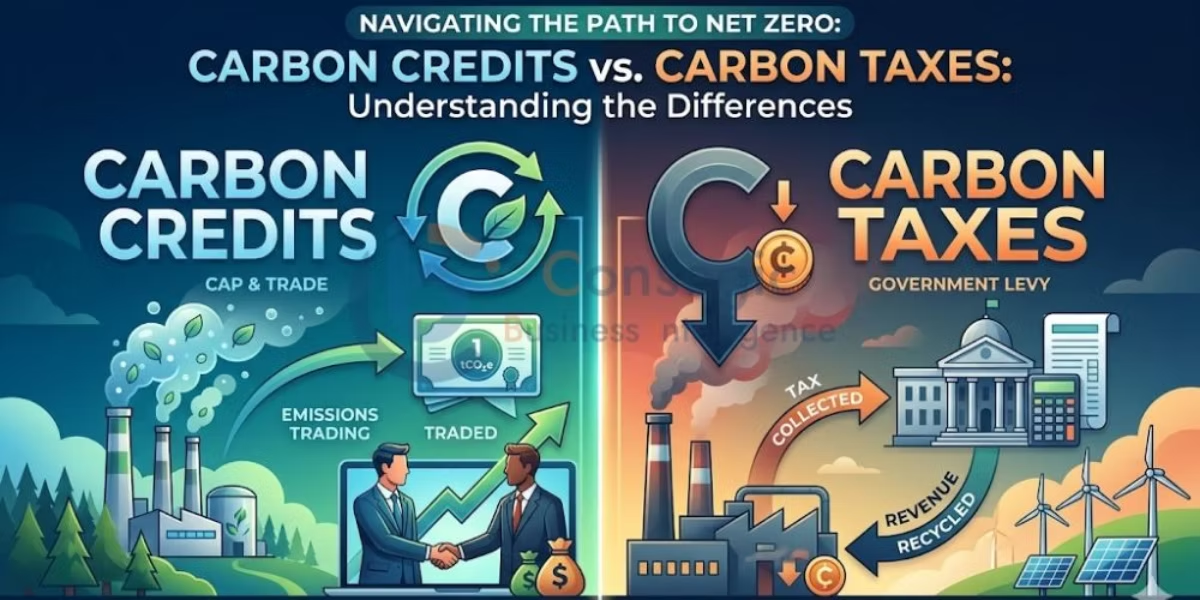
A carbon credit is a tradeable certificate or permit, entitling its owner to release a certain quantity of CO2 into the atmosphere. Normally, it is associated with an activity aimed at reducing or capturing carbon emissions, such as building green energy facilities or planting trees. One credit means the emission reduction of one metric ton of CO2. Thus, carbon credits represent a market-oriented approach that encourages organizations and nations to become involved in activities that reduce the number of global CO2 emissions.
There are two different markets for carbon credits: voluntary and compliance markets. In voluntary markets, companies or individuals voluntarily buy carbon credits in order to compensate for their own emissions. On the contrary, in the case of compliance markets, governments set strict CO2 emission restrictions for organizations.
However, there are many challenges to the carbon credit market. It is vital that the credit is verified and transparent as it will be based on verified emissions reduction. Without sufficient regulation, there is the possibility of "greenwashing" as companies will be purchasing carbon credits that aren't really carbon credits. Moreover, with the developing market liquidity the market is currently not meeting the demands of the world.
Additionally, technology is also changing the face of the market, with one innovation being the ability to tokenize carbon credits through blockchain technology.
The Case for Carbon Taxes: A Direct Approach to Curbing Emissions
The rationale behind a carbon tax is that of polluter pays, where companies and individuals are taxed according to the quantity of CO2 emissions they produce. This carbon tax is meant to incentivize businesses to engage in sustainable practices by adopting cleaner technology. Moreover, through taxes, the government makes it costly for any individual to emit carbon dioxide, thereby making it more likely for them to adopt environment friendly measures.
The main benefit of carbon taxes lies in their ability to provide predictability. As opposed to carbon credits, which may experience price volatility, a carbon tax ensures the creation of a steady price, which makes it easy for companies to plan their business operations accordingly. Moreover, carbon taxes have simpler procedures compared to carbon credit systems, making them easy to administer and understand.
Examples from all over the world include Sweden, where the implementation of the carbon tax started in 1991. This country has achieved tremendous emission reductions and continued its economic development, making this practice an example for other states. The introduction of carbon taxes is, however, a complicated matter. On one hand, these taxes create an additional source of governmental income that can either be spent on environmental projects or paid back to citizens. At the same time, there is resistance to the taxation policy, particularly in carbon-intensive industries.
How Is the Financial Industry Shaping the $10 Trillion Market?
Role of the financial sector in moving towards net zero is pivotal, as illustrated by the projected investment market valued at around $10 trillion during the coming years. The green finance field is seeing increasing possibilities, which range from clean energy, electric vehicles, carbon-capture technology, and sustainable infrastructures among others. It is becoming more common for financiers to invest their resources in areas, which are given tremendous room for future growth.
Some of the major instruments involved are green bonds and sustainable finance. Green bonds, which are issued to raise funds for green initiatives, have gained popularity in recent times as both government agencies and corporates are issuing them in support of renewable energy and carbon reduction projects.
Moreover, banks and investment firms are developing new financial instruments for carbon trading in the form of carbon futures, exchange-traded funds, and carbon options, thereby allowing more advanced trading with carbon credits and allowances.
As the legal environment changes, financial institutions are also becoming more aware of climate risks and incorporating them into their portfolios. There is a need to evaluate risks in terms of stranded assets, particularly in industries using fossil fuels, and to get ready for new legislation such as the EU’s Carbon Border Adjustment Mechanism (CBAM).
The Tug-of-War: Carbon Credits or Carbon Taxes?
The problem of addressing the issue of climate change is the one that is pressing on the globe at the moment; there are two major methods used to tackle the problem: carbon credit and carbon tax.
Effectiveness: For the reduction of carbon emissions worldwide, there are two vital procedures used - carbon credits and carbon taxes. For example, carbon taxes create certainty in the pricing of emissions, making it easier for businesses to cut down their emissions by investing in more environmental-friendly technologies. However, carbon credits create an incentive for innovation since they reward the companies that work on emissions-reduction projects. Nevertheless, the effectiveness of carbon credits depends on whether they can be verified properly, as some companies might get undeserved credits and do not really help the environment.
Flexibility vs. Intervention: Another difference between these two solutions is that carbon credits involve no government interference and leave all the decisions regarding how to reduce emissions to the companies themselves. In this regard, the companies might find new innovative ways to decrease their carbon footprints, while at the same time carbon taxes are imposed by the government and require little innovation from the companies.
Price Signals: There is a definite advantage that carbon taxes have over carbon credits because they act as a good price signal for firms, making the process much simpler. On the other hand, carbon credits are subject to market changes, which might make it difficult for the firm to plan their activities. The uncertainty involved in carbon credits can be detrimental when compared to a carbon tax.
Hybrid Approach: More and more governments are experimenting with hybrid systems that use carbon taxes and credits at the same time. Such a system would combine the advantage of the carbon credit system as well as that of the carbon tax system.
Political Acceptability: Politically, the credit system seems to enjoy a lot more support than the carbon tax system. Combining them may provide an appropriate solution to many political barriers.
Conclusion: Bridging the Gap for a Sustainable Future
To attain a sustainable future, the world needs to cooperate with one another in the harmonization of the pricing of carbon emissions across different countries to prevent fragmentation, which may weaken all the efforts at the global level. One potential solution includes the introduction of digital carbon markets and the inclusion of technology through artificial intelligence and machine learning.
Moreover, the finance sector has been instrumental in helping achieve sustainability through the provision of funds and management of the associated climate risks. With the continued growth of the $10 trillion market for carbon, its long-term implications will have an effect on sustainability across the globe.