How Is Cyber Warfare Rising in a Digitally Interconnected World?
Cyber warfare is no longer just an isolated engagement between competing parties; rather, it has become part of a digitally integrated environment where any form of interference at one point can have a ripple effect. With the fast-paced development of hyperconnectivity, modern infrastructures are accessed through cloud platforms, IoTs, SaaS services, and other types of software and API. While this level of connection may offer some efficiencies, it can also pose systemic threats since once a vulnerability is identified within common software and tools, it can potentially expose many users.
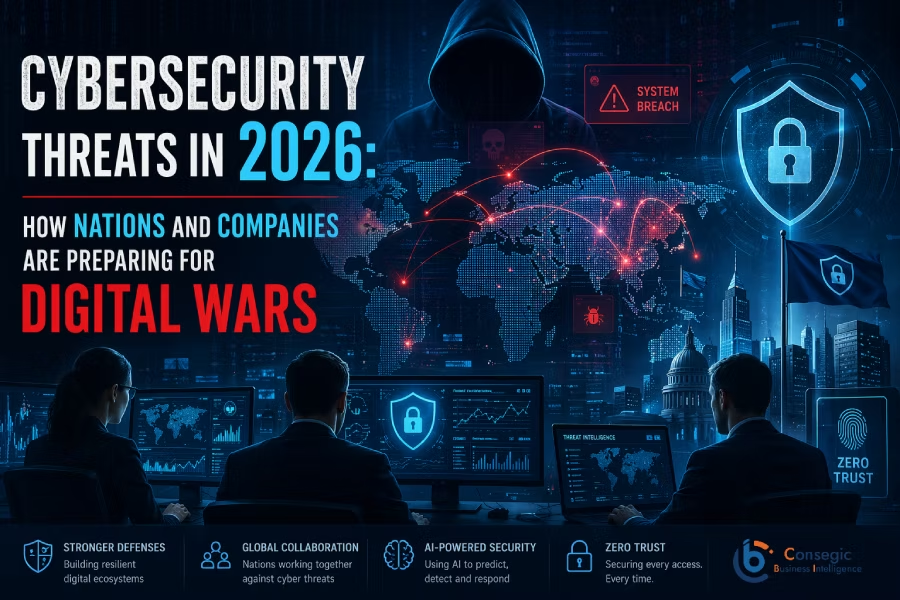
At the same time, it has become difficult to distinguish between cybercrime and cyber warfare. There is a proliferation of cyber gangs operating with military-level expertise and using models like Ransomware-as-a-Service to launch sophisticated cyber-attacks that directly target businesses and companies. Another significant transformation is the pace at which cyberattacks occur in today’s digital landscape. There has been a marked reduction in the timeline of exploiting any vulnerability, with vulnerabilities being exploited almost immediately after their detection. This speed is complemented by the changing tactic of hackers that focuses on getting “logged-in” rather than hacking into the network. Significantly, as critical areas such as finance, health care, and energy have become increasingly digitized, the implications of cyber-attacks have become much more severe.
Cyberwarfare has transformed from an occasional activity during times of war into an ongoing battle that relies heavily on economic considerations.
AI-Powered Threats: The New Face of Cyber Attacks
The implementation of artificial intelligence has drastically changed cyberattacks by making them self-sustaining and highly dynamic processes capable of executing at computer speed.
AI can now be found across all stages of the attack process, from reconnaissance to discovering vulnerabilities and exploiting them to lateral movements to data exfiltration. With advanced techniques of analysis, attacks have been made faster by scanning through large digital landscapes, identifying any weak point and launching an automatic attack with limited human intervention. The result is highly efficient autonomous attack systems which can operate without human supervision and continue learning.
Another alarming development is the integration of AI in social engineering. Using deepfake technology, artificial intelligence has been used to imitate individuals' voices and even record videos in an effort to conduct impersonation attacks on decision-making officials such as executives and financiers. Moreover, AI is used to conduct phishing attacks by sending emails that are highly personalized, hence becoming virtually impossible to detect. With the advent of offensive AI algorithms, the danger level will only intensify as these technologies can detect security weaknesses, create hypothetical attacks, and develop tactics on their own without any human intervention.
To counter this trend, cybersecurity is now headed for an “AI against AI” era, which means only automated cybersecurity measures can contend with advanced artificial intelligence-based attacks. AI technology is not merely an instrument used in cyber warfare; it is a multiplier that accelerates the speed of operations exponentially.
Nation-State Cyber Warfare and Geopolitical Tensions
Cyber warfare has emerged as one of the main components of geopolitics that works parallel to traditional components of national power such as economic sanctions, diplomacy, and military.
In recent years, nation-states have targeted critical infrastructure such as power grids, water, and telecommunication networks in order to exert pressure on economies and societies without engaging in a military operation against the target state. The recent attacks by the Iranians targeting US infrastructure are an example of how cyber operations reflect actual geopolitics between nation-states.
At the same time, a new arms race driven by AI capabilities is underway between major powers including the United States and China, where cybersecurity has gained importance as a component of technological superiority. In addition to disruptive cyber operations, espionage and IP theft have been among the main concerns of nations when it comes to cyberwarfare.
The modern wars have started incorporating elements of hybrid warfare, which include not only cyber-attacks but also information and economic pressures to accomplish strategic goals. This type of operation is usually referred to as “grey zone warfare” since the activities do not rise to the level of conventional war and therefore cannot be attributed and reacted to properly. As the capabilities of cyber technologies keep advancing, future wars will most likely start from the cyber environment before any physical engagement occurs.
Expanding Attack Surfaces: Supply Chains, Identity, and Critical Infrastructure
The current attack surface continues to grow at a pace faster than what security can keep up with due to increased digital transformations and ecosystem dependencies.
The most vulnerable form of cyber threats currently is the use of supply chain attacks where third-party vendors become the weak links. Organizations currently depend heavily on outside software and services, which makes a compromise of one component potentially affect many others. It has been noted that nearly 29% of all cybersecurity breaches are related to some degree of third-party exposure.
Another form of cyber threat that has become the primary method of compromising an organization's security infrastructure is the identity-based attacks, where approximately 75% of all cyberattacks are through stolen credentials. Cyber criminals are moving from attacking the technology to attacking identities. Moreover, IT convergence with operational technology (OT), used in critical infrastructures such as energy, manufacturing, and transportation, has also increased vulnerabilities. Hacking these technologies can cause physical damage, and therefore, cybersecurity must be treated not only as a matter of information but of public safety.
Additionally, public applications and API exploits have become increasingly common with a substantial increase in their rate of attacks, which results from accessibility. Perimeter security in today’s digital world is virtually non-existent since everything is connected, always accessible, and attackable.
How Governments and Companies Are Preparing for Cyber Wars?
Governments and organizations are gradually transitioning from the concept of prevention-oriented cybersecurity strategies to resilient and continuously evolving cybersecurity systems because breaches in today's digital world are inevitable.
In terms of governments, zero trust architecture has been embraced in most organizations as the primary approach to dealing with the problem of cybersecurity attacks since it requires continuous verification rather than assuming perimeter-based security. Governments are also developing regulations faster than ever as well as putting monitoring mechanisms to ensure there is no breach of cybersecurity compliance guidelines. Most countries have also embarked on cyber defence initiatives, including cyber commands, and have also started engaging in cyber threats intelligence sharing.
AI-driven SOC (security operations center) are now being adopted by firms that are capable of conducting automated threat detection and prediction within the enterprise environment. Moreover, the new trends include a strong emphasis on conducting supply chain security audits, implementing an identity-first security approach, and increasing investments in building the next generation of cybersecurity workers.
It has transitioned from “Can we prevent attacks” to “How fast can we detect, contain, and recover from them?” Cybersecurity is not only part of the IT department; rather, it has become one of the pillars of national security and high-level strategic decision-making within firms.
Conclusion: The Future of Cybersecurity in an Era of Digital Conflict
Cybersecurity is no longer about reaction to a potential technical threat; rather, it has become a constant battle driven by global dependency, geopolitics and accelerated by AI. With the proliferation of digital systems and networks, the lines between cybercrime, cyber warfare, and state-sponsored activities remain evermore unclear, leading to continuously changing and increasingly difficult threat scenarios. Leading to automated attacks through AI capabilities, identity-related threats, or compromised supply chains, causing disruption in the modern-day business ecosystem on a global scale in seconds. Moreover, with zero trust architecture, artificial intelligence defences, and resilient strategies have become key priorities for governments and companies in recent years, as they recognize the need to focus more on detection, protection, and recovery. With increasing threats in the modern times, it has become increasingly clear that cybersecurity plays a key role in national and economic security.