The Emergence of BRICS in a Changing Global Order
The formation of BRICS (Brazil, Russia, India, China, and South Africa) is a major paradigm shift in the international system, which is characterized by a change from Western hegemony in favor of power distribution. Initially, BRIC was a term introduced by an economist at Goldman Sachs in 2001 for describing countries with rapidly growing economies, which later became a political entity in 2009 and further grew with the inclusion of South Africa in 2011. As a result, BRICS has become more than an economic construct but has gained a geopolitical character symbolizing the aspirations of the Global South.
This development should be placed in the backdrop of fundamental shifts occurring in the global arena. The 2008 financial crisis highlighted the weaknesses of the economy dominated by the Western world, which brought about a weakening of traditional economies and enhanced the stature of emerging economies like China and India. At present, the number of members constituting BRICS has reached 11, namely China, India, South Africa, Saudi Arabia, Brazil, Russia, Egypt, Iran, UAE, Ethiopia, and Indonesia.
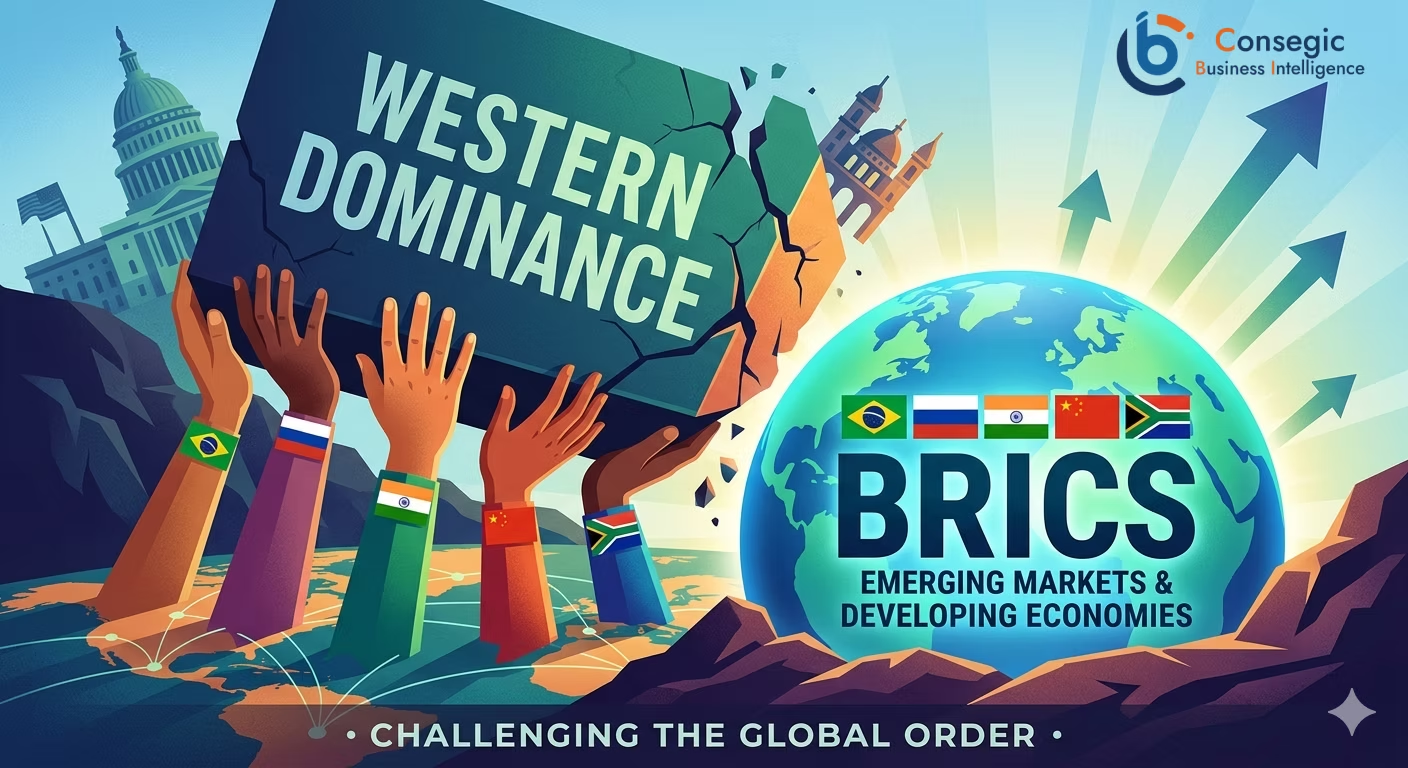
Together, the bloc accounts for approximately 45-50% of the population in the world and 37-40% of the global gross domestic product measured by purchasing power parity, which exceeds many Western alliances in terms of both demographics and economics. Therefore, rather than viewing BRICS merely as an alliance of rising nations, it is necessary to recognize BRICS as an illustration of a trend towards multipolarity as a challenge to Western institutions.
How Is BRICS+ Expansion Strengthening the Global South’s Influence?
The transition of BRICS into BRICS+ has greatly boosted its power as a group because of numbers, control over the sources, and its legitimate position in geopolitics. There have been great changes in the composition of BRICS in 2024, namely, it has included Egypt, Ethiopia, Iran, and the UAE, and then Indonesia joined it in 2025, making it eleven-member strong. In addition to member countries, there were also introduced some "partner countries" to this association in 2024, namely, Malaysia, Nigeria, Vietnam, and Kazakhstan, and more than thirty countries have applied for BRICS membership.
Such changes are highly valuable for BRICS, and their reason lies in the fact that Iran and the UAE are major energy producers, and the possible participation of Saudi Arabia will make BRICS an important player in the world energy sector since it may control a significant share of energy supply. Besides, adding African and Middle Eastern countries to BRICS is crucial for the group due to its enhanced control over minerals, food, and energy.
In terms of political gains, the BRICS Plus initiative strengthens the negotiating position of developing countries in international organizations such as the United Nations and World Trade Organization, providing a consolidated front to confront Western politics and sanctions regimes. In effect, this move is symptomatic of the growing emphasis placed on “South-South cooperation,” which decreases reliance on the Global North.”
Is the Global Economic Balance Shifting from G7 to BRICS?
The global economic balance shifting from G7 to BRICS is linked to the ongoing process of changing the structure of the world economy. BRICS has already exceeded the G7 in PPP (Public-Private Partnership) terms, being responsible for about 35-40% of global GDP while the G7 produces only about 28-30%. Thus, there has been a significant change in productive resources allocation. However, G7 still maintains its superiority because the shift has not been completed yet.
The share of the global exports made up by BRICS countries becomes larger, reaching the level of the G7. Moreover, BRICS countries enhance their intra-BRICS trade cooperation, actively using local currencies instead of USD to diminish dependence. Countries such as China and India are important drivers of growth, while BRICS countries are expected to grow by 3.7-3.8% annually (2025-26).
Moreover, demographics work to support BRICS, as young populations stand in opposition to aging populations in the West, while manufacturing and production move to Asia. Nevertheless, there remain obstacles, among which are the gap between economies within the group and the lack of policy coordination. Therefore, the international balance is not experiencing the total replacement of the G7 but only a relative weakening of its influence—a process that is slow, inconsistent, yet undeniably under way.
Challenging Western Financial Systems and the Dollar
BRICS is gradually undermining Western economic systems by creating alternatives and bypassing traditional institutions. The key point is the establishment of the New Development Bank (NDB) that will be working alongside other international financial institutions, like the International Monetary Fund (IMF) and the World Bank, and will become an alternative system for financing infrastructure development projects in emerging economies. The active discussion of recent times is related to the issuance of local currency-denominated bonds, like the Indian rupee.
One of the essential points concerning BRICS' effort to go its own way and move away from Western dominance is the issue of using local currency instead of the American dollar. Thus, the use of the yuan, rupee, and ruble for trade purposes has become common practice between BRICS members. In particular, more than 25% of BRICS trade has already taken place using national currencies as of 2024. To ensure the successful functioning of trade relations between BRICS members, the BRICS Pay system was introduced. It should be noted that this decentralized payment system allows one to conduct financial transactions independently of both SWIFT and the dollar.
Furthermore, changes can be observed in the global energy market, as well, where some oil deals are carried out using other currencies than the US dollar. Nevertheless, considerable drawbacks persist. The American currency still holds a leading position in terms of international reserves and international transactions, and the suggestion to introduce a single currency of BRICS remains theoretical.
In other words, the BRICS states do not terminate dollar hegemony but start its transformation into a more diverse global financial framework.
Geopolitical Ambitions: Toward a Multipolar World Order
The geopolitical ambitions of the BRICS are based on the fact that the world order will evolve into a multipolar rather than a unipolar world dominated by the United States. This geopolitical ambition is based on the notion that BRICS countries seek to change international bodies, such as the UN Security Council and the International Monetary Fund, to make them reflective of present-day realities.
Geopolitically, BRICS is strengthening its strategic ties within crucial sectors. The creation of energy partnerships, especially among Russia, China, and BRICS nations of the Middle East, increases the joint control over global energy markets. Furthermore, defense and security talks are also being increased for geopolitical reasons, with respect to global wars, BRICS countries prefer neutrality and non-alignment, as it was observed in the Ukraine war.
The 2025 BRICS summit in Rio de Janeiro can be seen as a landmark event in regard, with 126 commitments related to AI governance, climate finance, and reforms in global governance. China, which has been the leader in driving growth and defining strategies within the framework of BRICS, while India seeks “strategic autonomy” by playing a dual role between BRICS and the Western world.
In other words, BRICS is not necessarily an anti-West organization but rather a power bloc that seeks to create an alternative global order.
Conclusion
The formation and development of the BRICS can be seen as a major revolution in the international relations system. This revolution has been characterized by the slow decline of Western domination and the gradual move towards a new multipolar world order. By increasing its political, economic, and financial power, the BRICS organization has succeeded in giving a greater voice to the Global South, thus posing a threat to the traditional power centres. Despite some internal disagreements and constraints, its influence on the international economic and political scene is evident. Instead of overthrowing the existing Western organizations, the BRICS organization is reforming them.