Why Moore’s Law Is No Longer Enough?
For many years, Moore's law had served as one of the most crucial foundations for the semiconductor industry. The idea was that there would be approximately twice as many transistors in every two years, which would lead to an increase in performance and decrease in cost. But the further advancement in the production of semiconductors at smaller process nodes is becoming harder due to physical limits, growing manufacturing cost, heat, power dissipation, and complexity of design.
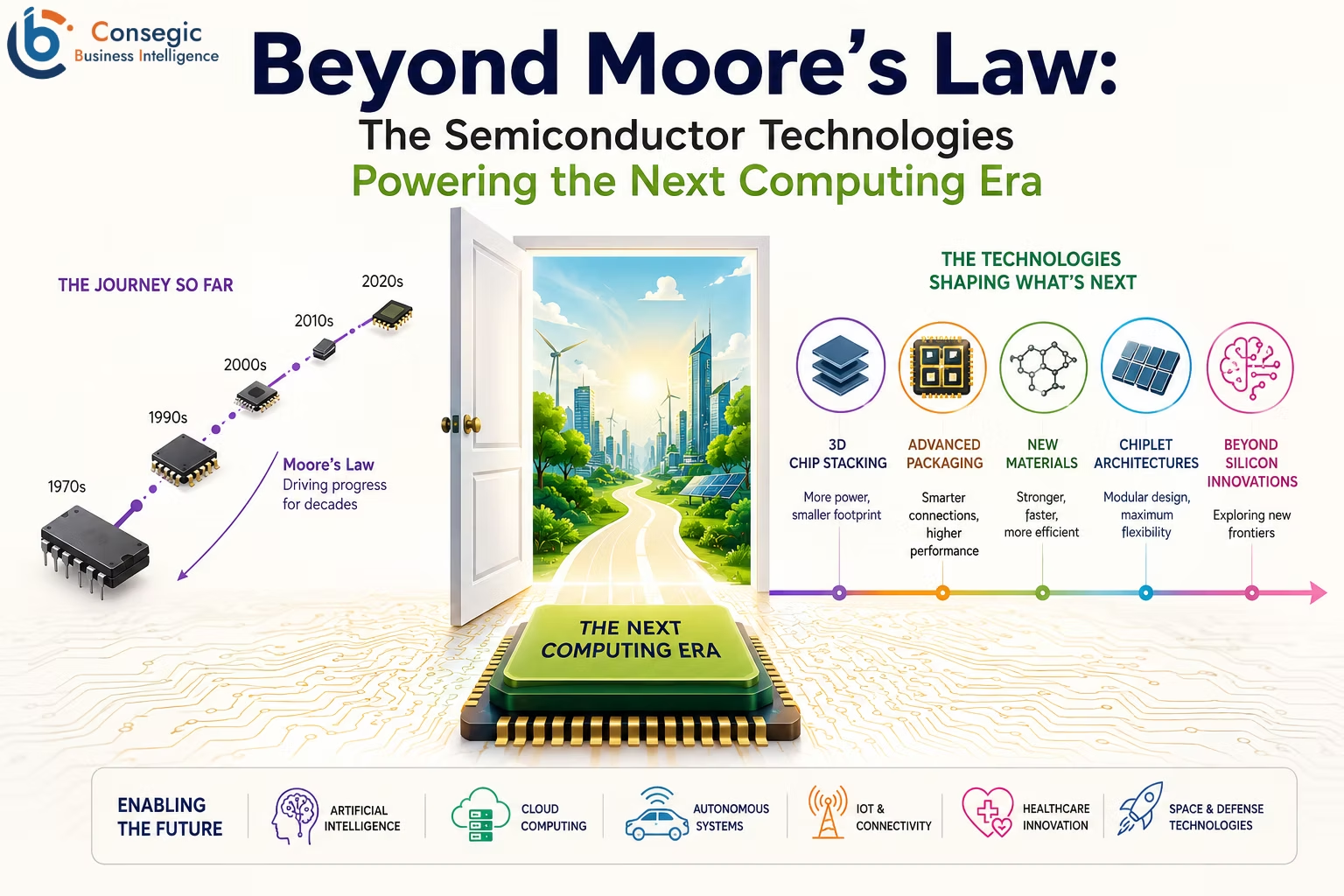
Hence, the semiconductor industry starts moving past the concept of smaller transistors. Semiconductor companies start researching other types of architectures, new materials, innovative packaging, and specialized processors in order to achieve higher performance and efficiency. “There are development opportunities in technologies such as chiplets, three-dimensional integration, AI accelerators, silicon carbide, gallium nitride, photonic computing and quantum technology.
This is a huge shift in the approach to the design of computers. The future of computing is based not on the single advancement in technology but rather on the combination of different semiconductor technologies to achieve the required performance, energy efficiency, and specialized computing.
Advanced Chip Architectures and 3D Semiconductor Design
With the increasing difficulty of traditional transistor scaling, advanced architectures are now needed to enhance computing capabilities. The first one to be mentioned is a chiplet architecture. In the chiplet-based design, various functionalities of a processor can be manufactured separately using several small pieces of silicon and then integrated in a single package. Chiplets could be helpful for improving manufacturing flexibility and decreasing costs by combining various process technologies in one device.
Another prospective area would be the three-dimensional integration of semiconductors. The vertical integration of many layers of circuits can boost transistor density while reducing propagation lengths of signals. Some examples of the advantages of vertical integration are given by the 3D NAND flash technology and logic stacking technologies.
The advanced packaging becomes increasingly important. High-bandwidth interconnects, hybrid bonding, and heterogeneous integration play an essential role in processor integration, memory integration, and accelerators' integration. They can be especially useful for artificial intelligence and high-performance computing applications which require extremely high-speed data transfer between processor elements and memory.
Thus, the use of advanced architecture and packaging is changing traditional approaches to chip design.
New Materials Driving the Next Generation of Semiconductors
The semiconductor technology in the future will not necessarily rely on silicon alone. While silicon currently holds dominance in integrated circuits, there have been efforts by researchers and manufacturers in finding a better performing alternative that may perform under certain conditions. Some of the promising semiconductor materials are wide-bandgap semiconductors like silicon carbide (SiC) and gallium nitride (GaN). They are gaining ground because they can operate at high temperature, voltage and frequency compared to silicon based semiconductors.
Some of the applications where these semiconductor materials are useful include electric cars, renewable energy, data centers, telecommunication equipment, and power electronics. GaN is useful in building smaller and efficient power converters while SiC is widely used in electric vehicles for its high efficiency and thermal performances.
Apart from the existing semiconductor material, there are other semiconductors materials that researchers are working on as a means of developing future electronic components. These materials include graphene and other two-dimensional materials. The special electrical and physical properties of these materials can help to build highly efficient and very small electronic components.
However, the problem of manufacturability, integration, reliability, and cost need to be sorted out.
AI Chips, Neuromorphic Computing, and Specialized Processors
The fast development of artificial intelligence technology is revolutionizing semiconductor design. Classic, universal processors are often inefficient when dealing with machine learning tasks, neural networks, and data processing tasks in general. That, in turn, leads to the creation of processors that are specifically tailored for AI workloads and other resource-hungry tasks.
GPUs are currently extensively used in AI applications because they are capable of performing multiple operations simultaneously. NPUs and special purpose accelerators take this one step further by creating specific hardware that is optimized to perform machine learning processing operations. These processors are extensively used in mobile phones, PCs, vehicles, servers, and edge devices.
Neuromorphic computing is another new trend that tries to replicate some capabilities of the human brain using hardware based on neuron and synapse-like architecture. Unlike classic computer processors that process data using traditional approach, neuromorphic chips are capable of completing certain tasks with much less energy consumption.
Specialized computing is a proof that performance gains in the future will be achieved through special hardware designs. Therefore, AI accelerators, neuromorphic chips and heterogeneous computing systems may become the key component of future computing solutions.
The Future of Computing: Quantum, Photonic, and Energy-Efficient Technologies
In addition to the advanced classical semiconductors, computing technology of the future might undergo radical transformation as a result of emerging technologies that will provide alternative information processing solutions. One of the promising areas is quantum computing. The concept of quantum computing entails the use of quantum mechanical phenomena to solve computational challenges and this phenomenon is impossible to recreate using conventional computers. While large-scale quantum computing has not been achieved yet, great progress is made in the development of quantum processors and semiconductor devices.
Photonic computing is another promising direction. In contrast to computing that relies solely on electrical impulses, photonic computing processes information with light signals. Being able to transfer massive amounts of data fast and possibly saving energy needed for certain operations, photonic technology could become indispensable for artificial intelligence, telecommunication and data-center industries.
The development of energy-efficient technologies will also become crucial since the need for AI and cloud computing increases energy consumption.
Thus, the next generation of computers is expected to be very heterogeneous as quantum, photonic, advanced semiconductor and energy-efficient technologies might coexist with traditional processors for different applications. These technologies combined together can create new standards of computing performance, which cannot be measured by Moore’s Law.
Conclusion
The semiconductor industry is approaching a phase when progress cannot be achieved by reducing the size of transistors alone. With the increasing awareness of physical and economic barriers associated with scaling, solutions like chiplets, 3D integration, advanced packaging, new semiconductor materials, AI accelerators, and neuromorphic processing will grow in importance. Simultaneously, quantum computing and photonics computing could help address certain issues that cannot be handled using regular computing methods. There would also be the need to take care of the rising need for energy efficiency due to the proliferation of AI and data-centric applications. In all probability, the future of computing will be influenced by the convergence of several technologies rather than a single technological breakthrough. Beyond Moore’s law would make computing heterogeneous, specialized, powerful, and energy efficient.