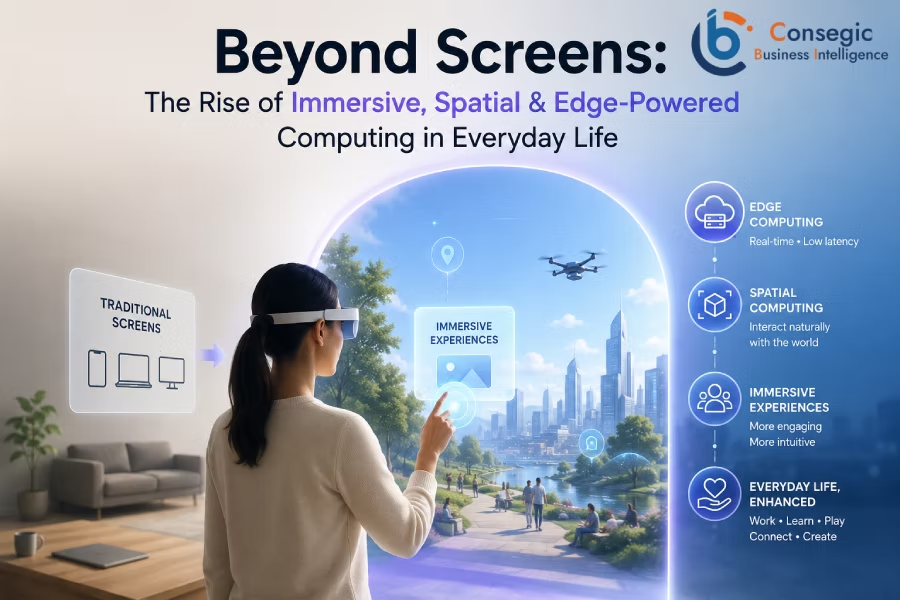
For years, our relationship with technology has been driven by screens. From the desktop monitor, to the smartphone, tablet or television, our interaction with digital services has been almost exclusively through a two-dimensional interface. However, technology is evolving beyond flat displays, into our physical environment. Using advancements in immersive technologies, spatial computing and edge computing, we're witnessing a move toward experiences that are more natural, interactive and seamlessly integrated with our everyday lives. As we move into 2026 and beyond, the use of these technologies is extending beyond research laboratories and conceptual designs to the ways in which we work, shop, play, communicate and are entertained. All are combining to drive the next phase of digital transformation and human-computer interaction.
What is "Beyond Screens"?
Initially, the digital revolution focused on making information available to us via desktop and then mobile devices. These technologies, while changing the world, still relied on human interaction via an interface, which inherently depended on screens. Today, technology is developing toward experiences that are more natural and intuitive. Instead of consuming information through screens, we are being empowered to directly interact with digital information in our surrounding environments. This advancement is driven by a combination of spatial computing, augmented and virtual reality, artificial intelligence as well as an enhanced capacity for connectivity. The aim of this is simple: to remove technology, which still feels like a separate tool, and integrate it further into human action.
What is Spatial Computing?
Spatial computing is the concept of computers that understand and interact with their physical environment. Using cameras, sensors and advanced software, they combine this understanding with AI to offer seamless blending of digital and physical worlds. Imagine being shown navigation on a smart glass overlay, or manipulating a three-dimensional model directly in mid-air on a workstation. Or a doctor interacting with a patient's digital file, projected onto their person during examination. These are all examples of spatial computing in action. Rather than isolating digital content from the physical world it's applied to, spatial computing fuses the two, making interactions more immersive. With improved hardware, likely being increasingly lightweight, more powerful and also more affordable in coming years, spatial computing is set to permeate every aspect of our lives.
Immersive Technology - from novelty to everyday essential
Immersive technologies such as augmented reality (AR), virtual reality (VR) and mixed reality (MR), have spread far beyond gaming and entertainment. Within education, these technologies can bring to life historical events or scientific concepts, allow students to walk through complex engineering projects or experience them from an entirely new perspective. In health care, AR is being used to help with medical training, rehabilitations, and for surgical assistance and guidance. Visualizing complex human anatomy in 3D can greatly improve a surgeon’s accuracy and success rate. AR is being welcomed by the retail sector to allow customers to 'try on' clothing without physically being near a dressing room, to visualize furniture within a customer's home, or to 'explore' a product in an interactive showroom before committing to a purchase. These applications highlight the transition from novelty to mainstream practicality in immersive technologies.
Why it's important to consider edge computing
Where AR and spatial computing are often the center of attention, there is a closely related technology that quietly makes these applications viable – edge computing. Unlike traditional cloud computing that relies on sending data away from the point of origin for processing in central locations, this approach can be too slow for real-time experiences. Edge computing addresses this by delivering processing power closer to the source, meaning data does not necessarily need to be transmitted to a central cloud for analysis and may be processed by local devices, a nearby network of machines, or local edge servers. Latency is reduced, performance is enhanced and faster decision-making processes are put into place. Even tiny amounts of delay in AR, autonomous vehicle or smart factory systems can compromise a user experience or be a safety risk; edge computing means that these systems are instantly responsive and highly reliable.
Edge intelligence in smart cities
A significant area where we're witnessing the potential of edge computing unfold is smart cities. Smart cities collect data through sensors and cameras as well as traffic and other intelligent systems. Each second generates massive volumes of data, too much to effectively manage in centralized cloud environments, potentially creating huge delays. However, by processing data at the edge – at the point where it is collected – these systems allow cities to analyze local conditions and react in real time, whether adjusting traffic lights to accommodate traffic flow or changing power consumption to make energy use more efficient. The benefits are cities that are more sustainable, smarter and respond more quickly to the needs of citizens.
Transforming the modern workplace and collaborations
The modern workplace is also changing as immersive and spatial technologies mature. Where remote and hybrid working environments previously revealed limitations in simple video conferencing solutions, spatial computing presents an alternative; the possibility of truly shared work environments, allowing colleagues to feel and work as if they were in the same space. These environments support both three-dimensional modelling and virtual team training or meeting spaces, allowing for more engaged and productive working. When integrated with the responsive power of edge computing, immersive collaboration spaces become more intuitive and enjoyable to use and will continue to develop as part of future workplace design.
The essential role of Artificial Intelligence
Artificial intelligence is the crucial ingredient that allows for truly immersive and spatial computer interactions to take place. AI-powered systems can understand complex environments, recognise objects and interpret the actions of users in a real time, intelligent and interactive manner, allowing interaction through a variety of inputs including voice commands, gestures and movement. Smart glasses can use AI to recognize landmarks or translate languages as you read them, or can be designed to offer information in an ambient and predictive way, based on what you are observing. These various forms of AI are a key enabler of an increasingly interactive, adaptive and useful environment.
Into the future
The shift to 'beyond screens' is perhaps the most important development in computing since the introduction of the smartphone. Spatial, immersive and edge-powered computing, together with AI, is transforming our digital experiences to make them more integrated, intuitive and interactive in our everyday lives. In the next decade, it is possible that traditional screens will become less important as our use of ambient information, wearables and direct interaction within our surroundings becomes the norm.
Conclusion
The era of the keyboard, the mouse, the touchscreen, and the flat display are slowly being superseded. Immersive technology is set to revolutionise how we interact with information, learn, work, shop, play and communicate; spatial computing promises to bring our digital experiences directly into our physical environments; edge computing will deliver the necessary responsiveness and performance to make these systems reliable and useful in all applications, from the smart home to the smart city. Combined, they represent a fundamental shift towards computing experiences that will not only become part of our lives, but will feel like they belong.