Picture a city planner in Singapore walking through a digital version of the whole city trying out the impact of a new skyscraper in terms of traffic flow, energy consumption and noise levels before the first brick is even laid. Imagine a factory manager in Germany being notified that a piece of equipment is expected to break down within the next 48 hours enabling a service engineer to perform maintenance before production lines are stopped. Imagine a CEO sending thousands of workers personalized messages in several languages using a photo and voice like AI.
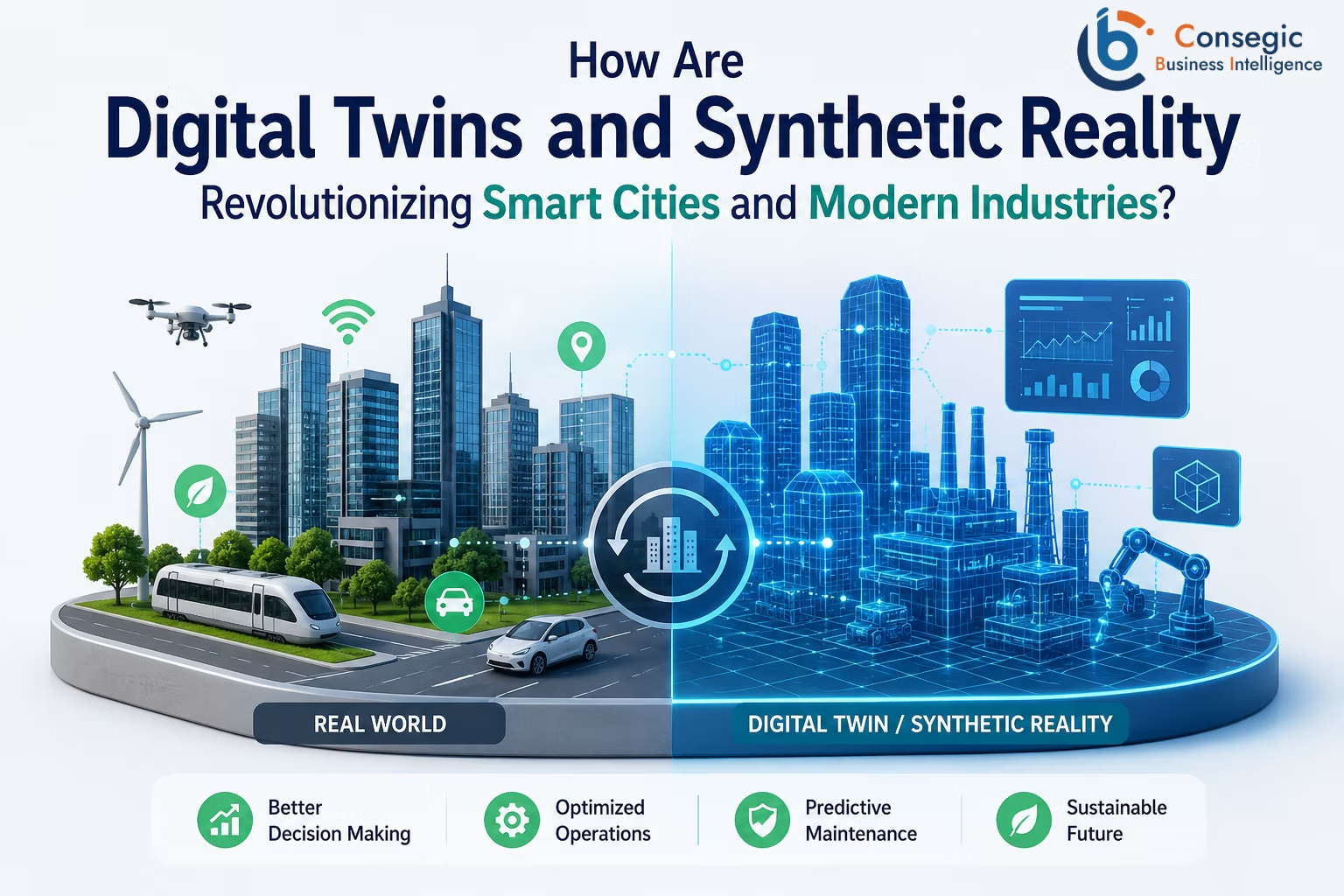
The above may be future visions but they are actually happening already, thanks to digital twin and synthetic reality.
Understanding these technologies
A digital twin is a virtual representation of a physical object, process, systems or organization. Unlike traditional simulations that are once used and forgotten, digital twins continuously update themselves using real time data collected from sensors and connected devices. They function as living digital models that evolve along their physical counterparts.
Thanks to the continuous data streams it receives, a digital twin enables an organization to understand performance, anticipate problems or simulate scenarios in a real-world environment, but without interfering with it. From monitoring a jet engine, a production line or a city, digital twins offers a wealth of information to make more intelligent decisions.
Synthetic reality builds on this notion. Using generative AI and machine learning, it creates realistic digital environments, people and interactions. In many cases, only a few minutes of video footage are needed to generate a highly convincing AI avatar.
Unlike virtual reality, which requires headsets to enter digital environment or augmented reality, which overlays digital content on the physical world, synthetic reality focuses on AI generated people and experiences that can be assessed on ordinary devices. These avatars can speak different languages, adopt various accents and mimic specific communication styles using only text-based instructions.
Transforming Smart Cities
Digital twins are changing how cities are planned, managed and improved. Instead on relying solely on forecasts and past experiences, city planners can explore different scenarios in virtual environment and see how new developments might affect traffic, energy use, public services and everyday life of the people.
A great example of this is Singapore’s Virtual Singapore Initiative. This digital detailed replica of the city gathers information from thousands of sensors and use it to model everything- from traffic patterns to energy consumption.
Cities around the globe are beginning the same thing. Helsinki uses digital twins to improve public services while managing resources more efficiently and reducing environmental impact. In Chattanooga, Tennessee, data from weather systems, traffic cameras, radar networks and emergency services is brought together to create a clearer picture of what is happening across the city.
In Bologna and Munich, the models are used for transport planning, climate resilience projects, analysing the solar potential and to increase people with disabilities accessibilities. Virtual models of city is also experimented by Las Vegas in order to decrease energy consumption and New York City use it in the framework of the reduction of carbon dioxide. For Orlando, it also improved the energy consumption and the water management.
Digital twins can also make a real difference when emergencies occur. During natural disasters or other critical events, responders often have to make quick decisions with limited visibility. Technologies such as Aechelon’s Project Orbion provide real time 3D views of affected area, even when darkness, smoke or heavy cloud cover would normally make conditions difficult to assess. With a clearer understanding of the situation, emergency teams can react faster and make better informed decisions when every second counts.
Impact on Manufacturing, Training and Business Operations
Manufacturing is seen as the biggest gain from digital twin technology. Businesses don't have to depend solely on old history or scheduled maintenance. They can also use digital prototypes to analyse equipment in real time and quickly detect a problem before it causes a costly equipment failure. This foresight can minimize downtime, maintenance expenses and ensure that the factory continues operating.
General Motors is using digital twins to check the manufacturing processes and problems can be detected in the early design stages to eliminate issues with quality and waste.
Synthetic reality is also changing how organizations train employee and communicate with customers. AI generated avatars can lead onboarding sessions, deliver training content and provide realistic training experiences without requiring instructors to be present.
The technology is also shaping marketing and communication. Businesses can create personalised video messages at scale using AI avatars, making it easier to reach wider audience. One notable example comes from China where an AI generated video of influencer Luo Yonghao generated millions of dollars in livestream sales without the real person appearing on screen.
The Power of Combining Both Technologies
When digital twin and synthetic reality combine, they offer huge potential. The first step in building a digital twin is creating a version within synthetic reality before an item has been physically manufactured. Once a ‘real world’ vision begins to run, data is collected from real-world sensor output, which then feeds back to update and enhance the digital twin. Digital twin can then inform more detailed synthetic reality, resulting in an infinite improvement loop.
Systems like the NVIDIA Omniverse is being positioned for exactly this, to allow companies to develop elaborate digital twins that, in turn, drive highly realistic synthetic reality data for the purposes of feeding an AI’s training and testing.
With further evolution of AI technology, there is bound to be an increasing demand for digital twins and synthetic reality in the years ahead.
Challenges and Future Outlook
Despite their benefits, digital technologies also create various challenges. In synthetic reality there lies the capacity to create highly realistic videos, voices and digital identities, that may be not possible to differentiate from genuine media. Without controls there may be risks of misleading, manipulation and misuse.
To prevent the threats, many organizations provide solutions such as digital watermarking, verification tools, transparent policies and consents when it comes to using personal likeness and voices. In addition to that, the skills on employee's side is of growing importance too, in order to differentiate an AI generated content from real.
Conclusion: The Growing Impact of Digital Twins and Synthetic Reality on the Future of Cities and Industries
Digital twins and synthetic reality have moved beyond research laboratories and are already transforming cities and industries worldwide. These technologies are delivering major improvement in efficiency, sustainability, productivity and cost reduction.
City leaders can make better planning decisions; manufacturers can prevent equipment failure before they occur and businesses can train and communicate more efficiently than ever before. As artificial intelligence continues to evolve, the impact of these technologies will only grow.
The smart cities and the intelligent industry of the future are already taking shape today through digital twins, synthetic reality and data driven innovation. The question is no longer whether organizations will adopt these technologies, but how fast can they take advantage of the opportunity after.