Smart homes have come a long way. What once was a setup of simple speakers and voice-controlled lights has now transformed into something much more advanced, connected and intelligent ecosystem that learns your habits and ensures safety, lowers energy costs and quietly manages everyday tasks in the background.
In 2026, homes just didn’t react to your commands anymore- they understand the people living in them.
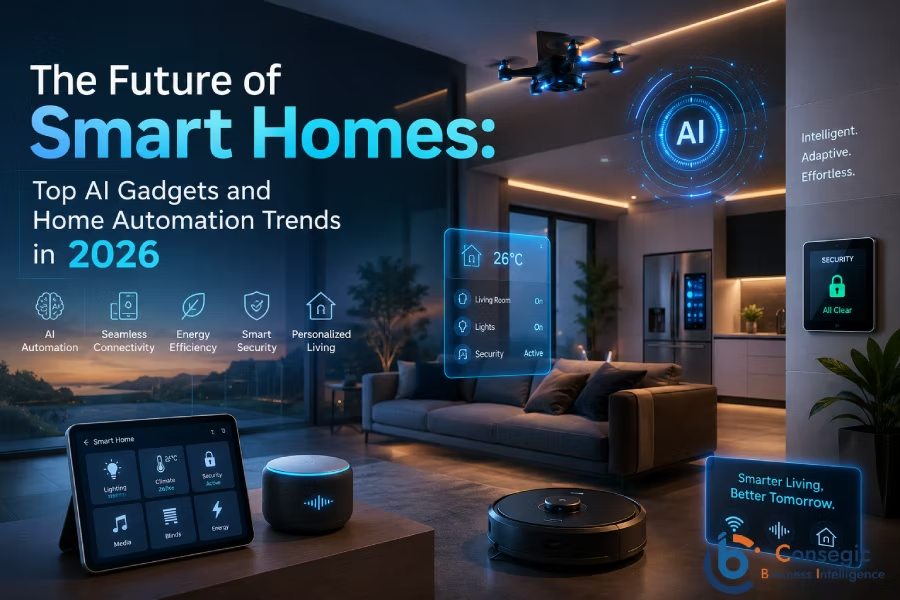
From Separate Gadgets to a Connected Ecosystem
For a long time, smart homes felt fragmented and a collection of disconnected devices. A smart bulb here, a voice assistant there and a thermostat somewhere.
This issue is finally fading away.
The Matter protocol- now updated to version 1.3, has become the common language for smart home devices. It allows product from different brands like Philips Hue, Nest, Amazon Echo and Eufy to work together effortlessly.
Whether someone uses apple homes, google homes or Alexa, devices can now communicate seamlessly. Instead of feeling like scattered gadgets controlled by different apps, the modern smart home works as a unified system.
The AI That Powers Modern Homes
The biggest breakthrough in 2026 isn’t just modern gadgets- it’s the artificial intelligence behind them. Today’s smart home AI does far more than follow fixed commands. It studies daily routines, adapt to preferences and make decisions automatically to simplify life.
AI driven routines can now manage much of the work on their own. A home can learn wake up schedules, preferred room temperatures, lighting habits and even family routines. This can be seen when, for example, bedroom lights may subtly turn up just before getting up in the morning, or when air conditioning is subtly switched on before bed time in the living room, all with no intervention.
A key change is also taking place in the shape of local processing and on-device Artificial intelligence, or Edge AI. Most smart devices no longer need to upload requests and then wait for the cloud, instead the data is now processed locally on the device. This speed is crucial and also benefits privacy by keeping sensitive personal data at home.
As cybersecurity becomes more of an issue, this trend to smarter on-device processing is definitely one of the key changes occurring in the smart home space, intelligence has become one of the most important trends in smart home technology.
AI Gadgets Changing Homes in 2026
Following are some of the trending AI gadgets that are actively transforming the smart home industry in 2026-
-
Smarter Kitchen
Perhaps one of the biggest changes in the modern home has been the evolution of the kitchen. AI oven can see food with the camera and sensor and select the best method of cooking to not over or under-cook. Smart refrigerators not only contain the food, they know what is being stored, when it is out of date and what would go with it as well as suggesting recipes and building your shopping list for when you are out of the house, sometimes allowing you to check on your stores from the supermarket through your mobile phone. Similarly, smart coffee makers learn personal preferences over time and prepare coffee with the ideal strength and temperature automatically.
-
Smarter robotic cleaning
Robot vacuums are now much more advanced than previous models. Many new types of vacuum robot have different types of wheel systems and mechanical legs and are able to navigate between different floors of a house, so that one robot can efficiently clean a whole property. Combined with self-emptying dust containers and intelligent mapping of rooms and navigation around obstacles, robot vacuums can cut a significant chunk of time off housework and maintenance.
-
Intelligent Lighting
Smart lighting systems no longer just exist in the form of a remotely operated bulb. Room aware smart lighting systems use sensors and AI learning to change their brightness and colour temperature according to the activity or the time of day and whether or not a person is in the room. For example, lighting can automatically transition from being bright and white in office hours, to warm and relaxing in the evening.
-
Household climate and air quality management
Regarding management of household climate and air quality, smart thermostats have advanced to a level of sophisticated control systems. The heating or cooling system automatically runs at desired times based on a learned pattern of behaviour, thus saving on household energy and cost. Similarly, a vast advancement has been made in air quality monitoring. Smart air monitors are capable of real time detection of the level of humidity, carbon dioxide, allergens and contaminants within a home. These devices also regulate airflow and filtration to ensure a healthier home atmosphere which is ideal for children or individuals prone to allergic conditions.
-
Smart Security Systems
Home security in the year 2026 is quite different from the traditional motion detectors. The latest smart locks employ AI for the identification of family members, trusted visitors and strangers, controlling access for both. Smart cameras, for example, utilize behaviour monitoring in favour of simple movement analysis, to minimize nuisance alarms and maximize the detection of threats. Depending on settings and detected actions, a number of systems can simultaneously lock all home entries, alert occupants and also dispatch an emergency response team.
-
Energy and Water Monitoring
Another common application of the smart home technology is smart water monitoring. These devices alert homeowners to potential leaks in order to minimize potential damage. Real-time notifications allow for immediate detection and remedy of the problem. Smart home energy management systems also help in reducing utility bills by monitoring electrical power consumption, optimizing appliance operation schedules and coordinating home systems with photovoltaic devices, all in real time and accessible through mobile devices.
The Growing Focus on Wellness
Health and wellness are now becoming part of the smart home experience. Devices such as smart scales can measure multiple health indicators and sync with fitness apps automatically. AI hydration reminders, posture monitoring tools and focus enhancing home office systems are also becoming more popular.
The modern smart home is no longer only about convenience. It is increasingly designed to support physical well being and healthier lifestyles.
Final Thoughts
The smart home in 2026 is no longer the stuff of science fiction and rather it’s reality. More importantly, it works more reliably, it’s more integrated and the AI actually does useful stuff.
Homes can now adapt to routines, improve security, reduce waste, save energy and even contribute to personal wellness with minimal effort from the user. The real question today is no longer whether smart homes are worth adopting- its deciding where to start.