Nobody might expect a resort town at the shores of Lake Geneva to be at the center of global events but that was the scene for the 52nd G7 Summit. The meeting with French president Macron in a smart vacation resort called vian-les-Bains on Lake Geneva could not have been very relaxing.
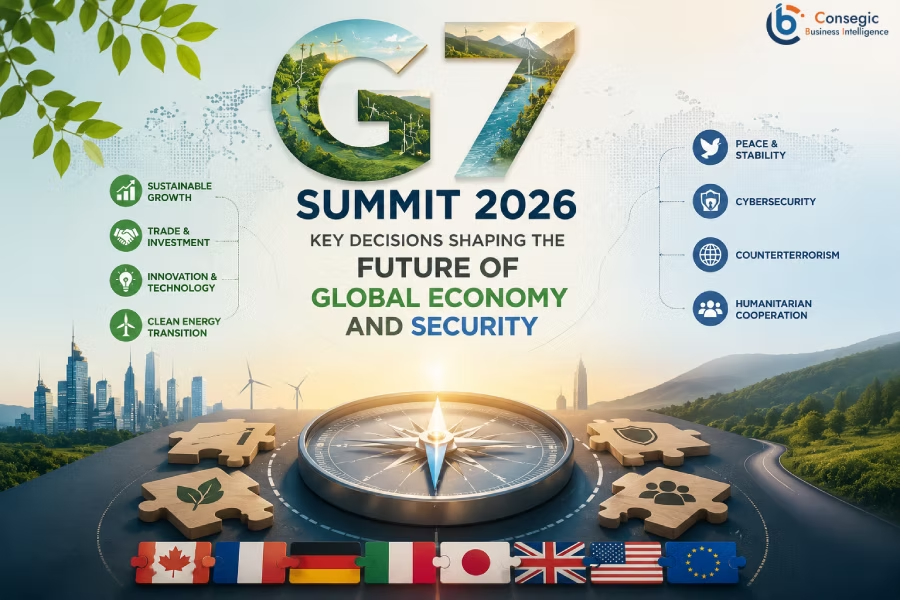
Held against a backdrop of active conflict in Europe, a fragile ceasefire in the Middle East, accelerating competition over critical technologies and widening global economic imbalances, the summit produced nine joint declarations and a set of decisions that will reverberate well beyond the French Alps.
Here is a close look at what was decided- and why it matters.
- Ukraine: A "Strategic Awakening"
The most emotionally charged moment of the summit came when Ukrainian President Volodymyr Zelensky joined the G7 leaders in person. The group reaffirmed its commitment to Ukraine's freedom, sovereignty and territorial integrity- but went further than previous pledges.
All leaders vowed to boost military assistance, promising more air defence, interception capability and long-range strike assets, but also strengthen Ukrainian energy resilience and apply further pressure on Moscow’s war effort, with further sanctions on Russia’s oil and gas output being explored too.
Paris labelled it a “genuine strategic awakening” by the G7- an abandonment of mere short-term crisis response in favour of sustained commitment. The sticking point is still the road to peace, with European countries deliberating possible arrangements for a lasting peace as they keep up the pressure on the Kremlin. Military aid versus diplomatic outcome is still not being matched.
- Middle East: Welcoming the US-Iran Deal and Securing the Strait
The G7 convened in the immediate aftermath of the US-Iran memorandum of understanding signed on June 17 the final day of the summit at the Palace of Versailles, during a dinner hosted by Macron. The symbolism was deliberate: a geopolitical breakthrough bookending a summit focused on stability.
Leaders welcomed the deal as "welcome news" and said there was a mutual understanding that the Strait of Hormuz - which carries one-fifth of world oil and gas traffic - must be opened up instantly and unconditionally. The G7 endorsed a multinational defensive maritime initiative under the leadership of France and Britain to secure merchant ships and support mines disposal assurance efforts and restore the confidence of transport owners to resume maritime transport trade. Regarding Lebanon, leaders demanded an immediate ceasefire and pledged support to Lebanon authorities to implement the disarmament process of Hezbollah party and maintain the integrity of the sovereignty of Lebanon. Regarding Gaza and the West Bank, communiqué underlined that the speed up of humanitarian aid delivery and reconstruction works must accompany an immediate cessation of hostilities.
The G7's acknowledgment of the Iran deal as an opening- rather than a solved problem- reflects the summit's pragmatic tone: engagement on what is achievable, pressure sustained where it is necessary.
- Global Economic Imbalances: The IMF Gets a Bigger Mandate
French President Macron's signature issue for his G7 presidency was the reduction of global economic imbalances and he secured concrete language on it. Leaders recognized the collective interest in coordinating economic policies to address imbalances- covering industrial overcapacity, underinvestment, excessive debt, deregulation and the underconsumption that characterizes some of the world's largest exporting economies.
The IMF was given a central, reinforced monitoring role, with leaders asking both the IMF and the OECD to track how domestic policy choices in major economies, a reference to China's export-led model, though Beijing was not named contribute to those imbalances. Egypt, Kenya and South Korea co-signed the statement, broadening its legitimacy beyond the G7 club.
The discussions are to continue at the G20, which will be the next major multilateral venue for translating these principles into actionable commitments. The direction of travel is clear: the G7 is building a Western-anchored normative framework around fair competition, job protection and macroeconomic transparency- a direct counterweight to economic practices deemed unfair by major industrialized democracies.
- Critical Minerals: The New Strategic Frontier
Perhaps the most consequential long-term decision at Évian was the establishment of the G7 Critical Minerals Resilience and Production Alliance- a non-binding but strategically significant coordination body targeting the supply chains underpinning the clean energy transition, semiconductor manufacturing and modern defense systems.
Leaders set a target of reducing dependence on any single supplier outside the G7 and partner countries for rare earths and permanent magnets to below 60% by 2030, with ambitions to reach 50% as soon as possible. The declaration did not name China- but the initiative followed directly on Chinese export curbs on permanent magnets that had exposed dangerous single-supplier vulnerabilities across multiple industries.
The alliance covers the full value chain: financing, traceability, stockpiling and recycling. Australia participated as a partner country and the framework is designed to be open to trusted partner economies- a structure that mirrors, in the mineral domain, what NATO did for collective defense.
For businesses and investors in energy, automotive, defense and electronics, this is the clearest signal yet that Western governments intend to actively restructure their critical resource dependencies.
- Artificial Intelligence: Safety, Children and the Labour Market
Building on the AI Action Summit held in Paris in 2025, G7 leaders advanced their AI governance agenda in three practical directions.
First, on child safety: members committed to working with leading technology companies to adapt AI systems, including chatbots, to be developmentally appropriate when interacting with children. This represents the first concrete G7-level commitment to age-sensitive AI design and it is likely to influence platform regulation across member states.
Second, on economic impact: G7 labour ministers, meeting in Geneva ahead of the summit, issued a communiqué emphasizing AI training, quality jobs, decent work and labour standards across critical mineral supply chains. A G7 conference on labour mobility and career progression was announced for Paris in December 2026- signalling that the social contract dimensions of automation are now squarely on the policy agenda.
Third, on deployment: leaders committed to accelerating the "safe and beneficial" deployment of AI, a formulation that tries to hold together pro-innovation and precautionary impulses- a balance that remains contested across member states, particularly between the United States and the European Union.
- Global Health: Ebola, Cancer and a $1 Billion Commitment
The meeting also focused on longer term and urgent issues. In the face of a rapidly developing Ebola outbreak in Bundibugyo – a variety with a known record of higher fatality rates – G7 leaders agreed over US $1 billion for responses, mirroring UN appeal for funds. The size and speed of this pledge signals a determination not to replicate a previous outbreak response that had already begun to move sluggishly.
Regarding cancer, leaders backed a new declaration calling for concerted action and data sharing on low-prognosis cancers, childhood cancer and universal access to treatment - areas where greater international co-ordination would undoubtedly lead to faster research progress and equitable treatment.
- Global Governance Reform: Bringing the Global South In
One of the structurally significant aspects of the 2026 summit was its deliberate broadening of participation. Brazil, India, Kenya and South Korea were integrated into the Sherpa track- the preparatory discussions that shape summit outcomes- not just invited as observers to a final session. Syria was invited to participate in a G7 summit for the first time. Egypt, Qatar, Saudi Arabia and Ukraine also attended.
India's Prime Minister Narendra Modi used the platform to advocate for the interests of the Global South, calling for reform of the traditional donor-recipient development model and stronger representation in multilateral institutions. The India-EU announcement of plans to conclude a free trade agreement by the end of 2026 added economic substance to the diplomatic inclusion.
This expansion reflects a recognition that the G7's legitimacy and its ability to lead on norms and rules depends on bringing emerging economies into the conversation, not simply issuing communiqués that others are expected to follow.
The Bigger Picture
The Évian summit was, in the French presidency's own words, a "summit of convergence and unity." That framing is partly diplomatic pride of authorship but it is not entirely self-serving. The nine declarations adopted, the concrete commitments on minerals and Ukraine and the Iran deal signed on the summit's final day collectively represent a denser output than many recent G7 gatherings.
The questions that linger are about implementation. Critical mineral supply chains cannot be restructured by declaration alone. Ukraine needs a peace pathway, not just weapons. AI governance frameworks require enforcement mechanisms and the Global South's inclusion in summit discussions has not yet translated into genuine reform of the institutions the IMF, the World Bank, the WTO that govern the global economy in practice.