For decades, global events – be it sporting tournaments, cultural festivals or international assemblies - were largely centred around the main draw. Attendees went to watch athletes perform, teams battle it out for titles, and talented artists showcase their skills. But, more recently, global event experiences have evolved dramatically.
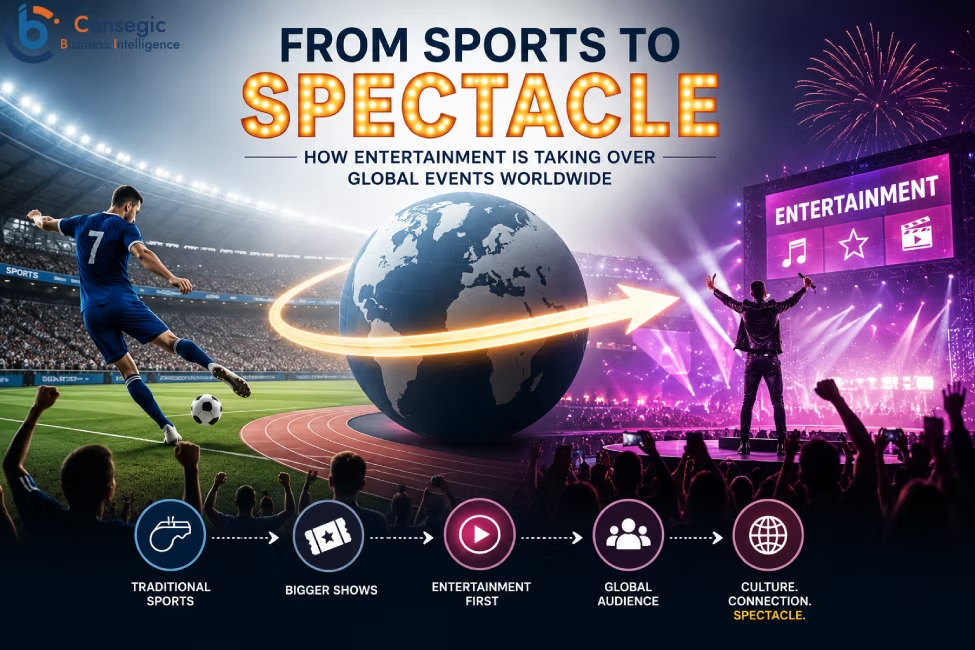
The public today seeks more than just the core competition or performance, looking for fully-fledged, immersive experiences, complete with unforgettable moments, that spill out beyond the boundary lines.
The landscape of global events is thus transforming, with organisers striving to create massive, captivating spectacles that weave together sports, music, innovative technologies, storytelling and fan involvement into a dynamic global tapestry.
The Evolution of Sports Spectacle
In the old days, sports events were predominantly about the athleticism. Fan interaction was key but it usually circled around cheering the athletes. In time, the broadcasting sphere expanded, the advent of digital technology enabled instant replay and live updates – all of which changed the very fabric of sports viewing and expectations. We live in an age where entertainment options abound, thanks to platforms like Netflix and Disney+.
Whether through their preferred digital or traditional channels, audiences today crave for more, for entertainment that is not only memorable but that can be integrated into the event, rather than confined to the stands or playing field. Now, international sporting tournaments and festivals have transcended athletic pursuits to become broad-spectrum entertainment experiences targeting not only sports fanatics, but also everyone else looking for a captivating show to entertain them.
The Rise of Celebrity Culture in Global Events
Celebrities have now become an indispensable fixture of most major events – the face and soul of both promotional materials and actual events. Opening ceremonies no longer just comprise a brief mention of the key figures in the game – it often features top-tier music celebrities or Hollywood’s finest. When fans are offered entertainment which features their favourite celebrity, either through live appearances or performances at halftime, attendance numbers tend to soar even amongst fans of the sports only partially – this has led to greater visibility, more advertising opportunities, and an unprecedented spread beyond niche fanbases across the web.
Technology Is Transforming Audience Engagement
The visual revolution spurred by technological advancements such as augmented reality (AR) technology – including sophisticated holograms – and robotics has truly revolutionized attendee participation and engagement at such large-scale gatherings. The visual spectacle provided by advanced computer technology has expanded the overall impact and experience for spectators across a huge variety of events – from live sports events to concerts or trade expos. Using drones to produce visually stunning arrays, alongside the ever-expanding application of AR technology to create immersive, interactives or informative visual elements, has taken events to a higher level of spectator interactivity. From in-person interactions that seem impossible or come across as magically generated on a smart device in hand – even during events – event marketers, planners and their audiences stand to benefit and be amazed in many ways, through technology, interactive features and smart applications.
Sports Are Becoming Entertainment Brands
Organisers of global events can no longer merely present sports on their own terms, they need to adapt. Sporting leagues like the National Basketball Association (NBA) now run content channels in which sports athletes provide video highlights and commentaries themselves for added viewing engagement. Professional athletes like Usain Bolt, for instance, have successfully transcended their status of being athletes alone; They are now celebrities and social media stars in their own rights, using their huge followings to promote sports beyond the confines of the stadium – and further integrate sports into the broader world of sports and entertainment. International leagues and clubs have thus become entertainment power brands in their own right.
Music and Live Performances Enhance Event Experiences
Music has quickly emerged to become an integral component of several international events worldwide. These large-scale events use concerts as a mechanism for expanding event reach and attendee numbers while strengthening spectator relations. They can even rival sports games for audience attention - at least in terms of media visibility.
For example, events like the FIFA World Cup would not be what they are today without a star-studded line-up to open the show with breathtaking performances or as part of half-time entertainment to pump up the crowds during a tournament.
Ultimately, by combining sports with music and a stellar host city entertainment strategy, event organizers broaden their appeal to a much wider demographic and in so doing ensure more sustained, popular interest for global events moving forward.
Social Media Amplifies the Spectacle
This is how technology enhances engagement across these large-scale global events: from AR overlays on live broadcasts that instantly bring replays or stats right into fans’ fields of vision; to social media campaigns that build excitement before the event, and fan forums that sustain the conversations throughout and beyond. Events no longer need to rely on television broadcasts; instead, they actively work towards making sure that content is shared live on social media by fans. This increases visibility exponentially and enhances a broad range of new revenue streams, be it sponsorship dollars or merchandising opportunities. Indeed, today, it is virtually impossible to run a major global event without a well-oiled social media and content creation machine.
Economic Benefits of Entertainment-Driven Events
An event is a financial investment - and like most things that demand considerable resources, event planners want to maximize returns. The increasing use of entertainment in global events isn’t just for show; it helps boost economic value. Greater demand leads to more ticket and sponsorship sales, and enhanced TV ratings, which in turn translates into higher profits for television networks, digital platforms and the organising body of the event. Host cities are often significantly enriched by these larger crowds, from increased revenue from ticket sales and merchandise to boom in local business (e.g. Transportation, food and accommodation, the list is truly endless!) all as a result of the major global event held within their precincts.
Challenges of Balancing Competition and Entertainment
One area of contention, however, concerns whether excessive entertainment can potentially detract from the sport’s core or cause a phenomenon known as the “Disney-fication of sports.” Sports are, for the traditionalists, first and foremost about competition. If overdone, entertainment can cause significant controversy. There are concerns that the more entertainment a sport incorporates, the more it dilutes the authenticity that it historically possessed and as such, that sport is ultimately undermined in the long-run.
This is because the sports fans who pay to see the contest may be unhappy that such a large percentage of their payment is going towards entertaining the rest of us who may not care so much about the athletes, but rather the overall show experience. It can be very hard to please everybody in a crowd made up of millions of attendees.
Beyond Today: A Glance at the Tomorrow
Technology and audience demand is not showing signs of abating in this regard, and global event planners are continuing to push the envelope of innovation, and innovation that may be more entertaining than the latest technological feat of yesteryears, more imaginative than anything presented so far. A.I. Technology and machine learning will be essential, allowing organizers to deliver unparalleled personalized, tailored, or curated content in real-time during any event – a prospect most appealing to attendees with varying levels of sports or artistic knowledge and preference. These events, the global events of the future, will offer dynamic entertainment content that is almost impossible to differentiate from video games, which are themselves constantly morphing.
From Competitive Spectacle to Full Scale Entertainment
It appears, beyond doubt, that the future of global events is firmly in the entertainment industry. The success of sporting competitions or cultural performances is now, invariably, linked to their capacity to incorporate all manner of artistic and technological elements in order to create a completely absorbing, and unforgettable spectator encounter. Beyond their traditional value as competitions and exhibitions, and with increasingly advanced ways to capture and disperse them both across media and through word-of-mouth, the world’s greatest events can become all the more engrossing – and enormously lucrative – when… and as… entertainment becomes ever more integral to their very core.