The signing of a memorandum of understanding between the United States and Iran on June 17, 2026 inked by President Donald Trump and Iranian President Masoud Pezeshkian during the G7 summit at the Palace of Versailles marks one of the most consequential diplomatic moments of the decade. After more than three months of a devastating conflict that triggered what the International Energy Agency called "the greatest global energy security challenge in history," the world is now cautiously watching to see whether this fragile agreement can translate into lasting stability and what that means for oil prices, inflation and the global economy.
How We Got Here: The Biggest Oil Shock in History
In order to understand the enormous impact of this deal, knowing how much instability led to it is important. On February 28th 2026, both the U.S. and Israel attacked Iran. They attacked their nuclear weapon program, as well as ballistic missile infrastructure. The IRGC immediately responded by blocking access to the Strait of Hormuz, the vital chokepoint through which about 20% of the worlds’ oil and gas transits annually.
The consequences were immediate and severe. Brent crude oil prices surged 10–13% to around $80–82 per barrel within days of the conflict beginning and continued climbing as the blockade dragged on. By mid-June, Brent futures were trading near $97 per barrel- still more than a third higher than pre-war levels, even after falling sharply on hopes of a deal.
The World Trade Organization reported a staggering 95% reduction in ships carrying crude oil from Persian Gulf ports and a 99% drop in LNG shipments. Nothing in modern history- not the 1973 Arab oil embargo, not the 1979 Iranian Revolution- had ever disrupted global energy markets at this scale.
What the Deal Actually Says
The June 17 memorandum is an initial framework, not a final peace treaty. At its core, the agreement does several things: it extends the ceasefire between the US and Iran for 60 days, lifts the US naval blockade of Iranian ports, requires Iran to reopen the Strait of Hormuz without tolls and begins a negotiation window on Iran's nuclear program, sanctions relief and broader regional security. Iran also reaffirmed it would not pursue a nuclear weapon, though the long-term fate of its enrichment programme remains unresolved.
Significantly, Trump announced on social media that ships were free to "start their engines", effectively authorising the toll-free reopening of the strait. Pakistan, which played a central mediating role alongside Qatar, confirmed that Tehran would promptly comply. European leaders from the UK, France, Germany and Italy welcomed the deal, calling for swift implementation, while UN Secretary-General António Guterres described it as a "critical step."
There are, however, meaningful gaps. US and Iranian interpretations diverge on implementation details around asset releases and long-term management of the Hormuz strait. Iran's hardliners have been pushing a version of the deal more favourable to Tehran and Vice President JD Vance had to publicly deny that Iran would receive immediate cash transfers. The 60-day negotiation window is a race against time.
The Immediate Impact on Oil Prices
Markets moved swiftly on news of the deal. Oil futures prices sank roughly 4% when markets reopened after the weekend of the announcement, following falls that had already begun building through the previous week. By Monday, prices were down nearly 13% from mid-week highs. For context, Brent crude- the global benchmark- dropped to around $83 per barrel, a level still elevated compared to pre-war figures, but the sharpest weekly decline the market had seen in years.
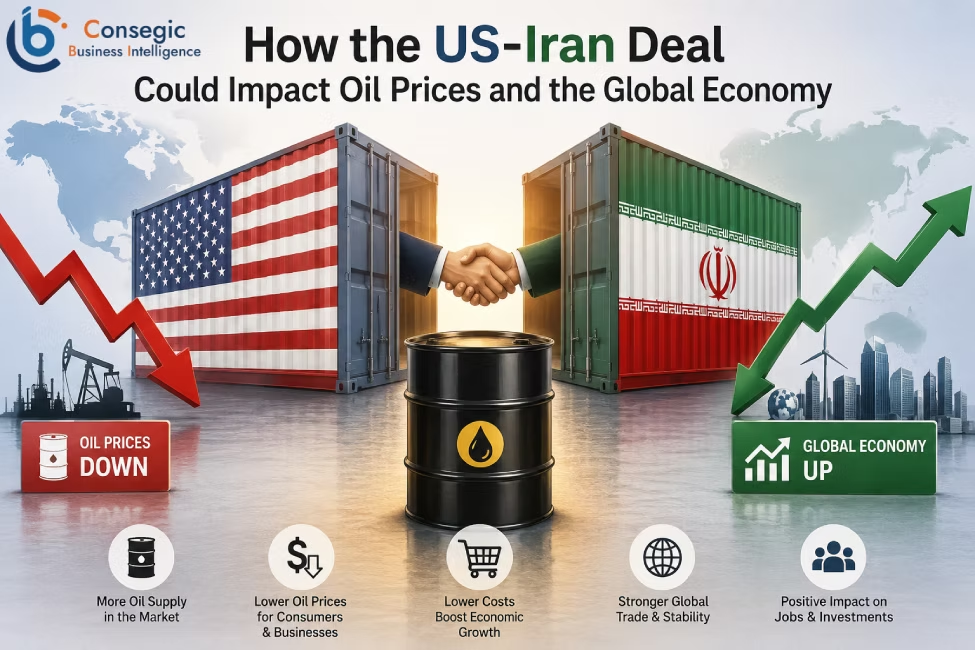
This repricing reflects the market's recognition of a simple reality: the reopening of the Strait of Hormuz effectively releases the largest oil supply constraint since the 1970s energy crisis. Before the conflict, approximately 3,000 vessels passed through the strait every month. Restoring even a fraction of that flow puts significant downward pressure on prices.
That said, the path back to pre-war normalcy is not a straight line. Mines laid in the strait will need to be cleared. Trump said the waterway would reopen fully "upon the signing of the deal, for purposes of mine removal." The UAE's state-owned oil company has estimated that full flows through Hormuz will not resume until 2027, even if a deal was reached quickly. Insurance costs for vessels remain elevated. Supply chains, particularly in food and energy, will take months to normalise.
Inflation: Relief Is Coming, But Slowly
The conflict inflicted a serious inflationary wound on the global economy. Researchers at CEPR found that even under an optimistic scenario- a one-quarter closure of the strait- the oil price surge would raise US headline inflation by 0.6 percentage points in 2026, with core inflation rising by 0.2 percentage points. Multiple forecasters revised their US inflation projections upward to around 3%, eroding household purchasing power and weighing on job creation.
For Europe, the damage was sharper. The crisis coincided with historically low European gas storage levels, estimated at just 30% capacity following a harsh winter causing Dutch TTF gas benchmarks to nearly double to over €60/MWh by mid-March. The European Central Bank postponed its planned interest rate cuts and warned that energy-intensive economies like Germany and Italy faced genuine risks of technical recession. UK inflation was projected to breach 5% in 2026.
The deal will ease these pressures, but it won't erase them overnight. As the chief economist of food and drink trade body FDF noted, "while the Strait of Hormuz is now reopening, it will take another six months, at least, for supply chains to normalise." The food sector has been particularly hard hit- rising energy costs have pushed up the price of fertilisers, transport and manufacturing and those increases ripple through every stage of the supply chain before consumers see relief at the checkout.
Winners, Losers, and Strategic Shifts
The deal reshapes the economic landscape in complex ways.
Countries that benefit most from lower oil prices- Japan, South Korea, India and large swaths of Southeast Asia- are the biggest winners. These nations are heavily dependent on Middle Eastern oil transiting the Strait of Hormuz. Japan's stock market surged more than 3% in a single session on news of the deal, hitting an all-time high. Lower fuel costs will ease manufacturing costs, reduce inflationary pressure and give central banks in the region more room to cut rates.
US consumers will see declining petrol prices, which the Trump administration views as a political win ahead of the midterms. The war had driven the US national average petrol price up by as much as $1.50 per gallon. As Rystad Energy's chief economist Claudio Galimberti observed, Washington has a clear incentive to avoid a gasoline price spike, Tehran wants sanctions relief and restored export revenues and the global economy has a strong interest in keeping Hormuz open.
Russia and non-OPEC producers may find themselves squeezed. During the conflict, Russia benefited significantly from elevated oil prices and redirected trade flows. A return to normalised Hormuz traffic and lower crude prices will narrow Russian oil revenue, a complication for an economy already under sanctions pressure. Similarly, Venezuela and Brazil, which had begun ramping up production to fill the gap, may see investment slow if Middle Eastern supply returns quickly.
Iran itself stands to benefit economically from sanctions relief and the ability to resume oil exports, though the domestic political picture is volatile. A government poll from June 20 found that nearly 60% of Iranians reported being financially unable to continue their daily lives and 70% were demanding government changes- signs of deep public discontent that will shape how Iran's leadership navigates the next 60 days.
The Longer Road: Nuclear Talks and Lasting Stability
The deal's biggest unresolved question is Iran's nuclear programme. The memorandum secured Iran's reaffirmation that it will not pursue a nuclear weapon, but the actual dismantlement- the centrifuges, the enriched uranium stockpiles, the facilities- is all subject to the upcoming 60-day negotiation.
Analysts draw comparisons to the original 2015 JCPOA, which took years to negotiate and was eventually abandoned by the US in 2018. Getting from a ceasefire memo to a durable, verifiable nuclear agreement is a fundamentally harder task.
Regional actors complicate matters further. Israel has stated it will keep troops in southern Lebanon indefinitely and Hezbollah has continued firing drones into northern Israel despite an official ceasefire. Gulf states, particularly those whose entire economic model depends on stable Hormuz transit, are watching the implementation closely and have expressed anxiety that unresolved provisions could enhance Iran's strategic leverage.
Markets are pricing in hope, not certainty. The 60-day window is narrow and a breakdown in negotiations or a new military incident could send oil prices surging again.
The Takeaway
The US-Iran memorandum of understanding is a genuine breakthrough after the largest oil supply disruption in modern history. If implemented faithfully, it will push oil prices lower, ease inflationary pressures in the US, Europe and Asia and give central banks breathing room to resume easing cycles. The economic benefits are real and meaningful.
But the deal is an interim agreement, not a resolution. The nuclear question, the future of Iranian sanctions, freedom of navigation through Hormuz and the status of regional proxy conflicts all remain open. Supply chain recovery will be measured in months, not weeks. And the gap between the US and Iranian interpretations of what was agreed creates ongoing uncertainty.
For businesses, investors and policymakers watching this space, the message is clear- the worst of the energy shock may be behind us, but the road to genuine stability is still being paved.