If you've been feeling like the economic ground keeps shifting beneath your feet, you're not imagining it. In 2026, the global economy is navigating a genuinely extraordinary collision of crises- a Middle East war that triggered the largest oil supply disruption in modern history, persistent inflation that refuses to fully subside, rising trade barriers, record public debt and a growing sense that the rules governing global commerce are being rewritten in real time. The unease you feel when checking prices at the grocery store or watching your investment portfolio swing is not irrational. It reflects something real.
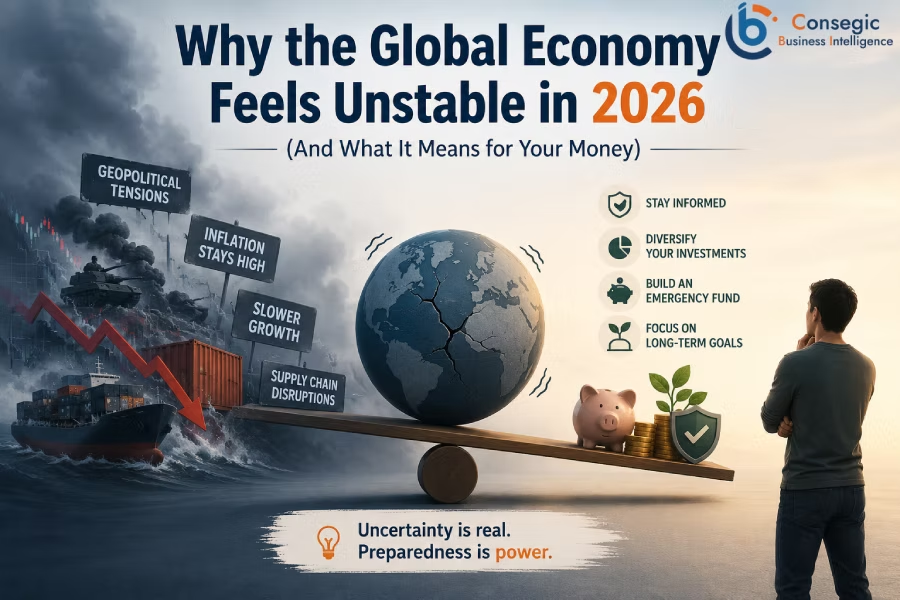
This post breaks down why the global economy is so unsettled right now, what the biggest forces at play actually are and what you can do to protect your financial position.
The Big Picture: A World Under Multiple Pressures
The World Economic Forum's Global Risks Report 2026 described the current moment as an "age of competition," noting that "uncertainty is the defining theme" and that 50% of surveyed global experts anticipated either a turbulent or stormy economic outlook over the next two years. That kind of consensus among experts is rare. It reflects how many serious, overlapping forces are converging at once.
- The Middle East War and the Energy Shock
The single most dramatic disruption of 2026 has been the US-Israel war on Iran, which began in late February and triggered Iran's closure of the Strait of Hormuz- the narrow waterway through which roughly 20% of the world's oil and liquefied natural gas flows. The International Energy Agency called it "the greatest global energy security challenge in history," and that characterisation is hard to argue with.
The World Bank now projects global growth will slow to just 2.5% in 2026, driven largely by the energy shock from the conflict. The IMF, in its April 2026 World Economic Outlook, similarly downgraded its forecast to 3.1% and warned that risks remain "decisively on the downside." The EY-Parthenon outlook put global growth at 2.9%, down from 3.4% in 2025.
An initial US-Iran ceasefire deal signed in mid-June has provided some relief- oil prices fell sharply on the news- but the deal is fragile. A 60-day negotiation window on Iran's nuclear programme is ongoing and analysts are clear that full supply chain normalisation will take six months to a year at minimum.
- Inflation That Won't Fully Quit
The energy shock reignited inflationary pressures just as they were beginning to ease. US headline inflation was heading toward a higher trajectory, with some forecasters placing it near 4% PCE at its peak and core inflation stubbornly settling around 3%. The global spread of the war and other geopolitical tensions meant several global research firms raised forecasts for global inflation.
European gas stocks had fallen to just 30% of total capacity after a severe 2025-26 winter, nearly doubling benchmarks and forcing the European Central Bank to delay anticipated interest rate cuts and warn about risks of stagflation for Germany and Italy in particular- the most dependent upon energy imports.
Even as the Iran deal brings energy prices down and alleviates fears about energy shocks and oil prices, there will still be an inflationary knock-on effect, given that supply chains- especially for foodstuffs- which need time and months to normalise after shock.
- Trade Policy Uncertainty and Geopolitical Fragmentation
Beyond the Middle East, the broader trade environment remains deeply unsettled. McKinsey's latest global survey found that respondents now cite changes in trade policy as the single biggest disruption to global economic growth ranking above even geopolitical conflict. The World Economic Forum's risk report identified "geoeconomic confrontation" as the top global risk over the next two years, up eight positions from the prior year.
The rules-based international order that underpinned global commerce for decades is fraying. Tariffs, sanctions, export controls and the growing rivalry between the US and China over technology and supply chains are creating a more fragmented and less efficient global economy. For businesses and investors, this translates into higher costs, reduced predictability and the need to think about geopolitical risk in ways that would have felt unusual just five years ago.
- Rising Debt and Tighter Fiscal Space
Governments around the world spent heavily during the COVID-19 pandemic and subsequent energy crises, and public debt levels have climbed to historically elevated levels in many economies. This matters because it limits what governments can do when the next shock arrives. Fiscal space- the room to stimulate the economy through spending -is narrower than it has been in decades.
The World Economic Forum's risk report noted that "economic downturn and inflation are both up eight positions" in its risk rankings, alongside concern about an "asset bubble burst." High leverage in both public and private sectors makes the global economy more sensitive to interest rate movements and financial shocks than it was in previous cycles.
What Does All This Mean for Your Money?
Understanding the macro picture is one thing. Translating it into practical steps for your personal finances is another. Here is what actually matters for your financial life right now.
Accept That Inflation Is a Long Game:
Even as energy prices ease with the Iran deal, inflation is unlikely to snap back to the low, stable levels of the pre-2020 era quickly. A moderate inflation rate of 3% means your savings lose meaningful purchasing power each year if they're sitting in low-interest accounts. The priority is ensuring your money is working hard enough to at least keep pace.
High-yield savings accounts, money market funds, and inflation-protected securities are all worth considering for savings you want to keep liquid. The old rule of leaving large sums in a standard current account is especially costly in an inflationary environment.
Build Your Emergency Fund — Now, Not Later:
In an environment where job security becomes less certain during economic slowdowns, and where unexpected expenses can spike suddenly, a cash buffer is your first line of defence. The standard advice of three to six months of essential expenses in an easily accessible account exists for exactly this kind of moment. If your emergency fund is thin or non-existent, this is the most important thing to fix before thinking about investments.
Don't Try to Time the Market:
Market volatility in 2026 has been significant- sharp falls on war news, sharp recoveries on deal news, whipsawing on every twist in the Iran negotiations. It is extremely tempting to try to get out before the next fall and back in before the next rally. The evidence, historically, is clear: this strategy fails for almost everyone. The days that matter most for long-term investment returns tend to cluster around periods of peak uncertainty and missing even a handful of them dramatically reduces lifetime portfolio performance.
Regular, consistent investment, whether through a pension, provident fund, or self-directed portfolio beats market timing over the long run.
Take a Hard Look at High-Interest Debt:
When central banks keep rates elevated to fight inflation, as the US Federal Reserve has been doing, holding through 2026 rather than cutting aggressively the cost of carrying high-interest debt rises. Credit card balances, personal loans, and variable-rate borrowings become more expensive to maintain. Paying down high-interest debt before investing further is often the highest guaranteed "return" available in this environment.
Think About Your Income — Not Just Your Investments:
Economic uncertainty affects income stability before it affects portfolio values. Businesses under pressure cut costs, slow hiring and freeze wages. Building income resilience is as important as any investment decision.
The Bottom Line
The global economy in 2026 is genuinely difficult, shaped by forces that are unprecedented in their combination: a major energy war, sticky inflation, geopolitical trade fragmentation, and stretched public finances. The instability you feel is real, and it isn't going away quickly.
But difficulty is not the same as disaster. The IMF still projects global growth- slower, but positive. The Iran deal, fragile as it is, reduces the tail risk of a catastrophic oil price spiral. AI-driven productivity gains offer a genuine upside if they materialise broadly. And historically, the investors who fare best through turbulent periods are those who stay rational, stay diversified, keep their costs down and resist the urge to make dramatic moves based on the news cycle.
The goal right now is not to find the clever trade that beats the market. It's to protect what you've built, stay invested in assets that can outpace inflation over time and keep enough liquidity to weather whatever comes next.