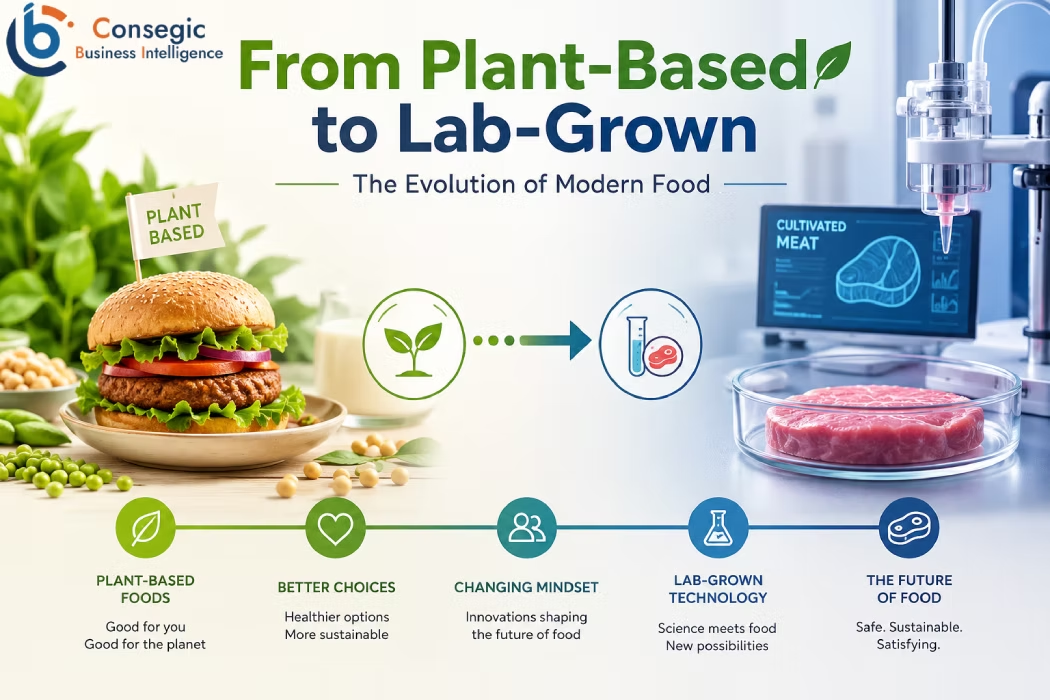
Something fundamental is shifting on our plates. Over the last decade, the conversation around food has moved from "should I eat less meat?" to "what even is meat?" From lentil burgers to chicken grown in a bioreactor, modern food science is dismantling centuries old assumptions about where protein comes from and why it has to come from an animal at all. The journey from plant-based to lab-grown is not a single leap; it is a long, messy, delicious evolution that is still very much underway.
The Plant-Based Revolution: From Fringe to Mainstream
Plant-based eating used to belong to health food stores and the committed few. Then came the burger, the oat milk latte, the pea-protein nugget and suddenly, an entire generation of consumers began questioning the default.
Today, plant-based foods reach 59% of American households, with health overwhelmingly identified as the primary driver of purchase. In Europe, 28% of consumers eat plant-based alternatives at least weekly, up from 21% just five years ago.
The market numbers reflect this momentum. The global plant-based food sector is expanding from $15.9 billion in 2026 toward $49.5 billion by 2036, growing at a compound annual rate of 12%. This is not a hype cycle- it is a mature category in sustained, volume-driven growth.
The Clean Label Shift: Less Processing, More Plants
The first generation of plant-based products won on novelty. The next generation is winning on integrity. A key factor transforming the plant-based scene in 2026 will be the clean label phenomenon- a consumer-led crusade against ultra-processed ingredients, artificial flavourings and transparent supply chains. Not only are brands shrinking their ingredient statements, many are also openly printing the ingredient count on their labels to declare them a cut above their competitors.
A prominent contributor of this wave, pea protein has seized over 35% of new plant-based formulations. It has overtaken soy in many products, valued for its non-GMO status, low allergenicity and functional versatility. The same consumers who once embraced the sizzling burger patty are now reaching for tempeh, whole-grain bowls and legume-forward dishes that look more like food and less like science.
The Hybrid Middle Ground
Between the fully plant-based and the conventional lies a booming middle category: blended products that combine meat with plants. Brands like Perdue and Better Meat Co. are mixing chicken with mushrooms, beef with soy, creating products with better texture, fewer calories and a lighter environmental footprint than conventional alternatives. These hybrid products are not a compromise; they are a new category built precisely for the flexitarian majority who want to reduce meat without giving it up entirely.
Menu data from food intelligence platforms shows chicken mushroom nuggets growing 20% year-over-year. Blended burgers and half veggie sausages are appearing across fast casual menus globally. The insight here is powerful- for most consumers, eating well is not an identity statement. It is a series of daily decisions nudged by taste, price and convenience.
Enter Cellular Agriculture: Meat Without the Animal
While plant-based food was conquering supermarket shelves, a quieter revolution was taking shape in laboratories. Cellular agriculture- the science of growing animal muscle tissue from cells, without ever raising or slaughtering a live animal- has moved from speculative to regulatory reality.
In 2026, five cultivated meat products including chicken, salmon and pork fat have received regulatory clearance from both the FDA and USDA following a joint review process. Singapore has approved three products and the UK's Food Standards Agency has launched a dedicated pilot support service to guide cultivated food companies through authorisation.
The Cost Problem and How It's Being Solved
The single biggest barrier to mainstreaming lab-grown meat has always been cost. Early production relied on fetal bovine serum (FBS) as a cell growth medium- expensive, ethically contentious and difficult to scale. What is truly the step change of 2026 is companies switching completely to moving away from FBS.
Mosa Meat and Meatable have successfully produced their own plant-based growth media, that have lowered costs of production by up to 80%. Aleph Farms have developed scalable bioreactor technology, that has significantly increased cell density and efficiency.
Though cultivated meat has achieved approval and may now begin to enter grocery stores, not a single purchase of cultivated meat was recorded last year. Companies are instead testing through limited restaurant placements, learning willingness to pay before committing to shelf level supply chains.
The smarter near-term play, many analysts suggest, is the blended approach of incorporating cultivated ingredients into conventional or plant-based product pipelines, reducing unit costs while building consumer familiarity.
The Regulatory Patchwork and Political Resistance
The road to your plate is not purely a scientific one. In the United States, cultivated meat has become a cultural flashpoint. Florida and Alabama have enacted outright bans on its sale and production. Several other states have introduced legislation requiring strict labelling or restricting the use of public funds for related research. There are currently no cell-based meat products for sale in the U.S as of mid-2026, although they have received federal approval.
Globally, cell-based meat is more embraced. Singapore has again shown leadership with adoption of cell-based meat, Australia approved its first cultivated meat product in 2026, The EU's FSA is building regulatory infrastructure.
The political complexity in the U.S. means that the commercial future of lab-grown meat may advance faster in Asia and Europe than in its most scientifically advanced market.
What Consumers Actually Want
Beyond the science and the politics, the food revolution ultimately lives or dies on taste, price and trust. Research consistently shows that consumers prioritise natural or authentic flavour above all other attributes in plant-based products.
They want protein that performs, that delivers fullness, energy and satisfaction, not just a label claim. They want shorter ingredient lists and recognisable components and increasingly, they want the environmental credentials of their food to be as legible as the calorie count.
Gen Z is driving this agenda more forcefully than any prior generation. In Europe, they have the highest rates of veganism and vegetarianism of any age group. Globally, 79% of Gen Z consumers go meatless at least one day a week. They are twice as likely as older consumers to choose plant-based when dining out. The brands and food systems that earn their trust in the next five years are likely to define the dietary landscape for decades.
The Future Plate
The evolution of modern food is not a binary choice between a steak and a soybean. It is a spectrum- from whole-plant foods to precision-fermented proteins to cultivated muscle tissue- each with its own nutritional profile, environmental footprint and cultural meaning.
What is becoming clear in 2026 is that no single solution will feed the world. The future plate will be plural. A thoughtful combination of vegetables, legumes, hybrid products and, in time, cultivated proteins produced without the land use, water consumption and animal welfare costs of conventional farming.
The journey from a pea-protein burger to a bioreactor-grown chicken fillet is, at its core, the same journey, a civilisation slowly, imperfectly, but persistently renegotiating its relationship with animals, with land and with the question of what it means to eat well. That renegotiation is the most important food conversation of our time and it is just getting started.