How is Continuous Health Monitoring Important?
Continuous health monitoring is transforming healthcare from being just about treating patients to focusing on a system centred on prevention and early intervention. With more people getting chronic illnesses like diabetes, heart disease, and high blood pressure, there's a big push for real-time health tracking. Now one can wear or even implant medical devices through which doctors can watch your vitals constantly and spot issues early, maybe even before you notice anything wrong yourself. This is super helpful because it lets them stop small health niggles from turning into major crises.
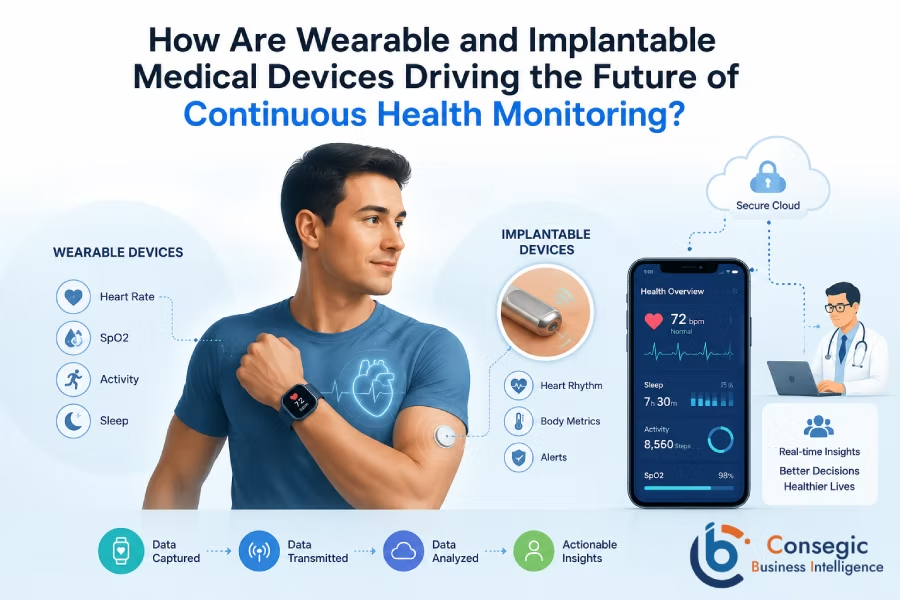
Additionally, increasing demand for remote patient monitoring in the healthcare industry is attributed to aging populations straining health systems across the globe. Now patients can easily send health information to doctors, making care easier and less expensive. Moreover, there were other type of AI-powered wearables at CES 2026 that can help with preventive care and personalized wellness.
Wearable Medical Devices: Transforming Everyday Health Tracking
Wearable medical devices have evolved from simple fitness trackers to sophisticated health-monitoring systems that provide accurate health data. These gadgets are always measuring important vitals such as heart rate, blood oxygen, sleep quality, etc. ranging from smartwatches to ECG patches. Early detection of problems helps health care providers to make better decisions about their patients’ care.
Nowadays AI is making these devices much more intelligent. At CES 2026, there were various new models designed to predict health problems before they happen, and suggest ways to stay healthy. Oura, for instance, brought out a shiny new smart ring in 2026 that could not only track your blood pressure and breathing but also send alerts to doctors about possible problems. Moreover, there is an increasing need for wearables for more personalized health care.
Implantable Medical Devices: Advancing Long-Term Disease Management
Implantable medical devices play a major role in managing chronic and life-threatening conditions. Unlike wearables, they give continuous and precise readings with no hassle. Think pacemakers, implantable cardiac monitors, neurostimulators, and implantable glucose monitors – all working to keep an eye on things inside the body.
One of the biggest developments is implantable continuous glucose monitoring technologies. Medical technology companies are working to develop fully implantable systems that can monitor blood glucose levels longer without the use of external wearable components. Additionally, Glucotrack recently announced progress on its fully-implantable blood-based glucose monitoring platform for long-term, real-time monitoring of diabetes patients, moving towards clinical evaluation. In the meantime, Senseonics received European approval to roll out its Eversense 365 system, offering one of the world’s longest-lasting implantable continuous glucose monitoring solutions that lasts up to a year. Such advances will lead to increased patient comfort, increased compliance to monitoring protocols and reduction in the burden of traditional monitoring devices. As implantable technologies become smaller, more accurate and longer lasting, they are expected to play an increasingly central role in personalized disease management.
The Role of AI, IoT, and Data Analytics in Continuous Health Monitoring
Artificial intelligence (AI), Internet of Things (IoT) and advanced data analytics is the technological backbone of the next-generation continuous health monitoring systems. Connected wearable and implantable devices generate huge volumes of health data that can be analysed in real time to detect trends, predict risks, and support clinical decision making. Moreover, AI algorithms are also increasingly sensitive to subtle physiological changes that may herald the onset of disease before symptoms are apparent.
The IoT connectivity allows health information to be securely transferred between patients, healthcare providers and cloud-based systems, enabling remote monitoring and timely medical intervention. In recent years, research has been published demonstrating the ability of AI based monitoring systems to improve anomaly detection and personalized health assessment via learning individual physiological patterns. In addition, tech companies are increasingly embedding AI directly into the wearable hardware, allowing for faster analysis and less reliance on cloud computing. This trend is also evident from the emergence of dedicated AI operating systems and wearable platforms specifically developed for health-focused devices. Furthermore, AI, IoT and analytics are combining together to convert raw health data into actionable insights, making healthcare predictive, personalized and more efficient while improving outcomes for both patients and healthcare providers.
Future Trends and Challenges in Wearable and Implantable Healthcare Technologies
Wearable and implantable medical devices are getting way smarter and more integrated into our healthcare setup. These tech gadgets are moving beyond just simple monitoring to doing multiple jobs at once – think of tracking different health stats all together. We're seeing smart rings, clever AI devices, tiny glucose monitors you can implant, and super-advanced biosensors.
These gadgets aren't just about checking your vitals; some now combine tracking with actually taking action if something's wrong. Fetal monitoring, for instance – researchers are working on wearables for that too. Despite all these amazing uses, there are some major hurdles to clear. Privacy, security, and making sure these things work well with other devices and follow the rules are huge concerns. Moreover, there are issues of affordability, as these wearables and implantable gadgets are not cost effective. Yet, with steady progress in AI and sensor tech, continuous health monitoring will play a big part in how we get healthcare in the future. It’ll likely lead to catching illnesses sooner and helping folks stay healthier overall.
Conclusion
Wearable and implantable medical devices are transforming healthcare by allowing continuous, real-time health monitoring and facilitating a move toward preventive and personalized care. Moreover, with the emergence of artificial intelligence, IoT connectivity, and data analytics in continuous health monitoring, these technologies are helping healthcare providers detect conditions earlier, improve disease management, and improve patient outcomes. Furthermore, there are still challenges with data security, affordability, and regulatory compliance, continued innovation is increasing their capabilities and accessibility. In addition to that, healthcare systems becoming increasingly digital, wearable and implantable devices are expected to be key to building more connected, efficient and patient-centric healthcare ecosystems around the world.