Jump to Content
Bottle Display Packaging Market - Size, Share, Industry Trends, and Forecasts (2025-2032)
Bottle Display Packaging Market Size:
Bottle Display Packaging Market size is estimated to reach over USD 32.44 Billion by 2032 from a value of USD 25.64 Billion in 2024 and is projected to grow by USD 25.96 Billion in 2025, growing at a CAGR of 3.1% from 2025 to 2032.
Bottle Display Packaging Market Scope & Overview:
Bottle display packaging is designed to enhance product visibility and presentation while ensuring protection during storage and transportation. It includes materials such as cardboard, plastic, and metal, offering durability and structural integrity. These packaging solutions feature custom printing, ergonomic designs, and secure enclosures to improve branding and shelf appeal.
Key characteristics include high-impact resistance, customizable shapes, and eco-friendly materials. They enhance product differentiation, improve consumer engagement, and support efficient retail placement. Benefits include increased brand recognition, reduced product damage, and optimized space utilization.
It is widely used in the beverage, cosmetics, and pharmaceutical industries. It is applied in retail displays, promotional campaigns, and e-commerce packaging. End users include beverage manufacturers, personal care brands, and pharmaceutical companies.

Bottle Display Packaging Market Dynamics - (DRO):
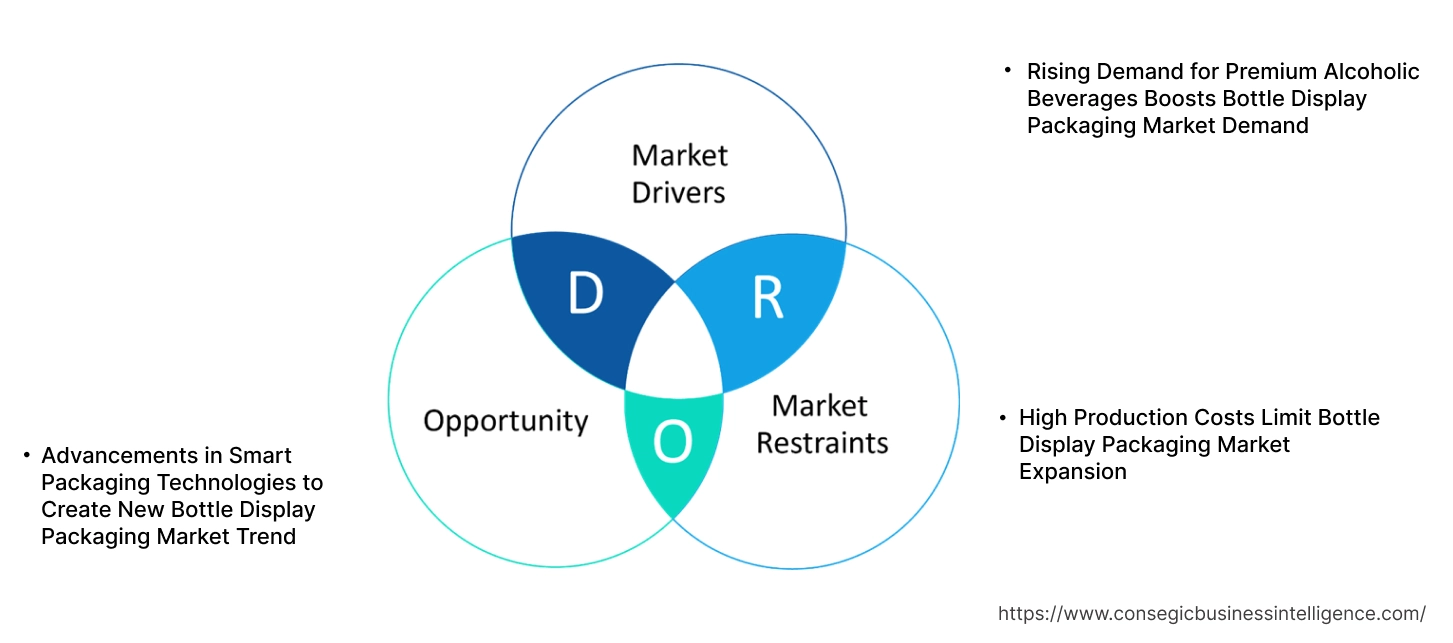
Key Drivers:
Rising Demand for Premium Alcoholic Beverages Boosts Bottle Display Packaging Market Demand
The increasing consumer preference for premium alcoholic beverages, including wines, whiskeys, and craft spirits, has led to a surge in trend for high-end bottle display packaging. Luxury liquor brands focus on visually appealing packaging solutions to enhance brand perception and attract consumers. Premium bottle display packaging enhances product visibility and communicates exclusivity, influencing purchasing decisions. Additionally, high-end packaging materials, such as glass cases with LED lighting and intricate wooden display units, provide a superior unboxing experience that appeals to consumers seeking sophistication. For example, premium whiskey brands utilize intricate wooden or glass display cases to differentiate themselves in retail spaces, reinforcing the luxurious appeal of their products. Therefore, the adoption of premium alcoholic beverages is positively impacting the bottle display packaging market, driving innovation in packaging designs and materials.
Key Restraints:
High Production Costs Limit Bottle Display Packaging Market Expansion
Manufacturing bottle display packaging involves the use of high-quality materials such as rigid plastics, glass, and wood, which increases production costs. Additionally, advanced printing techniques, embossing, and sustainable packaging materials further elevate expenses. Small and medium enterprises find it challenging to invest in high-cost packaging solutions, limiting their adoption. The costs associated with sourcing raw materials, custom molding, and specialized finishing techniques further exacerbate the financial burden on manufacturers. For instance, the cost-intensive nature of eco-friendly display packaging, such as biodegradable materials and recyclable components, discourages smaller beverage brands from utilizing such solutions. Furthermore, the need for compliance with stringent packaging regulations adds to the expenses, making high-end display packaging less accessible to emerging brands. These high costs create a barrier to display packaging market expansion, restricting its widespread adoption, particularly in price-sensitive markets.
Future Opportunities:
Advancements in Smart Packaging Technologies to Create New Bottle Display Packaging Market Trend
The integration of smart packaging technologies, such as NFC-enabled labels and interactive QR codes, is expected to transform the bottle display packaging industry. These technologies enhance consumer engagement by providing product authenticity verification, brand storytelling, and personalized marketing experiences. Luxury wine and spirits brands are expected to incorporate smart display packaging to offer interactive experiences for customers. The use of augmented reality (AR) features embedded in display packaging can create immersive brand experiences, allowing consumers to access exclusive content, virtual tastings, or behind-the-scenes production insights. For instance, NFC-enabled bottle displays allow customers to access digital content by simply tapping their smartphones, offering real-time brand interaction. Additionally, the rise of connected packaging, where data analytics provide brands with insights into consumer behavior, is anticipated to drive strategic marketing initiatives. These advancements in smart packaging technologies are projected to drive new bottle display packaging market opportunities, fostering innovation and increased consumer engagement.
Bottle Display Packaging Market Segmental Analysis :
By Type:
Based on type, the bottle display packaging market is segmented into single bottle and multiple bottle.
The multiple bottle segment accounted for the largest revenue in bottle display packaging market share in 2024.
- This segment includes packaging solutions designed to hold two or more bottles, commonly used in retail environments, promotional displays, and wholesale distribution.
- These packaging solutions enhance product visibility and convenience for consumers, making them highly preferred by beverage brands and retailers.
- They are frequently utilized for gifting purposes, promotional campaigns, and multipack sales, which boost consumer engagement.
- Furthermore, multiple bottle packaging is often designed with reinforced materials, ensuring product safety during transport and handling.
- Therefore, according to bottle display packaging market analysis, these factors contribute to the segment’s significant revenue share in the market.
The single bottle segment is anticipated to register the fastest CAGR during the forecast period.
- Single bottle packaging is used for premium and specialty beverages, luxury personal care items, and exclusive product launches.
- The increasing trend for personalized and customized packaging solutions for high-end alcohol, cosmetics, and wellness products is driving its adoption.
- Brands are investing in innovative and aesthetically appealing packaging designs to enhance consumer experience and brand perception.
- Additionally, the rise of e-commerce and direct-to-consumer sales has increased the need for protective single bottle packaging.
- Thus, according to the market analysis, trends are expected to contribute to the rapid growth of the single bottle segment in the coming years.
By Material:
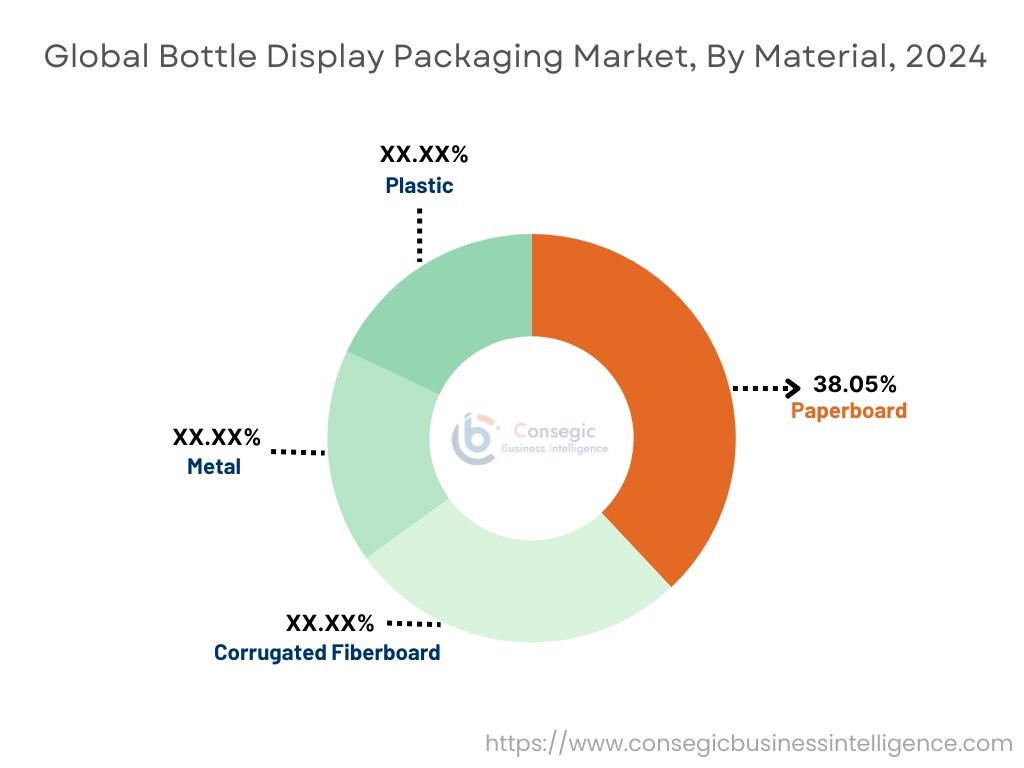
Based on material, the bottle display packaging market is segmented into plastic, paperboard, corrugated fiberboard, and metal.
The paperboard segment accounted for the largest revenue share of 38.05% in 2024.
- Paperboard packaging is widely used due to its lightweight nature, cost-effectiveness, and recyclability.
- It is preferred by brands seeking eco-friendly and sustainable packaging solutions, aligning with global sustainability initiatives.
- The material is easy to customize, allowing for high-quality printing and branding, making it attractive for retail displays.
- Additionally, paperboard packaging offers sufficient protection while maintaining an aesthetically pleasing appearance for premium and standard products.
- Therefore, according to bottle display packaging market analysis, these factors contribute to the segment’s dominance in the market.
The corrugated fiberboard segment is anticipated to register the fastest CAGR during the forecast period.
- Corrugated fiberboard is known for its durability, strength, and versatility in providing superior protection during transportation and handling.
- It is increasingly used in bulk packaging, e-commerce shipping, and large-format retail displays.
- The growing ask for sustainable and biodegradable materials has further accelerated its adoption in the market.
- Advancements in printing technology allow for high-quality graphics and branding on corrugated packaging, enhancing product presentation.
- Thus, according to the market analysis, trends are expected to drive the segment’s growth in the coming years.
By Application:
Based on application, the bottle display packaging market is segmented into the alcoholic beverages sector, non-alcoholic beverages sector, personal care sector, and household care sector.
The alcoholic beverages sector accounted for the largest revenue in bottle display packaging market share in 2024.
- The segment includes packaging solutions for wines, spirits, beers, and other alcoholic beverages, with a strong presence in retail and duty-free outlets.
- High consumer demand for premium alcoholic beverages has led to increased investment in high-quality and visually appealing display packaging.
- Luxury and craft beverage brands use customized bottle display packaging to differentiate their products in a competitive market.
- Furthermore, sustainability initiatives have led to the use of eco-friendly materials in alcoholic beverage packaging.
- Therefore, according to the market analysis, factors contribute to the segment’s leading revenue share in the bottle display packaging market.
The personal care sector is anticipated to register the fastest CAGR during the forecast period.
- The segment includes packaging for beauty, skincare, and wellness products, where visual appeal and branding play a crucial role in consumer purchasing decisions.
- The rising requirement for premium cosmetics and organic personal care products has fueled the need for innovative display packaging.
- Brands are increasingly adopting sustainable materials such as biodegradable paperboard and recyclable plastic for their packaging.
- The growth of e-commerce and digital marketing has further emphasized the importance of attractive and protective packaging solutions.
- Therefore, according to the market analysis, these trends are expected to drive the segment’s rapid expansion in the coming years.
Regional Analysis:
The regional segment includes North America, Europe, Asia Pacific, Middle East and Africa, and Latin America.
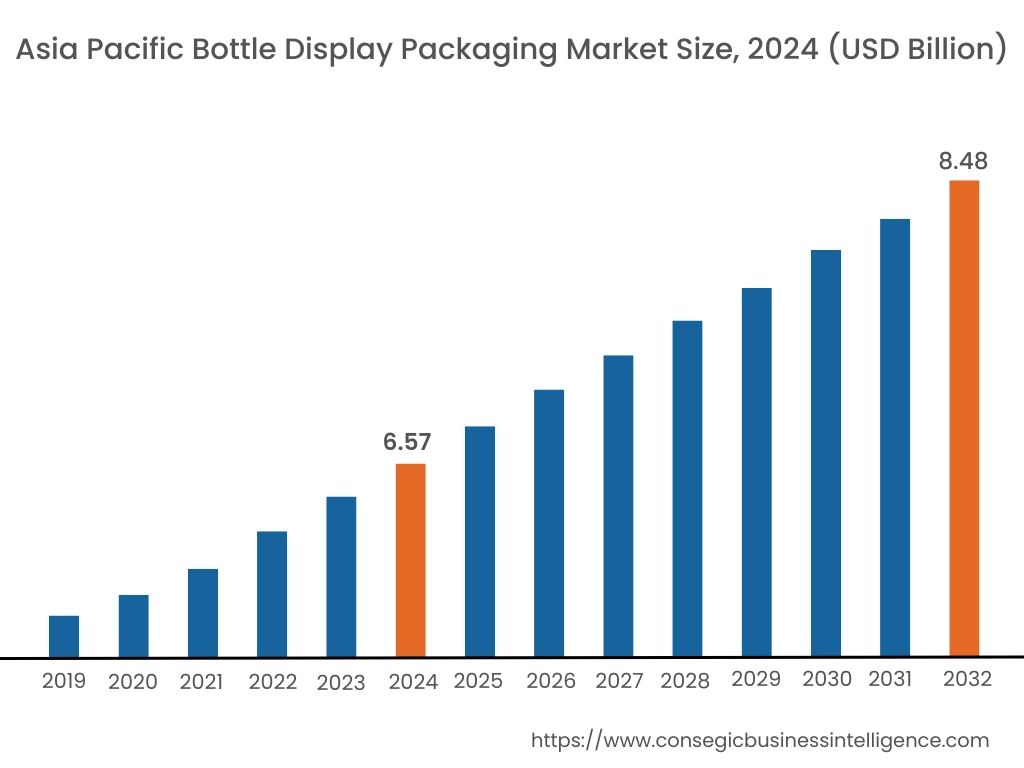
In 2024, Asia-Pacific was valued at USD 6.57 Billion and is expected to reach USD 8.48 Billion in 2032. In Asia-Pacific, China accounted for the highest share of 36.92% during the base year of 2024. Asia-Pacific exhibits high demand for bottle display packaging, supported by rapid urbanization, economic growth, and the expansion of the retail and e-commerce sectors. Increasing disposable income and shifting consumer lifestyles contribute to higher consumption of alcoholic beverages, soft drinks, personal care items, and luxury cosmetics, which drive packaging demand. China, Japan, and India serve as key markets due to their strong manufacturing capabilities and growing middle-class population. The proliferation of convenience stores and hypermarkets further accelerates bottle display packaging market growth. Additionally, government regulations aimed at reducing plastic waste encourage manufacturers to develop biodegradable packaging solutions. Technological advancements in printing and smart packaging enhance product differentiation and brand visibility in the region.

North America region was valued at USD 8.92 Billion in 2024. Moreover, it is projected to grow by USD 9.02 Billion in 2025 and reach over USD 11.24 Billion by 2032. North America holds a significant share in the bottle display packaging market due to the strong presence of the beverage, personal care, and pharmaceutical industries. The growing adoption of premium packaging solutions, particularly for alcoholic beverages, cosmetics, and perfumes, influences bottle display packaging market trends. Retail expansion, including hypermarkets, supermarkets, and convenience stores, increases the need for visually appealing packaging solutions. Evolving consumer preferences toward innovative and eco-friendly packaging drive manufacturers to invest in sustainable materials. Stringent environmental regulations in the United States and Canada encourage the adoption of biodegradable and recyclable packaging. Additionally, the rise of e-commerce platforms contributes to the ask for durable yet visually attractive packaging solutions that enhance product visibility.
Europe demonstrates steady demand for bottle display packaging, driven by stringent environmental policies and strong consumer preference for sustainable and aesthetically appealing packaging. The European Union’s regulations on single-use plastics and packaging waste influence the adoption of recyclable and biodegradable packaging materials. Countries like Germany, France, and the United Kingdom lead the market due to the presence of well-established beverage, cosmetics, and personal care industries. Luxury brands operating in these sectors prioritize high-quality and visually appealing packaging to maintain brand identity. Advanced printing techniques, including digital and 3D printing, enhance customization and personalization, which are key trends shaping the market. The growing importance of online retail also fuels the need for protective yet visually appealing packaging solutions.
The Middle East and Africa have a developing bottle display packaging market, influenced by the expanding retail, hospitality, and duty-free sectors. The increasing requirement for premium alcoholic beverages, perfumes, and luxury personal care products, particularly in Gulf Cooperation Council (GCC) countries, impacts market performance. High consumer spending on luxury goods in the United Arab Emirates and Saudi Arabia supports the adoption of high-end packaging solutions. Government initiatives aimed at economic diversification promote investments in manufacturing and packaging industries. However, the limited presence of local manufacturers and the dependency on imports affect supply chain efficiency. Sustainability concerns are gaining traction, with companies investing in eco-friendly materials to align with global environmental standards.
Latin America experiences rising demand for bottle display packaging due to increasing consumer spending on alcoholic beverages, personal care products, and soft drinks. Brazil, Mexico, and Argentina serve as key markets, driven by expanding retail infrastructure and a growing preference for branded and premium products. The rise of duty-free stores and tourism-related sales influences packaging demand in the region. However, economic fluctuations, inflation, and regulatory variations across different countries impact pricing and availability of packaging materials. The shift toward sustainable packaging solutions gains momentum as companies comply with environmental regulations and cater to the evolving preferences of eco-conscious consumers. Additionally, advancements in digital printing and smart packaging enhance the market’s competitiveness by offering customization and anti-counterfeit solutions.
Top Key Players & Market Share Insights:
The global bottle display packaging market is highly competitive with major players providing products and services to the national and international markets. Key players are adopting several strategies in research and development (r&d), product innovation, and end-user launches to hold a strong position in the global bottle display packaging market. Key players in the bottle display packaging industry include-
- Orora Limited (Australia)
- WestRock Company (United States)
- Stora Enso Oyj (Finland)
- UPM-Kymmene Corporation (Finland)
- Sealed Air Corporation (United States)
- Smurfit Kappa Group (Ireland)
- Mondi plc (United Kingdom)
- Amcor plc (Switzerland)
- DS Smith plc (United Kingdom)
- International Paper Company (United States)
Recent Industry Developments :
Product Launches:
- In February 2025, Australian Vintage introduced a new wine packaging concept called Poco Vino. This initiative features 187ml bottles with stylish designs resembling perfume or olive oil containers, sourced from various countries including France, Italy, the U.S., and Australia. The Poco Vino line aims to make wine more approachable and is set to be available in Australia, the UK, and Dubai duty-free markets within the year.
- In February 2025, Reliance Consumer Products relaunched the iconic Indian cola brand "Campa Cola" in the UAE, marking its first international expansion since its revival in 2023. The product line includes Campa Cola, Campa Lemon, Campa Orange, and Cola Zero, all featuring the original packaging design to resonate with both the Indian expatriate community and local consumers.
- In December 2024, WestRock utilized artificial intelligence to enhance their fiber-based sustainable packaging solutions, improving efficiency and sustainability. This includes the development of smart packaging that integrates digital innovations to boost sustainability, reduce food waste, and ensure product authenticity.
- In January 2025, Touchland, known for its innovative hand sanitizers, expanded into the fragrance market with the "Power Essence Mist" line. These hair and body mists come in eight unique scents and are packaged in the brand's signature ergonomic design, maintaining brand continuity and offering a user-friendly experience
- In February 2025, for the first time in over two decades, Capri Sun introduced resealable bottles to its product lineup. These 12-ounce bottles, available in flavors like Fruit Punch, Pacific Cooler, and Strawberry Kiwi, provide a convenient, on-the-go option for consumers, expanding the brand's traditional pouch offerings.
Mergers and Acquisitions:
- In November 2024, Amcor announced an agreement to acquire Berry Global Group in a stock swap deal valued at approximately $8.4 billion. This merger aims to create a combined entity with annual revenues of around $24 billion, enhancing product offerings in flexible packaging, containers, and closures. The transaction is expected to be completed by mid-2025.
- In August 2024, Orora, a prominent glass manufacturer, announced the potential sale of its North American packaging business to focus on high-end liquor bottles. This decision followed its acquisition of French bottle manufacturer Saverglass for $2.2 billion, aiming to strengthen its position in the premium beverage packaging market.
- In October 2024, Mondi, a leading packaging group, acquired the western European assets of Germany's Schumacher Packaging for €634 million. This acquisition includes advanced box production plants in Germany and a packaging plant in the UK, bolstering Mondi's presence in the e-commerce and consumer goods packaging sectors.
Bottle Display Packaging Market Report Insights:
| Report Attributes | Report Details |
| Study Timeline | 2019-2032 |
| Market Size in 2032 | USD 32.44 Billion |
| CAGR (2025-2032) | 3.1% |
| By Type |
|
| By Material |
|
| By Application |
|
| By Region |
|
| Key Players |
|
| North America | U.S. Canada Mexico |
| Europe | U.K. Germany France Spain Italy Russia Benelux Rest of Europe |
| APAC | China South Korea Japan India Australia ASEAN Rest of Asia-Pacific |
| Middle East and Africa | GCC Turkey South Africa Rest of MEA |
| LATAM | Brazil Argentina Chile Rest of LATAM |
| Report Coverage |
|
Key Questions Answered in the Report
How big is the Bottle Display Packaging Market? −
In 2024, the Bottle Display Packaging Market was USD 25.64 billion.
What will be the potential market valuation for the Bottle Display Packaging Market by 2032? +
In 2032, the market size of Bottle Display Packaging Market is expected to reach USD 32.44 billion.
What are the segments covered in the Bottle Display Packaging Market report? +
The type, material and application are the segments covered in this report.
Who are the major players in the Bottle Display Packaging Market? +
Orora Limited (Australia), WestRock Company (United States), Smurfit Kappa Group (Ireland), Mondi plc (United Kingdom), Amcor plc (Switzerland), DS Smith plc (United Kingdom), International Paper Company (United States), Stora Enso Oyj (Finland), UPM-Kymmene Corporation (Finland), Sealed Air Corporation (United States) are the major players in the Bottle Display Packaging market.
Overview
Reputation & Certifications


Our Services
- Market Intelligence & Forecasting
- Custom Research Solutions
- Market Entry Strategy
- Competitive Intelligence
- Customer Insights
- Industry Innovation Analysis
- Investment Advisory