Jump to Content
Bring your own Device Market - Size, Share, Industry Trends, and Forecasts (2025-2032)
Bring your own Device Market Size:
Bring your own Device Market size is estimated to reach over USD 327.36 Billion by 2032 from a value of USD 113.27 Billion in 2024 and is projected to grow by USD 127.37 Billion in 2025, growing at a CAGR of 15.8% from 2025 to 2032.
Bring your own Device Market Scope & Overview:
Bring Your Own Device (BYOD) refers to a policy where employees use their personal devices for work-related activities, instead of relying solely on company-provided equipment. BYOD offer convenience, cost savings for companies and increased employee freedom in choosing their preferred devices. Employees are able to work from anywhere using their own devices. Employees are more productive using devices they are comfortable with.
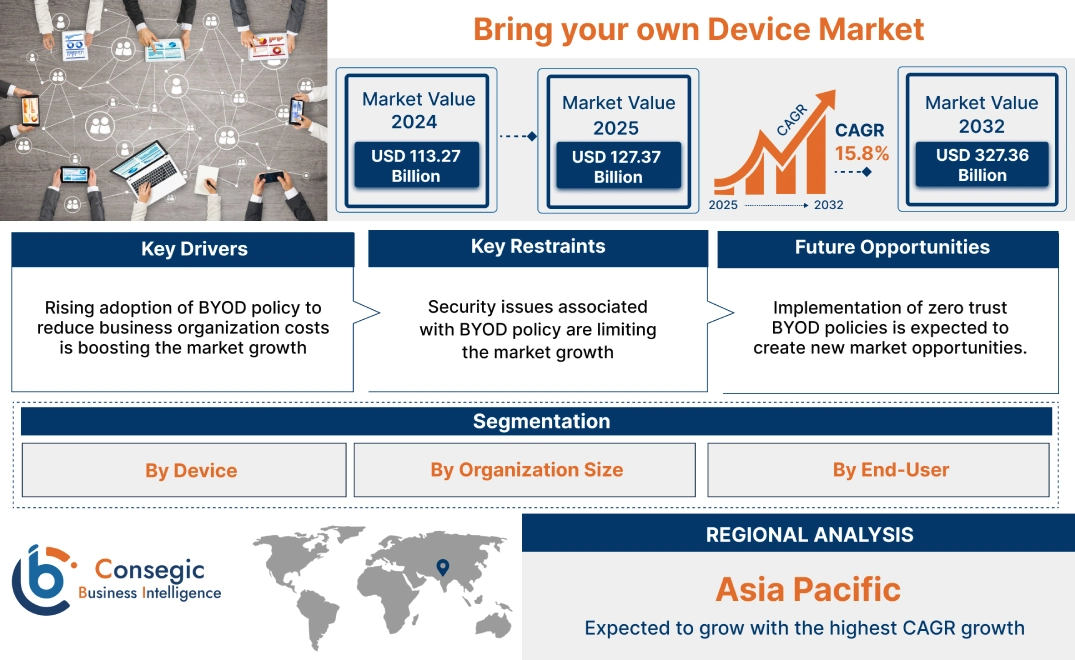
Bring your own Device Market Dynamics - (DRO) :
Key Drivers:
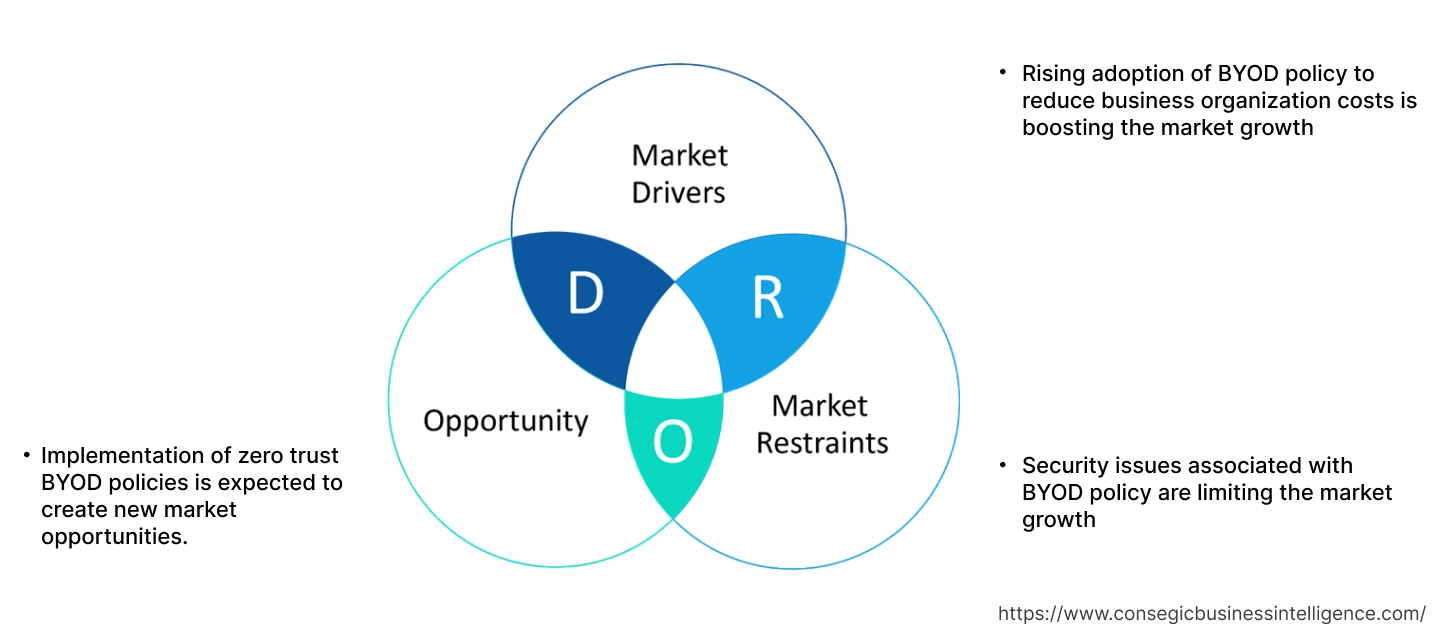
Rising adoption of BYOD policy to reduce business organization costs is boosting the market growth
Bring your own device policy eliminates the need for companies to purchase and maintain a large inventory of devices for employees, as they use their own personal devices for work. Companies experience reduced support costs as employees are already familiar with their own devices and are able to troubleshoot common issues independently. Moreover, the company will not have to buy additional computers or phones for its employees, which can represent a significant savings in terms of purchasing costs.
- For instance, according to Capgemini’s analysis about BYOD policy, around 67% organizations in North America experienced a reduction in expenditure due to adoption the BYOD policy.
Thus, the aforementioned factors are boosting the usage of BYOD, in turn driving bring your own device market growth.
Key Restraints:
Security issues associated with BYOD policy are limiting the market growth
Personal devices lack the security measures found in company-issued devices, making them vulnerable to data breaches. The same device used for both personal and work activities lead to unintentional exposure of sensitive information. Employees use personal devices on unsecured Wi-Fi networks, making them vulnerable to eavesdropping and cyberattacks.
Moreover, employees unknowingly install malicious apps on their devices, which can be used to access company data or spread malware. Thus, the market analysis shows that the aforementioned factors are restraining bring your own device market demand.
Future Opportunities :
Implementation of zero trust BYOD policies is expected to create new market opportunities.
Zero trust with bring your own device enhances security by verifying every access request, even from familiar devices. It offers benefits including improved access control, reduced attack surface, and enhanced data protection, which are particularly valuable in dynamic environments. Moreover, zero trust limits the potential impact of a breach by verifying access requests, even from trusted devices, making it harder for attackers to move laterally within the network.
- For instance, in January 2025, Hypori secured USD 12 Million in Series B extension funding. This funding aims to drive zero trust BYOD adoption.
Thus, the implementation of zero trust policies is projected to drive bring your own device market opportunities during the forecast period.
Bring your own Device Market Segmental Analysis :
By Device:
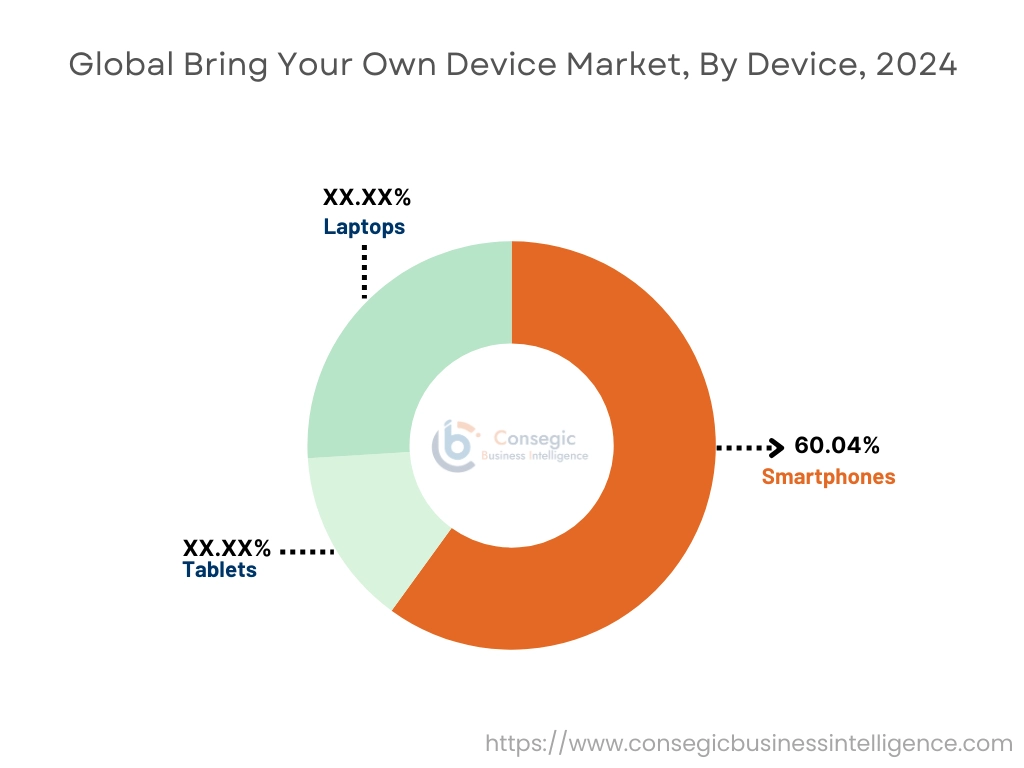
Based on the device, the market is segmented into smartphones, tablets, and laptops.
Trends in the Device:
- Rising demand for bring your own smartphones policy in companies to reduce costs and enhance flexibility is boosting bring your own device market size.
- Increasing trend in adoption of bring your own tablets policy for easier accessibility and enhanced productivity.
The smartphones segment accounted for the largest revenue share of 60.04% in the market in 2024.
- BYOD with smartphones includes employees using their personal smartphones for work. This offers benefits including increased employee satisfaction and productivity, cost savings for companies, and enhanced flexibility and mobility.
- Moreover, employees frequently upgrade their personal devices more often than organizations update company-owned hardware, enabling organizations to access the latest technology without incurring additional expenses.
- Additionally, employees use one device for both personal and work purposes, leading to convenience. Meanwhile, employees access work resources and complete tasks from anywhere, anytime.
- Therefore, the wide spread adoption of smartphones policy is boosting bring your own device market growth.
The laptops segment is expected to register the fastest CAGR during the forecast period.
- Bring your own laptop policy reduce hardware and software licensing costs, as companies do not have to purchase and maintain devices for every employee.
- Moreover, employees are more productive when using devices they are comfortable and familiar with, potentially leading to faster task completion.
- BYOL policies help employees better manage their work and personal lives by allowing them to use their personal devices for work tasks.
- Thus, the ongoing adoption of personal laptops at workplace is expected to boost bring your own device market trends during the forecast period.
By Organization Size:
Based on the organization size, the market is segmented into mid-to-large sized businesses and small businesses.
Trends in the Organization Size:
- Rising trend in adoption of BYOD policy in large businesses to offer flexibility and convenience to employees.
- Increasing demand of BYOD policies in small businesses to reduce costs and the need for extensive IT support.
The mid-to-large sized businesses segment accounted for the largest revenue share in bring your own device market share in 2024.
- BYOD significantly reduce the cost of providing and maintaining company-owned devices.
- Employees are already familiar with their own devices, potentially reducing the need for extensive IT support.
- BYOD empowers employees to choose the devices and tools that best suit their needs, leading to higher job satisfaction.
- Employees access work resources on their personal devices, potentially reducing the need to carry multiple devices.
- Therefore, the above benefits lead to adoption of BYOD policies in mid-to-large sized businesses, driving bring your own device market demand.
The small businesses segment is expected to register the fastest CAGR during the forecast period.
- BYOD policy significantly reduce hardware costs for small businesses, as they won't need to purchase and maintain devices for each employee.
- BYOD policy allows employees to use devices they are comfortable with, leading to increased flexibility and convenience.
- A BYOD policy makes a company more attractive to potential employees, particularly those who value flexibility and using their own devices.
- Thus, the market analysis shows that the aforementioned factors are expected to boost bring your own device market trends during the forecast period.
By End User:
Based on the end user, the market is segmented into retail, healthcare, IT, energy and utility, automotive, and others.
Trends in the End User:
- Rising demand for BYOD policies in retail to allow employees to facilitate tasks like inventory management, sales transactions, and customer service.
The IT segment accounted for the largest revenue in bring your own device market share in 2024.
- In IT sector, BYOD policies need to define clear guidelines for security requirements, device usage, and data access.
- Moreover, the companies have to use security tools and technologies to protect corporate data on BYOD devices, implement a system for managing BYOD devices, including security updates, enrollment, and device wipe, and monitor BYOD device usage to identify potential security risks or issues.
- Therefore, the rising adoption of BYOD policies in the IT sector is boosting bring your own device market expansion.
The healthcare segment is expected to register the significant CAGR during the forecast period.
- Clinicians use BYOD to quickly access electronic health records (EHRs), medical history, test results, and other critical patient data.
- Moreover, it facilitates real-time communication with colleagues, specialists, and other healthcare providers, improving coordination of care.
- Additionally, it enables the use of specialized medical apps for tasks like drug ordering, diagnostic imaging, and remote patient monitoring.
- Furthermore, it plays a crucial role in facilitating telehealth consultations and remote patient monitoring, expanding access to care and improving continuity of care.
- It also allows clinicians to access and manage patient information and perform tasks from anywhere, improving their mobility and efficiency.
- Thus, the demand for BYOD in healthcare in expected to drive bring your own device market opportunities during the forecast period.
Regional Analysis:
The regions covered are North America, Europe, Asia Pacific, the Middle East and Africa, and Latin America.
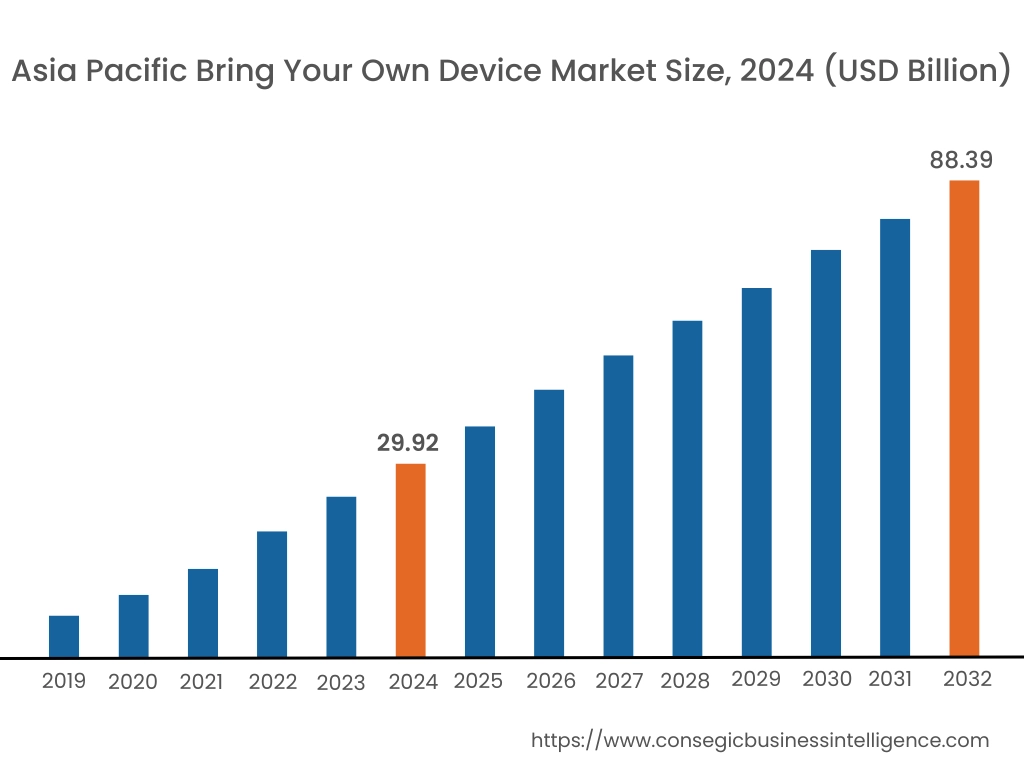
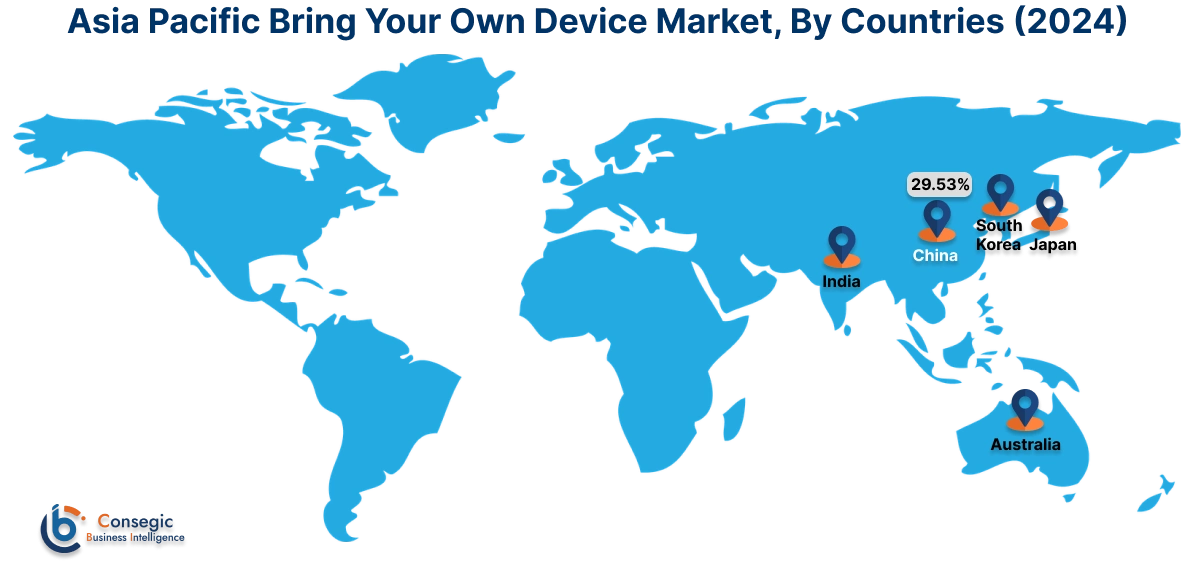
Asia Pacific region was valued at USD 29.92 Billion in 2024. Moreover, it is projected to grow by USD 33.70 Billion in 2025 and reach over USD 88.39 Billion by 2032. Out of this, China accounted for the maximum revenue share of 29.53%. The bring your own device market analysis shows that the market is growing due to rising IT sector, leading to adoption of employee friendly policies. Moreover, the BYOD policies offer reduction in costs and enhances the employee satisfaction and productivity, leading to its wide spread adoption in the region, in turn, boosting the market growth.
North America is estimated to reach over USD 111.76 Billion by 2032 from a value of USD 38.92 Billion in 2024 and is projected to grow by USD 43.74 Billion in 2025. The bring your own device market analysis shows that the market in the region is primarily growing due to companies changing policies that allows employees to use personal devices for work, driven by factors like agile workspaces, increased flexibility, and cost reduction. The above factors are proliferating the market growth in North America.
In Europe, the market is growing due to adoption of BYOD in industries including retail, manufacturing, IT, automotive, education, and others. The market analysis depicts that in Latin America, Middle East and Africa, the market is experiencing steady growth due to widespread adoption of smartphones and cost savings policies by the companies, in turn, boosting bring your own device market expansion.
Top Key Players and Market Share Insights:
The bring your own device industry is highly competitive with major players providing solutions to the national and international markets. Key players are adopting several strategies in research and development (R&D), product innovation, and end-user launches to hold a strong position in the global bring your own device market. Key players in the bring your own device industry include -
- Accenture (Ireland)
- BlackBerry Limited (US)
- Infosys Limited (India)
- Microsoft (US)
- MobileIron Inc. (US)
- Capgemini (France)
- Citrix Systems Inc. (US)
- HCL Technologies Limited (India)
- Honeywell International Inc. (US)
- IBM Corporation (US)
Recent Industry Developments :
- In August 2024, Hypori signed a USD 12 Million contract with US army for the BYOD support. The Halo, a BYOD solution, enables access to the US Department of Defense’s cloud-based enterprise operating system “DoD 365” and allows the signing of digital documents.
Bring your own Device Market Report Insights:
| Report Attributes | Report Details |
| Study Timeline | 2019-2032 |
| Market Size in 2032 | USD 327.36 Billion |
| CAGR (2025-2032) | 15.8% |
| By Device |
|
| By Organization Size |
|
| By End-User |
|
| By Region |
|
| Key Players |
|
| North America | U.S. Canada Mexico |
| Europe | U.K. Germany France Spain Italy Russia Benelux Rest of Europe |
| APAC | China South Korea Japan India Australia ASEAN Rest of Asia-Pacific |
| Middle East and Africa | GCC Turkey South Africa Rest of MEA |
| LATAM | Brazil Argentina Chile Rest of LATAM |
| Report Coverage |
|
Key Questions Answered in the Report
How big is bring your own device market? −
Bring your own Device Market size is estimated to reach over USD 327.36 Billion by 2032 from a value of USD 113.27 Billion in 2024 and is projected to grow by USD 127.37 Billion in 2025, growing at a CAGR of 15.8% from 2025 to 2032.
What are the major segments covered in bring your own device market report? +
The segments covered in the report are device, organization size, end user, and region.
Which region holds the largest revenue share in 2024 in bring your own device market? +
North America holds the largest revenue share in bring your own device market in 2024.
Who are the major key players in bring your own device market? +
The major key players in the market are Accenture (Ireland), BlackBerry Limited (US), Capgemini (France), Citrix Systems Inc. (US), HCL Technologies Limited (India), Honeywell International Inc. (US), IBM Corporation (US), Infosys Limited (India), Microsoft (US), and MobileIron Inc. (US).
Overview
Reputation & Certifications


Our Services
- Market Intelligence & Forecasting
- Custom Research Solutions
- Market Entry Strategy
- Competitive Intelligence
- Customer Insights
- Industry Innovation Analysis
- Investment Advisory