Jump to Content
Cloud-Based Quantum Computing Market Size & Industry Share - Growth Trends & Forecasts (2026 - 2034)
Cloud-based Quantum Computing Market Size:
The Cloud-based Quantum Computing market size was valued at 17.38 (US$B) in 2025 and is projected to grow from 24.07 (US$B) in 2026 to 325.91 (US$B) by 2034, at a CAGR of 38.5% from 2026 to 2034, according to a recent report from Consegic Business Intelligence.
Cloud-based Quantum Computing Market Scope & Overview:
Cloud-based quantum computing provides access to quantum processors and computing resources through cloud platforms, enabling organizations to run quantum algorithms and perform complex simulations without needing to invest in expensive hardware. This technology offers computational power far beyond the capabilities of classical computers, allowing for advancements in fields such as cryptography, materials science, and optimization problems. Quantum computing resources are provided via a cloud interface, making it easier for businesses to leverage quantum capabilities while maintaining flexibility and scalability. The market for this technology caters to a wide range of industries, including pharmaceuticals, automotive, finance, and logistics, where the need for high-performance computing is increasingly critical. Cloud services in this space allow for collaborative research and development, enhancing innovation across multiple sectors.
End-users of these quantum computing solutions include academic institutions, research organizations, and enterprises engaged in advanced research and development. As quantum computing continues to evolve, the market for cloud-hosted quantum resources is expanding, offering a more accessible and scalable alternative for computing-intensive applications.

Cloud-based Quantum Computing Market Dynamics - (DRO) :
Key Drivers:
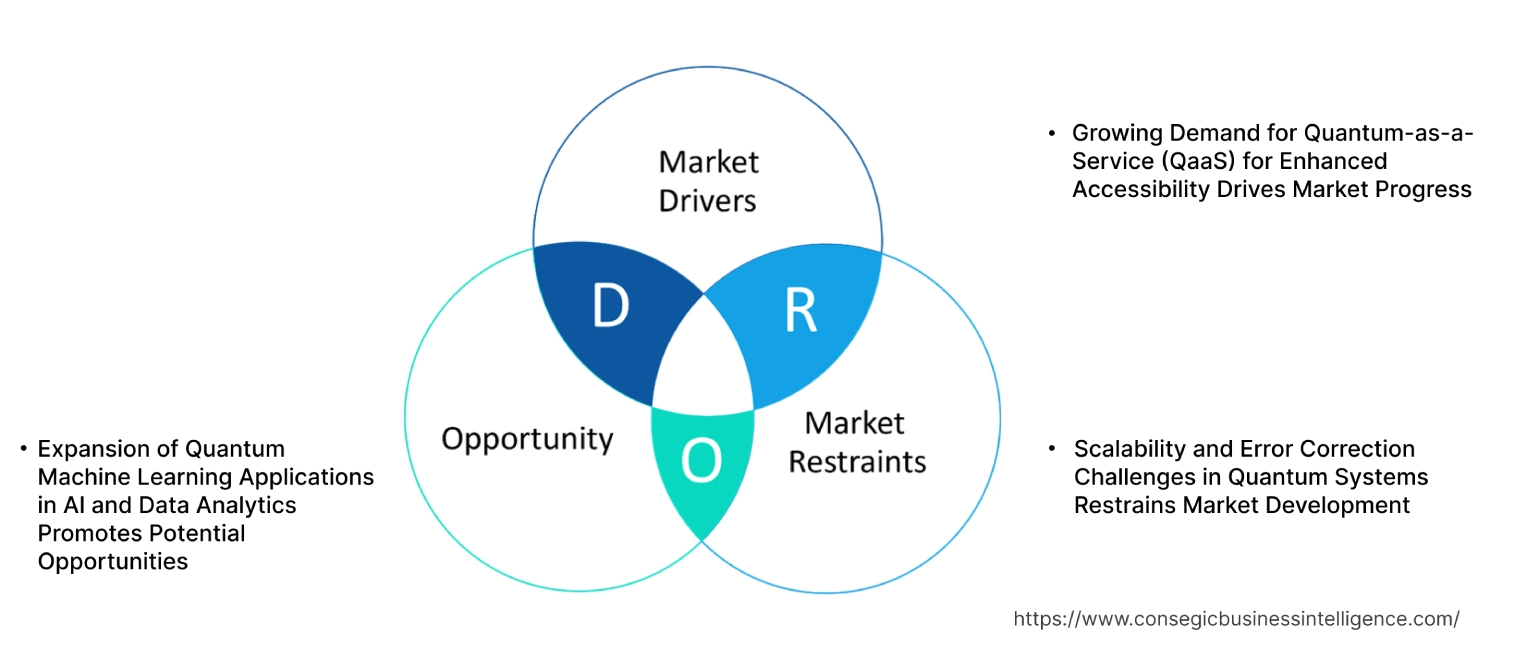
Growing Demand for Quantum-as-a-Service (QaaS) for Enhanced Accessibility Drives Market Progress
The increasing adoption of Quantum-as-a-Service (QaaS) offerings is a significant driver in the market. QaaS models provide businesses and researchers with access to quantum computing resources without the need for specialized hardware or in-house quantum expertise. By leveraging cloud platforms, companies access powerful quantum processors and simulators, enabling them to experiment with quantum algorithms and solve complex problems that are beyond the capabilities of classical computing. This model significantly lowers the entry barriers for organizations across various industries, including pharmaceuticals, financial services, and logistics, by providing scalable and cost-effective access to quantum computing capabilities. The demand for QaaS is particularly high among businesses looking to harness quantum advantages in areas like optimization, cryptography, and advanced machine learning without making significant upfront investments in hardware. Thus, the rising adoption of Quantum-as-a-Service (QaaS) is driving the cloud-based quantum computing market growth.
Key Restraints :
Scalability and Error Correction Challenges in Quantum Systems Restrains Market Development
A significant restraint in the market is the scalability and error correction challenges associated with current quantum systems. Quantum computing processors are highly sensitive to environmental disturbances, leading to issues such as decoherence and quantum noise, which affect the reliability and accuracy of computations. The implementation of error correction codes is necessary to mitigate these issues; however, this process requires a substantial increase in the number of physical qubits, limiting the scalability of quantum systems. The current state of quantum hardware often struggles to maintain coherence for extended computations, which impacts the ability to solve complex, large-scale problems. These technical constraints hinder the broader adoption of quantum solutions, especially in applications that require high levels of precision and error-free calculations. Therefore, scalability and error correction difficulties hinder the cloud-based quantum computing market demand.
Future Opportunities :
Expansion of Quantum Machine Learning Applications in AI and Data Analytics Promotes Potential Opportunities
The application of quantum machine learning (QML) offers a significant growth opportunity in the market. Quantum algorithms have the potential to enhance machine learning models by processing data faster and more efficiently than classical methods, particularly for tasks involving large datasets or complex pattern recognition. Cloud platforms provide the computational power needed to experiment with QML algorithms, enabling businesses to explore advanced analytics solutions and develop more accurate predictive models. The integration of quantum capabilities with AI and machine learning tools will accelerate innovation in fields such as drug discovery, climate modeling, and financial forecasting. As the adoption of AI and big data analytics continues to grow across industries, the demand for quantum-enhanced machine learning solutions via cloud platforms is expected to increase, driving cloud-based quantum computing market opportunities.
Cloud-based Quantum Computing Market Segmental Analysis :
By Component:
Based on components, the market is segmented into hardware, software, and services.
The hardware segment accounted for the largest revenue of the total cloud-based quantum computing market share in 2024.
- The hardware segment includes quantum processors and quantum simulators, which are essential for performing complex computations at unprecedented speeds.
- Quantum processors enable the execution of quantum algorithms, which offer significant advantages over traditional computing, particularly in solving optimization and cryptography problems.
- Quantum simulators provide a platform for testing quantum algorithms and validating quantum theories, facilitating research and development.
- The increasing investment in quantum hardware development by tech giants and the rising interest in enhancing computational power drive the growth of this segment.
- The dominance of the hardware segment is due to its fundamental role in enabling quantum computing capabilities, which facilitates the cloud-based quantum computing market growth.
The software segment is anticipated to register the fastest CAGR during the forecast period.
- The software segment comprises quantum development kits and optimization software, which provide the tools necessary for developing and running quantum algorithms.
- Quantum development kits offer pre-built libraries and simulation environments, allowing developers to experiment with quantum algorithms without requiring access to physical quantum hardware.
- Quantum optimization software is used across industries for solving complex problems related to logistics, financial modeling, and machine learning.
- The growth of the software segment is driven by the increasing need for accessible tools that support the development and testing of quantum algorithms in various applications, driving cloud-based quantum computing market expansion.
By Technology:
Based on technology, the market is segmented into quantum annealing, quantum gates, and topological quantum computing.
The quantum gate segment accounted for the largest revenue of the total cloud-based quantum computing market share in 2024.
- Quantum gate technology is the foundation of universal quantum computing, enabling the implementation of a broad range of quantum algorithms.
- This technology is highly versatile and performs complex calculations that are beyond the reach of classical computing, particularly in applications like cryptography and machine learning.
- Leading companies are heavily investing in quantum gate systems due to their potential for high computational power and their use in scalable quantum computers.
- As per cloud-based quantum computing market analysis, the dominance of quantum gate technology is attributed to its capability to support a wide variety of use cases and its role in advancing the development of universal quantum computers.
The quantum annealing segment is expected to register the fastest CAGR during the forecast period.
- Quantum annealing technology is specialized for solving optimization problems, making it highly effective in applications such as financial modeling and logistics.
- Companies utilize quantum annealing for tasks that require finding the optimal solution among many possibilities, significantly reducing processing time compared to classical methods.
- The growing focus on optimization across industries like finance and supply chain management is driving the need for quantum annealing technology.
- As per cloud-based quantum computing market trends, the rapid extension of the quantum annealing segment is fueled by its specialized application in solving complex optimization problems efficiently.
By Application:
Based on application, the market is segmented into drug discovery, financial modeling, climate simulation, cryptography, machine learning & AI, and optimization problems.
The drug discovery segment accounted for the largest revenue share in 2024.
- Quantum computing is revolutionizing drug discovery by enabling simulations of molecular interactions at a quantum level, significantly accelerating the research process.
- Pharmaceutical companies leverage quantum algorithms to model complex biological systems, identify potential drug candidates, and optimize drug formulations.
- The increasing need for faster drug development, particularly highlighted during the COVID-19 pandemic, has driven the adoption of quantum computing in the healthcare industry.
- The drug discovery segment leads the market due to its high potential for reducing research timelines and costs, providing a competitive edge in the pharmaceutical sector further driving the cloud-based quantum computing market demand.
The cryptography segment is expected to register the fastest CAGR during the forecast period.
- Quantum computing poses an opportunity for cryptography, as it breaks traditional encryption methods and enables the development of quantum-safe cryptographic algorithms.
- The need for enhanced security in financial transactions, data storage, and communication is driving the focus on quantum cryptography solutions.
- Research institutions and tech companies are developing quantum-resistant encryption to safeguard against the potential threats posed by quantum computing advancements.
- The cryptography segment's rapid growth is attributed to the increasing emphasis on data security and the evolving landscape of cybersecurity threats promoting cloud-based quantum computing market opportunities.
By Deployment Mode:
Based on deployment mode, the market is segmented into public cloud, private cloud, and hybrid cloud.
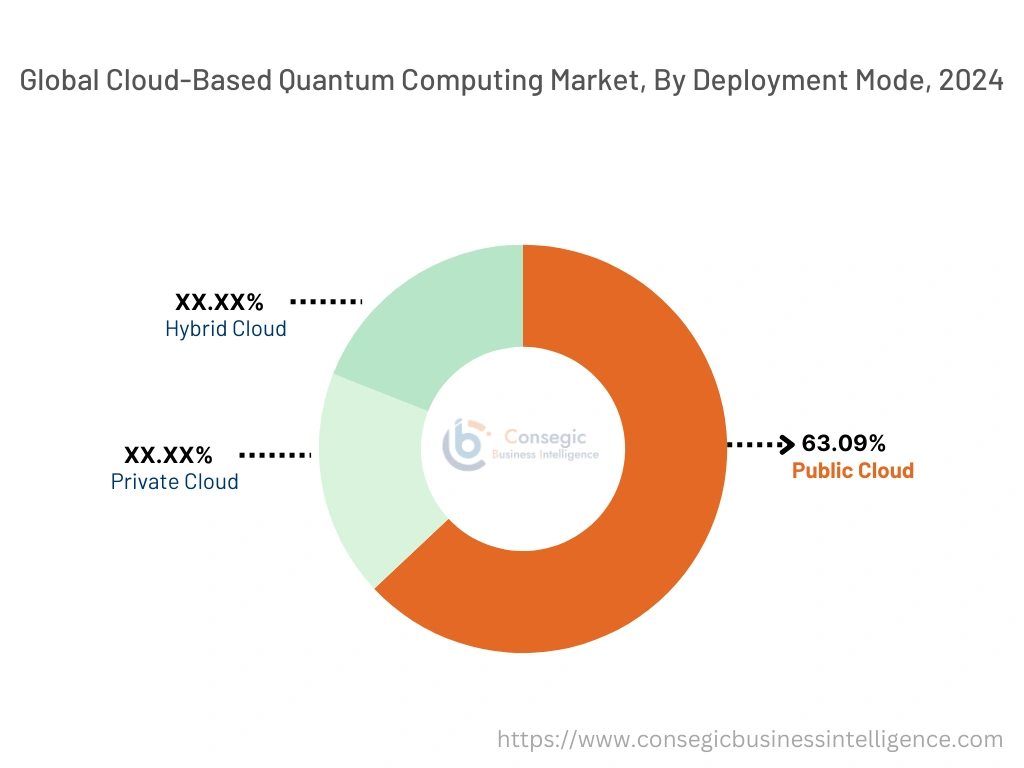
The public cloud segment held the largest market share of 63.09% in 2024.
- Public cloud offers scalability, flexibility, and cost-effectiveness, making it the preferred choice for organizations utilizing quantum computing resources without investing in physical infrastructure.
- Major cloud providers like AWS, Microsoft Azure, and Google Cloud offer quantum computing platforms as part of their services, facilitating easy access for researchers and developers.
- The growth of the public cloud segment is driven by its ability to provide on-demand access to quantum computing resources, reducing the barriers to entry for businesses and academic institutions.
- The dominance of the public cloud segment is due to its wide availability, ease of access, and lower operational costs, which drives the cloud-based quantum computing market expansion.
The hybrid cloud segment is expected to register the fastest CAGR during the forecast period.
- Hybrid cloud combines public and private cloud environments, offering enhanced security and control over sensitive data while leveraging the scalability of public cloud resources.
- This deployment model is popular among enterprises with stringent data security requirements, such as those in the financial and healthcare sectors.
- The increasing adoption of multi-cloud strategies and the need for flexible, scalable infrastructure are driving the progress of hybrid cloud solutions.
- As per cloud-based quantum computing market trends, the hybrid cloud segment is projected to expand rapidly due to its ability to meet diverse organizational needs while balancing cost and security.
By End-User:
Based on the end-user industry, the market is segmented into healthcare & pharmaceuticals, BFSI, IT & telecom, aerospace & defense, and energy & utilities.
The healthcare & pharmaceuticals segment accounted for the largest revenue share in 2024.
- The healthcare sector uses quantum computing for complex simulations, drug discovery, and personalized medicine, enhancing research capabilities and patient outcomes.
- Quantum computing enables faster analysis of large datasets, improving the efficiency of clinical trials and accelerating the drug development process.
- Thus, as per cloud-based quantum computing market analysis, the dominance of the healthcare & pharmaceuticals segment is due to its strong focus on research and innovation, supported by significant investments in advanced technologies.
The BFSI segment is expected to register the fastest CAGR during the forecast period.
- The BFSI sector utilizes quantum computing for risk analysis, fraud detection, and financial modeling, leveraging its ability to process complex calculations rapidly.
- Quantum algorithms help financial institutions optimize investment strategies, analyze market trends, and enhance predictive modeling for risk management.
- The increasing emphasis on data security and the potential for quantum-enhanced cryptography are driving the BFSI segment's adoption of advanced computing solutions.
- Therefore, as per segmental trends analysis, the rapid progress of the BFSI segment is attributed to its focus on leveraging quantum computing for enhanced decision-making and competitive advantage.
Regional Analysis:
The regions covered are North America, Europe, Asia Pacific, the Middle East and Africa, and Latin America.
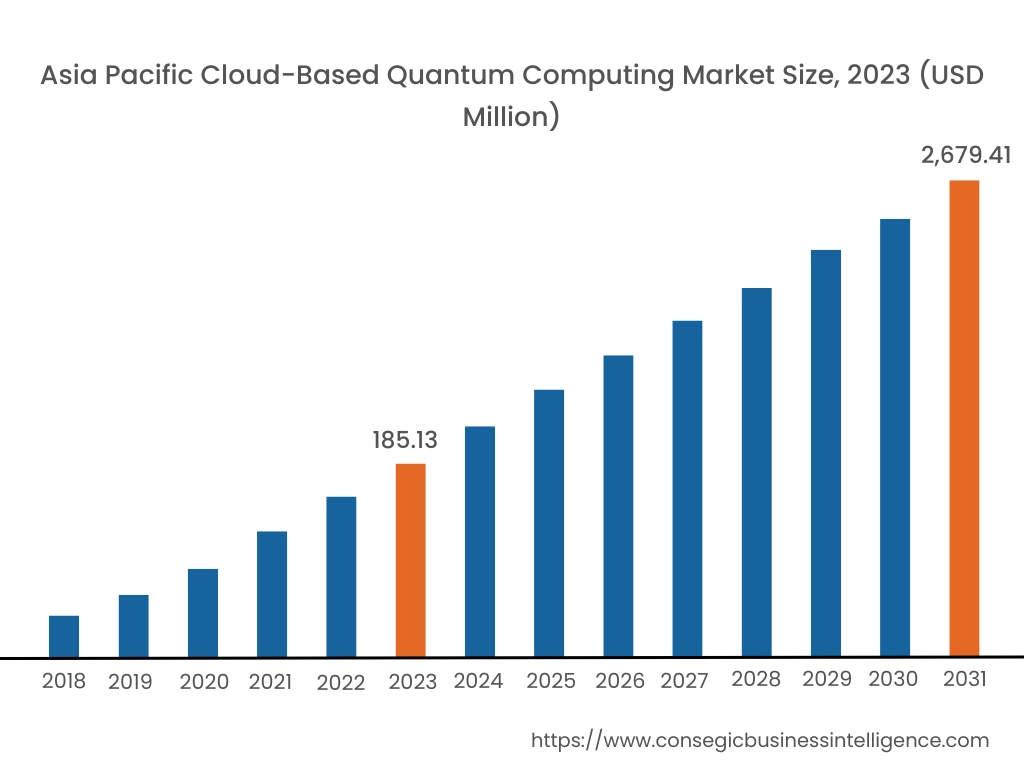
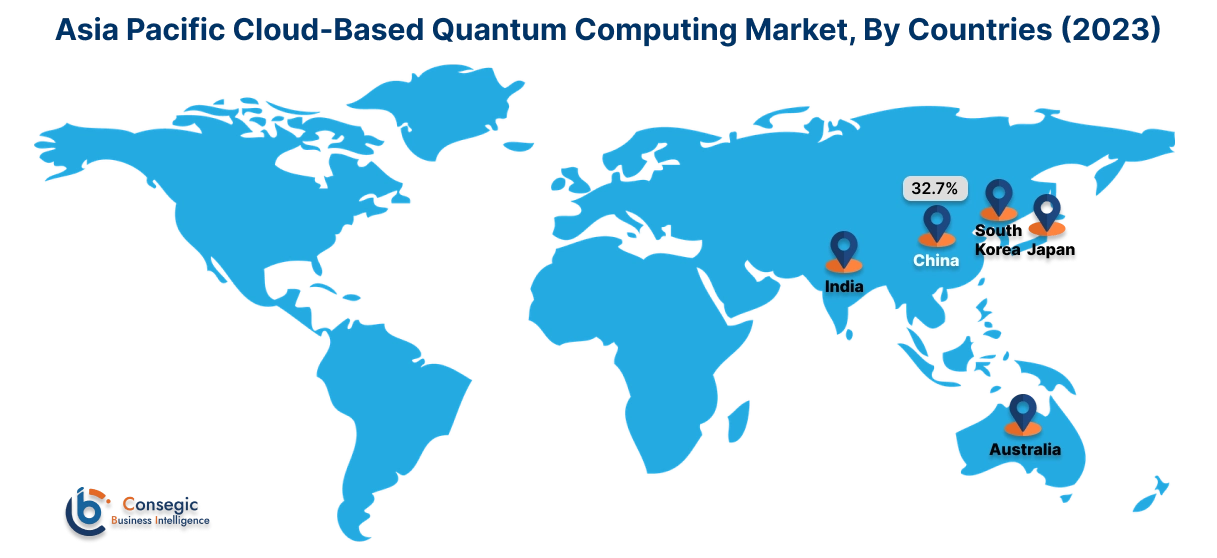
Asia Pacific region was valued at USD 14.49 Billion in 2024. Moreover, it is projected to grow by USD 16.7 Billion in 2025 and reach over USD 51.73 Billion by 2032. Out of these, China accounted for the largest share of 32.7% in 2024. Asia-Pacific is experiencing rapid growth in the market, led by China, Japan, and South Korea. The region is becoming a hotspot for quantum research, driven by substantial government funding and significant advancements in quantum technologies. China's aggressive push in quantum communication and computing research, alongside Japan's investments in quantum hardware, is accelerating market expansion. South Korea's focus on integrating quantum capabilities with its 5G infrastructure adds a competitive edge.
North America is estimated to reach over USD 55.06 Billion by 2032 from a value of USD 16.32 Billion in 2024 and is projected to grow by USD 18.72 Billion in 2025. North America dominates the cloud-based quantum computing market, due to significant investments in R&D and the strong presence of leading technology firms like IBM, Google, and Microsoft. The U.S. spearheads the region's development, focusing heavily on the integration of quantum computing with cloud platforms for industries like aerospace, finance, and healthcare. The rising demand for complex problem-solving capabilities and enhanced data processing in AI and machine learning applications drives the adoption of cloud-based quantum computing solutions.
Europe is a prominent player in the global cloud-based quantum computing market, with notable contributions from countries like Germany, the UK, and France. The European Union's heavy investments in quantum initiatives, such as the Quantum Flagship Program, aim to position Europe as a leader in quantum research and applications. The region's focus on advancing cybersecurity and quantum encryption technologies has boosted the need for cloud-based quantum solutions. Germany's strong industrial base, particularly in automotive and pharmaceuticals, drives the need for enhanced computational capabilities.
The Middle East & Africa (MEA) region is gradually emerging in the cloud-based quantum computing market, particularly with initiatives in the UAE and Saudi Arabia. The growing focus on digital transformation and investments in smart city projects, like those in Dubai and NEOM, have spurred interest in leveraging quantum computing for complex data analysis and optimization problems. The region's increasing adoption of cloud services, coupled with government-backed innovation programs, supports the development of quantum computing capabilities.
Latin America is an evolving market for cloud-based quantum computing, with Brazil and Mexico leading the region's efforts. The rise of digital transformation initiatives and the increasing need for advanced computational capabilities in sectors such as finance, logistics, and healthcare drives market progress. Brazil's focus on enhancing its R&D capabilities and Mexico's growing interest in adopting cutting-edge technologies to boost industry efficiency are key factors contributing to market development.
Top Key Players & Market Share Insights:
The Cloud-based Quantum Computing market is highly competitive with major players providing products and services to the national and international markets. Key players are adopting several strategies in research and development (R&D), product innovation, and end-user launches to hold a strong position in the global Cloud-based Quantum computing market. Key players in the Cloud-based Quantum Computing industry include –
- IBM Corporation (USA)
- Microsoft Corporation (USA)
- Amazon Web Services, Inc. (USA)
- Google LLC (USA)
- Honeywell International Inc. (USA)
- Intel Corporation (USA)
- Alibaba Group Holding Limited (China)
- D-Wave Systems Inc. (Canada)
- Rigetti Computing (USA)
- IonQ, Inc. (USA)
Recent Industry Developments :
Investments & Funding:
- In July 2024, planqc raised €50 million in Series A funding, led by CATRON Holding and DeepTech & Climate Fonds. The funds will be used to establish a quantum computing cloud service and develop software for various industries, including healthcare, automotive, and climate tech. Planqc, using atom-based quantum technology, aims to scale qubit numbers, targeting fault-tolerant quantum computers. Recent contracts include a 1,000-qubit quantum computer for Germany's Leibniz Supercomputing Centre.
Product Launches:
- In March 2024, NVIDIA launched cloud quantum-computer simulation microservices, available through major cloud providers like Google Cloud, Microsoft Azure, and Oracle Cloud. These microservices are part of the NVIDIA Quantum Cloud, based on the CUDA-Q platform, and aim to help scientists advance quantum computing in fields like chemistry and materials science. The platform includes tools for hybrid quantum-classical programming and supports collaborations with universities and companies to tackle complex quantum problems, such as molecular simulations.
Partnerships & Collaborations:
- In March 2023, QM-ware, a leading provider of hybrid quantum computing solutions, announced the integration of NVIDIA's quantum-classical computing stack into its cloud platform . This collaboration aims to enhance computing performance by combining classical high-performance computing (HPC) with quantum capabilities. The integration leverages NVIDIA's DGX Quantum architecture, known for its high-performance and low-latency features, to deliver advanced hybrid quantum computing solutions across various industries. This partnership underscores QMware's commitment to providing state-of-the-art hardware and software solutions in the quantum computing space.
Product Enhancements:
- In August 2023, D-Wave announced an update to its Constrained Quadratic Model (CQM) hybrid solver, available via the Leap™ quantum cloud service. This update improves performance for complex optimization problems, such as portfolio optimization and offer allocation, through quantum-classical hybrid computation. Benchmark tests showed an 80% success rate in solving binary quadratic problems, a notable improvement over previous versions. These advancements aim to make quantum computing more accessible for business applications.
Cloud-based Quantum Computing Market Report Insights :
| Report Attributes | Report Details |
| Study Timeline | 2021-2034 |
| Market Size in 2034 | USD 325.91 Billion |
| CAGR (2026-2034) | 38.50% |
| Base Year | 2025 |
| By Component |
|
| By Technology |
|
| By Application |
|
| By Deployment Mode |
|
| By End-User Industry |
|
| By Region |
|
| Key Players |
|
| North America | U.S. Canada Mexico |
| Europe | U.K. Germany France Spain Italy Russia Benelux Rest of Europe |
| APAC | China South Korea Japan India Australia ASEAN Rest of Asia-Pacific |
| Middle East and Africa | GCC Turkey South Africa Rest of MEA |
| LATAM | Brazil Argentina Chile Rest of LATAM |
| Report Coverage |
|
Key Questions Answered in the Report
How big is the Cloud-based Quantum Computing market? −
Cloud-based Quantum Computing Market size is estimated to reach over USD 169.9 Billion by 2032 from a value of USD 49.19 Billion in 2024 and is projected to grow by USD 56.55 Billion in 2025, growing at a CAGR of 38.5% from 2025 to 2032.
What specific segmentation details are covered in the Cloud-based Quantum Computing Market report? +
The Cloud-based Quantum Computing market report includes segmentation details for components (hardware, software, services), technology (quantum annealing, quantum gate, topological quantum computing), application (drug discovery, financial modeling, climate simulation, cryptography, machine learning & AI, optimization problems), deployment mode (public cloud, private cloud, hybrid cloud), end-user industry (healthcare & pharmaceuticals, BFSI, IT & telecom, aerospace & defense, energy & utilities), and region.
Which is the fastest-growing application in the Cloud-based Quantum Computing market? +
According to the analysis, the cryptography segment is expected to register the fastest CAGR during the forecast period, driven by the need for enhanced security and the development of quantum-safe cryptographic algorithms.
Who are the major players in the Cloud-based Quantum Computing market? +
The major players in the Cloud-based Quantum Computing market include IBM Corporation (USA), Microsoft Corporation (USA), Amazon Web Services, Inc. (USA), Google LLC (USA), Honeywell International Inc. (USA), Intel Corporation (USA), Alibaba Group Holding Limited (China), D-Wave Systems Inc. (Canada), Rigetti Computing (USA), and IonQ, Inc. (USA).
Overview
Reputation & Certifications


Our Services
- Market Intelligence & Forecasting
- Custom Research Solutions
- Market Entry Strategy
- Competitive Intelligence
- Customer Insights
- Industry Innovation Analysis
- Investment Advisory