Jump to Content
Building-to-Grid Technology Market - Size, Share, Industry Trends, and Forecasts (2025-2032)
Building-to-Grid Technology Market Size:
Building-to-Grid Technology Market size is growing with a CAGR of 10.2% during the forecast period (2025-2032), and the market is projected to be valued at USD 8,509.96 Million by 2032 from USD 3,936.72 Million in 2024. Additionally, the market value for 2025 attributes to USD 4,322.75 Million.
Building-to-Grid Technology Market Scope & Overview:
Building-to-grid (B2G) technology is the incorporation of power grid in the buildings. The integration allows them to interact by adjusting the consumption of energy, storing energy, and supplying energy back to the grid. This interaction improves the energy efficiency and grid reliability. The technology for optimizing the energy use in the buildings consists of demand response (DR), energy storage systems (ESS), smart meters & sensors, distributed energy resources, building energy management systems, and others. The components mainly used for this technology consists of hardware, software, and services. The technology finds its application in residential buildings, commercial buildings, and industrial facilities.

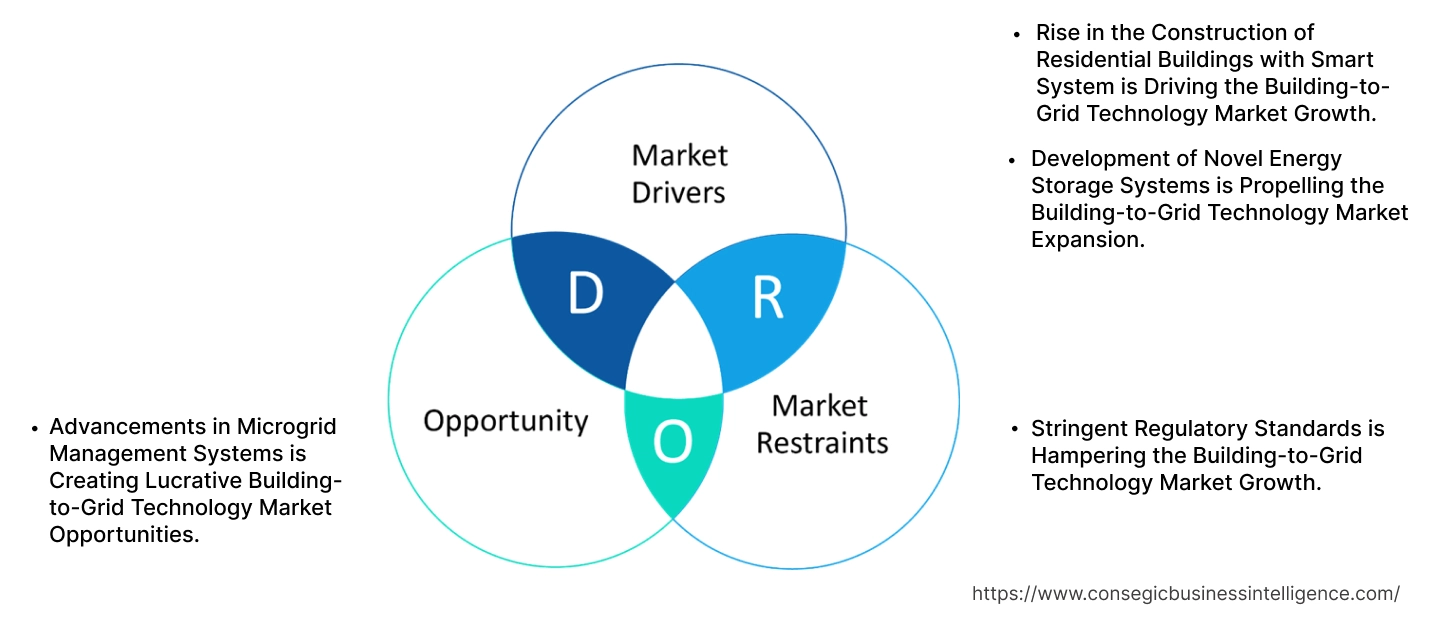
Building-to-Grid Technology Market Dynamics - (DRO) :
Key Drivers:
Rise in the Construction of Residential Buildings with Smart System is Driving the Building-to-Grid Technology Market Growth.
Residential construction projects require sustainable and efficient energy solutions. B2G technology presents a superior approach to meeting this demand. The use of smart energy management systems, energy storage, and distributed energy resources interacts with the power grid. It is essential for optimizing the electricity requirement and supply. These factors drive the construction of residential buildings, which include smart homes and high-efficiency housing projects.
For instance,
- The data published by the S. Census Bureau states that the construction of residential building was 1,468,000 in June 2023 in the U.S. This shows an 11% rise from June 2022 which was observed to be 1,392,000. The construction also includes smart home projects.
Thus, the rise in the construction projects for residential buildings is driving the growth of the market.
Development of Novel Energy Storage Systems is Propelling the Building-to-Grid Technology Market Expansion.
Energy storage systems are devices that store energy for later use. Advanced energy storage solutions, such as improved battery technologies and thermal storage, are becoming increasingly important for optimizing energy usage and grid interaction. These systems allow buildings to store excess energy generated from renewable sources. As a result, manufacturers are developing novel storage systems to optimize energy.
For instance,
- In April 2024, Schneider Electric's introduced its all-in-one Battery Energy Storage System (BESS). This integrated system simplifies the operation of energy storage within buildings. They enhance the distribution of energy in buildings. It simplifies the installation and management of energy.
Thus, the development of novel energy storage systems is driving the development of the market.
Key Restraints:
Stringent Regulatory Standards is Hampering the Building-to-Grid Technology Market Growth.
Stringent regulatory standards imposed by government bodies worldwide pose significant constraints in the building-to-grid technology market expansion. The grid integration and energy management require compliance with complex web regulations. These regulations change in different countries. These regulations address issues such as grid interconnection requirements, safety standards, and data privacy. The lack of harmonization in these standards creates barriers to entry for manufacturers and hinders the scalability of B2G solutions. Compliance with regulations and standards increases the cost of product development and testing. Moreover, evolving federal regulations accelerate annual compliance and operating costs throughout the sector. Thus, these factors are hindering the building-to-grid technology market demand.
Future Opportunities :
Advancements in Microgrid Management Systems is Creating Lucrative Building-to-Grid Technology Market Opportunities.
Microgrid management systems are automation platforms designed to oversee the operation of microgrids. Microgrids are localized energy grids that function independently or in conjunction with the main power grid. Improved management systems allow for integration of distributed energy resources (DERs). This advancement directly benefits B2G technology by allowing buildings to function as active participants in microgrid systems to gain net-zero emission targets. Manufacturers are developing novel software for net-zero emission targets.
For instance,
- In October 2024, Aspen Technology introduced a new microgrid management system aimed at assisting customers in achieving both power reliability and net-zero emissions targets. By providing advanced control and automation capabilities, the system enhances power availability, boosts productivity, and strengthens energy security for these applications.
Thus, advancements in micromanagement systems are creating lucrative building-to-grid technology market opportunities in the coming years.
Building-to-Grid Technology Market Segmental Analysis :
By Technology Type:
Based on technology type, the market is categorized as demand response (DR), energy storage systems (ESS), smart meters & sensors, distributed energy resources, building energy management systems, and others.
Trends in Technology Type:
- Buildings are using smart building energy management systems for real time energy monitoring and energy optimization.
- The rise in the trend for energy solutions such as solar panels require advanced energy storage systems.
The building energy management systems segment accounted for the largest market share in 2024.
- The building energy management systems are dominating the building-to-grid technology market trends.
- These devices control and manage building’s consumption of energy.
- They enhance the working of systems present in buildings such as HVAC, lighting, and appliances.
- In building-to-grid solutions they act as the interface between the building's internal energy consumption and external grid signals.
- This allows for automated response to grid requirements.
- Automated management systems are introduced to manage energy consumption and operational effectiveness.
- For instance, in January 2024, Honeywell introduced an automated building management platform. The platform consists of energy management systems to support energy efficiency and improve operational efficiency.
- Thus, development and use of building management systems is influencing the segment trends.
The energy storage systems (ESS) segment is expected to grow at the fastest CAGR over the forecast period.
- The energy storage systems are expected to grow at the fastest CAGR in the coming years.
- ESS allows buildings to store excess energy generated from on-site renewable resources.
- This stored energy is discharged during peak requirement periods. It reduces the reliance on the grid and lowers energy costs for building owners.
- ESS improves the stability of grids by providing additional services, such as frequency regulation and voltage support.
- They help balance supply and requirement on the grid.
- Advancements in battery technology, mainly lithium-ion batteries, have led to increased energy density, longer lifespans, and reduced costs.
- Thus, based on the market analysis, these factors are influencing the development of the segment in the coming years.
By Component:
Based on components, the market is categorized into hardware, software, and services
Trends in Components
- The rise in the use of cloud-based platforms allows for remote monitoring and predictive analysis of energy.
The software segment accounted for the largest market share in the year 2024 and is expected to grow at the fastest CAGR over the forecast period.
- The software component improves the management of energy, grid interaction and building automation.
- B2G software solutions consists of a range of functionalities. They include energy management in buildings for communication and coordination with the grid.
- Building energy management systems use software to monitor and control building systems like HVAC, lighting, and appliances.
- B2G software platforms allows communication between buildings and the grid, transmitting data on energy consumption and generation from distributed energy resources such as solar panels.
- The software is incorporating Ai-driven analytics, real time energy optimization, and cloud-based platforms.
- They are known to enhance the resilience of the grid.
- For instance, GE Vernova in February 2024, introduced GridBeats. It is a software that is used for grid digitalization and enhances the grid resilience.
- Thus, as per the market analysis, these factors are influencing segment growth currently and in the coming years.
By Application:
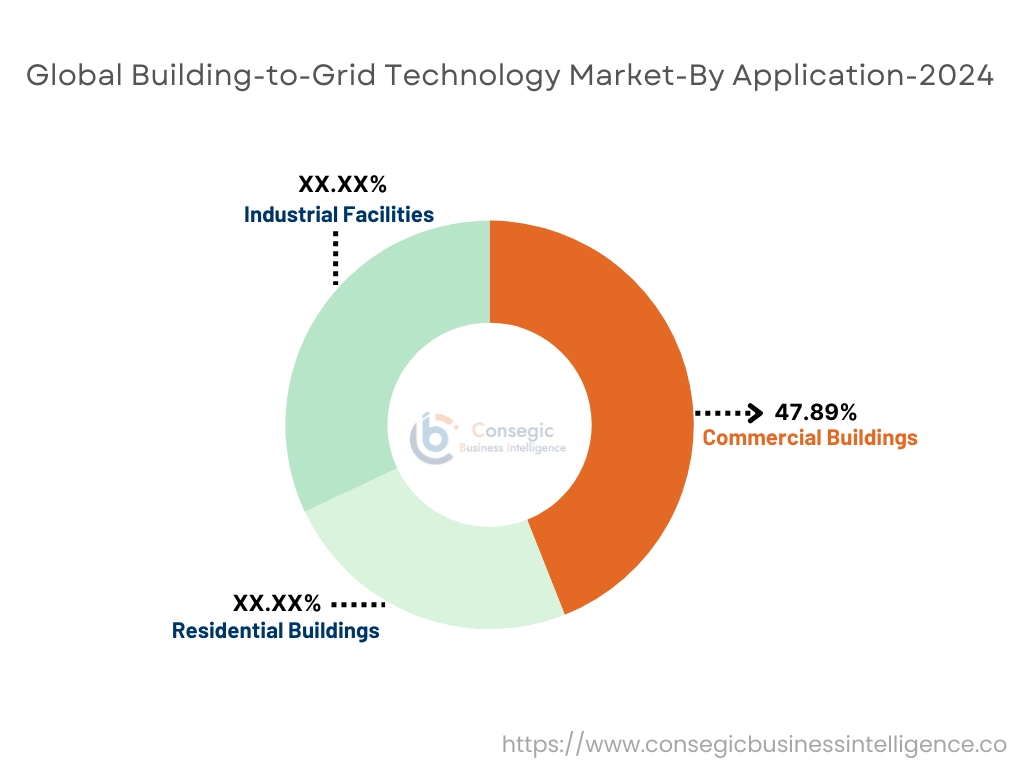
Based on applications, the market is categorized into commercial buildings, residential buildings, and industrial facilities.
Trends in the Application:
- Buildings are using integrated biophilic design, enhanced ventilation, and air purification to promote the well-being of individuals.
- Rise in trend for advanced security systems to improve the energy efficiency of commercial buildings.
The commercial building segment accounted for the largest building-to-grid technology market share of 47.89% in the year 2024.
- Commercial buildings generally consist of shopping malls, hotels, hospitals, office spaces and others.
- These spaces consume a high amount of energy. This leads to the adoption of B2G solutions for management of energy and cost reduction.
- Many commercial buildings incorporate demand response programs. This allows them to adjust the use of energy on the basis of real time grid conditions and reduce the peak loads.
- Large commercial spaces incorporate solar PV systems and battery storage which enhances their interaction with the grid.
- Advanced technologies are being incorporated in commercial buildings to improve the grid-interactive capabilities.
- For instance, In August 2024, Infogrid introduced IOT’s adaptive buildings technology for commercial building. It consists of grid-interactive capabilities that enhance the AI driven product building energy efficiency and decarbonization.
- Thus, based on the market analysis, these factors are influencing the building-to-Grid technology market.
The industrial facilities segment is expected to grow at the fastest CAGR over the forecast period.
- These industrial facilities are large consumers of energy. They use leverage B2G systems to optimize their energy usage and contribute to grid stability.
- B2G technology enables facilities to monitor real-time energy prices and adjust their consumption, accordingly, taking advantage of off-peak rates and reducing peak demand charges.
- They optimize energy use within the facility by analyzing data from various sources, such as production schedules, equipment performance, and environmental conditions.
- This leads to significant energy savings and reduces operational costs.
- These systems make it easier for industrial facilities to incorporate renewable energy sources, such as solar panels or wind turbines, into their energy mix.
- Thus, these factors are influencing the development of the segment in the coming years.
Regional Analysis:
The regional segment includes North America, Europe, Asia Pacific, the Middle East and Africa, and Latin America.
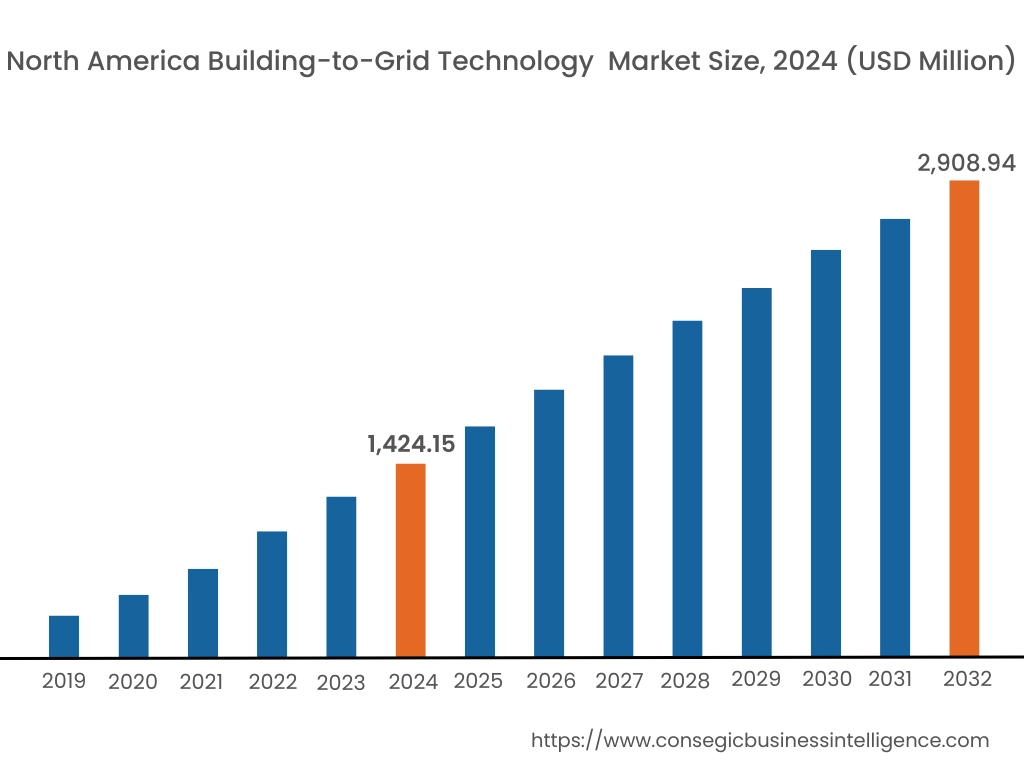
In 2024, North America accounted for the highest market share at 36.18% and was valued at USD 1,424.15 Million and is expected to reach USD 2,908.94 Million in 2032. In North America, U.S. accounted for the highest market share of 71.62% during the base year of 2024.
The building-to-grid technology industry in North America is dominated because of the energy efficiency mandates, incorporation of smart grid infrastructure and the requirement for decarbonization. The countries such as U.S. and Canada are incorporating advanced energy storage systems. They are essential for grid interactive buildings to improve the resilience of energy. The energy storage system helps in decarbonization by enhancing the grid reliability and integrating renewable energy.
For instance,
- In November 2021, Easton introduced a novel energy storage system called xStorage battery energy storage system. It accelerates decarbonization and electrification for commercial and industrial customers across North America. The system helps maximize onsite renewables, reduce energy costs and decarbonize power systems
Thus, these factors are influencing the building-to-grid technology market demand in this region.

Asia Pacific is experiencing the fastest growth with a CAGR of 11.9% over the forecast period. There is a rise in the use of microgrid management systems in this region. The countries such as China, Japan, and India among others are adopting smart grids, and renewable energy integration. Microgrids enhance the stability of the grid by allowing the buildings to operate individually during power outages. These advanced systems reduce the congestion in the grids by enhancing the flow between the buildings and the main grid. Thus, as per the building-to-grid technology market analysis, the rise in the utilization of advanced microgrids is driving the market growth in this region in the coming years.
Europe makes a significant contribution to the building-to-grid technology market analysis. The expansion of smart grid programs in this region is because of the use of smart meters because of EU regulations. These smart meters provide granular, real-time data on energy consumption. This allows both consumers and grid operators to gain a more detailed understanding of energy usage patterns. Smart meters also offer dynamic pricing schemes, where electricity prices vary based on real-time requirement. This is encouraging consumers to shift their energy usage to off-peak hours. Thus, these factors are influencing the market growth in this region.
The Middle East and Africa (MEA) region is witnessing market requirement characterized by significant potential. The region is significantly using building-to grid technology because of the integration of renewable energy and various smart city initiatives. Numerous smart city initiatives across the MEA region are incorporating B2G technology as a core component of their infrastructure. These projects aim to create more sustainable and efficient environments. The B2G systems contribute to this by allowing buildings to become active participants in smart energy grids. These factors are influencing the building-to-grid technology market trends in this region.
Latin America is an emerging region in the building-to-grid technology market share, with significant potential for innovation. There is a rise in the government initiatives for energy efficiency in residential and commercial building in Latin America. Governments are implementing various programs, such as building codes that mandate energy-efficient designs, financial incentives for energy-saving upgrades, and public awareness campaigns to educate consumers about the benefits of energy conservation. Building-to-grid technology aligns with these goals by enabling buildings to enhance their energy consumption, integrate distributed energy resources, and interact intelligently with the grid. Thus, these factors are driving the market trends in this region
Top Key Players and Market Share Insights:
The global building-to-grid technology market is highly competitive with major players providing precise products to the national and international markets. Key players are adopting several strategies in research and development (R&D) and product innovation to hold a strong position in the global Building-to-Grid Technology market. Key players in the building-to-Grid Technology industry include-
- Schneider Electric (France)
- Eaton (Ireland)
- GE Vernova (United States)
- General Electric (United States)
- Itron, Inc (United States)
- GridPoint (United States)
- ABB (Switzerland)
- Oracle (United States)
- Siemens (Germany)
- Ericsson (Sweden)
Recent Industry Developments :
Product Launch:
- In April 2024, Schneider Electric's introduced its all-in-one Battery Energy Storage System (BESS). This integrated system simplifies the operation of energy storage within buildings. They enhance the distribution of energy in buildings. It simplifies the installation and management of energy.
- In October 2024, Aspen Technology introduced a new microgrid management system aimed at assisting customers in achieving both power reliability and net-zero emissions targets. By providing advanced control and automation capabilities, the system enhances power availability, boosts productivity, and strengthens energy security for these applications.
Building-to-Grid Technology Market Report Insights :
| Report Attributes | Report Details |
| Study Timeline | 2019-2032 |
| Market Size in 2032 | USD 8,509.96 Million |
| CAGR (2025-2032) | 10.2% |
| By Technology Type |
|
| By Component |
|
| By Application |
|
| By Region |
|
| Key Players |
|
| North America | U.S. Canada Mexico |
| Europe | U.K. Germany France Spain Italy Russia Benelux Rest of Europe |
| APAC | China South Korea Japan India Australia ASEAN Rest of Asia-Pacific |
| Middle East and Africa | GCC Turkey South Africa Rest of MEA |
| LATAM | Brazil Argentina Chile Rest of LATAM |
| Report Coverage |
|
Key Questions Answered in the Report
How big is the building-to-grid technology market? −
In 2024, the building-to-grid technology market is USD 3,936.72 Million.
Which is the fastest-growing region in the building-to-grid technology market? +
Asia Pacific is the fastest-growing region in the building-to-grid technology market.
What specific segmentation details are covered in the building-to-grid technology market? +
Technology Type, Component, and Application segmentation details are covered in the building-to-grid technology market.
Who are the major players in the building-to-grid technology market? +
Schneider Electric (France), Eaton (Ireland), GridPoint (United States) are some of the major players in the market.
Overview
Reputation & Certifications


Our Services
- Market Intelligence & Forecasting
- Custom Research Solutions
- Market Entry Strategy
- Competitive Intelligence
- Customer Insights
- Industry Innovation Analysis
- Investment Advisory