Jump to Content
Buprofezin Market - Size, Share, Industry Trends, and Forecasts (2025-2032)
Buprofezin Market Size:
Buprofezin Market size is estimated to reach over USD 905.11 Million by 2032 from a value of USD 565.34 Million in 2024 and is projected to grow by USD 589.53 Million in 2025, growing at a CAGR of 6.1% from 2025 to 2032.
Buprofezin Market Scope & Overview:
Buprofezin is an insect growth regulator widely used in agriculture to control pests affecting crops such as rice, vegetables, and fruits. It disrupts the molting process in insects, preventing their development and reducing infestations. Its selective action targets specific pests while minimizing impact on beneficial organisms, making it a preferred choice for integrated pest management strategies.
Its key attributes include long residual activity, low toxicity to non-target species, and resistance management benefits. The formulation ensures effective pest control while maintaining crop quality and yield. It is available in various application forms, including wettable powders, suspension concentrates, and granules, allowing flexibility in agricultural practices.
Farmers, agribusinesses, and pest control agencies utilize this insecticide to enhance crop protection and minimize economic losses caused by pest damage. Advancements in formulation technology continue to improve its efficacy, ensuring reliable pest control solutions across diverse agricultural environments.
How is AI Transforming the Buprofezin Market?
There is a rising adoption of AI in the buprofezin market, specifically to improve the efficacy, safety, and sustainability of buprofezin, by enhancing pest management, optimizing formulations, and mitigating potential toxicity. AI-powered systems can analyze data to identify optimum application strategies, predict pest outbreaks, and develop safer, more targeted formulations. Additionally, AI-powered systems are facilitating more accurate pest detection and prediction, which further leads to targeted buprofezin application and reduced chemical usage. This includes using AI for image recognition to identify pests early, optimizing spraying equipment through real-time data analytics, and accelerating research and development of new buprofezin formulations. Consequently, the above factors are expected to propel the market growth during the forecast period.

Buprofezin Market Dynamics - (DRO):
Key Drivers:
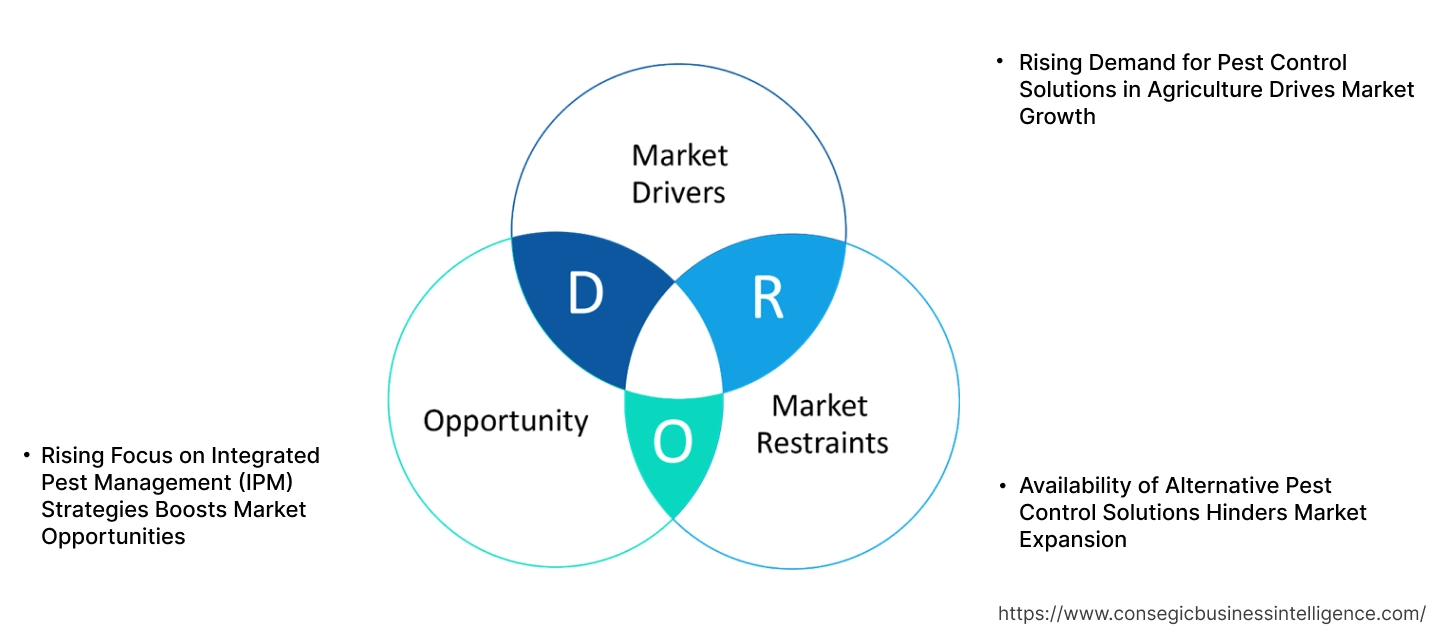
Rising Demand for Pest Control Solutions in Agriculture Drives Market Growth
Farmers are seeking long-term solutions to control pests such as planthoppers, whiteflies, and leafhoppers, which significantly impact crop yields. Buprofezin is widely used in cotton farming and vegetable crops, providing selective action against target pests while minimizing harm to beneficial insects. Its compatibility with integrated pest management (IPM) programs makes it a preferred choice for sustainable farming practices. Additionally, the rising concerns over food security and crop protection regulations are pushing governments and agricultural organizations to promote effective insecticides with minimal environmental impact. As modern farming practices continue to evolve, the demand for high-performance, residue-free pest control solutions is expected to grow.
- For instance, EU has authorized the use of buprofezin as an insecticide only on non-edible crops. This encourages its utilization in cash crops such as cotton.
These factors play a crucial role in driving buprofezin market expansion, ensuring its continued relevance in agricultural pest management.
Key Restraints:
Availability of Alternative Pest Control Solutions Hinders Market Expansion
The availability of biopesticides, synthetic insecticides, and genetically modified pest-resistant crops is limiting its market dominance. Biopesticides, derived from natural microorganisms and plant-based compounds, are gaining traction due to their environmental benefits and organic farming certifications. Additionally, synthetic insecticides with broad-spectrum control and faster knockdown effects are preferred in high-intensity farming regions. The rising adoption of IPM techniques encourages the use of multiple pest control strategies, reducing dependency on any single chemical solution. As regulatory bodies impose restrictions on chemical pesticide residues, the demand for low-toxicity and eco-friendly alternatives continues to increase. These challenges are influencing market dynamics, requiring continuous innovation in pest management formulations. Addressing these issues through advanced research and sustainable solutions is essential for driving buprofezin market growth.
Future Opportunities:
Rising Focus on Integrated Pest Management (IPM) Strategies Boosts Market Opportunities
IPM promotes targeted pest control solutions that reduce chemical dependency, preserve beneficial insects, and enhance crop resilience. Buprofezin is widely used in IPM programs due to its selective insect growth regulation, minimal environmental impact, and compatibility with biological control methods. The growth of organic and precision farming is further strengthening the demand for low-residue insecticides that align with regulatory standards. Additionally, government incentives promoting eco-friendly pest management are encouraging farmers to integrate chemical and non-chemical approaches for improved crop protection.
- For instance, researchers are investigating the potential of AI-integrated pest identification and management systems to minimize economic losses and improve crop yield.
As agricultural industries shift toward sustainable and science-driven farming solutions, these developments will create buprofezin market opportunities, reinforcing its role in efficient and responsible pest control strategies worldwide.
Buprofezin Market Segmental Analysis :
By Formulation Type:
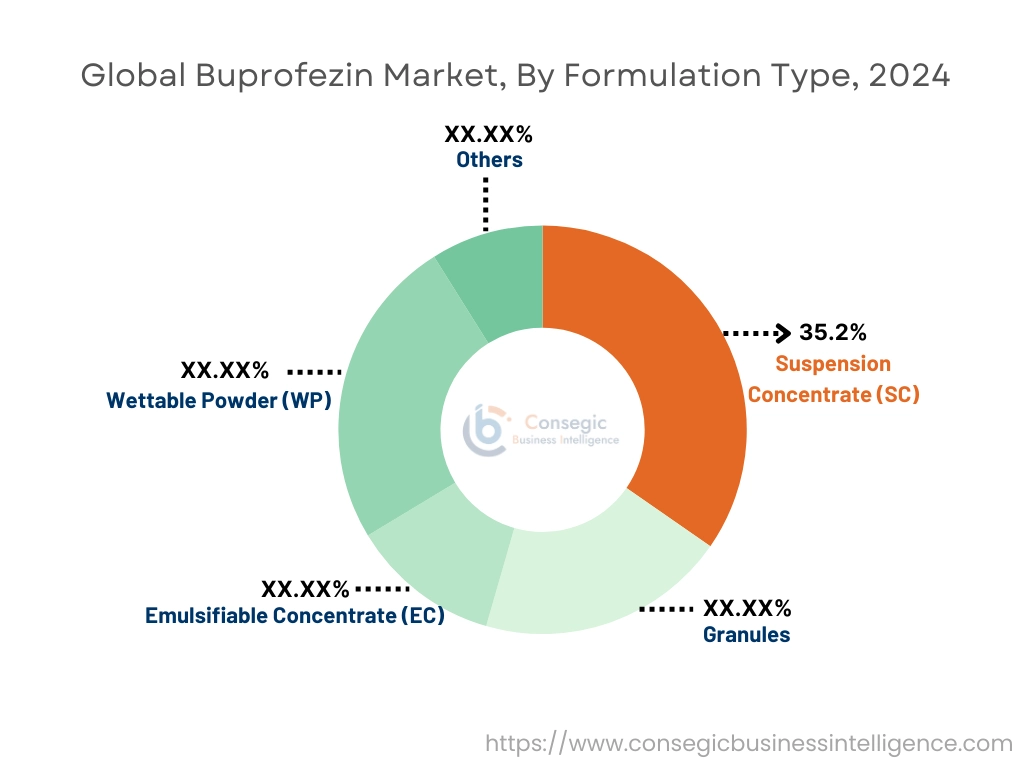
By formulation type, the market is segmented into wettable powder (WP), suspension concentrate (SC), granules, emulsifiable concentrate (EC), and others.
The suspension concentrate (SC) segment held the largest buprofezin market share of 35.2% in 2024.
- Suspension concentrate formulations are commonly used in modern agriculture due to their enhanced stability, ease of application, and improved absorption by crops.
- The need for efficient pest control solutions is increasing as farmers seek residue-free and long-lasting insecticides for crop protection.
- Market analysis suggests that SC formulations provide better coverage and increased effectiveness in managing pests, making them the preferred choice in high-yield farming.
- Thus, as per buprofezin market trends, the adoption of liquid-based pesticide formulations is growing, particularly due to advancements in application technologies.
The granules segment is anticipated to experience the fastest CAGR during the forecast period.
- Granular formulations offer ease of use, extended residual effects, and controlled release, making them ideal for large-scale agricultural operations.
- The need for long-acting formulations is rising as farmers seek cost-effective and labor-saving pesticide solutions.
- Segmental trends highlight the increasing adoption of granular pesticides in crops like cereals, fruits, and vegetables, where sustained pest control is required.
- Therefore, with innovations in controlled-release pesticide technologies, the granules segment is contributing to buprofezin market growth.
By Crop Type:
Based on crop type, the market is categorized into cereals & grains, fruits & vegetables, oilseeds & pulses, plantation crops, and others.
The cereals & grains segment held the largest share in 2024.
- Cereals and grains, including rice, wheat, and maize, require effective pest management solutions, making buprofezin a crucial component in crop protection.
- The need for high-yield and disease-resistant crops is driving its widespread adoption in commercial cereal farming.
- Buprofezin market analysis highlights its effectiveness in controlling rice planthoppers, aphids, and other cereal crop pests, ensuring optimal productivity.
- In March 2022, United States Environmental Protection Agency released new guidelines regarding the use of this insecticide for cereals and grains production.
- Thus, as per market trends, with the increasing global food demand, pest management strategies in cereal crops are expected to grow.
The fruits & vegetables segment is expected to have the fastest CAGR during the forecast period.
- The need for residue-free, organic pest control solutions is rising among fruit and vegetable growers, particularly in export-oriented markets.
- It is highly effective in managing whiteflies, aphids, and thrips, which are major pests in horticultural farming.
- Market trends indicate that IPM programs are increasingly incorporating buprofezin-based formulations, improving pest resistance management.
- Therefore, with a growing focus on sustainable agriculture and high-value crops, this segment is driving buprofezin market expansion.
By Application Method:
By application method, the market is segmented into foliar spray, soil treatment, seed treatment, and others.
The foliar spray segment held the largest buprofezin market share in 2024.
- Foliar spray applications ensure direct contact with pests, offering fast and effective pest control in various crops.
- The need for highly efficient pesticide application methods is growing as farmers seek to reduce crop losses and maximize yields.
- Buprofezin market analysis suggests that foliar spray methods enhance pesticide absorption, making them more effective in high-infestation areas.
- Thus, as per segmental trends, advancements in spray technology and precision agriculture are improving the effectiveness of foliar-applied pesticides.
The soil treatment segment is expected to experience the fastest CAGR during the forecast period.
- Soil treatment applications help in long-term pest management, providing sustained protection for crops from root-level infestations.
- The need for pre-plant pest control solutions is increasing as farmers adopt preventive approaches to manage crop diseases and insect outbreaks.
- Buprofezin market trends highlight increasing research into soil-friendly pesticide formulations, ensuring better crop health and nutrient uptake.
- Therefore, with the expansion of precision agriculture and soil management strategies, soil treatment is contributing to market growth.
Regional Analysis:
The regions covered are North America, Europe, Asia Pacific, the Middle East and Africa, and Latin America.
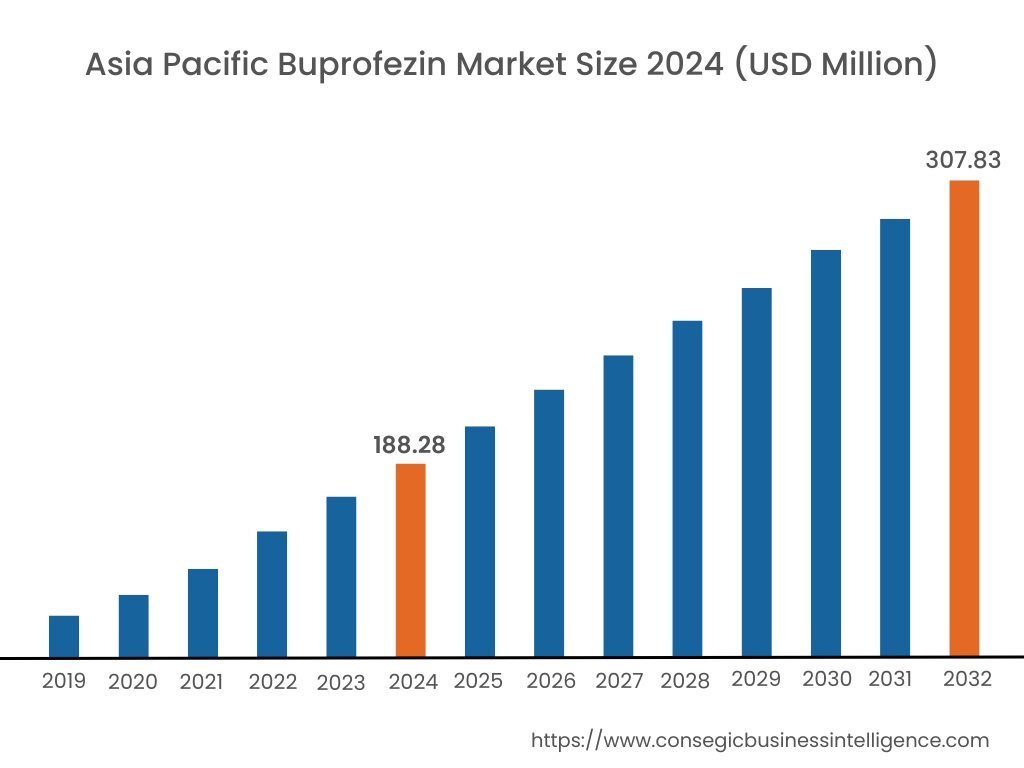
Asia Pacific region was valued at USD 188.28 Million in 2024. Moreover, it is projected to grow by USD 196.68 Million in 2025 and reach over USD 307.83 Million by 2032. Out of this, China accounted for the maximum revenue share of 45.8%. The Asia Pacific region holds a significant share of the buprofezin industry, primarily due to the extensive agricultural sector in countries like China and India. The rising need for high-quality crops and the prevalence of pests have led to increased adoption of its products. Government initiatives supporting sustainable farming practices further bolster the market. The expansion of high-value crop cultivation presents a substantial buprofezin market opportunity for manufacturers aiming to cater to this burgeoning demand.

North America is estimated to reach over USD 267.46 Million by 2032 from a value of USD 166.07 Million in 2024 and is projected to grow by USD 173.26 Million in 2025. In North America, the market is driven by advanced agricultural practices and a focus on integrated pest management. The United States, in particular, has seen a surge in its usage to combat pests affecting major crops. The emphasis on reducing environmental impact and adhering to stringent regulations has prompted farmers to opt for selective insecticides which target specific pests while preserving beneficial insects.
Europe exhibits a mature market, with countries such as France, Italy, and Spain leading in its application. The region's stringent environmental regulations and commitment to sustainable agriculture have facilitated its adoption as a preferred alternative to broad-spectrum insecticides. The growing need for organic and residue-free produce further amplifies the buprofezin market demand in this region.
The buprofezin market demand in Latin America is influenced by the increasing cultivation of cash crops like coffee, sugarcane, and fruits. Countries such as Brazil and Argentina are investing in modern agricultural techniques, including the use of targeted pest control solutions. The susceptibility of these high-value crops to pest infestations necessitates effective management strategies, thereby driving the need for buprofezin-based products.
The Middle East and Africa present emerging markets for buprofezin, with growth potential linked to the development of the agricultural sector and the need for enhanced food security. The adoption of modern farming practices and the introduction of high-yield crop varieties susceptible to pest attacks have led to an increased reliance on effective insecticides. While challenges such as limited awareness and economic constraints exist, the market offers promising prospects as governments and organizations invest in agricultural development programs.
Top Key Players & Market Share Insights:
The buprofezin market is highly competitive with major players providing products and services to the national and international markets. Key players are adopting several strategies in research and development (R&D), product innovation, and end-user launches to hold a strong position in the global buprofezin market. Key players in the buprofezin industry include -
- Nihon Nohyaku Co., Ltd. (Japan)
- Jiangsu Fengshan Group Co., Ltd. (China)
- Agro-Star Biochemical (China)
- Dalian Winyard Chemical Co., Ltd. (China)
- JiangSu Sevencontinent Green Chemical (China)
- Dow AgroSciences (USA)
- Kenvos (China)
- Zhejiang Longwan Chemicals (China)
- Canary Agro Chemicals Private Limited (India)
- Bailing Agrochemical (China)
Buprofezin Market Report Insights:
| Report Attributes | Report Details |
| Study Timeline | 2019-2032 |
| Market Size in 2032 | USD 905.11 Million |
| CAGR (2025-2032) | 6.1% |
| By Formulation Type |
|
| By Crop Type |
|
| By Application Method |
|
| By Region |
|
| Key Players |
|
| North America | U.S. Canada Mexico |
| Europe | U.K. Germany France Spain Italy Russia Benelux Rest of Europe |
| APAC | China South Korea Japan India Australia ASEAN Rest of Asia-Pacific |
| Middle East and Africa | GCC Turkey South Africa Rest of MEA |
| LATAM | Brazil Argentina Chile Rest of LATAM |
| Report Coverage |
|
Key Questions Answered in the Report
How big is the Buprofezin Market? −
Buprofezin Market size is estimated to reach over USD 905.11 Million by 2032 from a value of USD 565.34 Million in 2024 and is projected to grow by USD 589.53 Million in 2025, growing at a CAGR of 6.1% from 2025 to 2032.
What specific segmentation details are covered in the Buprofezin Market report? +
The Buprofezin market report includes specific segmentation details for formulation type, crop type and application method.
What are the application methods in the Buprofezin Market? +
The application methods in the Buprofezin market are foliar spray, soil treatment, seed treatment and others.
Who are the major players in the Buprofezin Market? +
The key participants in the Buprofezin market are Nihon Nohyaku Co., Ltd. (Japan), Jiangsu Fengshan Group Co., Ltd. (China), Agro-Star Biochemical (China), Dalian Winyard Chemical Co., Ltd. (China), Dow AgroSciences (USA), Kenvos (China), Zhejiang Longwan Chemicals (China), Canary Agro Chemicals Private Limited (India), Bailing Agrochemical (China) and JiangSu Sevencontinent Green Chemical (China).
Overview
Reputation & Certifications


Our Services
- Market Intelligence & Forecasting
- Custom Research Solutions
- Market Entry Strategy
- Competitive Intelligence
- Customer Insights
- Industry Innovation Analysis
- Investment Advisory