Jump to Content
Calcium Fortified Orange Juice Market - Size, Share, Industry Trends, and Forecasts (2025-2032)
Calcium Fortified Orange Juice Market Size:
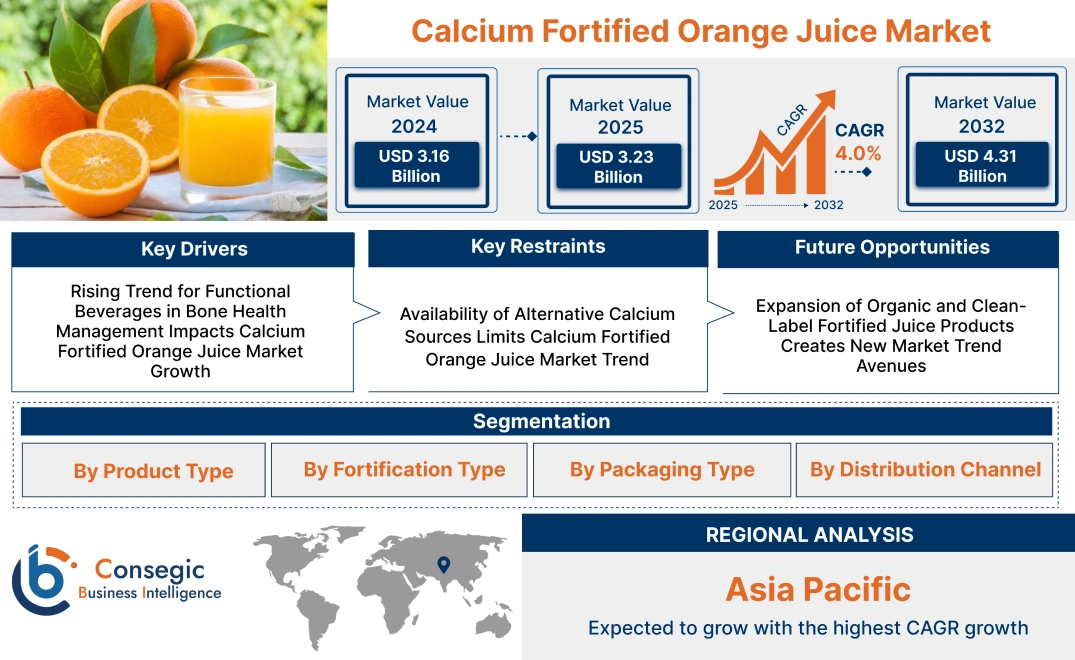
Calcium Fortified Orange Juice Market size is estimated to reach over USD 4.31 Billion by 2032 from a value of USD 3.16 Billion in 2024 and is projected to grow by USD 3.23 Billion in 2025, growing at a CAGR of 4.0% from 2025 to 2032.
Calcium Fortified Orange Juice Market Scope & Overview:
Calcium fortified orange juice is a nutrient-enriched beverage that provides an additional source of calcium to support bone health. It is formulated by incorporating bioavailable calcium compounds without altering the taste or texture of the juice.
Key characteristics include enhanced nutritional value, natural citrus flavor, and high bioavailability of calcium. It offers essential minerals that contribute to bone strength, dental health, and muscle function. This juice maintains stability over shelf life and retains its refreshing taste.
Calcium fortified orange juice is widely consumed in households, healthcare institutions, and fitness centers. It is commonly used as a dietary supplement for individuals with calcium deficiencies, athletes, and aging populations. End users include retail consumers, hospitals, and food service providers.
Calcium Fortified Orange Juice Market Dynamics - (DRO) :
Key Drivers:
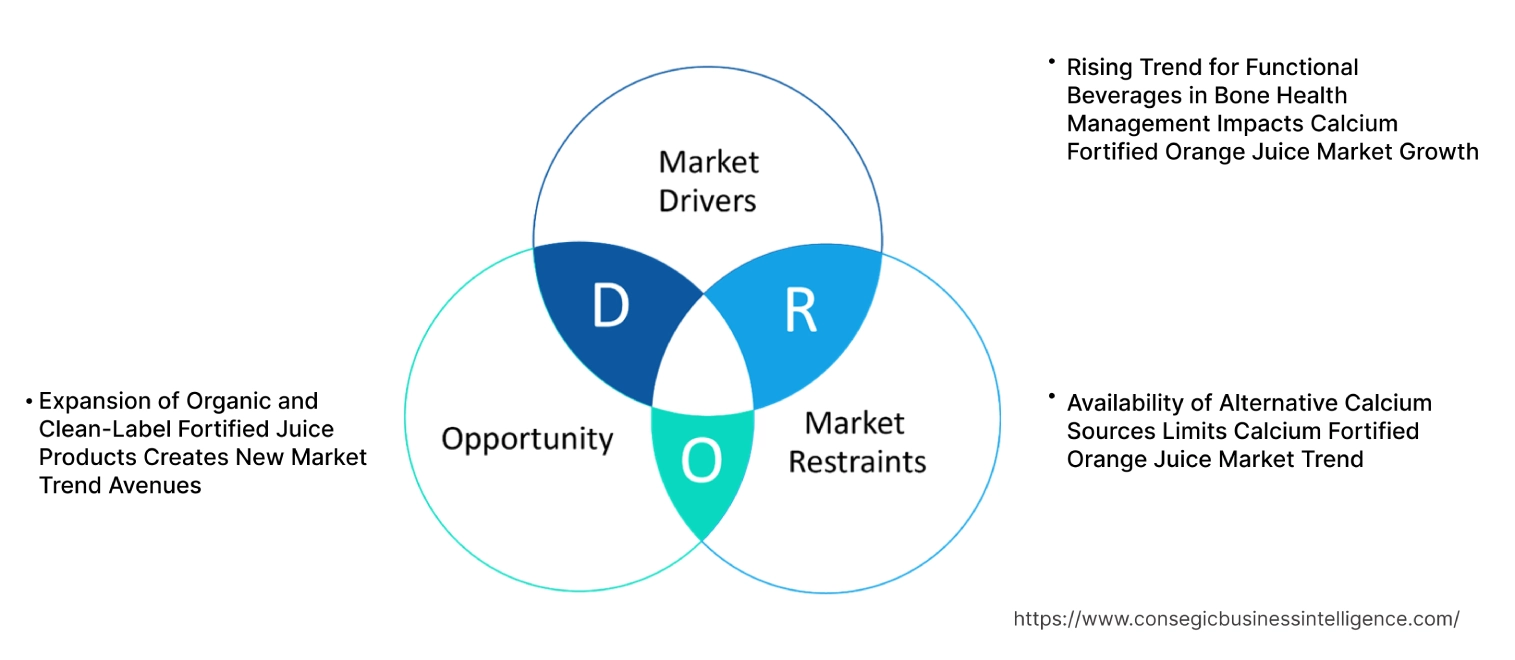
Rising Trend for Functional Beverages in Bone Health Management Impacts Calcium Fortified Orange Juice Market Growth
The increasing focus on bone health, particularly among aging populations and individuals with calcium deficiencies, is fueling the trend for functional beverages. Calcium fortified orange juice serves as an effective alternative to dairy products for individuals who are lactose intolerant or prefer plant-based sources. This juice provides essential calcium, supporting bone strength and reducing the risk of osteoporosis. A significant example is the growing consumer shift toward non-dairy calcium sources in North America, where fortified juices are a popular dietary choice. Therefore, the rising growth for functional beverages in bone health management is propelling the calcium fortified orange juice market demand.
Key Restraints:
Availability of Alternative Calcium Sources Limits Calcium Fortified Orange Juice Market Trend
The presence of multiple alternative calcium sources, including dairy products, dietary supplements, and plant-based fortified foods, poses a challenge to the calcium fortified orange juice market. Consumers seeking calcium intake often opt for supplements or fortified plant-based milk, which provide similar or higher calcium content with additional nutritional benefits. For instance, almond milk and soy milk fortified with calcium have gained significant consumer preference due to their lower acidity compared to orange juice.
These alternative sources reduce the dependence on calcium fortified orange juice, thereby limiting calcium fortified orange juice market expansion.
Future Opportunities :
Expansion of Organic and Clean-Label Fortified Juice Products Creates New Market Trend Avenues
The increasing consumer preference for organic and clean-label beverages is expected to create opportunities in the calcium fortified orange juice market. Manufacturers are focusing on producing fortified juices with natural ingredients, reduced sugar content, and organic certification to cater to health-conscious consumers. Brands launching USDA-certified organic calcium-fortified juices without synthetic additives are likely to gain a competitive edge. For example, companies are expected to introduce fortified juices with plant-derived calcium sources, appealing to consumers seeking clean-label options.
Therefore, the expansion of organic and clean-label fortified juice products is anticipated to present significant opportunities for calcium fortified orange juice market growth.
Calcium Fortified Orange Juice Market Segmental Analysis :
By Product Type
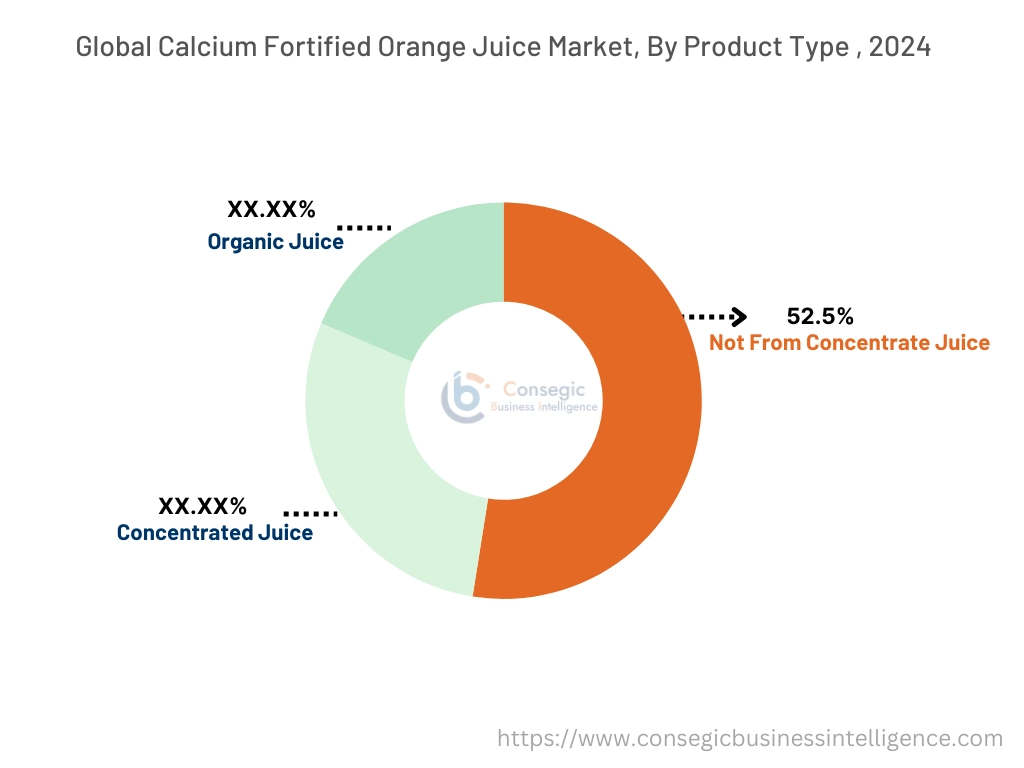
Based on product type, the calcium fortified orange juice market is segmented into concentrated juice, not from concentrate juice, and organic juice.
The not from concentrate juice segment accounted for the largest revenue share in calcium fortified orange juice market by 52.5% in 2024.
- Not from concentrate juice retains a fresher taste and higher nutritional value compared to concentrated alternatives, making it a preferred choice among consumers seeking premium options.
- Increasing consumer demand for natural and minimally processed beverages has boosted the adoption of not from concentrate juices in the market.
- Many leading beverage manufacturers have focused on expanding their not from concentrate product lines, further strengthening this segment.
- According to calcium fortified orange juice market analysis, rising preference for products with clean labels and fewer additives has also contributed to the segment’s dominance.
The organic juice segment is anticipated to register the fastest CAGR during the forecast period.
- The growing consumer inclination toward organic and clean-label products has accelerated the trend for organic juice.
- Rising health consciousness and concerns over synthetic additives in conventional juices have led to increased purchases of organic alternatives.
- Expanding distribution channels, including organic specialty stores and online retailers, have made organic juices more accessible to a broader consumer base.
- According to calcium fortified orange juice market analysis, regulatory support and certifications for organic products have encouraged manufacturers to expand their organic juice portfolios.
By Fortification Type:
Based on fortification type, the market is segmented into calcium citrate, calcium carbonate, and calcium lactate.
The calcium carbonate segment accounted for the largest revenue in calcium fortified orange juice market share in 2024.
- Calcium carbonate is widely used in fortified beverages due to its high bioavailability and cost-effectiveness.
- The ability to blend seamlessly into orange juice without significantly altering its taste or texture has made calcium carbonate the preferred choice for manufacturers.
- Increased consumer awareness regarding bone health and calcium supplementation has driven growth for calcium carbonate-fortified orange juice.
- According to market analysis, major beverage companies have incorporated calcium carbonate in their product formulations to cater to a broad customer base.
The calcium lactate segment is anticipated to register the fastest CAGR during the forecast period.
- Calcium lactate is known for its enhanced solubility, making it an ideal choice for liquid applications, including juices.
- The increasing preference for alternative calcium sources with better absorption rates has boosted the demand for calcium lactate.
- Its ability to provide a smoother texture and improved stability in beverages has encouraged manufacturers to integrate it into their formulations.
- As consumer preferences shift toward easily digestible and efficient calcium sources, calcium lactate-fortified juices are gaining traction.
By Packaging Type:
Based on packaging type, the market is segmented into cartons, bottles, and cans.
The cartons segment accounted for the largest revenue share in 2024.
- Cartons are widely used for juice packaging due to their cost-effectiveness, recyclability, and extended shelf life.
- Their ability to protect juice from light and air exposure helps in maintaining freshness and nutritional content for a longer duration.
- Consumers prefer cartons for their convenience and eco-friendly attributes, aligning with the rising trend for sustainable packaging solutions.
- According to market analysis, many juice manufacturers have adopted carton packaging to meet regulatory standards and environmental sustainability goals.
The bottles segment is anticipated to register the fastest CAGR during the forecast period.
- Bottles, particularly PET and glass variants, are gaining popularity due to their portability and reusability.
- The increasing consumer preference for single-serving and on-the-go beverage options has accelerated the growth for bottled juices.
- Glass bottles, in particular, appeal to premium consumers seeking BPA-free and environmentally friendly packaging.
- According to market analysis, innovations in lightweight and recyclable bottle materials have further fueled the growth of this segment.
By Distribution Channel:
Based on distribution channel, the market is segmented into supermarkets, convenience stores, and online retail.
The supermarkets segment accounted for the largest revenue share in 2024.
- Supermarkets offer a wide variety of calcium fortified orange juice brands, providing consumers with multiple choices under one roof.
- The presence of attractive discounts, promotions, and bulk purchase options makes supermarkets a preferred shopping destination.
- Consumers value the ability to physically inspect products and compare nutritional labels before making a purchase.
- According to market analysis, established retail chains have continued to expand their juice product offerings, further strengthening supermarket sales.
The online retail segment is anticipated to register the fastest CAGR during the forecast period.
- The rapid expansion of e-commerce platforms and direct-to-consumer sales channels has significantly boosted online juice sales.
- Consumers are increasingly opting for online purchases due to convenience, home delivery, and exclusive discounts available on digital platforms.
- Subscription-based juice delivery services and online-exclusive brands are gaining traction among health-conscious buyers.
- According to market analysis, the integration of digital marketing strategies and personalized product recommendations has enhanced consumer engagement and conversion rates in the online segment.
Regional Analysis:
The regions covered are North America, Europe, Asia Pacific, the Middle East and Africa, and Latin America.
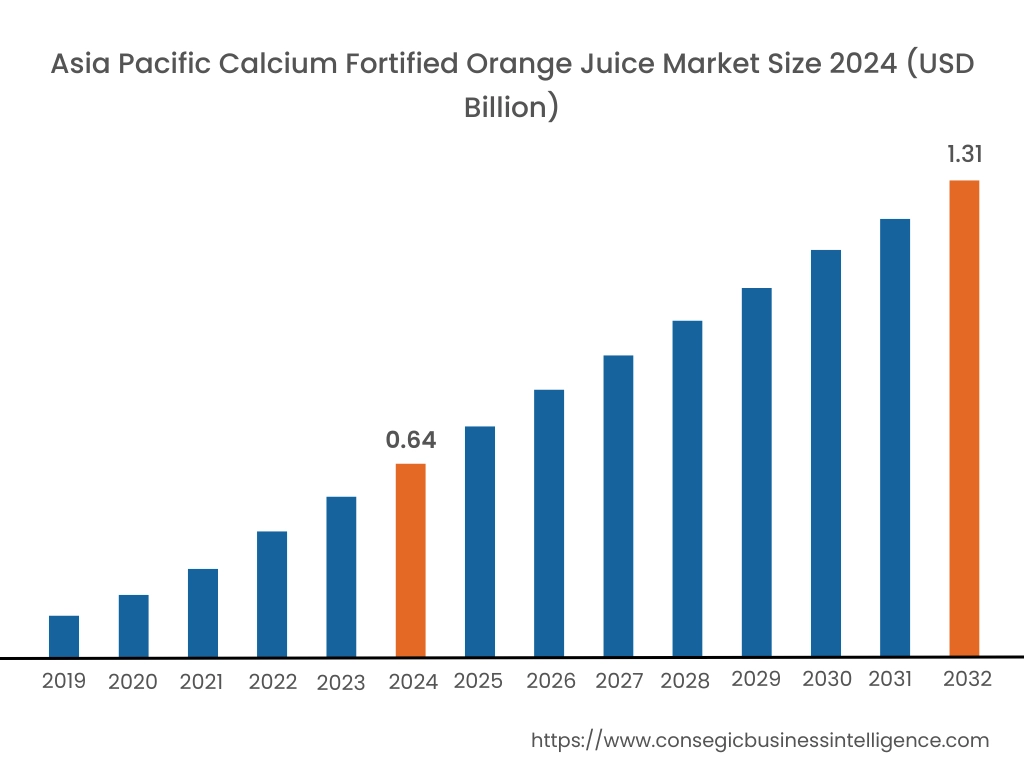
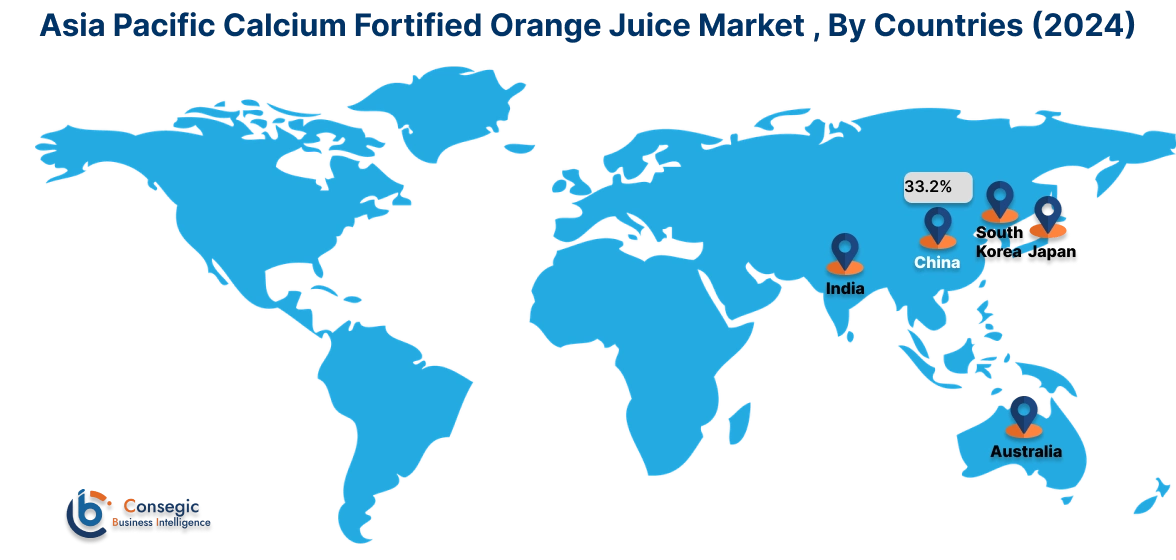
Asia Pacific region was valued at USD 0.64 Billion in 2024. Moreover, it is projected to grow by USD 0.68 Billion in 2025 and reach over USD 1.31 Billion by 2032. Out of this, China accounted for the maximum revenue share of 33.2%. Asia-Pacific exhibits increasing demand for calcium fortified orange juice due to changing dietary habits and rising health consciousness. Countries like China, Japan, and India show growing interest in functional beverages. Urbanization and expanding middle-class populations contribute to calcium fortified orange juice market opportunities. The presence of local and international juice brands enhances product accessibility. Government initiatives promoting nutrition and public health awareness further impact calcium fortified orange juice market trend.
In 2024, North America was valued at USD 1.16 Billion and is expected to reach USD 1.40 Billion in 2032. North America holds a significant share in the calcium fortified orange juice market due to rising consumer awareness of bone health and dietary supplements. The United States dominates the region, with major beverage manufacturers investing in product innovation and marketing campaigns. The increasing prevalence of osteoporosis and lactose intolerance influences demand. Retail opportunities and the presence of established distribution networks support market availability.
Europe maintains steady growth for calcium fortified orange juice, supported by a well-established functional beverage industry. Countries like Germany, France, and the United Kingdom witness increasing consumer preference for fortified beverages. Strict food regulations influence product formulations. The rising elderly population and awareness of bone health contribute to calcium fortified orange juice market expansion. Supermarkets and online retail channels enhance product accessibility.
The Middle East and Africa show a developing market for calcium fortified orange juice due to growing health awareness and changing consumer lifestyles. Urbanization and rising disposable incomes influence purchasing patterns. The demand for functional beverages increases in countries like the UAE and Saudi Arabia. Limited local production and reliance on imports affect market pricing and availability.
Latin America experiences moderate demand for calcium fortified orange juice, driven by growing health awareness and increasing supermarket penetration. Brazil and Mexico lead the market, with strong fruit juice consumption trends. Government nutrition programs and initiatives promoting fortified foods influence calcium fortified orange juice market opportunities. Economic challenges and fluctuating raw material costs impact market performance in some countries.
Top Key Players and Market Share Insights:
The global calcium fortified orange juice market is highly competitive with major players providing products and services to the national and international markets. Key players are adopting several strategies in research and development (R&D), product innovation, and end-user launches to hold a strong position in the global calcium fortified orange juice market. Key players in the calcium fortified orange juice industry include-
- The Coca-Cola Company (United States)
- PepsiCo, Inc. (United States)
- Tropicana Products, Inc. (United States)
- Florida’s Natural Growers (United States)
- Minute Maid (The Coca-Cola Company) (United States)
- Dr. Pepper Snapple Group (United States)
- Hain Celestial Group, Inc. (United States)
- Ceres Fruit Juices Pty Ltd. (South Africa)
- Eckes-Granini Group (Germany)
- Cutrale Group (Brazil)
Recent Industry Developments :
Product Launches:
- In August 2024, Raw Generation introduced "Sippers," a nutritionist-designed juice line aimed at children. These juices are made from over 40 raw fruits and vegetables, with no added sugars, preservatives, or artificial flavors. The Green Sipper variant is particularly noteworthy for being rich in calcium, offering a nutritious option for bone health.
Calcium Fortified Orange Juice Market Report Insights :
| Report Attributes | Report Details |
| Study Timeline | 2019-2032 |
| Market Size in 2032 | USD 4.31 Billion |
| CAGR (2025-2032) | 4.0% |
| By Product Type |
|
| By Fortification Type |
|
| By Packaging Type |
|
| By Distribution Channel |
|
| By Region |
|
| Key Players |
|
| North America | U.S. Canada Mexico |
| Europe | U.K. Germany France Spain Italy Russia Benelux Rest of Europe |
| APAC | China South Korea Japan India Australia ASEAN Rest of Asia-Pacific |
| Middle East and Africa | GCC Turkey South Africa Rest of MEA |
| LATAM | Brazil Argentina Chile Rest of LATAM |
| Report Coverage |
|
Key Questions Answered in the Report
How big is the Calcium Fortified Orange Juice Market? −
In 2024, the Calcium Fortified Orange Juice Market was USD 3.16 Billion.
What will be the potential market valuation for the Calcium Fortified Orange Juice Market by 2032? +
In 2032, the market size of Calcium Fortified Orange Juice Market is expected to reach USD 4.31 Billion.
What are the segments covered in the Calcium Fortified Orange Juice Market report? +
The product type, fortification type, packaging type, and distribution channel are the segments covered in this report.
Who are the major players in the Calcium Fortified Orange Juice Market? +
The Coca-Cola Company (United States), PepsiCo, Inc. (United States), Tropicana Products, Inc. (United States), Florida’s Natural Growers (United States), Minute Maid (The Coca-Cola Company) (United States), Dr. Pepper Snapple Group (United States), Hain Celestial Group, Inc. (United States), Ceres Fruit Juices Pty Ltd. (South Africa), Eckes-Granini Group (Germany), Cutrale Group (Brazil) are the major players in the Calcium Fortified Orange Juice market.
Overview
Reputation & Certifications


Our Services
- Market Intelligence & Forecasting
- Custom Research Solutions
- Market Entry Strategy
- Competitive Intelligence
- Customer Insights
- Industry Innovation Analysis
- Investment Advisory