Jump to Content
Canned Tuna Market - Size, Share, Industry Trends, and Forecasts - (2025 - 2035)
Canned Tuna Market:
Canned Tuna Market size is estimated to reach over USD 30.63 Billion by 2035 from a value of USD 18.68 Billion in 2024 and is projected to grow by USD 19.53 Billion in 2025, growing at a CAGR of 4.60% from 2025 to 2035
Canned Tuna Market Scope & Overview:
Canned tuna refers to processed tuna fish that has been cleaned, cooked, preserved, and packed in airtight containers to extend its shelf life. The canned tuna industry includes raw tuna sourcing, processing and canning operations, packaging in metal cans or pouches, labeling, cold chain logistics, and retail distribution. The aim is to provide affordable protein products that have a long shelf life and need minimal processing. The chain caters to the needs of the masses, food service, institutional clients, and private label distribution to both local and international markets.
The canned tuna market is growing, driven by increasing demand for convenient protein products and long-life food products. Urbanization patterns and the rise of modern retail outlets are helping to raise the profile and availability of the product. Manufacturers are introducing different flavors and other product forms to keep up with the changing tastes and preferences of consumers. The export market, driven by demand from North America and Europe, is helping to drive the demand in key processing countries in Southeast Asia and Latin America.
Canned Tuna Market Size & Forecast
- 2024 Market Size : USD 18.68 Billion
- 2025 Market Size : USD 19.53 Billion
- 2035 projected Market Size : USD 30.63 Billion
- CAGR (2025-2035) : 4.60%
- Largest Market in 2025 : North America
Impact of Tariffs on Packaged Tuna Market?
The recent US tariff agenda has disrupted the canned tuna market and the broader seafood supply chain. The US imports nearly three quarters of its seafood, which increases exposure to trade measures. Imports from China reached around USD 1,030 million in 2024. Tariffs of up to 145% have increased landed costs. Additional duties on India, Vietnam, and Indonesia have raised sourcing expenses. Tariffs on US-caught seafood processed abroad and re-imported have added further cost pressure across the canned tuna value chain.
The tariff structure is affecting seafood consumption patterns in the US market. The tariff is expected to result in higher retail prices of shrimp, salmon, canned tuna, and tilapia. Seafood is known for having a price premium compared to other protein sources. This is affecting affordability and is widening the difference between actual and USDA-recommended consumption levels. The increase in tuna is affecting the profitability of tuna processors, distributors, and retailers.

Canned Tuna Market Dynamics - (DRO):
Key Drivers:
Rising demand for affordable shelf-stable protein increases household penetration drives the market growth
The consumer is increasingly adopting affordable protein sources that are available in long-shelf-life formats and have minimal preparation requirements. Canned tuna is part of daily consumption patterns of urban households with working-class consumers and is also part of urban emergency food stock building and canned tuna’s visibility and brand support are also helping drive repeat purchases.
- For instance, in May 2023, Ayam Brand created yumeat, Asia's lowest-priced shelf-stable plant-based tuna and other proteins in cans and pouches, making it convenient for people to have Halal, cholesterol-free plant-based proteins with high fiber and low fat for Asian cuisines.
Hence, the increasing demand for affordable shelf-stable proteins is increasing the penetration of canned tuna.
Key Restraints:
Rising raw tuna prices compress processor margins hinders the growth of canned tuna
The fluctuating global tuna fishing yields and fuel price fluctuations are leading to increased raw material costs. The increased cost of procurement is hard to be reflected in the selling prices due to price-inhibited markets. Therefore, the increased costs can be seen in all stages of processing, packaging, and distribution.
Thus, the increasing raw tuna prices are affecting profitability in the canned tuna market value chain.
Future Opportunities:
Expansion of modern retail and e-commerce grocery platforms improves product accessibility creates growth avenues
There is an increase in the availability of shelf space for packaged seafood among organized retail chains. E-commerce platforms are aiding in direct-to-consumer accessibility in tier 2 and tier 3 cities. Subscription-based platforms are aiding in repeat purchase behavior for grocery items.
- In September 2025, Larry's Catch, a direct-to-consumer e-commerce platform that specializes in sustainably sourced Canadian seafood and is based in Ontario, will launch its delivery service nationwide in Canada.
Thus, there are growth opportunities for the canned tuna market due to the expansion of modern retail and e-commerce grocery platforms.
Canned Tuna Market Segmental Analysis:
By Product Type:
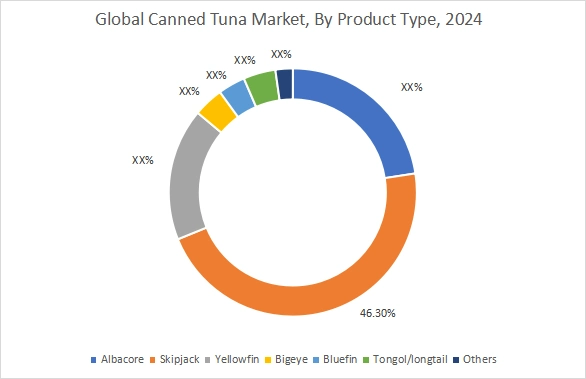
On the basis of product type, the canned tuna market is segmented into albacore, skipjack, yellowfin, bigeye, bluefin, tongol or longtail, and others.
Trends in the Product type:
- Growing demand for light meat tuna is increasing volume sales in mass retail.
- Rising preference for premium cuts is supporting higher value realization in developed markets.
The skipjack was responsible for the highest revenue share of 46.3% in 2024.
- Skipjack is commonly used for canning due to availability and cost-effectiveness.
- It also supports the large-scale commercial processing of the fish in Southeast Asia and Latin America.
- Additionally, the flavor profile of the fish matches the mainstream taste preferences of consumers.
- Further, the supply of the fish also makes it suitable for private label production.
- Thus, the high catch rates and cost factors contribute to the dominance of the Skipjack segment.
It is anticipated that the albacore will exhibit the highest compound annual growth rate (CAGR) during the forecast period.
- Albacore is positioned as a premium white meat tuna category.
- Additionally, demand is increasing in North America for solid white tuna variants.
- Further, health-focused consumers are opting for high-quality protein sources.
- Moreover, premium retail pricing improves revenue contribution.
- Therefore, rising premium product demand is expected to drive the Albacore segment growth.
By Flavor:
On the basis of flavor, the canned tuna market is segmented into unflavored and flavored.
Trends in the Flavor:
- Consumers are exploring ready-to-eat meal solutions with added seasoning.
- Retail brands are expanding product lines with regional taste profiles.
The unflavored was responsible for the highest revenue share in 2024.
- Unflavored tuna serves as a base ingredient for salads, sandwiches, and cooked meals.
- Moreover, it supports bulk purchasing by households and foodservice operators.
- In addition, price competitiveness strengthens its mass market demand.
- Additionally, longer shelf stability without added ingredients improves storage efficiency.
- Therefore, versatility and affordability are supporting dominance of the unflavored segment.
It is anticipated that the flavored will exhibit the highest compound annual growth rate (CAGR) during the forecast period.
- Flavored variants include chili, lemon, herb, and oil-based blends.
- Further, ready-to-eat demand is rising among urban working consumers.
- Moreover, portion-controlled packaging improves convenience.
- In addition, innovation in seasoning supports brand differentiation.
- Therefore, increasing demand for convenience-based protein snacks is expected to drive the flavored segment growth.
By Distribution Channel:
On the basis of distribution channel, the canned tuna market is divided into supermarkets and hypermarkets, convenience stores, specialty stores, and online.
Trends in the Distribution Channel:
- Organized retail expansion is increasing shelf space for packaged seafood.
- E-commerce grocery websites are also expanding access in tier 2 and tier 3 cities.
Supermarkets and Hypermarkets accounted for the largest revenue share in the year 2024.
- Large retail chains are also offering bulk display and private label options.
- Also, in-store promotions also increase category visibility.
- In addition, stable cold chain infrastructure supports inventory management.
- Additionally, consumer preference for one-stop shopping increases repeat purchases.
- Therefore, strong retail penetration is supporting dominance of supermarkets and hypermarkets.
Online is anticipated to register the fastest CAGR during the forecast period.
- Online grocery platforms are expanding subscription-based food delivery models.
- Further, digital promotions and bundled offers are increasing trial purchases.
- Moreover, direct-to-consumer brands are strengthening online presence.
- In addition, wider geographic coverage improves rural and semi-urban access.
- Therefore, rising digital grocery adoption is expected to accelerate growth of the online segment.
Regional Analysis:
North America, Europe, Asia Pacific, the Middle East and Africa, and Latin America are the regions of coverage.

In 2024, North America accounted for the highest market share at 44% and was valued at USD 8.22 Billion, and is expected to reach USD 13.48 Billion by 2035. In North America, the U.S. accounted for the highest market share of 82.03% during the base year of 2024. The growth of the market in this region is also driven by the high per capita consumption of seafood and the high penetration of packaged food into the retail market. The growth of the market in this region is also driven by the presence of large supermarket chains and the expansion of private label products, which increase the shelf space for canned tuna.
- For example, in August 2025, Bumble Bee Seafoods launched its new product line known as Bumble Bee Snackers, which is a single-serve 3-oz flavored tuna available in different flavors such as Lemon Pepper, Hickory Smoke, Sweet Heat, Thai Chili, and Tuna Salad, which does not require draining and is therefore more consumer-friendly.

Asia Pacific region is expected to experience the highest growth during the forecast period. Thailand, Indonesia, and Vietnam are key global processing hubs for exports. China is expanding modern retail infrastructure, which is increasing packaged seafood penetration in urban areas. India is witnessing gradual growth in organized retail and e-commerce grocery platforms, which is improving product accessibility. The increasing levels of income of people belonging to the growing middle class of Southeast Asia is also contributing to the demand for affordable sources of proteins.
- In June 2024, Thai Union Company’s John West canned tuna brand launched Ecotwist, a sustainable canned tuna multipack, in June 2024. Ecotwist eliminates plastic wrap and uses lighter steel cans and aluminum strips for recycling, reducing over 400 tons of steel and 1,500 tons of ingredients annually.
The Europe canned tuna market is growing due to steady consumption of seafood products in countries such as the UK, Germany, France, Italy, and Spain. Sustainable products are gaining traction in Western Europe. Private label is contributing to market growth as retailers aim to retain price competitiveness.
Latin America canned tuna market growth is supported by strong domestic consumption in Brazil and Mexico. Ecuador continues to serve as a major export-oriented processing hub. Expansion of supermarket chains is improving product reach across urban centers.
The Middle East and Africa canned tuna market is driven by rising demand for shelf-stable food products in the UAE, Saudi Arabia, and South Africa. The rise in organized retail and urban population expansion is supporting steady consumption trends.
Top Key Players & Market Share Insights:
The canned tuna market is moderately consolidated with global tuna processors, regional canneries, and private label manufacturers competing in the market. Industry players are focusing on improving raw tuna supply contracts and investing in automation to increase profitability of tuna processing. Certifications for sustainable sourcing are affecting brand positions in developed countries. Capacity additions in Southeast Asia and Latin America are increasing price competition across volume segments. Key participants in the market for canned tuna include:
- Thai Union Group – Thailand
- Bumble Bee Foods – US
- StarKist Co.– US
- Bolton Group – Italy
- Dongwon Group – South Korea
- Century Pacific Food Inc. – Philippines
- Jealsa Corporación – Spain
- Albacora S.A. – Spain
- Frinsa del Noroeste S.A. – Spain
- Wild Planet Foods – US
Recent Industry Developments:
- In March 2026, Tunamax formed an alliance with Gaictech to set up Morocco's largest high-tech tuna canning factory in Casablanca, where 15,000 tons of whole tuna are processed and over 50 million cans are produced.
- In March 2026, Patagonia Provisions is launching Smoked Jack Mackerel, sustainably sourced and MSC-approved tinned fish from Chile, available across the country at Whole Foods and Sprouts stores, replacing its discontinued Atlantic Mackerel due to overfishing.
Canned Tuna Market Report Insights:
| Report Attributes | Report Details |
|---|---|
| Study Timeline | 2019-2035 |
| Market Size in 2035 (USD Billion) | USD 30.63 Billion |
| CAGR (2025-2035) | 4.60% |
| By Product Type |
|
| By Flavor |
|
| By Distribution Channel |
|
| By Region |
|
| Key Players |
|
| Report Coverage |
|
Key Questions Answered in the Report
How big is the canned tuna market? −
The canned tuna market size is estimated to reach over USD 30.63 Billion by 2035 from a value of USD 18.68 Billion in 2024 and is projected to grow by USD 19.53 Billion in 2025, growing at a CAGR of 4.60% from 2025 to 2035.
Which segmentation details are covered in the canned tuna report? +
The canned tuna report includes specific segmentation details for product type, flavor, distribution channel, and regions.
Which is the fastest segment anticipated to impact the market growth? +
Online channel is the fastest growing segment, driven by rapid expansion of e-commerce grocery platforms.
Who are the major players in the canned tuna market? +
The key participants in the canned tuna market are Thai Union Group (Thailand), Bumble Bee Foods (US), StarKist Co. (US), Bolton Group (Italy), Dongwon Group (South Korea), Century Pacific Food Inc. (Philippines), Jealsa Corporación (Spain), Albacora S.A. (Spain), Frinsa del Noroeste S.A. (Spain), Wild Planet Foods (US), and others.
What are the key trends in the canned tuna market? +
Rising demand for shelf-stable protein, growth of private labels, and focus on sustainable sourcing are shaping the market.
Overview
Reputation & Certifications


Our Services
- Market Intelligence & Forecasting
- Custom Research Solutions
- Market Entry Strategy
- Competitive Intelligence
- Customer Insights
- Industry Innovation Analysis
- Investment Advisory