Jump to Content
Carry Deck Crane Market - Size, Share, Industry Trends, and Forecasts (2025-2032)
Carry Deck Crane Market Size:
Carry Deck Crane Market size is estimated to reach over USD 1,009.94 Million by 2032 from a value of USD 702.11 Million in 2024 and is projected to grow by USD 722.25 Million in 2025, growing at a CAGR of 4.6% from 2025 to 2032.
Carry Deck Crane Market Scope & Overview:
A carry deck crane is a compact, mobile lifting solution designed for material handling in confined spaces, particularly within industrial facilities, warehouses, and construction sites. Featuring a rotating boom mounted on a flat deck and four-wheel steering, it allows for load transport and placement with exceptional maneuverability.
Equipped with telescopic booms, hydraulic controls, and low-profile frames, these cranes are built for indoor and low-clearance operations. The integrated deck provides added functionality, allowing operators to transport materials across short distances without the need for additional equipment.
Key advantages include quick setup, multi-directional mobility, and versatility in lifting small to mid-sized loads. Carry deck crane models are designed to navigate tight work zones and support maintenance, installation, and material relocation tasks. Their compact footprint and efficient operation make them a valuable asset for sectors requiring flexible lifting capacity in restricted or obstacle-filled environments.
How is AI Transforming the Carry Deck Crane Market?
The integration of AI is significantly transforming the carry deck crane market. AI is increasingly being integrated into carry deck cranes for enhancing safety, efficiency, and facilitating automation. AI-powered systems are often used for optimizing crane operations, predictive maintenance, and improving safety features such as collision avoidance.
Additionally, AI can automate tasks such as precise load handling and others, in turn reducing manual labor and improving speed. Further, AI-powered systems can enable remote operation of cranes, thereby improving safety in hazardous environments. Consequently, the above factors are projected to boost the market growth in upcoming years.

Carry Deck Crane Market Dynamics - (DRO) :
Key Drivers:
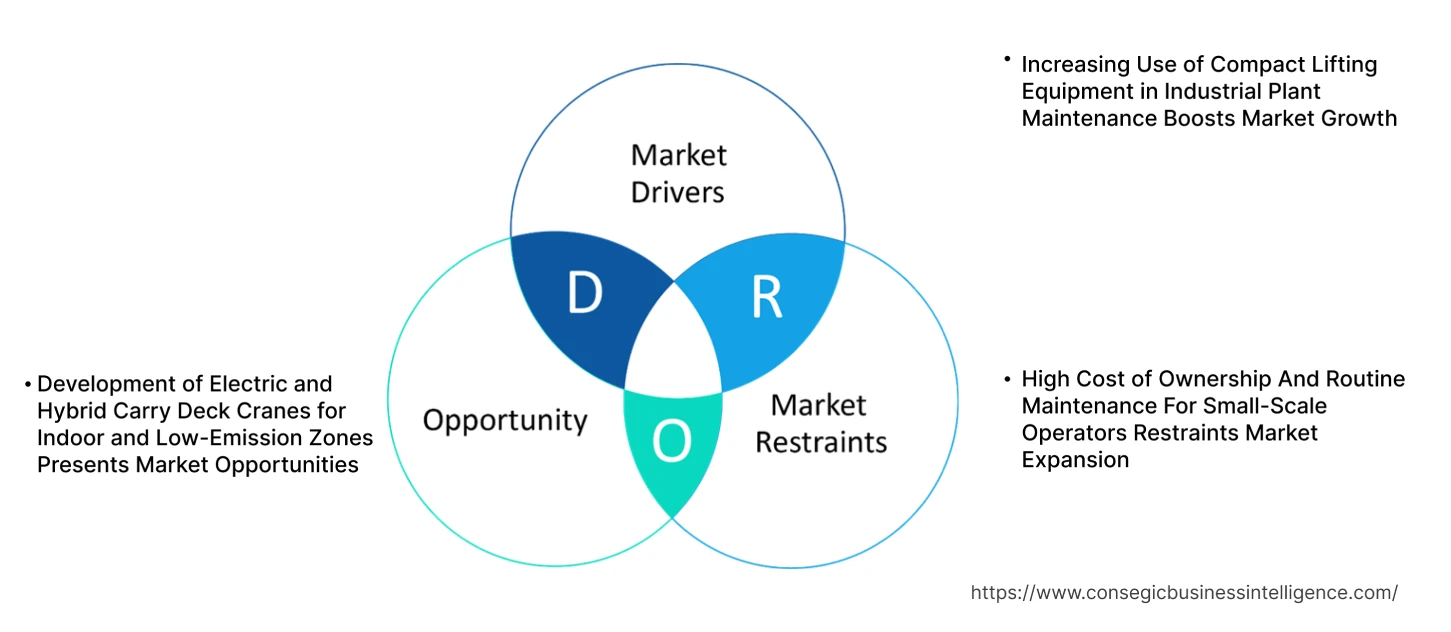
Increasing Use of Compact Lifting Equipment in Industrial Plant Maintenance Boosts Market Growth
Industrial facilities such as manufacturing plants, power stations, and chemical processing units require material handling equipment that can operate in confined indoor environments with low clearance and restricted movement paths. Carry deck cranes are specifically designed for these conditions, offering compact size, 360-degree rotation, and onboard load-carrying capabilities. Their ability to maneuver around tight aisles and operate under overhead obstructions makes them highly suitable for plant maintenance, component replacement, and equipment installation. Additionally, these cranes are often deployed in shutdown and turnaround activities, where downtime minimization is critical. As industries continue to upgrade and maintain aging infrastructure, the need for versatile, compact cranes is increasing. This growing reliance on specialized lifting solutions in operationally constrained environments is driving consistent demand, contributing to long-term carry deck crane market expansion.
Key Restraints:
High Cost of Ownership And Routine Maintenance For Small-Scale Operators Restraints Market Expansion
Carry deck cranes require regular inspection, hydraulic servicing, tire replacements, and safety compliance checks to maintain optimal performance and operator safety. For small-scale contractors and independent operators, these recurring expenses increase the total cost of ownership, especially when project volume is inconsistent. The initial capital investment for acquiring it, combined with the cost of skilled operators and certified maintenance, presents a financial burden for companies with limited budgets. Furthermore, depreciation and insurance costs add to the overall economic challenge. In many cases, smaller operators choose to rent or substitute with forklifts or smaller boom trucks, particularly when the scope of lifting is minimal. Despite strong demand from industrial and commercial sectors, the economic barrier associated with owning and maintaining this equipment continues to restrict broader adoption, limiting the carry deck crane market growth among smaller and mid-sized users.
Future Opportunities :
Development of Electric and Hybrid Carry Deck Cranes for Indoor and Low-Emission Zones Presents Market Opportunities
As emissions regulations become stricter and sustainability initiatives gain momentum, manufacturers are introducing electric and hybrid-powered carry deck cranes tailored for indoor use and urban job sites. These models offer zero on-site emissions, reduced noise levels, and lower operating costs, making them ideal for warehouses, factories, and environmentally regulated zones such as hospitals or food processing units. In addition to environmental benefits, electric drive systems reduce mechanical wear, improving equipment longevity and lowering maintenance requirements. Demand for low-emission material handling equipment is growing, particularly in regions enforcing carbon-neutral construction goals and green procurement policies. These cranes also appeal to rental fleets and industrial facilities aiming to modernize operations while meeting environmental standards.
- For instance, in March 2023, Broderson Manufacturing Corp unveiled its first battery electric-powered, zero-emissions industrial carry deck crane, ICe-80, at the ConExpo 2023 in the United States. The common diesel or dual-fuel powered engine is replaced with a 700 VDC lithium-ion battery pack and permanent magnet synchronous motors and inverters to operate the hydraulic systems. It is designed for 8 hours of usage with a maximum speed of 17 miles per hour.
As electrification trends continue to reshape the equipment landscape, the introduction of clean-powered cranes is unlocking new carry deck crane market opportunities driven by sustainability-driven growth and regulatory alignment.
Carry Deck Crane Market Segmental Analysis :
By Capacity:
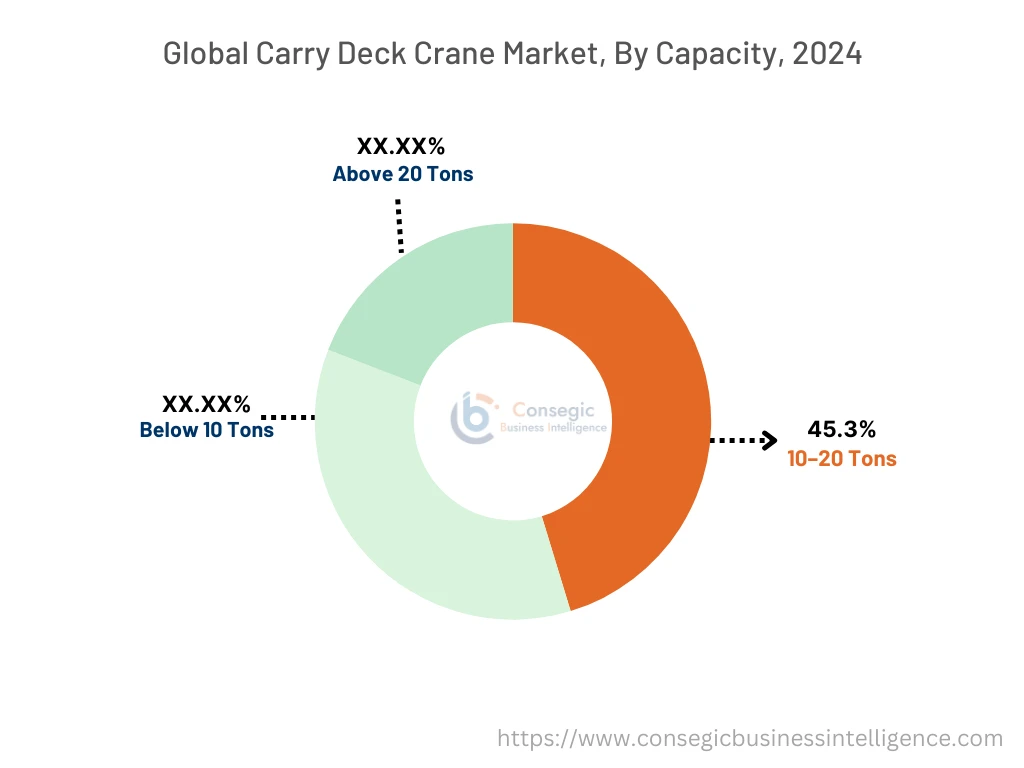
Based on capacity, the market is segmented into below 10 tons, 10–20 tons, and above 20 tons.
The 10–20 tons segment accounted for the largest carry deck crane market share of 45.3% in 2024.
- The 10–20 tons category is ideal for medium-scale construction and industrial projects, where flexibility and maneuverability are crucial.
- These cranes are commonly used in construction, warehousing, and transportation sectors, where their lifting capacity supports a wide range of equipment and materials.
- Their compact size and easy operation allow them to work in confined spaces, making them highly valued in urban and tight-space projects.
- As per the carry deck crane market analysis, this segment continues to dominate due to its versatility and applicability across various industries.
The above 20 tons segment is expected to witness the fastest CAGR during the forecast period.
- Larger cranes with capacities above 20 tons are required for heavy-duty operations, especially in industrial construction and large-scale infrastructure projects.
- These cranes are commonly used in oil & gas, mining, and shipping, where larger loads are involved.
- They offer greater stability, higher lifting heights, and the ability to handle heavy machinery and materials.
- For instance, in February 2021, Broderson Manufacturing launched the new 20-ton capacity IC-280-A industrial carry deck crane consisting of a 64-foot 5 inch (19,6m) four-section, full power boom; a compact boom head; and a 20-foot boom extension that offsets at different angles. The machine includes an integrated telematics system for enhanced performance.
- According to carry deck crane market trends, increasing investments in large-scale construction and industrial projects will drive the growth of this segment.
By Power Source:
Based on power source, the market is segmented into diesel, electric, and hybrid.
The diesel-powered segment held the largest carry deck crane market share in 2024.
- Diesel-powered cranes offer higher power output, extended operational hours, and versatility, making them suitable for outdoor and heavy-duty applications.
- These cranes are particularly favored in sectors such as construction, mining, and oil & gas, where high lifting capacity and robust performance are required.
- Their ability to operate without being dependent on electricity makes them ideal for use in remote locations and job sites with no power supply.
- As per carry deck crane market analysis, diesel-powered cranes remain dominant due to their performance, portability, and cost-effectiveness in large-scale operations.
The hybrid-powered segment is projected to witness the fastest CAGR.
- Hybrid cranes combine the efficiency of diesel with the energy savings of electric motors, offering improved fuel efficiency and reduced emissions.
- These cranes are gaining traction in environmentally conscious markets where sustainability and energy efficiency are prioritized.
- They are ideal for urban construction projects and indoor environments where noise reduction and air quality are essential.
- For instance, in May 2022, Escorts Construction Equipment (ECE) launched NXT13DC CNG, India’s first Hybrid Pick-n-Carry Crane, with dual Fuel (Diesel & CNG). The 13-ton machine has a 49.5 HP BSIII engine compatible with CNG, offering low operating cost and rear deck utility for the transfer of items.
- According to carry deck crane market trends, hybrid solutions are expected to play a key role in the market's future expansion, driven by increasing environmental regulations and green construction standards.
By Distribution Channel:
Based on distribution channel, the carry deck crane market is segmented into OEMs, aftermarket, online retail, and distributors & dealers.
The OEM segment accounted for the largest revenue share in 2024.
- OEMs supply them directly to construction companies and industries, ensuring quality, reliability, and system integration.
- These relationships are essential for large-scale industrial and construction projects that require specific crane configurations and custom solutions.
- OEMs also offer after-sales support, maintenance packages, and training for operators, further enhancing the segment's growth.
- As per carry deck crane market demand, the OEM channel remains dominant due to its ability to provide high-quality equipment and reliable service to large enterprises and project developers.
The distributors & dealers segment is expected to experience the fastest CAGR during the forecast period.
- Distributors and dealers act as intermediaries between OEMs and end-users, offering a broad range of cranes for different customer needs, from small enterprises to large-scale operations.
- This segment is crucial in regions where local access to OEM products is limited or where quick delivery is essential.
- Local dealers often offer flexible financing options, repairs, and installation services, which contribute to the segment's expansion.
- Thus, the increased requirement for rental and financing options, along with better distribution networks, drives the carry deck crane market growth.
By End-Use Industry:
Based on end-use industry, the carry deck crane market is segmented into construction, manufacturing, oil & gas, mining, transportation, and others.
The construction segment held the largest revenue share in 2024.
- Carry deck cranes are widely used in construction for material handling, site preparation, and lifting heavy equipment.
- Their compact size and ability to operate in tight spaces make them ideal for urban and residential construction projects.
- With increasing construction activities in both emerging and developed markets, its requirement remains high.
- As per the carry deck crane market demand, construction continues to be the most significant driver, due to the continued need for better roads and infrastructure.
The oil & gas segment s expected to register the fastest CAGR during the forecast period.
- In the oil & gas industry, they are used for lifting heavy equipment, transporting materials, and performing maintenance tasks at offshore platforms and drilling sites.
- These cranes are designed to handle rough conditions, providing operational reliability in extreme environments.
- With the growing investments in energy exploration and drilling activities, the oil & gas sector is experiencing a higher adoption of specialized cranes.
- Hence, this segment is poised for growth due to rising oil production projects and infrastructure development in offshore drilling regions, propelling carry deck crane market expansion.
Regional Analysis:
The regions covered are North America, Europe, Asia Pacific, the Middle East and Africa, and Latin America.
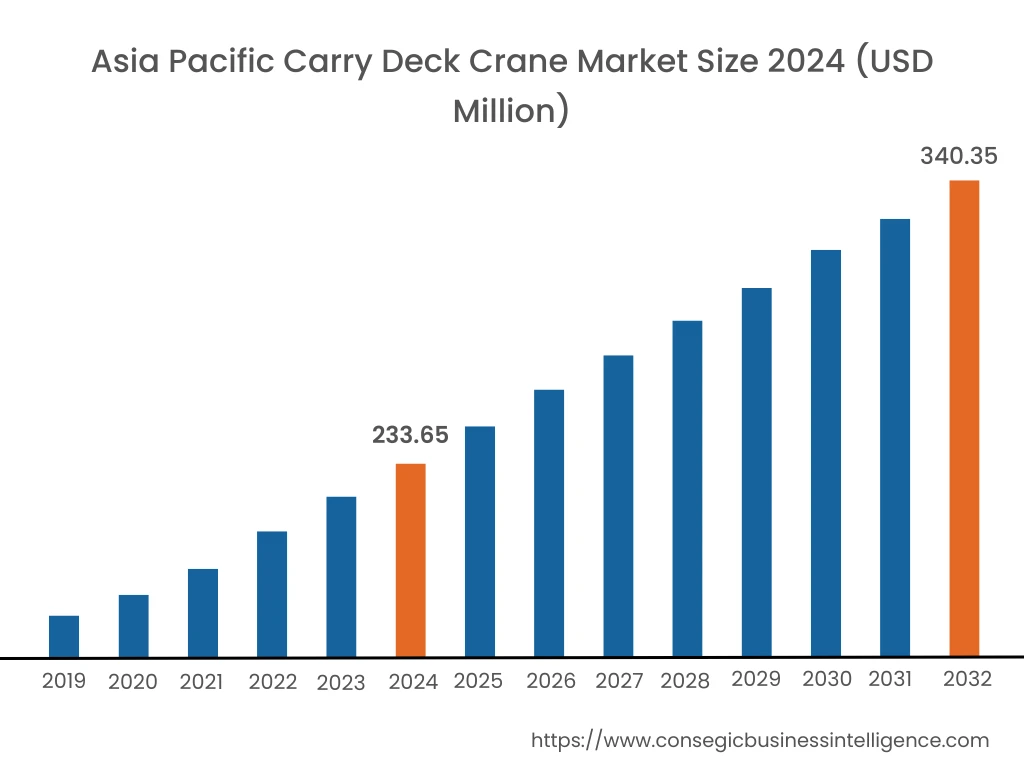
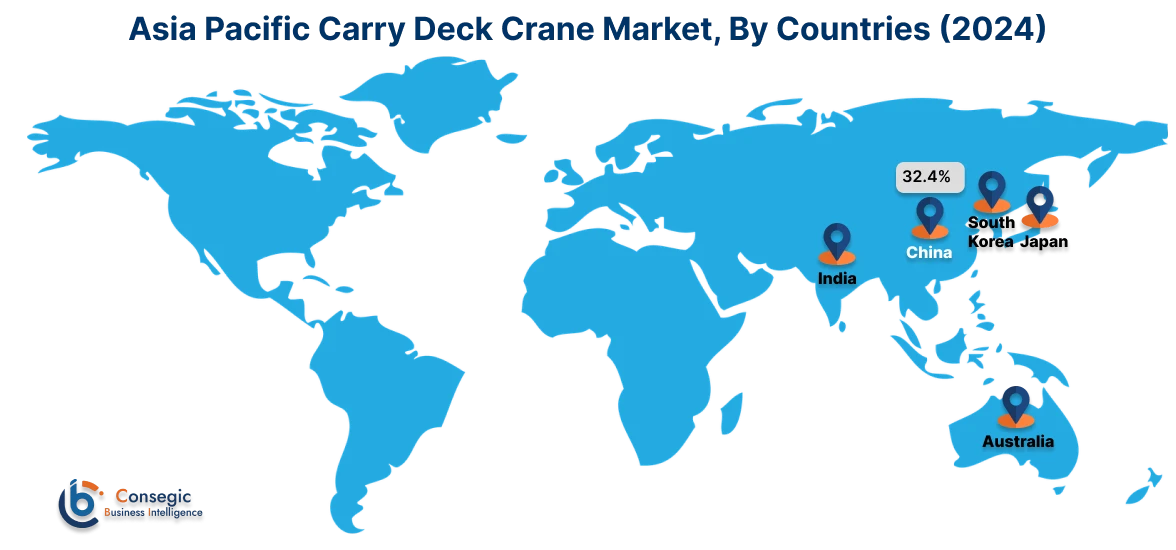
Asia Pacific region was valued at USD 233.65 Million in 2024. Moreover, it is projected to grow by USD 240.61 Million in 2025 and reach over USD 340.35 Million by 2032. Out of this, China accounted for the maximum revenue share of 32.4%. Asia-Pacific is experiencing steady growth, led by expansion in industrial automation, infrastructure modernization, and increased manufacturing activity. China, Japan, South Korea, and India are key contributors where industrial users are incorporating carry deck cranes in equipment assembly, logistics yards, and large-scale manufacturing facilities. Market analysis highlights growing need for cranes with compact footprints and high maneuverability in congested or enclosed sites. In Japan and South Korea, innovation is driving adoption of battery-operated models with advanced controls. Growth is supported by investment in smart factories and the widespread need for mobile lifting equipment across ports, refineries, and assembly lines.
North America is estimated to reach over USD 297.63 Million by 2032 from a value of USD 206.20 Million in 2024 and is projected to grow by USD 212.18 Million in 2025. North America maintains a leading role in the adoption of carry deck cranes, particularly in the United States and Canada where manufacturing plants, utility maintenance, and industrial facilities favor compact lifting solutions. Market analysis reveals strong need for electric and hybrid variants, especially for operations inside warehouses, refineries, and maintenance workshops. Growth in this region is being fueled by a rising emphasis on operational flexibility, safety compliance, and minimal downtime in confined workspaces. Additionally, the rental market for compact cranes is expanding as small- and mid-size contractors prioritize cost-effective solutions for short-term industrial lifting needs.
Europe represents a technologically advanced market, with growing demand for low-emission, high-maneuverability cranes suited to urban infrastructure and factory settings. Countries such as Germany, France, and the UK are investing in electric-powered models that meet stringent environmental and noise regulations. Market analysis shows increased integration of telematics and load management systems that enhance precision and operational safety. The development in Europe is bolstered by the push for decarbonized construction equipment and the shift toward compact machinery in urban redevelopment projects, cleanroom environments, and heavy manufacturing.
Latin America is emerging as a promising region for its adoption, especially in Brazil, Mexico, and Chile. Market analysis indicates requirement is largely driven by energy sector infrastructure, mining support operations, and urban utility maintenance. Contractors and facility managers seek compact cranes that are easy to transport and can handle moderate lifting in constrained spaces. There is also a gradual shift toward electric-powered models as regulatory focus on emissions intensifies. The carry deck crane market opportunity in Latin America is linked to industrial modernization, enhanced safety regulations, and expanding public-private partnerships in logistics and urban services.
The Middle East and Africa are gradually adopting carry deck cranes, especially in the UAE, Saudi Arabia, and South Africa. Demand is emerging from industrial maintenance, oil & gas support facilities, and infrastructure maintenance at airports and commercial buildings. Market analysis reveals an emphasis on durable, low-maintenance equipment capable of operating in extreme temperatures and confined service areas. While diesel-powered models are currently dominant, there is growing interest in hybrid and electric alternatives to comply with sustainability goals in industrial development projects. Growth in this region is supported by increased investment in manufacturing parks and logistics hubs.
Top Key Players and Market Share Insights:
The carry deck crane market is highly competitive with major players providing products and services to the national and international markets. Key players are adopting several strategies in research and development (R&D), product innovation, and end-user launches to hold a strong position in the global carry deck crane market. Key players in the carry deck crane industry include-
- Terex Corporation (USA)
- Broderson Manufacturing Corp. (USA)
- Manitex International, Inc. (USA)
- XCMG Group (China)
- Tadano Ltd. (Japan)
- Kobelco Construction Machinery Co., Ltd. (Japan)
- SANY Group (China)
- Zoomlion Heavy Industry Science & Technology Co., Ltd. (China)
- Liebherr Group (Germany)
- Locatelli Crane S.r.l. (Italy)
Acquisitions:
Product Launch:
- In October 2024, Jackson Walker advised Scott-Macon Group in its sale to Allegiance Crane & Equipment. The acquisition emphasizes both companies’ commitment to excellence and innovation, enabling new opportunities for future success.
- In March 2024, the US-based BOSS (Bennett On Site Services) Crane & Rigging acquired Cowboy’s Services, Inc.’s division dba CSI Heavy Haul. This acquisition increases BOSS’s heavy haul fleet, expertise, and capabilities. It also enhances customer benefits and strengthens its position in the market.
Carry Deck Crane Market Report Insights :
| Report Attributes | Report Details |
| Study Timeline | 2019-2032 |
| Market Size in 2032 | USD 1,009.94 Million |
| CAGR (2025-2032) | 4.6% |
| By Capacity |
|
| By Power Source |
|
| By Distribution Channel |
|
| By End-Use Industry |
|
| By Region |
|
| Key Players |
|
| North America | U.S. Canada Mexico |
| Europe | U.K. Germany France Spain Italy Russia Benelux Rest of Europe |
| APAC | China South Korea Japan India Australia ASEAN Rest of Asia-Pacific |
| Middle East and Africa | GCC Turkey South Africa Rest of MEA |
| LATAM | Brazil Argentina Chile Rest of LATAM |
| Report Coverage |
|
Key Questions Answered in the Report
How big is the Carry Deck Crane Market? −
Carry Deck Crane Market size is estimated to reach over USD 1,009.94 Million by 2032 from a value of USD 702.11 Million in 2024 and is projected to grow by USD 722.25 Million in 2025, growing at a CAGR of 4.6% from 2025 to 2032.
What specific segmentation details are covered in the Carry Deck Crane Market report? +
The Carry Deck Crane market report includes specific segmentation details for capacity, power source, distribution channel and end-use industry.
What are the end-use industries of the Carry Deck Crane Market? +
The end-use industries of the Carry Deck Crane Market are construction, manufacturing, oil & gas, mining, transportation, and others.
Who are the major players in the Carry Deck Crane Market? +
The key participants in the Carry Deck Crane market are Terex Corporation (USA), Broderson Manufacturing Corp. (USA), Manitex International, Inc. (USA), XCMG Group (China), Tadano Ltd. (Japan), Kobelco Construction Machinery Co., Ltd. (Japan), SANY Group (China), Zoomlion Heavy Industry Science & Technology Co., Ltd. (China), Liebherr Group (Germany) and Locatelli Crane S.r.l. (Italy).
Overview
Reputation & Certifications


Our Services
- Market Intelligence & Forecasting
- Custom Research Solutions
- Market Entry Strategy
- Competitive Intelligence
- Customer Insights
- Industry Innovation Analysis
- Investment Advisory