Jump to Content
Jackhammer Market - Size, Share, Industry Trends, and Forecasts (2025-2032)
Jackhammer Market Size:
Jackhammer Market size is growing with a CAGR of 6.9% during the forecast period (2025-2032), and the market is projected to be valued at USD 695.71 Million by 2032 from USD 409.10 Million in 2024. Additionally, the market value for the 2025 attributes to USD 435.91 Million.
Jackhammer Market Scope & Overview:
A jackhammer is a powerful handheld tool. It is used for breaking hard materials such as rock, concrete, and asphalt. There are three types of these tools. This includes pneumatic, hydraulic, and electric. The applications of this tool include mining (breaking rock), demolition (dismantling structure), and tunneling (excavating underground) amongst others. These power-source tools allow for quick completion of tasks for workers. This leads to fewer potential injuries and fatigue, which are associated with manual breaking. Modern design of these tools incorporates features to enhance user comfort and safety. The distribution of these tools occurs through online and offline channels such as equipment dealers or hardware stores.

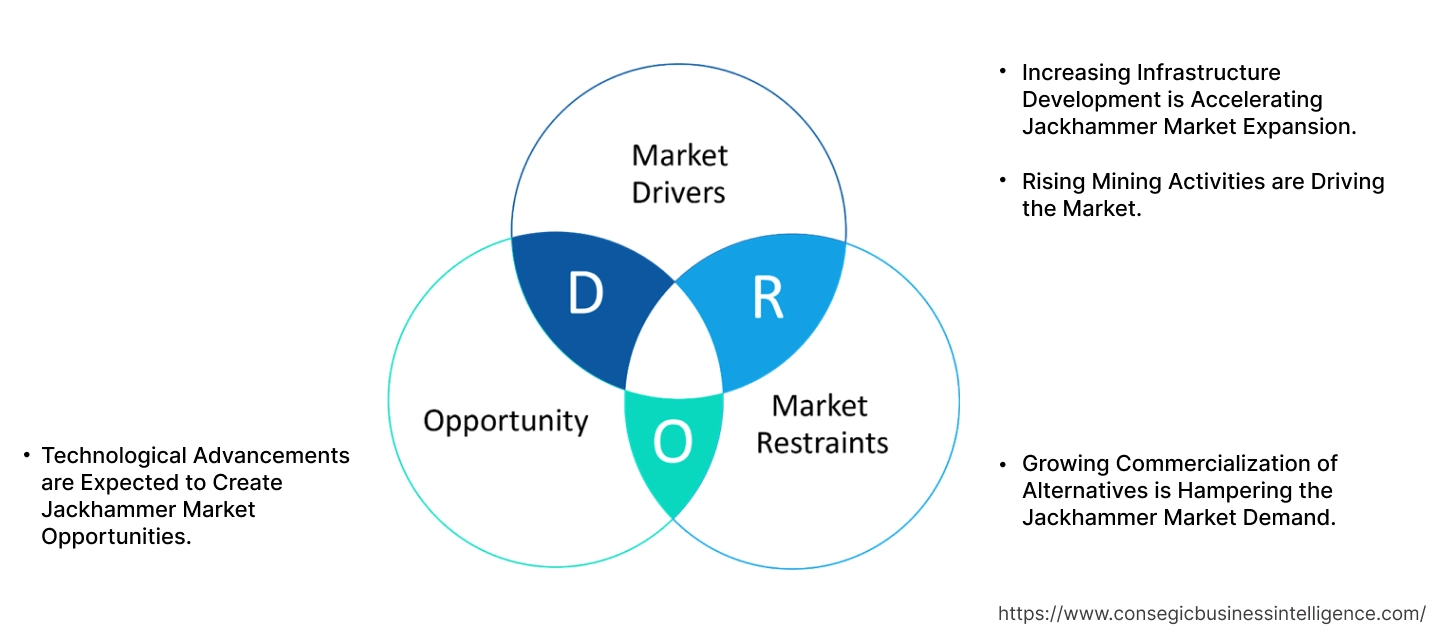
Jackhammer Market Dynamics - (DRO) :
Key Drivers:
Increasing Infrastructure Development is Accelerating Jackhammer Market Expansion.
Jackhammer tools are used for breaking and removing hard materials such as concrete and asphalt efficiently. They speed up the construction process and reduce manual labor. This enhances productivity for tasks such as road repairs, foundation work, and site preparation. The global investment in infrastructure projects is increasing. This includes the development of roads, railways, airports, and public utilities. These large-scale projects necessitate demolition and excavation, influencing the demand for jackhammer.
For instance,
- In 2023, the S. federal government directly spent USD 44.8 billion on infrastructure projects. Additionally, the federal government transferred USD 81.5 billion to state and local governments for infrastructure projects.
Overall, the increasing infrastructure development is significantly boosting the jackhammer market expansion.
Rising Mining Activities are Driving the Market.
Mining is the process of extracting valuable minerals and other geological materials from the earth. A jackhammer is crucial in mining for breaking and drilling rock formations to access ore deposits. Pneumatic and hydraulic types of these tools provide the high-impact force needed for these demanding tasks. These tools increase efficiency in breaking hard rock, enabling faster extraction rates. Growing demand for critical minerals needed for the energy transition has led to a rise in mining activities, increasing the need for jackhammer.
For instance,
- According to the Indian Ministry of Mines, the production of limestone, a non-metallic mineral, in India reached 451 million tonnes during the fiscal year 2023-24. This represents a significant increase of 11% compared to the production in the previous fiscal year.
Thus, rising mining activities are accelerating the global jackhammer market growth.
Key Restraints:
Growing Commercialization of Alternatives is Hampering the Jackhammer Market Demand.
The market faces competition from other available substitutes hindering the market. Robotic demolition machines offer precision and remote operation. This enhances safety in hazardous environments and allows access to confined spaces. Moreover, controlled blasting provides a powerful and efficient solution for large-scale rock excavation in mining and infrastructure projects. These techniques minimize environmental impact. Additionally, hydraulic excavators equipped with breaker attachments offer versatility, combining digging and breaking capabilities in a single machine. This is suitable for various construction and demolition tasks. These alternatives, along with other specialized tools, provide project managers with a broader range of options based on specific requirements such as scale, precision, safety, and environmental considerations. Hence, the growing commercialization of alternatives is hampering the jackhammer market demand.
Future Opportunities :
Technological Advancements are Expected to Create Jackhammer Market Opportunities.
Innovations are being developed to enhance the power efficiency of jackhammer. It is allowing newer models to deliver more impact force while consuming less energy. This is leading to cost savings and reduced environmental impact. Additionally, significant strides in vibration-dampening technology minimize operator fatigue and the risk of hand-arm vibration syndrome. Furthermore, there is an increased development of cordless jackhammer.
For instance,
- In 2024, Makita launched a new, powerful 70 lb. cordless breaker hammer. This tool provides concrete workers with a portable, AVT-equipped, battery-powered solution that performs comparably to corded or pneumatic breakers, facilitating a shift towards cordless job sites.
Overall, technological advancements are expected to increase jackhammer market opportunities.
Jackhammer Market Segmental Analysis :
By Product Type:
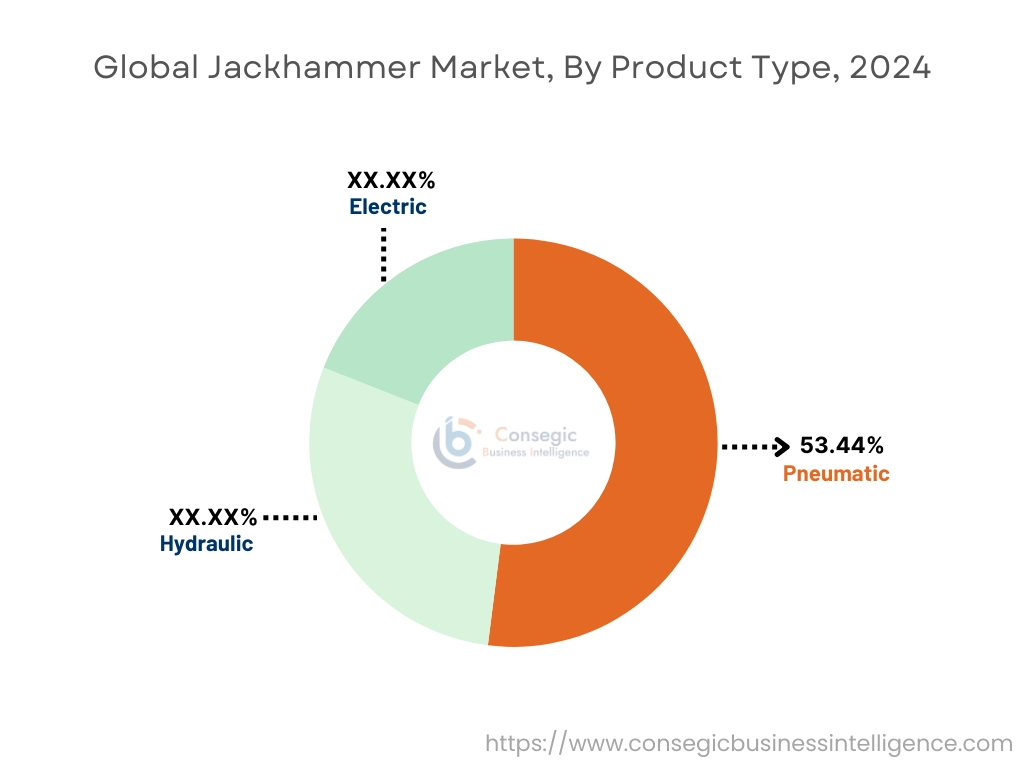
Based on product type, the market is categorized into pneumatic, hydraulic, and electric.
Trends in Product Type:
- Pneumatic is currently a widely used type due to its power and dependability, especially in heavy-duty construction, demolition, and mining.
- The rise of cordless, battery-powered electric type offers enhanced portability, contributing to the shift towards cord-free job sites.
The pneumatic segment accounted for the largest market share of 53.44% in 2024.
- The pneumatic segment dominated the jackhammer market trends. It is a powerful tool operated by compressed air, typically supplied by an external air compressor.
- The compressed air drives an internal piston, which repeatedly strikes a chisel or drill bit to break hard materials.
- They are used for tasks such as breaking concrete and asphalt, demolishing structures, drilling rock, and excavation.
- Moreover, these tools have a longer lifespan due to fewer moving parts and are used continuously without overheating.
- The increasing construction activities such as demolition and roadwork are influencing the need for these powerful tools.
- Overall, as per the market analysis, rising construction activities are driving a segment in the jackhammer market growth.
The electric segment is expected to grow at the fastest CAGR over the forecast period.
- The electric segment is emerging in the market. It is a handheld power tool that uses an electric motor to drive a hammering mechanism for breaking hard materials.
- Unlike pneumatic models that require an air compressor, electric models are powered directly from an electrical outlet or a battery.
- These tools are used in breaking up smaller concrete slabs, removing tiles, chipping masonry, and light excavation work.
- The development of advanced models offers increased portability for tasks in areas without easy access to power, thus influencing the segment growth.
- For instance, in 2025, Bosch launched its first cordless demolition hammer, the GSH 18V-5 Professional. This lightweight and compact tool aims to set new standards in the five-kilo cordless demolition hammer class.
- Thus, according to market analysis, technological advancements are driving segmental growth for the upcoming years.
By Application:
Based on application, the market is categorized into mining, demolition, tunneling, and others.
Trends in Application:
- The increasing need for minerals such as lithium and cobalt for green technologies is driving more mining activities, boosting jackhammer use for extraction.
- The rise of underground infrastructure in densely populated areas is driving the need for efficient excavation, where these powerful tools play a role.
The demolition segment accounted for the largest market share in 2024.
- The demolition segment dominated the jackhammer market trends. It is the process of dismantling, tearing down, or wrecking structures such as buildings.
- Pneumatic and electric tools are essential in demolition for breaking apart hard materials such as concrete, asphalt, and masonry.
- Advantages include significantly faster material breakdown compared to manual methods, reduced labor intensity, and the ability to tackle tough, unyielding structures effectively.
- Rapid urbanization and the need for urban redevelopment, leading to the replacement of older structures with new ones has led to an increase in demolition activities, influencing the segment expansion.
- Overall, according to market analysis, growing mining activities in different regions are driving the segment in the market.
The mining segment is expected to grow at the fastest CAGR over the forecast period.
- Mining is an emerging segment in the market trends. In mining, a jackhammer is essential for breaking and drilling rock formations to access ore deposits.
- Their high impact force, especially in pneumatic and hydraulic models, allows for efficient rock fragmentation.
- The rising global need for metals and minerals essential for various industries is driving more investment in mining, creating potential for the segment for drilling purposes.
- For instance, according to Export Finance Australia, Australia's mining industry saw a significant capital expenditure of USD 11.5 billion in the March quarter of 2024, which is a 6% increase compared to the same period in the previous year.
- Henceforth, growing investment in mining activities creates potential for the market over the forecast period.
By Distribution Channel:
Based on the distribution channel, the market is categorized into offline and online.
Trends in the Distribution Channel:
- Offline channels are increasingly emphasizing services such as on-site maintenance, repairs, training, and application support to differentiate themselves.
- Manufacturers are increasingly exploring online platforms to sell directly to end-users, offering wider product selections and potentially lower prices.
The offline segment accounted for the largest market share in 2024.
- The offline segment dominated the market. This channel refers to the traditional methods of selling and distributing products through physical stores, dealerships, and direct sales through manufacturer representatives.
- This channel offers tangible benefits, allowing customers to physically inspect and handle the jackhammer before purchase, fostering trust and confidence in the product.
- Moreover, knowledgeable sales staff provide personalized advice, and demonstrations, and answer specific queries, enhancing the buying experience.
- For industrial-grade tools, the offline channel provides crucial after-sales services, including maintenance and repairs, and building long-term customer relationships.
- Furthermore, physical presence increases brand visibility and credibility within the local construction and mining communities.
- Overall, as per the market analysis, the offline channel providing multiple benefits is driving segmental growth in the jackhammer industry.
The online segment is expected to grow at the fastest CAGR over the forecast period.
- The online segment is emerging in the market. Online distribution refers to the sale of products through websites or e-commerce platforms.
- They provide wider reach to potential customers, allowing manufacturers and sellers to tap into a global market. This increased visibility leads to higher sales volumes.
- Online platforms often offer cost-effective marketing and sales compared to traditional brick-and-mortar stores, reducing overhead costs.
- Customers benefit from the convenience of browsing and purchasing products from anywhere at any time, thus driving the segment.
- For instance, according to Prosemedia, U.S. e-commerce revenue is projected to experience a CAGR of approx 13.0% between 2024 and 2025.
- Thus, the expanding e-commerce platforms will drive segmental growth for the forecasted years.
Regional Analysis:
The regional segment includes North America, Europe, Asia Pacific, the Middle East and Africa, and Latin America.
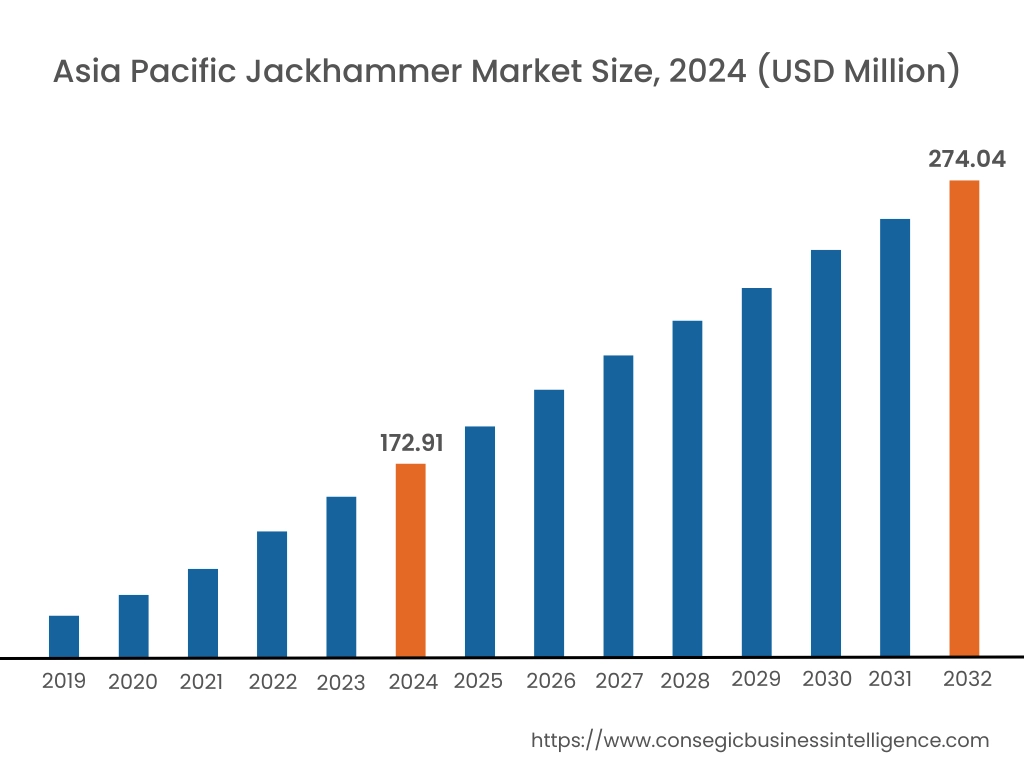
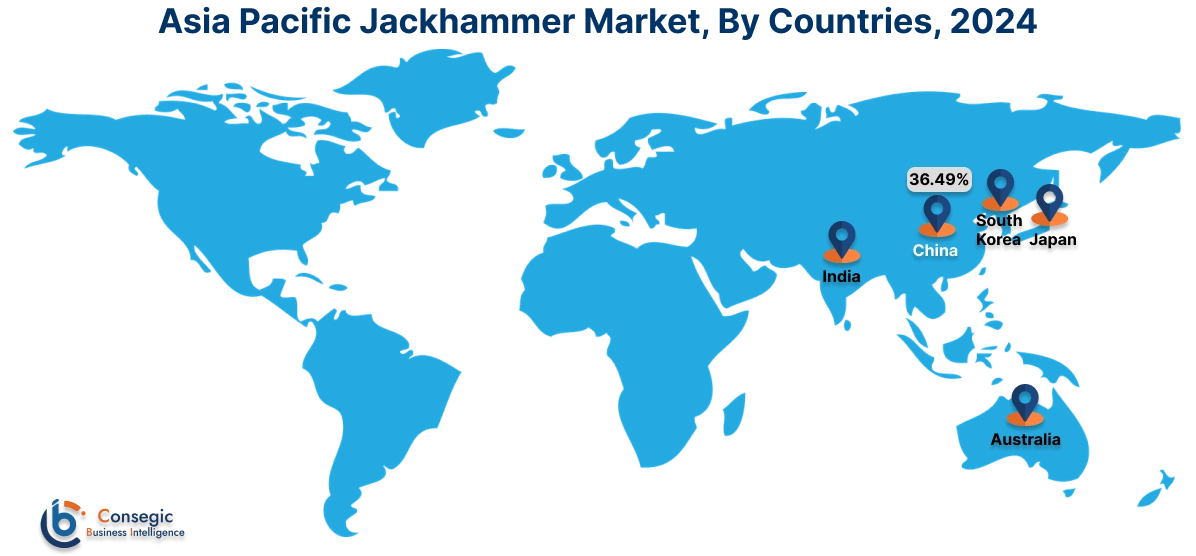
In 2024, Asia Pacific accounted for the highest jackhammer market share at 42.27% and was valued at USD 172.91 Million and is expected to reach USD 274.04 Million in 2032. In Asia Pacific, the China accounted for the jackhammer market share of 36.49% during the base year of 2024. The region is experiencing rapid increase in infrastructure projects, including transportation networks and urban development, influencing the need for jackhammer, which are used for demolition and excavation tasks.
For instance,
- According to the Times of India, in 2025, the metro network has expanded significantly over the past decade, tripling in range with the addition of 1,000 kilometers of track.
Moreover, governments are heavily investing in these areas to support economic growth and urbanization, leading to a substantial increase in the need for these power source tools for breaking ground, demolishing existing structures, and preparing sites for new construction across the continent. Overall, rising infrastructure development and government initiatives are driving the market in the region.
In Europe, the jackhammer market is experiencing the fastest growth with a CAGR of 8.1% over the forecast period. The increasing need for metals and minerals necessitates sustained mining operations in European countries. This sustained activity requires the use of powerful rock-breaking equipment such as jackhammer for extraction and tunneling within mines, thus driving the market into the region. Moreover, the increasing concentration of populations in cities necessitates renovation, and demolition activities, all requiring jackhammer for breaking and clearing materials.
North America’s jackhammer market analysis states that several trends are responsible for the progress of the market in the region. The region is witnessing a significant shift towards cordless electric jackhammer. Their enhanced portability, reduced noise levels, and ease of use are making them increasingly popular for a wide range of construction, and demolition. Advancements in battery technology are further driving this trend by offering comparable power to corded models.
The Middle East and Africa (MEA) jackhammer market analysis states that the region is also witnessing several trends, contributing towards market increase. There is a growing trend of DIY and home improvement projects in the region. This is increasing the requirements for lighter, more user-friendly tools, particularly electric models, among homeowners undertaking renovations, landscaping, and other small-scale construction tasks around their properties. Public sector spending on housing projects in numerous countries also supports the market.
Latin America's jackhammer market is also emerging. Technological advancements in jackhammer design are making these tools more efficient, safer, and easier to use. Features such as improved power-to-weight ratios, reduced vibration, and enhanced ergonomics are driving adoption by making them more productive and less physically demanding for construction and demolition workers in the region. The shift towards automation creates a need for specialized, smaller, breaking tools integrated into robotic or automated systems.
Top Key Players and Market Share Insights:
The Jackhammer market is highly competitive with major players providing products to the national and international markets. Key players are adopting several strategies in research and development (R&D) and product innovation to hold a strong position in the global Jackhammer market. Key players in The Jackhammer industry include-
- Hilti (Liechtenstein)
- Makita (Japan)
- BISON (China)
- Baumr-AG (Australia)
- Stanley Black & Decker, Inc. (United States)
- Robert Bosch Tool Corporation (United States)
- Milwaukee Tool (United States)
- Hengyou (China)
- TR Industrial (United States)
- Hitachi Koki Co., Ltd. (Japan)
Recent Industry Developments :
Product Launch:
- In July 2024, Sparc Electrex launched a new product, the 'Hyundai Demolition Hammer HB 11E. This tool is designed for various applications, including creating or expanding openings in concrete and brick walls, tile removal, concrete surface work, precision chiseling on masonry, and cutting channels in concrete or brickwork, among other uses.
- In May 2021, Makita launched two new robust demolition hammers, the 43 lb. (HM1502) and the 45 lb. AVT (HM1512) models. These powerful tools are designed for heavy-duty demolition work on lower walls or floor foundations up to 8 inches thick. They are also well-suited for digging trenches and tamping tasks.
Jackhammer Market Report Insights:
| Report Attributes | Report Details |
| Study Timeline | 2019-2032 |
| Market Size in 2032 | USD 695.71 Million |
| CAGR (2025-2032) | 6.9% |
| By Product Type |
|
| By Application |
|
| By Distribution Channel |
|
| By Region |
|
| Key Players |
|
| North America | U.S. Canada Mexico |
| Europe | U.K. Germany France Spain Italy Russia Benelux Rest of Europe |
| APAC | China South Korea Japan India Australia ASEAN Rest of Asia-Pacific |
| Middle East and Africa | GCC Turkey South Africa Rest of MEA |
| LATAM | Brazil Argentina Chile Rest of LATAM |
| Report Coverage |
|
Key Questions Answered in the Report
How big is the Jackhammer market? −
In 2024, the Jackhammer market is USD 409.10 Million.
Which is the fastest-growing region in the Jackhammer market? +
Europe is the fastest-growing region in the Jackhammer market.
What specific segmentation details are covered in the Jackhammer market? +
Product Type, Application, and Distribution Channel segmentation details are covered in the Jackhammer market.
Who are the major players in the Jackhammer market? +
Hilti (Liechtenstein), Makita (Japan), Robert Bosch Tool Corporation (United States), Milwaukee Tool (United States), and Hengyou (China) are some major players in the market.
Overview
Reputation & Certifications


Our Services
- Market Intelligence & Forecasting
- Custom Research Solutions
- Market Entry Strategy
- Competitive Intelligence
- Customer Insights
- Industry Innovation Analysis
- Investment Advisory