Jump to Content
Chloroprene Rubber Market - Size, Share, Industry Trends, and Forecasts (2025 - 2032)
Chloroprene Rubber Market Size:
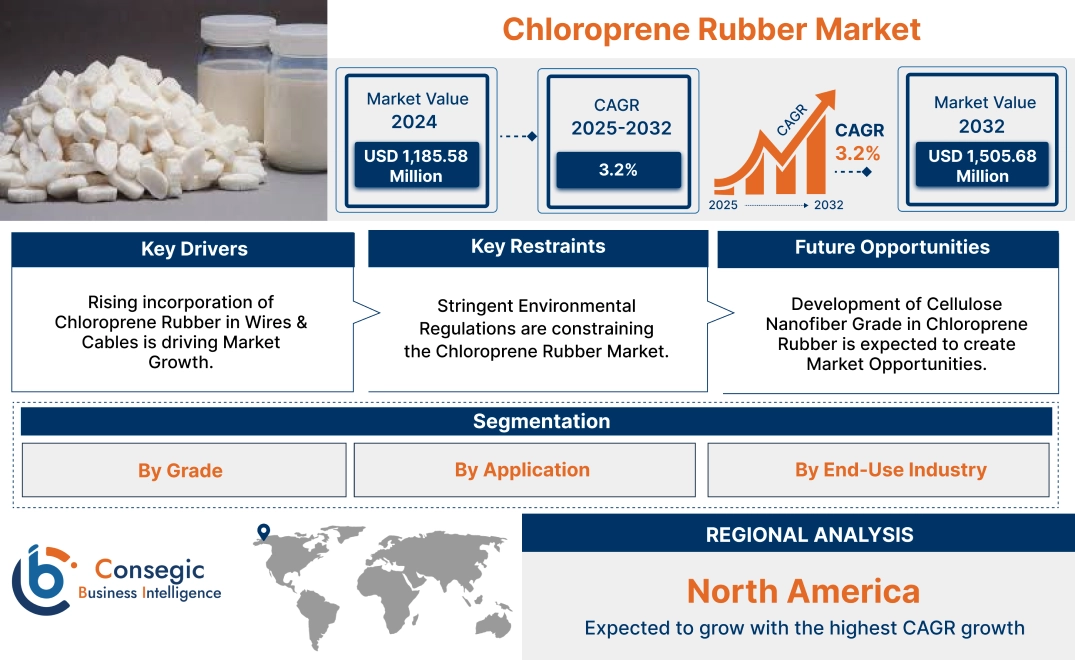
Chloroprene rubber market size is estimated to reach over USD 1,505.68 Million by 2032 from a value of USD 1,185.58 Million in 2024, growing at a CAGR of 3.2% from 2025 to 2032.
Chloroprene Rubber Market Scope & Overview:
Chloroprene rubber (CR) is a polymer produced from the monomer 2-chloro-1,3-butadiene. It possesses properties such as durability, high resistance to aging, better wear resistance, and others. There are different types of grades in the CR such as linear, sulphur-modified, cross-linked, crystalizing resistant, and others. Due to its excellent heat resistance and elasticity, chloroprene rubber is used in a wide range of applications such as coatings & adhesives, wires & cables, hoses, footwear, and others. It is also incorporated in various industries like automotive, construction, electronics, textile, and others. Further, in automotive, chloroprene rubber is used to manufacture seals, gaskets, and O-rings in engines, transmissions, and various automotive systems. The development of cellulose nanofiber grade is driving the demand in the chloroprene rubber market due to improved elasticity and chemical resistance.
Chloroprene Rubber Market Dynamics - (DRO) :
Key Drivers:
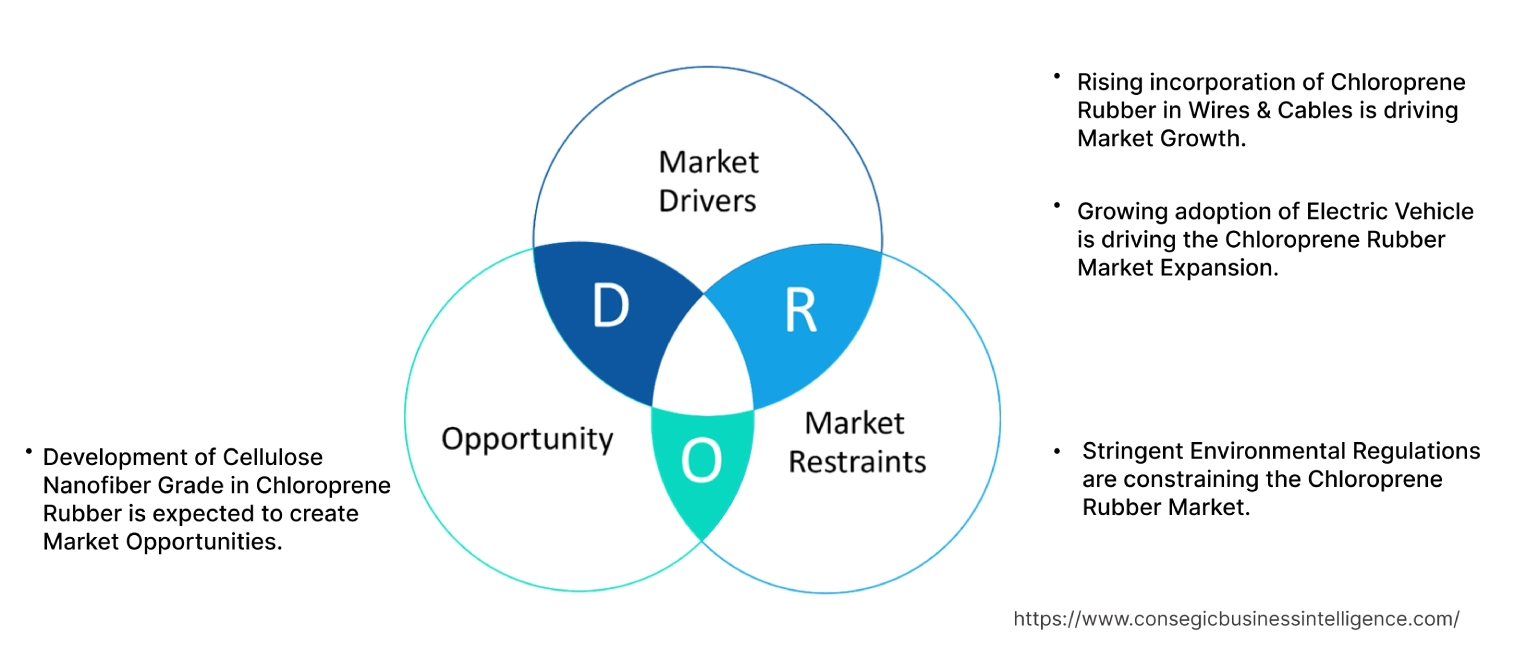
Rising incorporation of Chloroprene Rubber in Wires & Cables is driving Market Growth.
Chloroprene rubber is being extensively used in wires and cables due to its excellent insulation and protective properties. It offers high resistance to heat, oil, and chemicals, making it ideal for use in harsh environmental conditions. Additionally, chloroprene rubber provides effective protection against moisture, ultraviolet radiation, and ozone, enhancing the longevity of cables in outdoor and high-stress environments.
- In 2023, according to Resurgent India, global wires and cables production is expected to grow at a compound annual growth rate (CAGR) of 6.30% from 2023 to 2032. It is driving the market, as chloroprene rubber is widely used in wires and cables for insulation and heat resistance.
Thus, the growing use of chloroprene rubber in wires and cables is leading to chloroprene rubber market demand supported by its excellent insulation and protective properties.
Growing adoption of Electric Vehicle is driving the Chloroprene Rubber Market Expansion.
The chloroprene rubber plays an important role in ensuring the longevity and efficiency of electric vehicle (EV) components, such as insulation for electrical connectors, battery seals, and others. The demand for chloroprene rubber is rising as EV incorporates complex systems that require high-performance components. Its durability and heat resistance are essential in EVs for battery packs, inverters, and electric motors.
- In 2023, according to an Invest India report, EV sales in India have surged, with over 100,000 units sold for five consecutive months from October 2022 to February 2023. It is driving the market, supported by the increasing use of chloroprene rubber in EV components for thermal stability and chemical resistance.
Thus, the growing adoption of the electric vehicle sector is accelerating the chloroprene rubber market demand, supported by high-performance components and better thermal protection.
Key Restraints:
Stringent Environmental Regulations are constraining the Chloroprene Rubber Market.
Environmental regulations significantly restrain the market, as they require stringent compliance during the manufacturing, usage, and disposal of properties. Regulatory frameworks such as REACH (Registration, Evaluation, Authorization and Restriction of Chemicals) in Europe and the Environmental Protection Agency (EPA) in the United States and others are imposing regulations on chloroprene rubber manufacturers. It imposes regulations to limit emissions, manage chemical waste, and ensure product safety standards. These measures increase operational costs for the manufacturers. Additionally, the chloroprene rubber production process relies on petrochemical derivatives, which cause carbon emissions. With the growing focus on sustainability, manufacturers are required to adopt eco-friendly practices, invest in cleaner technologies, and explore renewable sources. This results in high investment costs and delays in the production process.
Thus, environmental regulations are restraining the chloroprene rubber market growth, due to regulatory standards and high cost.
Future Opportunities :
Development of Cellulose Nanofiber Grade in Chloroprene Rubber is expected to create Market Opportunities.
The cellulose nanofiber (CNF) grade in chloroprene rubber refers to the incorporation of cellulose nanofibers in the rubber enhancing the durability and elasticity improving performance in harsh environments. This grade combines the sustainable properties of CNF with the functional benefits of chloroprene rubber improving its resistance to heat, oil, and chemicals.
- In 2024, Tosoh Corporation developed a new grade of chloroprene rubber "Skyprene," called the "SG Series," which is a composite of cellulose nanofiber. CNF is derived from renewable sources such as sunflower, vegetable oils, corn, and others. Integrating CNF into chloroprene rubber production enhances its strength, flexibility, and durability, while also reducing environmental impact making it more sustainable.
Thus, the development of cellulose nanofiber grade is introducing sustainability and enhanced chemical resistance, further creating chloroprene rubber market opportunities.
Chloroprene Rubber Market Segmental Analysis :
By Grade:
By grade, the market is divided into linear, sulfur-modified, cross-linked, crystal-resistant, and others.
Trends in Grade:
- According to chloroprene rubber market trends, the linear grade is widely used in gaskets due to its elasticity and durability.
- Crystallization grade is being rapidly used grade in chloroprene rubber due to its flexibility and stability at low temperatures as per market trends.
Linear grade accounted for the largest market share in the year 2024.
- Linear grade is a widely used grade in chloroprene rubber due to its elasticity, improved tensile strength, and excellent resistance to aging, heat, and oil.
- It is widely used for manufacturing belts, hoses, gaskets, and others to provide excellent resistance to heat, oil, and other chemicals.
- Further, companies are investing in gasket manufacturing capacity to cater to the rising automotive sector, further driving the use of chloroprene rubber.
- For instance, in 2024, Great Lakes Industrial acquired Premier Seals Manufacturing Company in the United States to expand gasket manufacturing. Linear grade chloroprene rubber is widely used in gaskets for providing resistance to oil, solvents, and other chemicals, which is critical for gaskets used in industrial and automotive applications. This acquisition will further drive demand for chloroprene rubber, as it will strengthen the production of gaskets.
- In conclusion, linear grade is widely used in chloroprene rubber, due to its elasticity and improved tensile strength.
The crystallizing resistance is expected to grow at the fastest CAGR over the forecast period.
- Crystallizing resistant chloroprene rubber is a specialized grade that maintains flexibility and stability at low temperatures, preventing crystallizations over extended periods.
- This property makes it highly suitable for applications in cold environments such as marine equipment, refrigerators seals, and outdoor industrial components.
- It offers enhanced durability and elasticity, ensuring consistent performance in extreme weather conditions where standard grades do not provide sufficient resistance.
- Industries like automotive, construction, and aerospace increasingly adopting crystallization resistant grades for chloroprene rubber for superior cold weather resistance.
- Thus, the adoption of crystallization resistant grade in chloroprene rubber is growing, due to its high flexibility and stability at low temperatures.
By Application:
By application, the market is divided into coatings & adhesives, wires & cables, hoses, footwear, and others.
Trends in Application:
- According to market trends, chloroprene rubber is widely used in coatings & adhesives due to its durability and resistance to environmental stress.
- Chloroprene rubber is being extensively used in wires and cables to provide flexibility and abrasion resistance as per market trends.
The coatings & adhesives accounted for the largest market share in the year 2024.
- Chloroprene rubber is widely used in coatings and adhesives due to its excellent bonding properties and resistance to environmental stress.
- It is commonly used in manufacturing automotive coatings, roofing membranes, and footwear components, where durability and flexibility are essential.
- In automotive coatings, chloroprene rubber is used to create protective layers for metal surfaces, enhancing their resistance to corrosion, abrasion, and wear.
- Further companies are launching technical centers to support their automotive coatings products, driving the chloroprene rubber market.
- For instance, in 2024, BASF opened a new application and technical center for automotive coatings including chloroprene rubber in China, to create protective layers for metal surfaces, enhancing their resistance to corrosion, abrasion, and wear.
- Thus, chloroprene rubber is widely used in coatings and adhesives to provide resistance and thermal stability.
The wires & cables are expected to grow at the fastest CAGR over the forecast period.
- Chloroprene rubber is being extensively used in wires and cables due to its excellent insulation and protective properties.
- It offers high resistance to heat, oil, and chemicals, making it ideal for use in harsh environmental conditions.
- Chloroprene rubber is commonly applied as an insulating and sheathing material for electrical and power cables, ensuring safety and durability.
- Its flexibility and abrasion resistance also make it suitable for applications requiring frequent movement or bending, such as industrial machinery or robotics.
- Additionally, chloroprene rubber provides effective protection against moisture, ultraviolet radiation, and ozone, enhancing the longevity of cables in outdoor and high-stress environments.
- Thus, the use of chloroprene rubber is growing in the electronics industry due to its excellent insulation and chemical resistance properties.
By End-Use Industry:
By end-use industry, the market is divided into automotive, construction, electronics, textile, and others.
Trends in End-Use Industry:
- According to chloroprene rubber market trends, chloroprene rubber is widely used in the automotive industry due to its durability and suspension properties.
- The use of chloroprene rubber is growing in the electronics industry for durability and insulation.
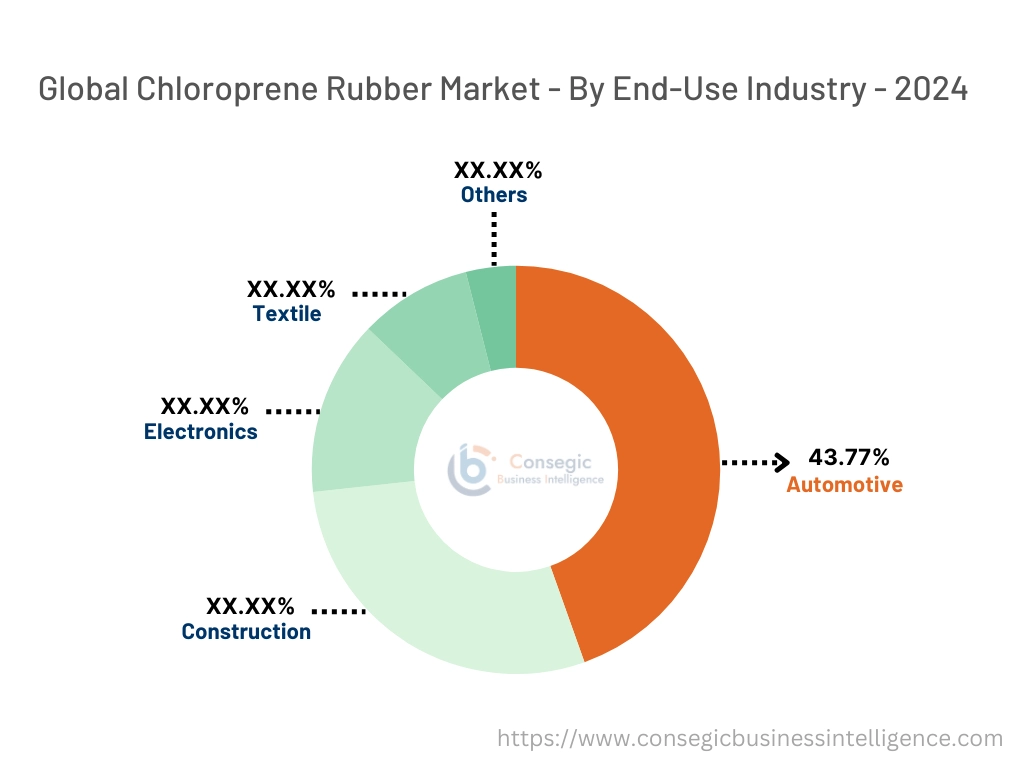
The automotive accounted for the largest market share of 43.77% in the year 2024.
- Chloroprene rubber is extensively used in the automotive sector due to its durability, resistance to oil, and flexibility.
- It is used to manufacture seals, gaskets, drive belts, and others. Also, chloroprene rubber is largely incorporated in O-rings in engines, transmissions, and various automotive systems.
- Further, companies are largely investing in the production of drive belts enhancing the demand for chloroprene rubber.
- For instance, in 2022, Dayco launched a new drive belt manufacturing facility in Mexico where chloroprene rubber acts as a vital component in their manufacturing due to its elasticity property.
- Thus, chloroprene rubber is widely used in the automotive industry due to its elasticity and chemical resistance properties.
Electronics is expected to grow at the fastest CAGR over the forecast period.
- The use of chloroprene rubber is rising in the electronics industry due to its excellent insulation properties and resistance to environmental factors.
- It is commonly used in the production of electrical cables, where it provides durable and flexible insulation, ensuring reliable performance in high-temperature and harsh conditions.
- Chloroprene rubber also offers protection against moisture, oil, and chemicals, which is crucial for maintaining the longevity and efficiency of electronic components.
- In addition to cables, chloroprene rubber is used in the manufacturing of gaskets, seals, and protective coatings for electronic devices.
- Thus, the use of chloroprene rubber in electronics is rising due to its excellent insulation properties and reliable performance in high temperatures.
Regional Analysis:
The regional segment includes North America, Europe, Asia Pacific, the Middle East and Africa, and Latin America.
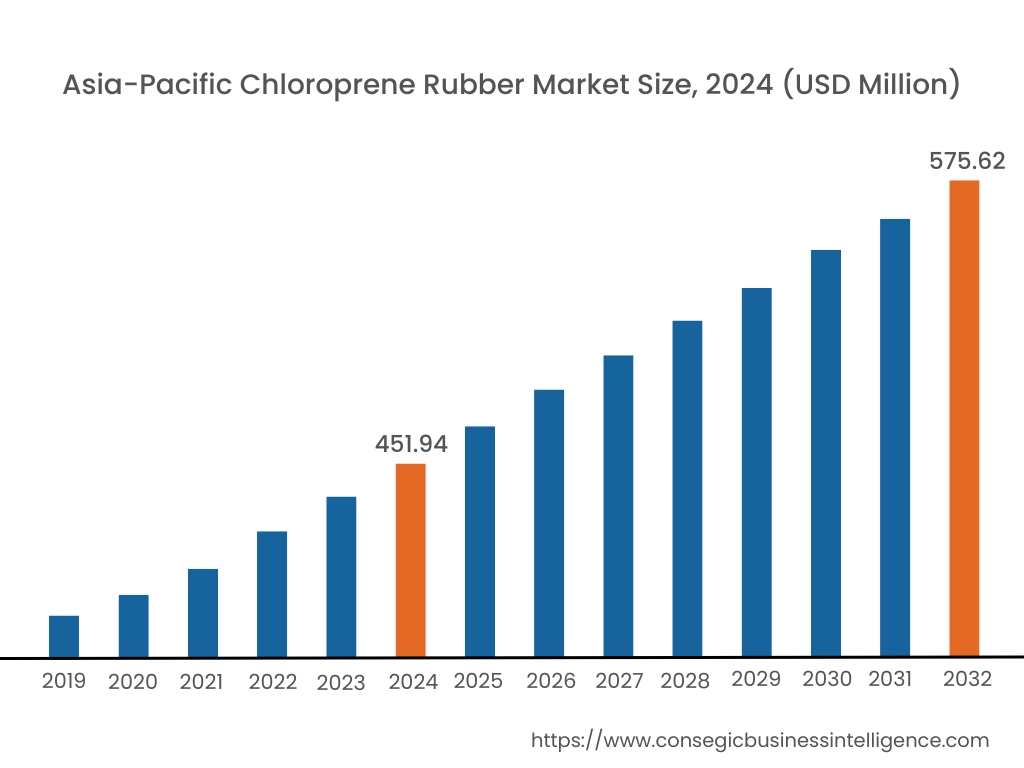
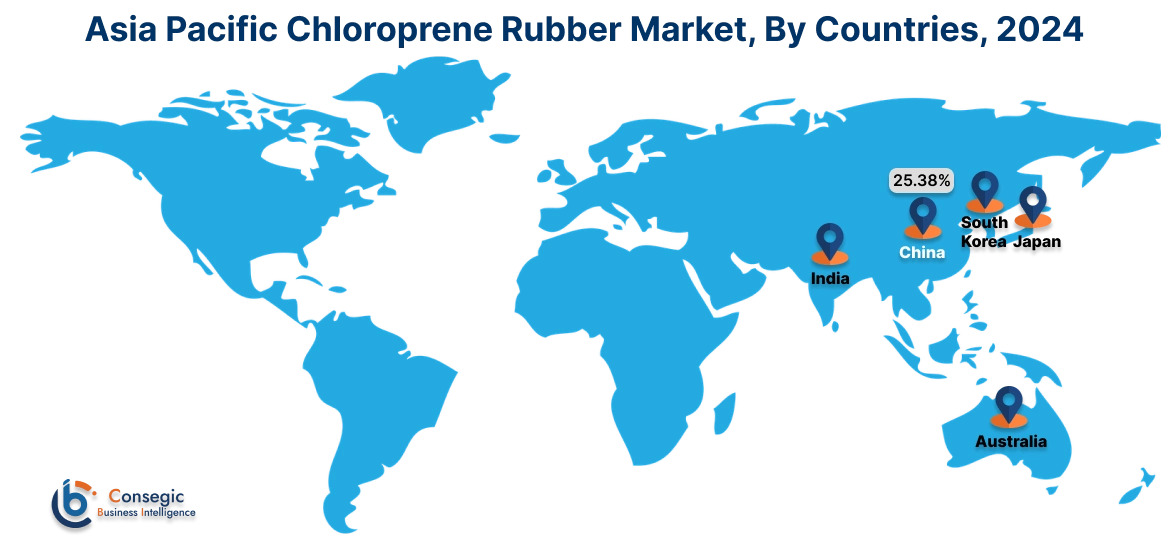
In 2024, Asia Pacific accounted for the highest market share at 38.12% and was valued at USD 451.94 Million and is expected to reach USD 575.62 Million in 2032. In Asia Pacific, China accounted for the highest market share of 25.38% during the base year of 2024. As per market analysis, the chloroprene rubber market share of the Asia-Pacific region is driven by rapid urbanization and industrial developments. The region is a global manufacturing hub, with industries such as electronics, textiles, and machinery heavily relying on this rubber for oil resistance, thermal stability, and more. Countries like China, India, and Japan are major automotive markets, driving the adoption of chloroprene rubber in engine seals, gaskets, and O-rings. Further, companies in this region are largely investing in electronics production driving the demand for chloroprene rubber market.
- In 2022, according to NITI Aayog, electronics production in India will increase with a growth rate of 13% from the year 2017 to 2022. In electronics, chloroprene rubber is commonly used in the production of electrical cables, where it provides durable and flexible insulation, ensuring reliable performance in high-temperature and harsh conditions.
Thus, the Asia-Pacific region is leading in the market due to well-established automotive infrastructure and wider consumption as per the analysis.
North America is expected to witness the fastest CAGR of 3.9% over the forecast period of 2025-2032. According to market analysis, North America’s chloroprene rubber market share is experiencing rapid proliferation in the market, driven by the well-established automotive and electronics sector. The region benefits from a strong automotive sector, which remains a significant consumer of chloroprene rubber used in gaskets, bearings, and others. The growing emphasis on electric vehicles in the region is further accelerating the market. The region is also experiencing rapid construction and industrial developments, which is further driving the need for this rubber to ensure the encapsulation of sensitive components such as electric circuits and sensors.
Thus, North America is experiencing chloroprene rubber market growth, driven by technological innovation and the presence of major manufacturers.
According to the chloroprene rubber market analysis, the European region is growing significantly in the market due to well-established automotive and manufacturing sectors. The European countries are leading in the manufacturing of cars and other vehicles such as trucks, containers, and others, further fueling the market growth. Countries like France, the United Kingdom, and Russia are key contributors due to the major production of advanced rubber formulations such as high-temperature and bio-based chloroprene rubber. The properties of high thermal stability and higher chemical resistance are the major factors accelerating the growth of the market in the region. Moreover, European manufacturers are investing heavily in research and development of advanced rubber formulations, further driving the chloroprene rubber market expansion.
According to chloroprene rubber market analysis, the market is expanding in the Middle East and Africa region driven by rapid construction and the growing automotive sector. In countries like Dubai, UAE, and South Africa the market is propelling due to the rapid proliferation of industrial projects and the expanding manufacturing sector. It is fueling the adoption of chloroprene rubber in engine seals, gaskets, O-rings, and others. Oil and gas remain significant contributors in this region, as this rubber is critical for heat and chemical resistance. Also, the government in this region is implementing stringent environmental regulations driving the transition towards sustainable and eco-friendly processes for this rubber production. The region is expected to grow significantly in the market, supported by industrial developments and government support.
According to market analysis, Latin America is witnessing moderate growth in the market, driven by expanding industrial activities, rising vehicle ownership, and infrastructure development. Key countries like Brazil, Mexico, and Argentina lead the market due to their strong automotive and industrial sectors. The growing automotive market is a significant contributor, with increasing demand for chloroprene rubber in engine seals, gearings, and others. Environmental regulations are encouraging the adoption of bio-based chloroprene rubber in the region, driving chloroprene rubber market opportunities. However, challenges such as supply chain complexities, rising raw material costs, and regulatory barriers impact the growth of the market in the region.
Top Key Players and Market Share Insights:
The chloroprene rubber industry is highly competitive with major players providing products to the national and international markets. Key players are adopting several strategies in research and development (R&D) and product innovation to hold a strong position in the global chloroprene rubber market. Key players in the chloroprene rubber industry include-
- Denka Company Limited. (Japan)
- Tosoh USA, Inc. (United States)
- RADO Gummi GmbH (Germany)
- NorMec (Netherlands)
- Mitsui & Co. Deutschland GmbH (Germany)
- Lavelle Industries, Inc. (United States)
- Resonac Holdings Corporation. (Japan)
- Nam Liong Global Corporation (Taiwan)
- Merck KGaA (Germany)
- Zenith Rubber (India)
Recent Industry Developments :
Product Launches:
- In December 2024, Sumarpo launches a swimsuit which is made of chloroprene rubber. The swimsuit supports eco-friendly practices and also delivers excellent performance in the water.
Chloroprene Rubber Market Report Insights :
| Report Attributes | Report Details |
| Study Timeline | 2019-2032 |
| Market Size in 2032 | USD 1,505.68 Million |
| CAGR (2025-2032) | 3.2% |
| By Grade |
|
| By Application |
|
| By End-Use Industry |
|
| By Region |
|
| Key Players |
|
| North America | U.S. Canada Mexico |
| Europe | U.K. Germany France Spain Italy Russia Benelux Rest of Europe |
| APAC | China South Korea Japan India Australia ASEAN Rest of Asia-Pacific |
| Middle East and Africa | GCC Turkey South Africa Rest of MEA |
| LATAM | Brazil Argentina Chile Rest of LATAM |
| Report Coverage |
|
Key Questions Answered in the Report
How big is the chloroprene rubber market? −
In 2024, the chloroprene rubber market is USD 1,185.58 Million.
Which is the fastest-growing region in the chloroprene rubber market? +
North America is the fastest-growing region in the chloroprene rubber market.
What specific segmentation details are covered in the chloroprene rubber market? +
Grade, application, and end-use industries are covered in the chloroprene rubber market.
Who are the major players in the chloroprene rubber market? +
Denka Company Limited. (Japan), Tosoh USA, Inc. (United States) and Lavelle Industries, Inc. (United States) are some of the major players in the market.
Overview
Reputation & Certifications


Our Services
- Market Intelligence & Forecasting
- Custom Research Solutions
- Market Entry Strategy
- Competitive Intelligence
- Customer Insights
- Industry Innovation Analysis
- Investment Advisory