Jump to Content
Halogen-Free Flame Retardant Market - Size, Share, Industry Trends, and Forecasts (2025-2032)
Halogen-Free Flame Retardant Market Size:
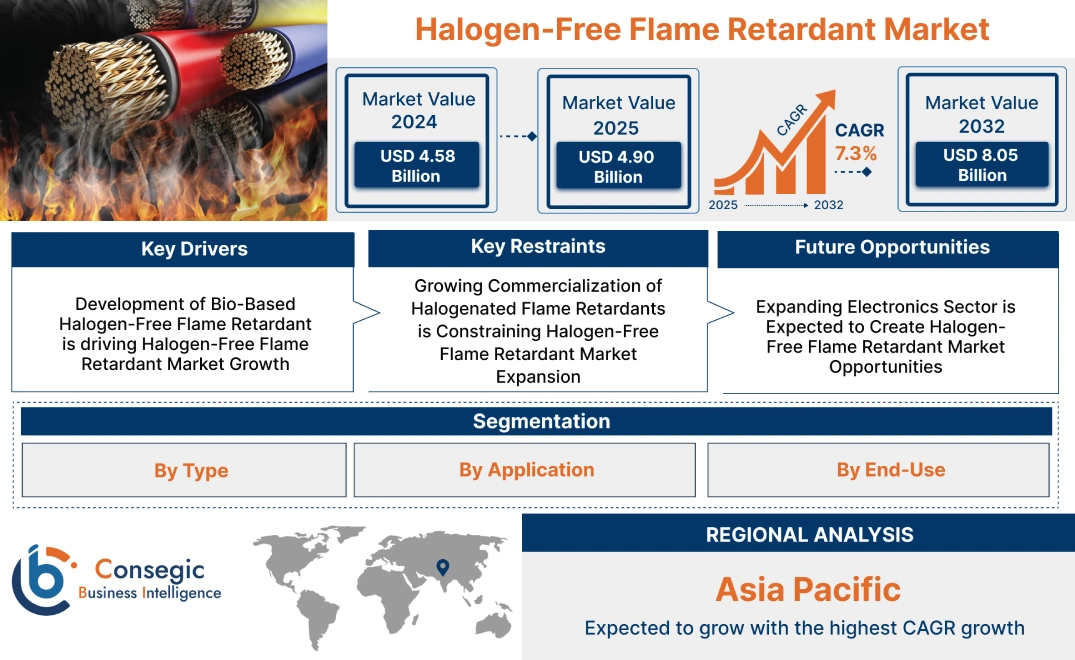
The halogen-free flame retardant market size is growing with a CAGR of 7.3% during the forecast period (2025-2032), and the market is projected to be valued at USD 8.05 Billion by 2032 from USD 4.58 Billion in 2024. Additionally, the market value for 2025 is attributed to USD 4.90 Billion.
Halogen-Free Flame Retardant Market Scope & Overview:
The halogen-free flame retardant (HFFR) is a chemical additive designed to prevent or delay the spread of fire including plastics. Based on the chemical composition, this retardant has various types, such as aluminium hydroxide, organophosphorus flame retardants, and others. The HFFR is used in various applications such as polyolefin, epoxy resins, thermoplastic elastomers, rubber, and others. It offers various advantages such as non-corrosive, inert, non-volatile, and being environmentally friendly. Due to these advantages, this retardant is used in various sectors such as construction, logistics and transportation, automotive, electronics, and others. Additionally, development of sustainable halogen-free flame retardant is furthermore driving the market demand.
How is AI Impacting the Halogen-Free Flame Retardant Market?
AI is significantly impacting the halogen-free flame retardant market by accelerating research, optimizing production, and enhancing sustainability. Additionally, AI-powered tools streamline the development of new flame retardant materials, improve manufacturing efficiency, and ensure better compliance with environmental regulations. This leads to faster innovation, reduced costs, and more sustainable products. Further, AI-powered systems can monitor chemical compositions in real-time, ensuring consistent product quality and compliance with safety standards. Furthermore, AI can predict potential equipment failures, enabling proactive maintenance and preventing costly downtime.
Halogen-Free Flame Retardant Market Dynamics - (DRO):
Key Drivers:
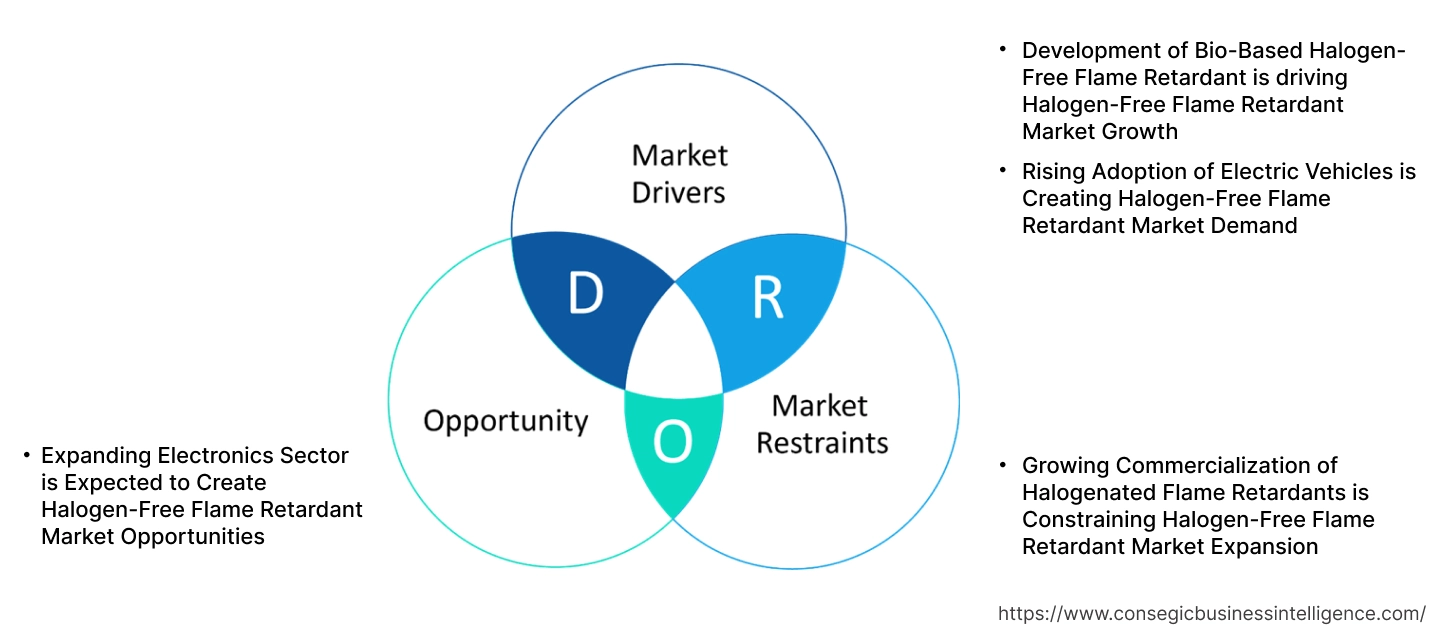
Development of Bio-Based Halogen-Free Flame Retardant is driving Halogen-Free Flame Retardant Market Growth
Traditional halogen-free flame retardant is made from phosphorus, nitrogen, magnesium, and sulfur-based compounds. They emit some toxic gases and has less effectivity. They also require high production costs. To address this, companies are developing bio-based halogen-free flame retardant.
- In 2023, Avient Corporation launched bio-based halogen-free flame retardant. This retardant contains up to 45% bio-based content which includes lignin, phytic acid, and other plant-based material. It reduces toxic emissions as compared to traditional halogen-free flame retardant. Additionally, it requires less investment in production, furthermore, driving the market.
Hence, development of bio-based halogen-free flame retardant is leading to halogen-free flame retardant market expansion.
Rising Adoption of Electric Vehicles is Creating Halogen-Free Flame Retardant Market Demand
In electric vehicles, halogen-free flame retardant is used in high-voltage connectors to ensure electrical insulation and prevent tracking under high temperatures and voltages. It is also used in battery pack gaskets and cooling circuit seals to prevent coolant contact with cells and stop flame spreading. Additionally, adoption of electric vehicles is growing due to environmental concerns, rising disposable income, and government support, furthermore, driving the market.
- According to the International Energy Agency, the global electric car sales represented 35% increase in 2023 from 2022. This growing preference towards electric cars is driving the use of halogen-free flame retardant to ensure electrical insulation of high-voltage connectors.
Thus, rising adoption of electric vehicles is creating halogen-free flame retardant market demand.
Key Restraints:
Growing Commercialization of Halogenated Flame Retardants is Constraining Halogen-Free Flame Retardant Market Expansion
The commercialization of halogenated flame retardants such as tetrabromobisphenol A, chlorinated paraffins amongst others is growing. They provide similar functions to that of halogen-free flame retardant. The tetrabromobisphenol A is widely used in electronic circuits and boards due to its lower production costs and easy processing. Furthermore, chlorinated paraffins are used in construction, coatings, and cables to enhance flame retardancy. Additionally, halogenated flame retardants have superior flame retardancy at lower loading levels which requires less processing and production cost. Hence, the growing commercialization of halogenated flame retardants is constraining halogen-free flame retardant market growth due to low production cost and easy processing.
Future Opportunities:
Expanding Electronics Sector is Expected to Create Halogen-Free Flame Retardant Market Opportunities
In the electronics sector, halogen-free flame retardant is used in encapsulants to protect them from fire damage. It is also incorporated in printed circuit boards to enhance their dielectric properties. Moreover, companies are investing in production of printed circuit boards due to increased demand for electronic devices, miniaturization design and rise of battery management systems.
- In 2024, Ascent Circuits invested USD 78 Million in new printed circuit boards manufacturing facility in India. This will lead to more production of printed circuit boards, thereby creating market opportunities to enhance fire safety.
Hence, expanding electronics sector is expected to create halogen-free flame retardant market opportunities.
Halogen-Free Flame Retardant Market Segmental Analysis :
By Type:
Based on Type, the market is categorized into aluminium hydroxide, organophosphorus flame retardants, and others.
Trends in Type:
- According to halogen-free flame retardant market trends, aluminium hydroxide is widely used in the production of chlorinated polyvinyl chloride polymer.
- Adoption of organophosphorus flame retardants is growing in the production of non-flammable fabric as per market trends.
The aluminium hydroxide segment accounted for the largest market share in the year 2024.
- Aluminum hydroxide is a halogen-free, non-toxic flame retardant. When exposed to high temperatures, it decomposes into aluminum oxide and water vapor, thereby cooling the material and diluting flammable gases.
- It is widely used in production of polymers such as chlorinated polyvinyl chloride, polyesters, and acrylics for effective smoke suppression.
- Furthermore, the adoption of chlorinated polyvinyl chloride is growing due to superior corrosion resistance and chemical resistance in pipelines. To cater for this, companies are investing in the production of chlorinated polyvinyl chloride.
- For instance, in 2024, according to Indian Chemical News, DCW invested USD 16.8 Million to expand chlorinated polyvinyl chloride production capacity to 50,000 million tons. This is increasing production of chlorinated polyvinyl chloride, thereby driving the use of aluminum hydroxide for effective smoke suppression.
- Hence, as production of chlorinated polyvinyl chloride is growing, the need for aluminum hydroxide is also increasing, in turn driving the segment.
The organophosphorus flame retardants segment is expected to grow at the fastest CAGR over the forecast period.
- The organophosphorus flame retardants are phosphorus containing halogen-free flame retardants.
- They include ammonium polyphosphate and phosphate esters which react chemically with free radicals in the gas or condensed phase during combustion, thus inhibiting the flame spread.
- Additionally, the adoption of non-flammable fabrics is increasingly driven by rising safety awareness, stringent regulations, and the need for advanced protective measures. To cater for this, textile manufacturers are increasingly incorporating organophosphorus flame retardants in their fabric for fire safety.
- Therefore, as the adoption of non-flammable fabrics is growing, the need for organophosphorus flame retardants is also increasing. This will drive the segment for the forecasted years.
By Application:
Based on Application, the market is categorized into polyolefin, epoxy resins, thermoplastic elastomers, rubber, and others.
Trends in Application:
- As per halogen-free flame retardant market trends, this retardant is extensively used in polyolefin to enhance the flame retardancy.
- Adoption of halogen-free flame retardant is growing in production of epoxy resins as per market trends.
The polyolefin segment accounted for the largest market share in the year 2024.
- Polyolefin are polymers derived from olefins, known for their durability, flexibility, and resistance to chemicals and ultraviolet radiation.
- The HFFR is used to enhance the flame retardancy of polyolefins and reduce afterglow.
- This retardant creates a char layer upon exposure to fire, insulating the underlying polyolefin material and preventing flame spread.
- Furthermore, adoption of polyolefin is driven by their versatility, durability, cost-effectiveness, and increasing demand from packaging. To cater this, manufacturers are increasing their production of polyolefin, thereby driving the use of HFFR to enhance the flame retardancy.
- Hence, as production of polyolefin is growing, the need for halogen-free flame retardant is also increasing, in turn driving the segment.
The epoxy resins segment is expected to grow at the fastest CAGR over the forecast period.
- Epoxy resins are a class of thermosetting polymers made from monomers that contain at least two epoxide groups.
- The halogen-free flame retardant is increasingly used in epoxy resins to improve smoke suppression and mechanical properties.
- Furthermore, the adoption of epoxy resins is increasing due to increasing focus on renewable energy and growing demand for high-performance coatings in construction. To cater for this, companies are investing in production of epoxy resins.
- For instance, in 2024, as per India Brand Equity Foundation, Aditya Birla Group invested USD 50 Million in the manufacturing of epoxy resins in United States. This will further facilitate the production of epoxy resins leading to more use of halogen-free flame retardant to enhance their mechanical properties.
- Hence, as production of epoxy resins is increasing, the need for halogen-free flame retardant will also increase. This will drive the segment for the forecasted years.
By End-Use:
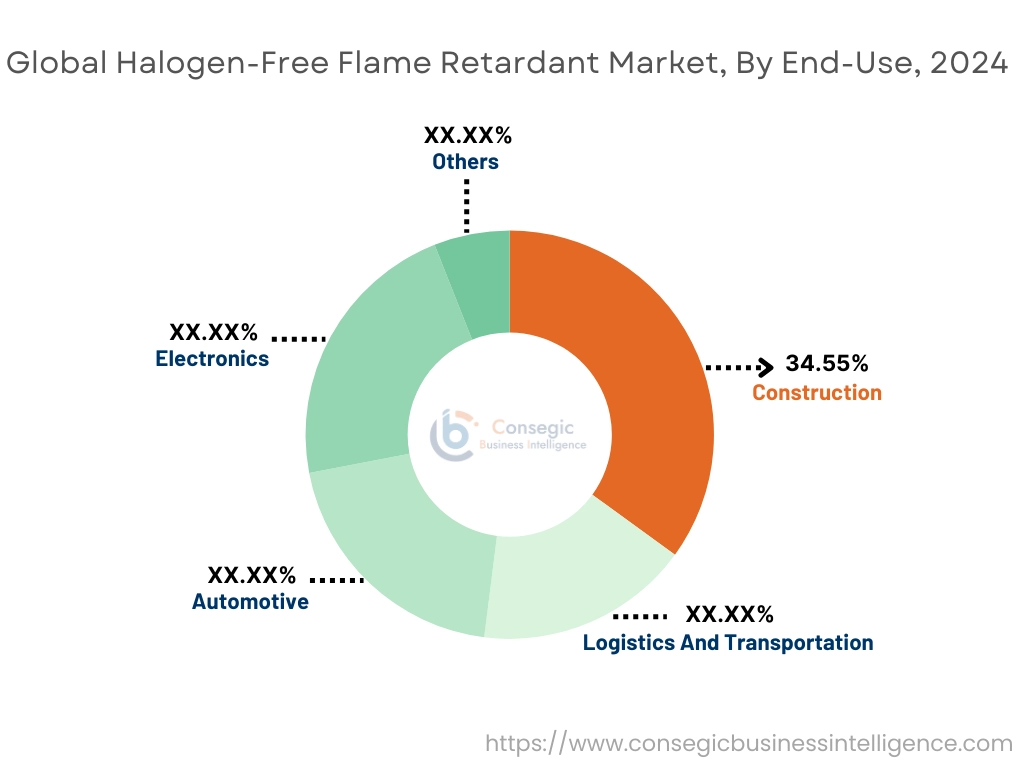
Based on End-Use, the market is categorized into construction, logistics and transportation, automotive, electronics, and others.
Trends in End-Use:
- The halogen-free flame retardant is widely used in the construction of green buildings.
- The adoption of HFFR is growing in the production of electric cables as per market trends.
The construction segment accounted for the largest market share of 34.55% in the year 2024.
- In construction sector, halogen-free flame retardant is used to preserve the structural integrity of materials such as wall panels and electric circuits to reduce heat-induced degradation.
- This retardant also supports compliance with green building standards such as Leadership in Energy and Environmental Design, which encourages the use of non-toxic and sustainable building materials.
- Furthermore, construction of green buildings is growing due to reduced environmental impact, lower operating costs, and waste reduction. To cater this demand, construction companies are increasingly adopting HFFR in green buildings for sustainable building materials compliance.
- Thus, as construction of green buildings is growing, the adoption of halogen-free flame retardant is also increasing, in turn driving the segment.
The electronics segment is expected to grow at the fastest CAGR over the forecast period.
- In the electronics sector, halogen-free flame retardant is used in switches, casings, micro-assemblies for better insulation.
- It is also used in the electric cables and wires to delay and prevent flames from spreading.
- Furthermore, the adoption of electric cables is growing due to increasing global demand for electricity, rise of renewable energy, and advancements in technology. To cater for this, manufacturers are expanding their electric cables production.
- For instance, in 2024, ELECTROPLAST invested USD 9.7 Million in the production of electric cables. This will accelerate the production of electric cables, thereby driving the use of halogen-free flame retardant to prevent flames from spreading.
- Hence, as production of electric cables is growing, the need for this retardant will also increase. This will drive the segment for the forecasted years.
Regional Analysis:
The regional segment includes North America, Europe, Asia Pacific, Middle East & Africa, and Latin America.
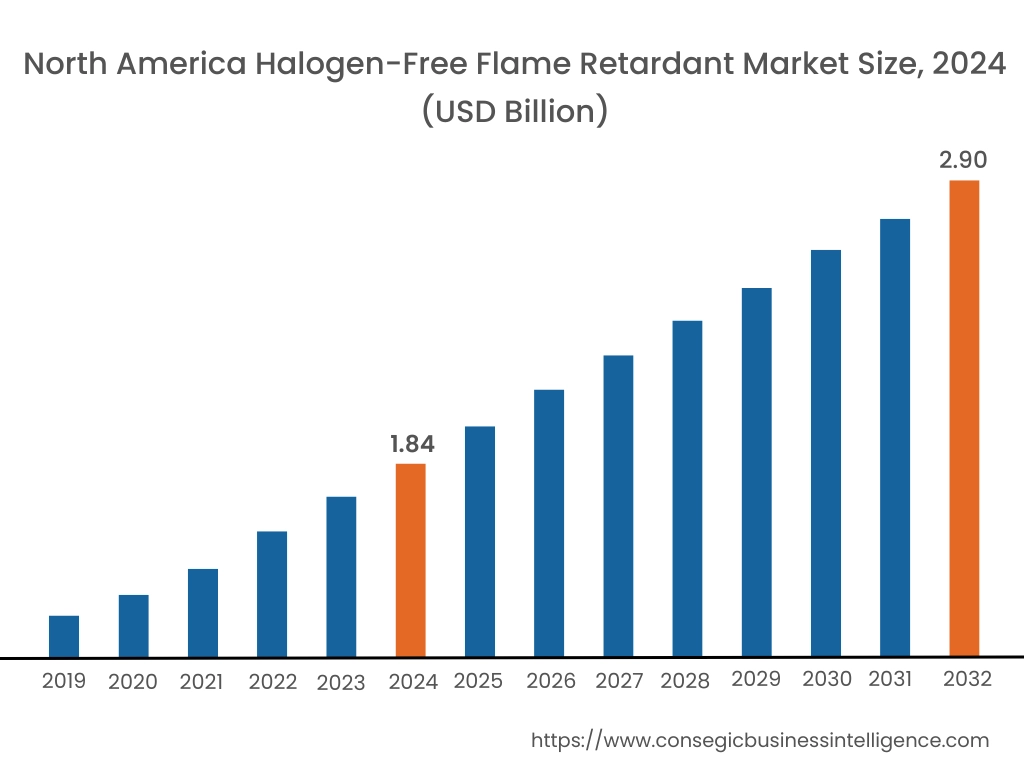
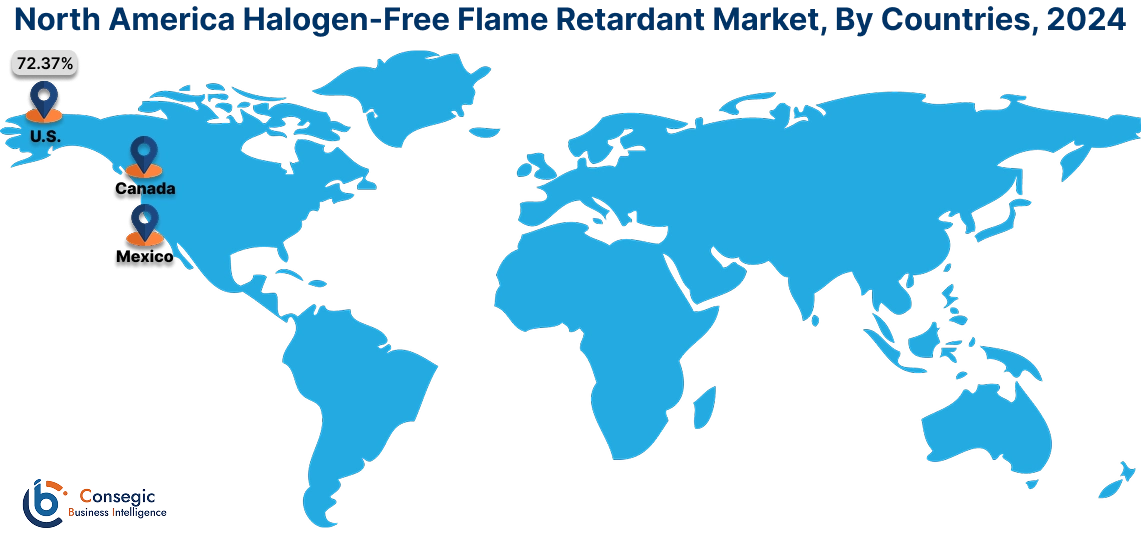
In 2024, North America accounted for the highest market share at 40.14% and was valued at USD 1.84 Billion and is expected to reach USD 2.90 Billion in 2032. In North America, United States accounted for the highest halogen-free flame retardant market share of 72.37% during the base year of 2024. As per analysis, the North America region holds a dominant position in the market due to the expanding construction sector. In the construction, halogen-free flame retardants do not release toxic halogenated gases during normal usage or decomposition which also helps to improve air quality in buildings. Moreover, companies in the region are incorporating this retardant in construction material, furthermore, driving the market adoption.
- In 2024, Ampacet launched halogen-free flame retardant masterbatches in United States. These masterbatches are used to ensure fire safety and reduce emission of corrosive gases in the construction. It is also compiled with EN 50642 and IEC 61249-2-21 building standards, furthermore, driving the market adoption.
Therefore, due to the above-mentioned factors, the North America region is dominating in the market as per analysis.
Asia Pacific is expected to witness the fastest CAGR of 9.8% over the forecast period of 2025-2032. According to halogen-free flame retardant market analysis, Asia Pacific region is growing considerably in the market driven by technological advancements. Advancement in chemical synthesis and polymer processing have enhanced the efficiency, sustainability, and cost-effectiveness of flame retardant. Moreover, countries such as China, India, Japan, and South Korea are increasingly adopting 3D manufacturing. It is lowering production cost and ensuring high-performance flame retardant for electronic devices and building materials. Hence, halogen-free flame retardant market share of Asia Pacific is expected to emerge rapidly through expansion of technological advancements as per analysis.
According to halogen-free flame retardant market analysis, Europe region is growing considerably in the market driven by stringent environmental regulations. These regulations are driving the use of flame retardant which is halogen free in electronic devices. This retardant reduces the risk of fire spreading and also reduce toxic gas emission during combustion. Additionally, countries such as Germany, France, and United Kingdom are increasing their electronics manufacturing, furthermore, driving the market across the region.
The Middle East & Africa region is experiencing moderate growth in the market driven by expanding logistics and the transportation sector. In this sector, particularly in railways, halogen-free flame retardant is used to ensure low flammability and smoke production for safe evacuation. It is also used in aircraft interiors to ensure passenger safety and meet stringent fire safety regulations. In countries such as Dubai, Saudi Arabia, and South Africa, logistics and transportation is expanding thereby driving the market growth across the region.
As per analysis, the market in Latin America is due to the expanding automotive sector. In this sector, HFFR is used vehicle seat foam, upholstery, and other interior components to reduce smoke density. It is also used in engine covers, door panels, carpets to enhance water and chemical resistance. Additionally, in countries such as Brazil, Argentina, and Columbia, automobile manufacturing plants are expanding. This is leading to market expansion across the region.
Top Key Players & Market Share Insights:
The halogen-free flame retardant industry is highly competitive with major players providing products to the national and international markets. Key players are adopting several strategies in research and development (R&D) and material innovation to hold a strong position in the global halogen-free flame retardant market. Key players in the halogen-free flame retardant industry include-
- Huber Advanced Materials (United States)
- Clariant (Switzerland)
- DSM (Netherlands)
- Italmatch Chemicals S.p.A. (Italy)
- Nabaltec (Germany)
- LANXESS (Germany)
- Albemarle Corporation (United States)
- ICL (Israel)
- BASF (Germany)
- Tosaf (Israel)
Recent Industry Developments :
Production Facility:
- In 2023, Clariant launched production plant for halogen-free flame retardant in China. This included investment of USD 69 Million and strengthening the product portfolio of organophosphorus flame retardants.
Launches:
- In 2022, LANXESS launched new polybutylene terephthalate halogen-free flame retardant. It provides high levels of flame retardancy and dielectric strength.
Halogen-Free Flame Retardant Market Report Insights:
| Report Attributes | Report Details |
| Study Timeline | 2019-2032 |
| Market Size in 2032 | USD 8.05 Billion |
| CAGR (2025-2032) | 7.3% |
| By Type |
|
| By Application |
|
| By End-Use |
|
| By Region |
|
| Key Players |
|
| North America | U.S. Canada Mexico |
| Europe | U.K. Germany France Spain Italy Russia Benelux Rest of Europe |
| APAC | China South Korea Japan India Australia ASEAN Rest of Asia-Pacific |
| Middle East and Africa | GCC Turkey South Africa Rest of MEA |
| LATAM | Brazil Argentina Chile Rest of LATAM |
| Report Coverage |
|
Key Questions Answered in the Report
How big is the halogen-free flame retardant market? −
In 2024, the halogen-free flame retardant market is USD 4.58 Billion.
Which is the fastest-growing region in the halogen-free flame retardant market? +
Asia Pacific is the fastest-growing region in the halogen-free flame retardant market.
What specific segmentation details are covered in the halogen-free flame retardant market? +
Type, Application, and End-Use are covered in the halogen-free flame retardant market.
Who are the major players in the halogen-free flame retardant market? +
Huber Advanced Materials (United States), Clariant (Switzerland), and LANXESS (Germany) are some of the major players in the market.
Overview
Reputation & Certifications


Our Services
- Market Intelligence & Forecasting
- Custom Research Solutions
- Market Entry Strategy
- Competitive Intelligence
- Customer Insights
- Industry Innovation Analysis
- Investment Advisory