Home > > IT And Telecommunications > > Cloud-Based PLM Market Size, Share, Applications, Demand & Analysis Report (2032)
Cloud-Based PLM Market - Size, Share, Industry Trends, and Forecasts (2025-2032)
ID : CBI_1616 | Updated on : | Author : Rashmee Shrestha | Category : IT And Telecommunications
Cloud-Based PLM Market Size:
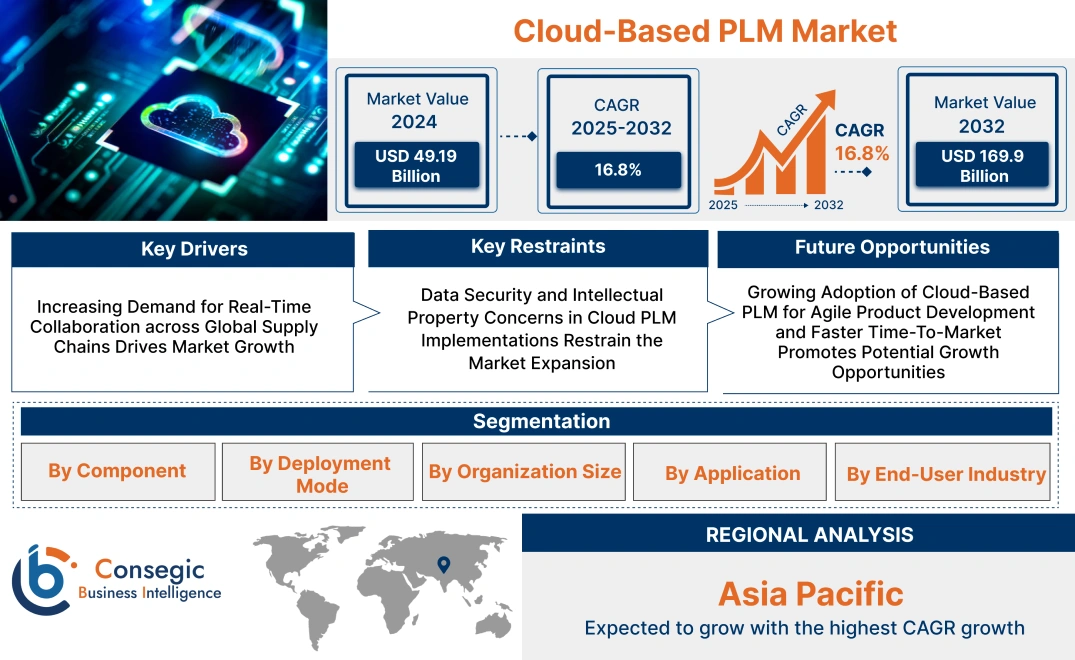
Cloud-Based PLM Market size is estimated to reach over USD 169.9 Billion by 2032 from a value of USD 49.19 Billion in 2024 and is projected to grow by USD 56.55 Billion in 2025, growing at a CAGR of 16.8 % from 2025 to 2032.
Cloud-Based PLM Market Scope & Overview:
Cloud-based Product Lifecycle Management (PLM) is a comprehensive solution that facilitates the management of a product's lifecycle, from concept and design to production, distribution, and retirement, through a cloud platform. Unlike traditional on-premises PLM, cloud-based PLM offers enhanced scalability, real-time collaboration, and remote accessibility, enabling teams to work together seamlessly across different locations. These solutions integrate product data, streamline workflows, and provide advanced analytics, supporting efficient product development and innovation. Industries such as automotive, aerospace, electronics, and consumer goods are increasingly leveraging cloud-based PLM solutions to accelerate time-to-market, reduce costs, and improve product quality. The end-users of cloud-based PLM include manufacturers, design and engineering firms, and IT service providers. As companies advance in digital transformation and Industry 4.0 initiatives, cloud-based PLM solutions are seeing significant growth, emphasizing enhanced collaboration, operational efficiency, and scalable product management systems.
Cloud-Based PLM Market Dynamics - (DRO) :
Key Drivers:
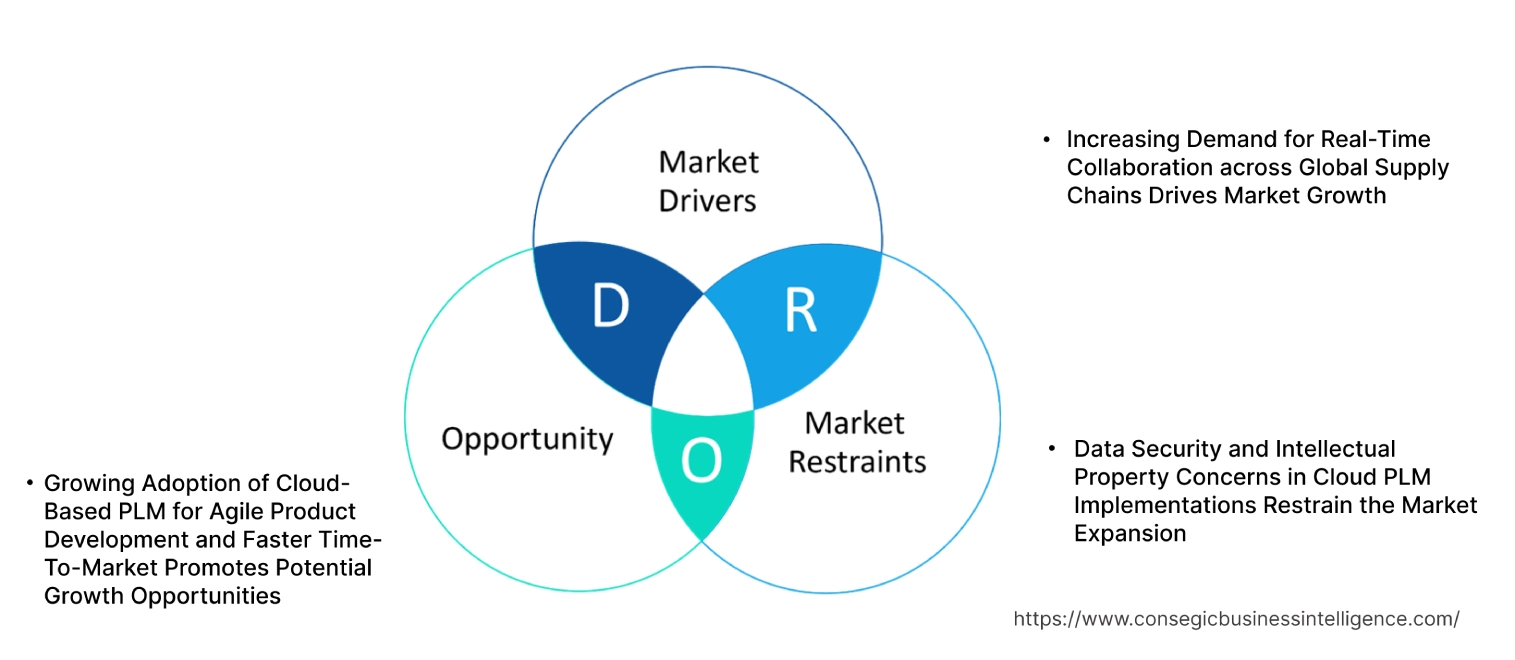
Increasing Demand for Real-Time Collaboration across Global Supply Chains Drives Market Growth
The rising complexity of global supply chains and the need for real-time collaboration are significant drivers for the market. As companies expand their operations globally, they require robust PLM solutions that enable seamless collaboration across different time zones, departments, and external partners. Cloud-based PLM platforms facilitate real-time data sharing, version control, and centralized access to product information, allowing teams to collaborate efficiently on product design, development, and manufacturing processes. The ability to access PLM data from anywhere, combined with features like real-time document sharing, digital twin capabilities, and integrated communication tools, enhances productivity and accelerates time-to-market. This trend is particularly pronounced in industries like automotive, aerospace, and consumer electronics, where complex products involve numerous stakeholders and require coordinated efforts across geographically dispersed teams. Therefore, the shift towards globalized operations and real-time collaboration is fueling the cloud-based PLM market demand.
Key Restraints :
Data Security and Intellectual Property Concerns in Cloud PLM Implementations Restrain the Market Expansion
One of the primary restraints in the market is the concern over data security and intellectual property (IP) protection, especially in industries where product designs and engineering specifications are highly sensitive. Cloud-based PLM platforms store vast amounts of proprietary data, including CAD files, product specifications, and confidential business information, making them attractive targets for cyberattacks. Ensuring the security of this data, while complying with strict industry regulations and IP laws is a major constraint. Companies may be hesitant to adopt cloud-based PLM solutions due to fears of data breaches, unauthorized access, and potential IP theft. Additionally, the complexity of implementing robust cybersecurity measures such as end-to-end encryption, multi-factor authentication, and secure data access controls can increase operational costs and impact the overall adoption rate, particularly among businesses in highly regulated industries like aerospace, defense, and pharmaceuticals. In conclusion, organizations in sensitive industries face difficulties in safeguarding proprietary information while complying with strict regulations, thereby hindering the cloud-based PLM market growth.
Future Opportunities :
Growing Adoption of Cloud-Based PLM for Agile Product Development and Faster Time-To-Market Promotes Potential Growth Opportunities
The increasing focus on agile product development methodologies in industries such as consumer electronics, automotive, and aerospace presents a significant growth opportunity for the market. Traditional PLM systems often struggle to support agile development processes due to their rigid structures and limited flexibility. Cloud-based PLM platforms, however, are inherently more adaptable, offering features like real-time updates, collaborative design tools, and seamless version control that align well with agile workflows. These platforms enable cross-functional teams to iterate quickly, make rapid design adjustments, and respond faster to market feedback, reducing the time to market for new products. As businesses aim to stay competitive by launching innovative products faster, the demand for cloud-based PLM solutions tailored to support agile development practices is expected to rise. In conclusion, the growing emphasis on agile product development is driving the cloud-based PLM market opportunities.
Cloud-Based PLM Market Segmental Analysis :
By Component:
Based on components, the market is segmented into software and services.
The software segment accounted for the largest revenue of the total cloud-based PLM market share in 2024.
- The software component includes key solutions such as design & engineering, BOM (Bill of Materials) management, document management, and compliance management, which are essential for effective product lifecycle management.
- Design & engineering tools support product development, enabling collaborative design, virtual prototyping, and rapid iteration, crucial for reducing time-to-market.
- BOM management provides a centralized view of all product components, ensuring consistency and accuracy throughout the product lifecycle.
- Document management solutions facilitate secure storage, retrieval, and sharing of product-related documents, enhancing compliance and traceability.
- As per cloud-based PLM market analysis, the software segment leads the market due to its comprehensive functionalities, which address critical aspects of product lifecycle management across industries.
The services segment is expected to register the fastest CAGR during the forecast period.
- Services include consulting, integration & deployment, and support & maintenance, offering tailored solutions to meet specific business requirements.
- Consulting services assist organizations in defining PLM strategies and selecting appropriate software solutions based on their unique needs.
- Integration & deployment services ensure seamless implementation of cloud-based PLM systems, minimizing disruption to existing workflows.
- Ongoing support & maintenance services provide troubleshooting, updates, and enhancements, helping businesses maximize the value of their PLM investment.
- As per cloud-based PLM market trends, the services segment is expected to grow steadily as companies increasingly rely on expert guidance for the successful implementation and management of cloud-based PLM solutions.
By Deployment Mode:
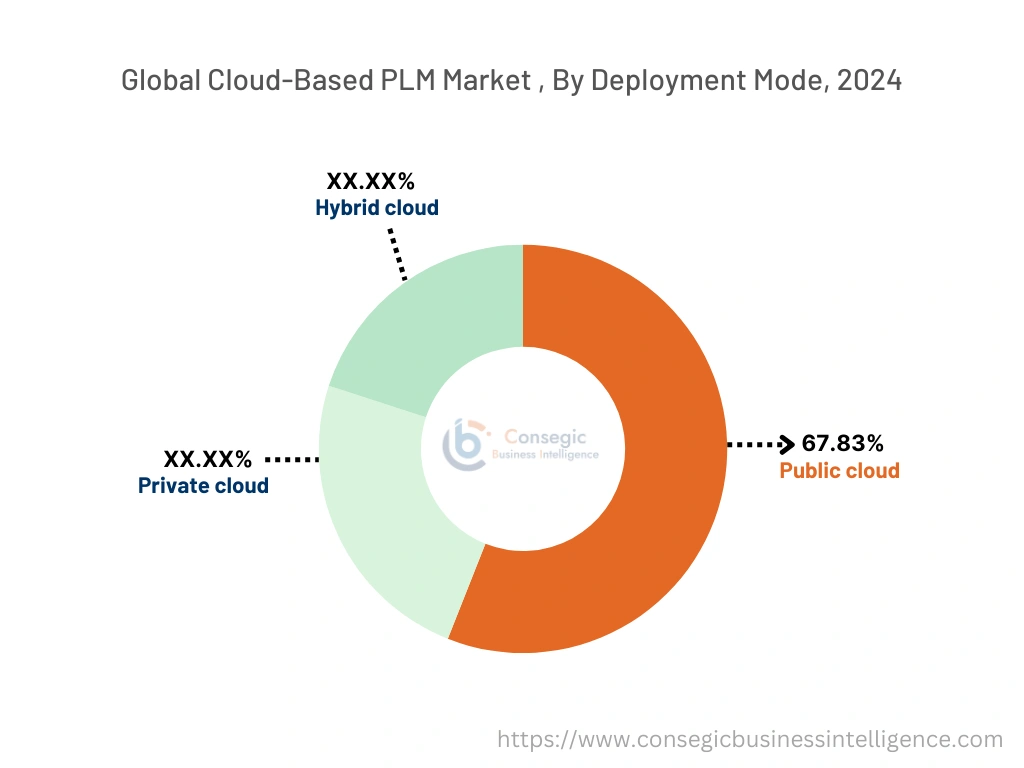
Based on deployment mode, the market is segmented into public cloud, private cloud, and hybrid cloud.
The public cloud segment accounted for the largest market share of 67.83% in 2024.
- Public cloud deployments offer scalability, cost-efficiency, and ease of access, making them a preferred choice for many businesses adopting cloud-based PLM solutions.
- Public cloud providers such as AWS, Microsoft Azure, and Google Cloud offer robust security measures, ensuring data protection while providing flexible storage options.
- The increasing adoption of SaaS (Software as a Service) models for PLM solutions is contributing to the growth of public cloud deployments, offering businesses a pay-as-you-go model.
- Therefore, as per segmental trends analysis, the public cloud segment leads due to its widespread adoption, driven by its scalability and the reduced need for on-premise infrastructure investments, driving the cloud-based PLM market expansion.
The hybrid cloud segment is anticipated to register the fastest CAGR during the forecast period.
- Hybrid cloud deployments combine public and private cloud environments, offering greater flexibility and control over sensitive data management.
- This approach is popular among enterprises that need to balance the scalability of public cloud solutions with the security of private cloud infrastructure.
- The adoption of hybrid cloud strategies is increasing as companies seek to leverage the benefits of both deployment models while minimizing risks associated with data security and compliance.
- Therefore, as per segmental trends analysis, the hybrid cloud segment is expected to grow rapidly, driven by its ability to meet diverse organizational needs and optimize cost-efficiency, driving the cloud-based PLM market growth.
By Organization Size:
Based on organization size, the market is segmented into small & medium enterprises (SMEs) and large enterprises.
The large enterprises segment held the largest revenue share in 2024.
- Large enterprises often have complex product development processes, requiring robust PLM solutions to manage extensive product data and ensure collaboration across multiple teams and geographies.
- Cloud-based PLM systems help large enterprises streamline operations, enhance product quality, and reduce development costs by providing centralized data management and real-time collaboration tools.
- The strong adoption of cloud-based PLM by large enterprises is driven by the need for comprehensive, scalable solutions that can handle large volumes of data and support global product development initiatives.
- The dominance of the large enterprises segment is attributed to their substantial investments in digital transformation and the growing focus on optimizing product lifecycle processes, driving the cloud-based PLM market share.
The SME segment is expected to register the fastest CAGR during the forecast period.
- SMEs are increasingly adopting cloud-based PLM solutions to enhance product development efficiency, reduce costs, and improve time-to-market.
- Cloud-based PLM offers a flexible, cost-effective solution for smaller businesses that need access to advanced PLM tools without the burden of heavy infrastructure investments.
- The focus on digital transformation and the need for streamlined product data management are key factors driving adoption among SMEs.
- The SME segment is projected to grow steadily, supported by the increasing availability of affordable, scalable PLM solutions tailored to the needs of smaller businesses, boosting the cloud-based PLM market demand.
By Application:
Based on application, the market is segmented into product data management, collaborative product design, manufacturing process management, and portfolio management.
The product data management segment accounted for the largest revenue share in 2024.
- Product data management (PDM) systems provide a centralized repository for product information, ensuring consistency and accuracy across the product lifecycle.
- PDM solutions help businesses manage complex product data, track changes, and maintain version control, which is crucial for compliance and quality assurance.
- The increasing need for efficient data management and the growing complexity of product designs are driving the adoption of PDM solutions.
- As per cloud-based PLM market trends, the product data management segment leads due to its essential role in streamlining data workflows and enhancing product development processes.
The collaborative product design segment is expected to register the fastest CAGR during the forecast period.
- Collaborative product design tools enable teams to work together in real time, improving communication, reducing design errors, and accelerating product development cycles.
- The shift towards distributed and remote work models has increased the demand for cloud-based tools that facilitate seamless collaboration across geographies.
- Advanced design tools integrated with cloud-based PLM systems offer features like real-time editing, version control, and secure file sharing, enhancing team productivity.
- As per cloud-based PLM market analysis, the collaborative product design segment is expected to grow rapidly, driven by the increasing emphasis on innovation and faster product development timelines.
By End-User Industry:
Based on end-user industry, the market is segmented into automotive, aerospace & defense, healthcare, electronics & semiconductors, consumer goods, and others.
The automotive segment accounted for the largest market share in 2024.
- The automotive sector relies heavily on cloud-based PLM solutions for efficient product development, managing complex supply chains, and ensuring compliance with regulatory standards.
- Cloud-based PLM helps automotive companies streamline design processes, enhance collaboration, and reduce time-to-market for new vehicle models.
- The automotive segment leads the market due to the industry's strong focus on innovation, cost optimization, and the increasing complexity of vehicle designs, driving the cloud-based PLM market expansion.
The healthcare segment is expected to register the fastest CAGR during the forecast period.
- The healthcare sector is increasingly adopting cloud-based PLM solutions to manage product development, ensure compliance, and enhance collaboration in the creation of medical devices and pharmaceuticals.
- Cloud-based PLM systems help healthcare companies streamline regulatory compliance, manage complex data, and accelerate product approvals.
- The rapid growth of the healthcare segment is driven by the increasing demand for advanced PLM solutions to support innovation and enhance patient safety driving the cloud-based PLM market opportunities.
Regional Analysis:
The regions covered are North America, Europe, Asia Pacific, the Middle East and Africa, and Latin America.
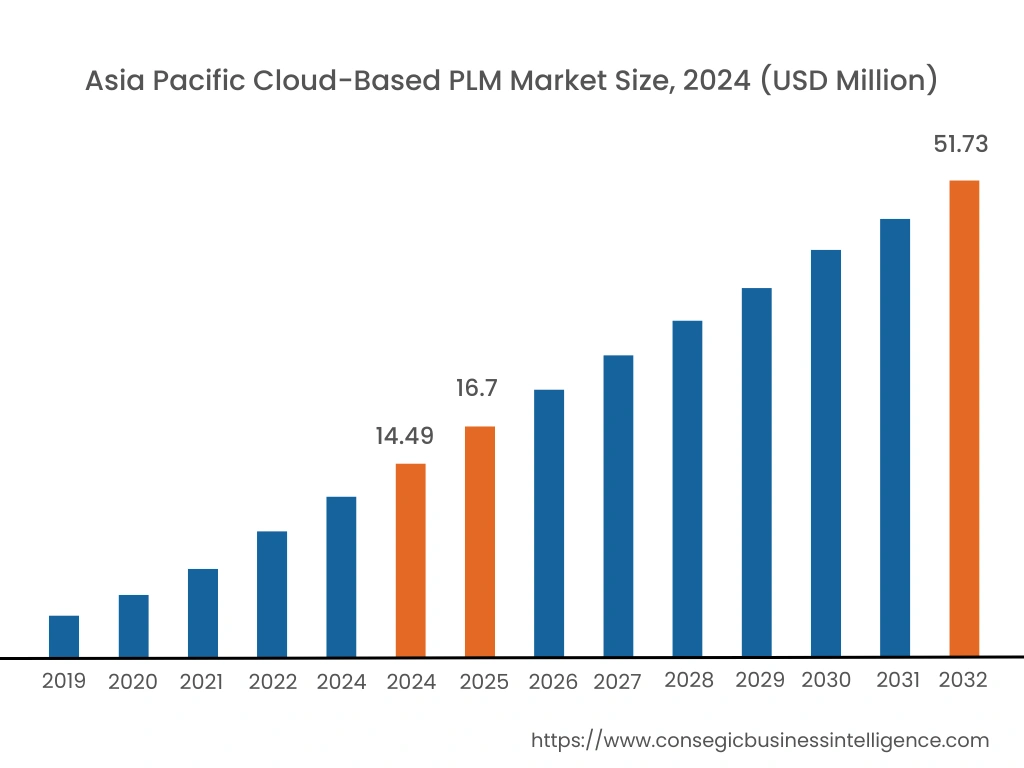
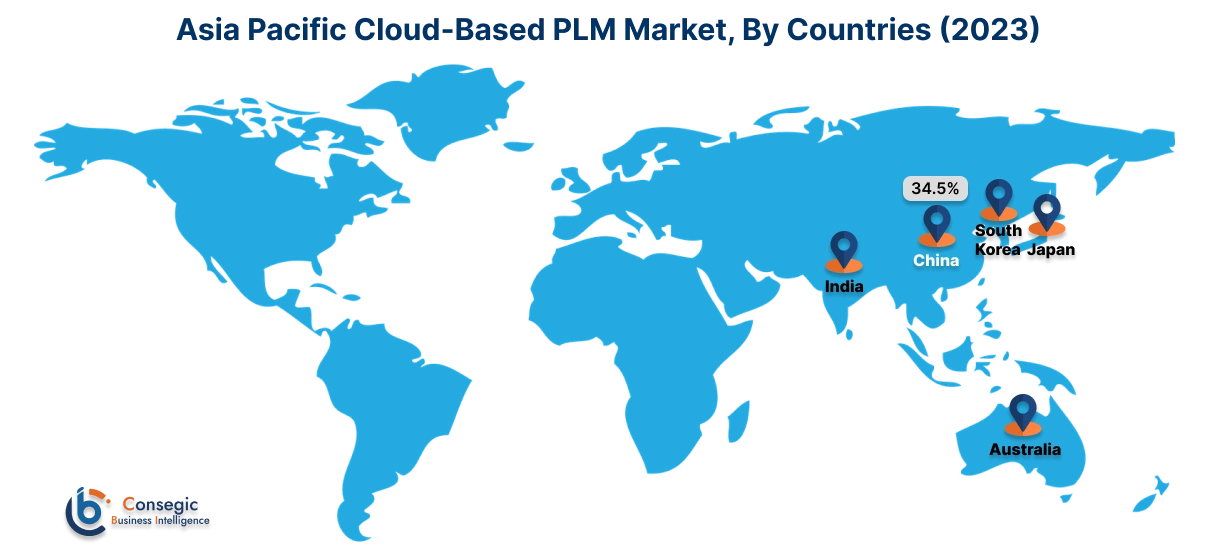
Asia Pacific region was valued at USD 14.49 Billion in 2024. Moreover, it is projected to grow by USD 16.7 Billion in 2025 and reach over USD 51.73 Billion by 2032. Out of these, China accounted for the largest market share of 34.5% in 2024. Asia-Pacific is the fastest-growing region in the cloud-based PLM market, fueled by rapid industrialization and the increasing adoption of digital solutions in China, Japan, and India. The region's manufacturing sector is embracing cloud-based PLM to enhance product development, reduce costs, and foster collaboration across geographically dispersed teams. China's growing automotive and electronics industries, along with Japan's focus on high-tech manufacturing, are major contributors to market development.
North America is estimated to reach over USD 55.06 Billion by 2032 from a value of USD 16.32 Billion in 2024 and is projected to grow by USD 18.72 Billion in 2025. North America remains a dominant force in the cloud-based PLM (Product Lifecycle Management) market, driven by strong adoption across industries such as aerospace, automotive, and electronics. The U.S. leads due to the presence of major PLM software providers and a high rate of digital transformation initiatives among manufacturing firms. The region's focus on leveraging cloud solutions for efficient product design, data management, and collaboration has accelerated market growth.
Europe is a key market for cloud-based PLM, with strong adoption observed in countries like Germany, France, and Italy. The region's focus on Industry 4.0 and smart manufacturing solutions drives the shift toward cloud-based PLM, enabling improved product innovation and faster time-to-market. Germany, in particular, leads in the automotive and industrial sectors, where cloud-based PLM helps streamline product design processes.
The Middle East & Africa (MEA) region is seeing a steady rise in the adoption of cloud-based PLM solutions, particularly in the UAE and Saudi Arabia, where digital transformation is a key government priority. The region's push for modernization in the manufacturing, construction, and energy sectors supports the adoption of PLM solutions for efficient product lifecycle management. The UAE's vision for smart cities and Saudi Arabia's Vision 2030 initiatives have further driven interest in cloud-based PLM platforms.
Latin America is an emerging market for cloud-based PLM, led by Brazil and Mexico. The region's increasing focus on enhancing manufacturing efficiency, coupled with the rise of digital initiatives, supports the uptake of cloud PLM solutions. Brazil's automotive and consumer goods industries, along with Mexico's expanding manufacturing base, are key adopters of cloud-based PLM to streamline operations and improve product innovation.
Top Key Players & Market Share Insights:
The cloud-based PLM market is highly competitive with major players providing products and services to the national and international markets. Key players are adopting several strategies in research and development (R&D), product innovation, and end-user launches to hold a strong position in the global cloud-based PLM market. Key players in the cloud-based PLM industry include –
- PTC (USA)
- Siemens Digital Industries Software (Germany)
- Dassault Systèmes (France)
- Autodesk (USA)
- Oracle Corporation (USA)
- SAP SE (Germany)
- Infor (USA)
- Upchain (Canada)
- Propel (USA)
- Arena Solutions (USA)
Recent Industry Developments :
- In August 2024, SAP and Hilti announced a collaboration to bring Product Lifecycle Management (PLM) to the cloud. This partnership focuses on integrating SAP's PLM solutions with Hilti's expertise in construction, enabling seamless data management across product development stages. The cloud-based PLM platform enhances collaboration, speeds up innovation, and improves efficiency in managing product data, design, and lifecycles, benefiting businesses aiming for digital transformation in their supply chain processes.
- In March 2024, Aras announced significant enhancements to its Product Lifecycle Management (PLM) platform. These updates aim to improve collaboration across supply chains by offering more efficient data management and process integration. The enhancements will support companies in streamlining product development workflows, enabling better collaboration between suppliers and business partners.
- In May 2024, Siemens partnered with Microsoft to enhance its Xcelerator as a Service portfolio by making it available on Microsoft Azure. This collaboration integrates Siemens' Teamcenter X software for Product Lifecycle Management (PLM) with Microsoft's AI and cloud technologies, including Azure OpenAI and Microsoft Copilot. These enhancements aim to boost productivity, accelerate time-to-market, and improve collaboration across product development teams by leveraging AI tools for task management and workflow optimization.
Cloud-Based PLM Market Report Insights :
| Report Attributes | Report Details |
| Study Timeline | 2019-2032 |
| Market Size in 2032 | USD 169.9 Billion |
| CAGR (2025-2032) | 16.8% |
| By Component |
|
| By Deployment Mode |
|
| By Organization Size |
|
| By Application |
|
| By End-User Industry |
|
| By Region |
|
| Key Players |
|
| North America | U.S. Canada Mexico |
| Europe | U.K. Germany France Spain Italy Russia Benelux Rest of Europe |
| APAC | China South Korea Japan India Australia ASEAN Rest of Asia-Pacific |
| Middle East and Africa | GCC Turkey South Africa Rest of MEA |
| LATAM | Brazil Argentina Chile Rest of LATAM |
| Report Coverage |
|
Key Questions Answered in the Report
How big is the Cloud-based PLM market? +
Cloud-Based PLM Market size is estimated to reach over USD 169.9 Billion by 2032 from a value of USD 49.19 Billion in 2024 and is projected to grow by USD 56.55 Billion in 2025, growing at a CAGR of 16.8 % from 2025 to 2032.
What specific segmentation details are covered in the Cloud-based PLM Market report? +
The Cloud-based PLM market report includes segmentation details for components, deployment mode, organization size, application, end-user industry, and region.
Which is the fastest-growing application in the Cloud-based PLM market? +
According to the analysis, the fastest-growing application in the Cloud-based PLM market is collaborative product design, driven by the increasing demand for real-time collaboration, improved design efficiency, and integrated solutions in product development processes.
Who are the major players in the Cloud-based PLM market? +
The major players in the Cloud-based PLM market include PTC (USA), Siemens Digital Industries Software (Germany), Dassault Systèmes (France), Autodesk (USA), Oracle Corporation (USA), SAP SE (Germany), Infor (USA), Upchain (Canada), Propel (USA) and Arena Solutions (USA).