Jump to Content
Concrete Paving Equipment Market - Size, Share, Industry Trends, and Forecasts (2025-2032)
Concrete Paving Equipment Market Size:
Concrete Paving Equipment Market size is estimated to reach over USD 2.59 Billion by 2032 from a value of USD 1.80 Billion in 2024 and is projected to grow by USD 1.85 Billion in 2025, growing at a CAGR of 4.6% from 2025 to 2032.
Concrete Paving Equipment Market Scope & Overview:
Concrete paving equipment refers to machines designed to spread, shape, and finish concrete surfaces for roads, runways, and other flatwork applications. These machines are used to place and smooth concrete efficiently, helping ensure uniform thickness, level alignment, and proper surface texture.
The equipment typically includes slipform pavers, curb and gutter machines, spreaders, and texture curing units. Slipform pavers are commonly used for mainline paving and are equipped with automatic control systems for grade and alignment. These machines are often configured with vibrators, tampers, or oscillating screeds to ensure proper compaction and surface finish during continuous placement. Some units are modular, allowing adjustments for varying slab widths or complex profiles.
Concrete paving equipment supports the execution of straight, curved, or sloped surfaces with tight tolerances and consistent finish quality. End-users include highway contractors, airport infrastructure builders, and municipal agencies that require high-precision machines for placing concrete on large-scale construction projects.

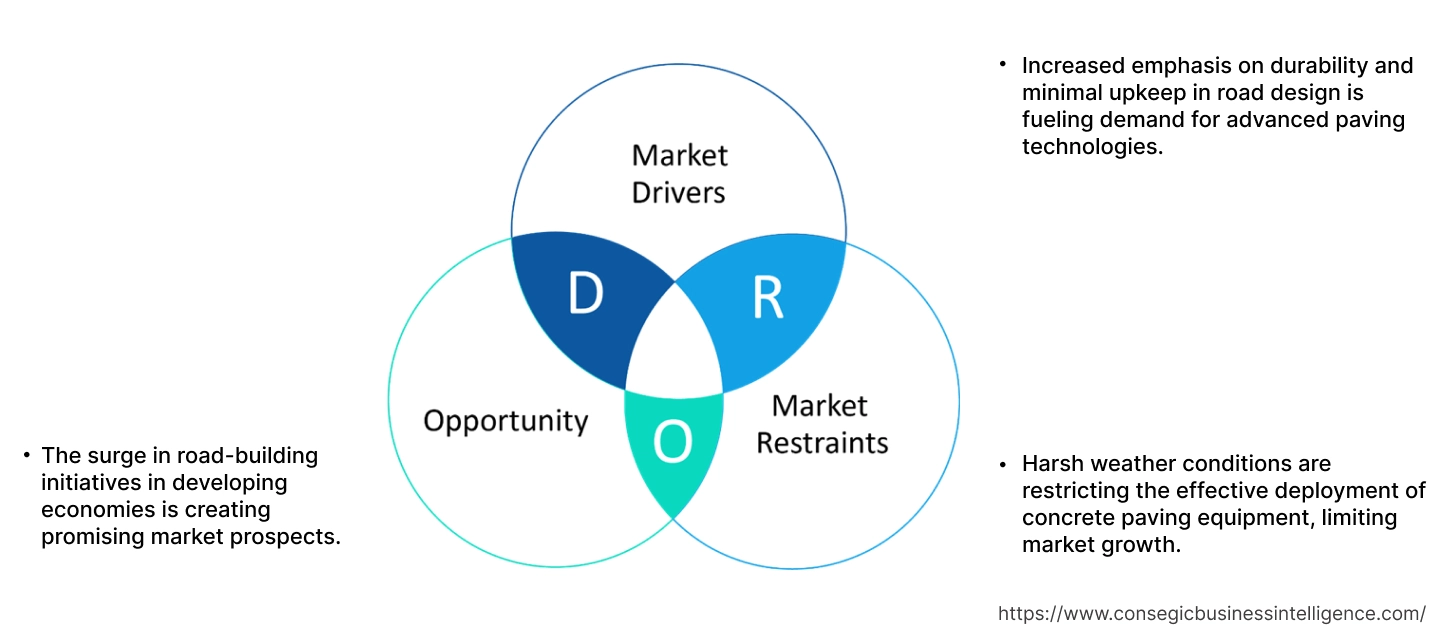
Concrete Paving Equipment Market Dynamics - (DRO) :
Key Drivers:
Increased emphasis on durability and minimal upkeep in road design is fueling demand for advanced paving technologies.
Concrete paving is becoming increasingly popular in areas with heavy traffic or extreme weather due to its long-lasting durability and lower maintenance requirements compared to asphalt. Municipalities and contractors are prioritizing road safety and longevity, making concrete an ideal solution for high-traffic areas such as highways and city streets. The inherent durability of concrete surfaces reduces the need for frequent repairs, making it a cost-effective option over time. As a result, there is a growing shift toward concrete paving for both residential and commercial road construction projects. The reduced maintenance needs and extended lifespan of concrete roads contribute to significant savings in repair costs and disruption minimization.
- For instance, in March 2023, GOMACO announced the launch of the GP460, a versatile machine that functions both as a placer/spreader and a slipform paver, designed to enhance productivity in large-scale concrete paving projects. In its slipform paving configuration, it accommodates widths up to 40 feet (12.2 meters). The machine is powered by a Caterpillar C7.1 Tier 4 Final diesel engine delivering 302 horsepower (225 kW), ensuring efficient operation. Key features include the GOMACO-exclusive G+ control system, compatibility with 3D machine guidance systems, and machine-to-machine (M2M) communication capabilities.
This trend toward durable and low-maintenance paving solutions is accelerating the adoption of specialized equipment, supporting the overall concrete paving equipment market growth.
Key Restraints:
Harsh weather conditions are restricting the effective deployment of concrete paving equipment, limiting market growth.
Concrete paving operations are highly influenced by weather conditions, which can pose hurdles, especially in extreme temperatures. In colder climates, freezing temperatures delay the curing and setting of concrete, affecting the final quality of the surface. In contrast, hot climates with high temperatures may lead to rapid evaporation of water from the concrete mixture, causing cracks and compromising the surface. These weather-related dependencies limit the operational window for paving projects, slowing down productivity in certain regions, especially those with harsh winter or summer conditions. Consequently, construction timelines may extend, and operational costs may rise. Such limitations on the working season due to unfavorable weather patterns can create a barrier to the widespread and timely adoption, limiting the market progress.
Future Opportunities :
The surge in road-building initiatives in developing economies is creating promising market prospects.
Urbanization and industrialization in emerging economies, particularly in regions like India, Brazil, and parts of Africa, will continue to drive the growing demand for road infrastructure development. These regions are expected to undergo rapid urban growth, with a significant focus on improving transportation networks, such as highways, expressways, and urban roads. As traffic volumes increase, the need for durable, long-lasting road surfaces that require less frequent maintenance will rise. Concrete paving will be increasingly recognized as the solution to these challenges, offering improved longevity and better resistance to wear and tear. As emerging markets invest in modernizing their road infrastructure, the demand for paving equipment is set to grow. The ongoing growth of these infrastructure projects will present substantial opportunities for companies specializing in concrete paving machinery.
- For instance, in November 2024, the Union Cabinet approved the implementation of the Pradhan Mantri Gram Sadak Yojana – IV (PMGSY - IV) for the fiscal years 2024-25 to 2028-29, with a total outlay of ₹70,125 crore. This phase aims to provide all-weather road connectivity to 25,000 unconnected habitations, particularly in remote and underserved regions, by constructing 62,500 kilometers of roads and associated bridges. PMGSY-IV emphasizes the adoption of innovative and sustainable construction technologies, including the use of cold mix technology, waste plastic, panelled cement concrete, cell-filled concrete, full-depth reclamation, and industrial by-products like fly ash and steel slag.
Furthermore, the emphasis on sustainable and resilient infrastructure development in these regions will further drive the demand for high-performance paving solutions, significantly driving the global concrete paving equipment market opportunities.
Concrete Paving Equipment Market Segmental Analysis :
By Equipment Type:
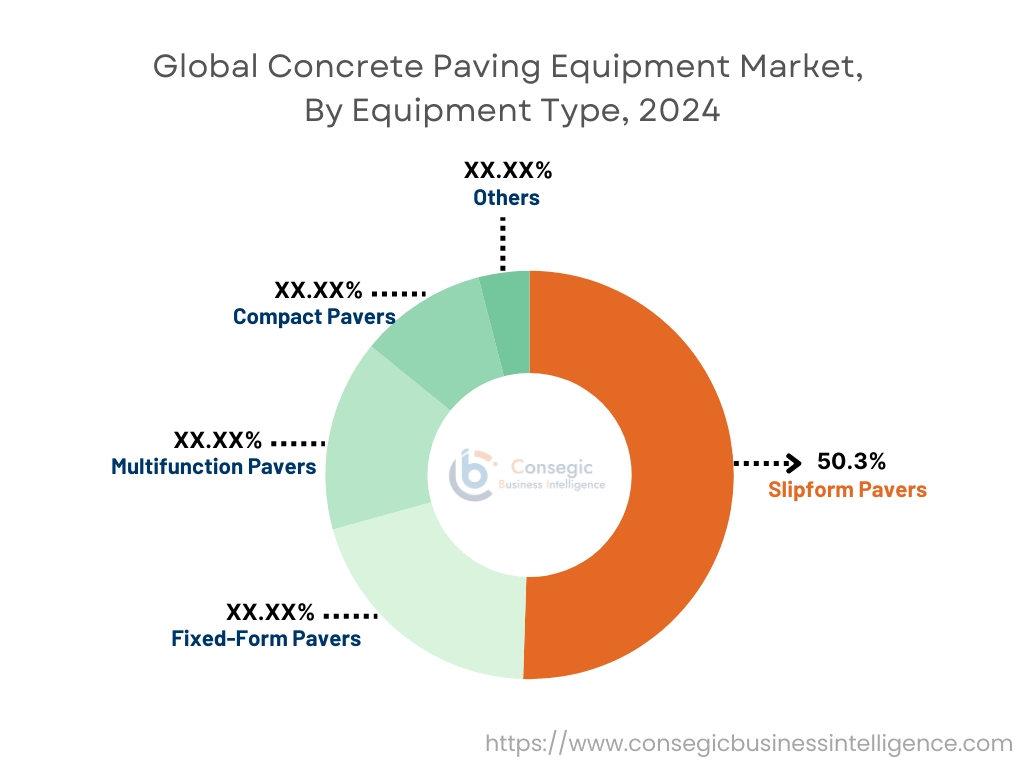
Based on Equipment Type, the market is segmented into Slipform Pavers, Fixed-Form Pavers, Multifunction Pavers, Compact Pavers, and Others.
The Slipform Pavers segment holds the largest revenue of the overall Concrete Paving Equipment Market share of 50.3% in the year 2024.
- Slipform pavers dominate large-scale concrete paving due to their continuous placement capability, making them ideal for highway, runway, and expressway projects.
- These machines reduce the need for fixed forms and manual finishing, enabling high-speed, uniform paving with fewer labor inputs.
- Contractors and public works agencies prefer slipform models for their trends in long-term performance and integration with sensor-guided control systems.
- For instance, in September 2023, Power Pavers introduced the SF-3404, a state-of-the-art four-track slipform paver designed for full-width concrete paving applications. This machine offers a maximum paving width of 40 feet (12 meters), with telescoping endpans providing an additional 2 feet (61 cm) of width flexibility on each side. Equipped with the SlipSmart control system, the SF-3404 ensures precise, 3D-ready operations, enhancing paving accuracy and efficiency.
- According to the concrete paving equipment market analysis, due to their widespread use in transportation infrastructure, slipform pavers remain the largest segment, fueling the concrete paving equipment market expansion.
The Multifunction Pavers segment is expected to grow at the fastest CAGR during the forecast period.
- Multifunction pavers are designed to handle multiple tasks such as curb forming, barrier shaping, and pavement finishing, making them highly adaptable.
- Municipal and urban contractors favor these units for small-to-medium scale projects where varied shaping and tight space operations are required.
- OEMs are developing modular units with adjustable molds and interchangeable tool heads to expand versatility across construction applications.
- As per the market analysis, the growing urban development and mixed-surface infrastructure projects fuel the global concrete paving equipment market development.
By Power Source:
Based on Power Source, the market is segmented into Diesel-Powered, Electric-Powered, and Hybrid-Powered.
The Diesel-Powered segment holds the largest revenue of the overall Concrete Paving Equipment Market share in the year 2024.
- Diesel remains the primary power source for most concrete paving equipment due to its high torque and reliability in heavy-duty, long-duration operations.
- These machines are favored in remote construction sites where grid access is limited and high power output is required for continuous operations.
- Diesel units are compatible with larger paving loads and extended use without frequent refueling or overheating risks.
- According to the concrete paving equipment market analysis, owing to infrastructure scale and performance demands, diesel-powered models account for the largest segment, significantly fueling the market growth.
The Electric-Powered segment is expected to grow at the fastest CAGR during the forecast period.
- Electric-powered paving equipment is gaining momentum due to global decarbonization efforts and regulatory push for low-emission construction zones.
- These machines are ideal for urban settings and tunnel projects where noise, vibration, and emission control are critical.
- OEMs are launching battery-electric compact pavers with telematics integration, remote diagnostics, and zero tailpipe emissions.
- The rising trend for tightening government standards and improving battery technology have substantially driven the concrete paving equipment market demand.
By Application:
Based on Application, the market is segmented into Roads & Highways, Airports, Dams & Canals, Industrial Zones, and Others.
The Roads & Highways segment holds the largest revenue share of the overall Concrete Paving Equipment Market in the year 2024.
- The largest application for concrete paving equipment is highway construction and urban expressway development, supported by consistent public and private funding.
- Pavers are used to lay long, durable concrete stretches with reduced maintenance costs compared to asphalt, especially in high-load corridors.
- Large contractors rely on slipform and high-width pavers to achieve lane uniformity, minimize surface defects, and enhance project turnaround.
- Thus, owing to scale, policy focus, and continuous investment, this segment leads in both equipment deployment and revenue contribution, significantly driving the concrete paving equipment market trends.
The Dams & Canals segment is expected to grow at the fastest CAGR during the forecast period.
- Infrastructure related to water conservation, hydroelectric projects, and irrigation is witnessing increased concrete usage for structural durability and water resistance.
- Canal lining and dam base construction often require specialty pavers with edge forming and slope-handling capabilities.
- Governments in water-stressed regions are implementing large-scale irrigation upgrades, benefiting from the precision and speed of mechanized paving.
- According to the market analysis, due to the increased focus on climate adaptation and rural infrastructure, dams & canals represent the fastest-growing application area, significantly fueling the global concrete paving equipment market expansion.
Regional Analysis:
The regions covered are North America, Europe, Asia Pacific, Middle East and Africa, and Latin America.
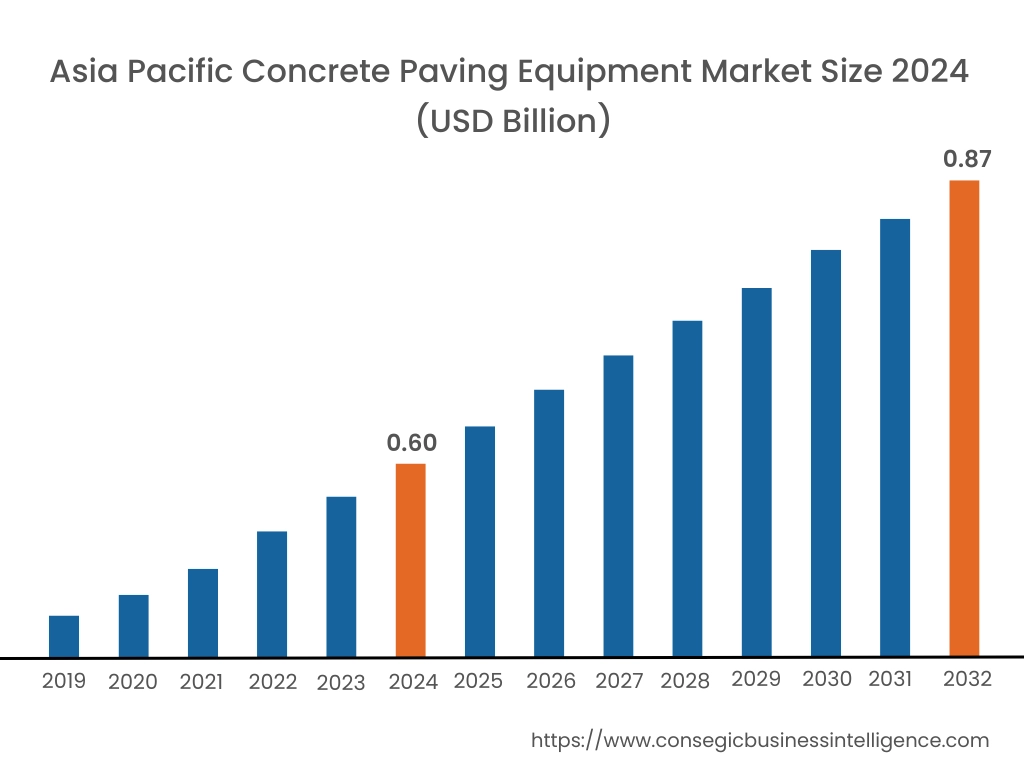
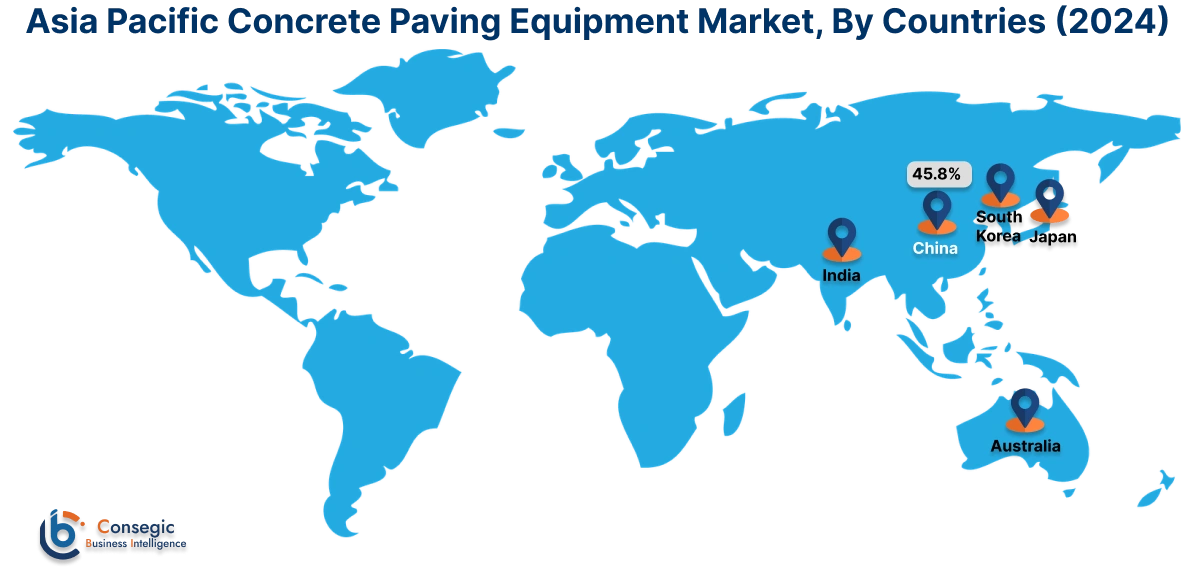
Asia Pacific region was valued at USD 0.60 Billion in 2024. Moreover, it is projected to grow by USD 0.62 Billion in 2025 and reach over USD 0.87 Billion by 2032. Out of this, China accounted for the maximum revenue share of 45.8%.
Asia-Pacific confronts rapid urban expansion and large-scale infrastructure build-outs that are transforming its concrete paving equipment landscape. China’s expressway extensions and India’s rural road programs anchor regional activity. Australia and Japan pursue high-precision urban resurfacing projects that emphasize automation and material efficiency. Trends like GPS-guided pavers for consistent layer thickness and mobile remote-diagnostic platforms for on-site performance monitoring propel significant market progress. Analysis of the market showed that government mechanization incentives and international OEM alliances are driving equipment upgrades significantly boosting the concrete paving equipment market demand.
North America is estimated to reach over USD 0.76 Billion by 2032 from a value of USD 0.53 Billion in 2024 and is projected to grow by USD 0.54 Billion in 2025.
North America is responding to extensive highway rehabilitation programs and federal infrastructure renewal mandates that are driving modernization of these equipment in the region. The United States leads with large-scale interstate resurfacing initiatives, and Canada follows through interprovincial highway maintenance schemes. Mexico’s rural road connectivity efforts also mirror these trends. Additionally trends like integrated sensor-based screed controls for real-time mix consistency monitoring and the deployment of automated grade-control systems that ensure uniform pavement profiles pave the way for the industry growth.
- For instance, in January 2025, Bidwell announced the launch of its advanced 3600HD paver at the World of Concrete 2025 exhibition at the Las Vegas Convention Center. This machine is engineered for high-volume concrete paving tasks, offering a combination of durability, precision, and adaptability. Key features include a remote-control system that enhances operational safety and communication among crew members, and 6-inch powered up and down legs, providing greater flexibility and ease of use. The 3600HD also incorporates fogger technology to improve the concrete curing process, ensuring optimal strength and durability.
Furthermore, analysis of the market showed that sustained public funding and OEM-contractor partnerships are key to technology adoption is significantly driving the Concrete Paving Equipment industry in this region.
Europe exhibits a strong presence in the market due to the urban renewal projects and stringent environmental regulations that are reshaping the equipment requirements across the region. Germany and France lead with major motorway rehabilitation contracts, while Spain and Italy follow by investing in sustainable city roadway upgrades. Collaborative rental-and-share schemes in the Netherlands and Belgium further illustrate regional alignment with efficiency goals. One notable trend emphasizes telematics-driven fleet management to improve equipment utilization. Analysis of the market showed that EU grant mechanisms and cross-industry collaborations are accelerating equipment innovation is significantly boosting the concrete paving equipment market in this region.
Middle East & Africa is experiencing ambitious urban development schemes and resource-driven infrastructure investments that are stimulating growth for advanced paving machinery. The United Arab Emirates and Saudi Arabia lead with mega-project highway networks. South Africa and Egypt follow through major trunk-road upgrade campaigns that prioritize durability in extreme climates. The factory-fitted electric screed motors to reduce site emissions and compact pavers designed for dense urban zones fuel market development. Analysis of the market showed that the growing importance of mobile training modules to enhance operator proficiency have fueled the concrete paving equipment market in this region.
Latin America is undergoing comprehensive roadway rehabilitation and transnational corridor development that are redefining its concrete paving equipment market. Brazil’s highway concession projects and Argentina’s rural road modernization efforts dominate the region. Colombia and Chile are also emphasizing sustainable paving approaches for mining and export logistics. Additionally, the adoption of rental-based paving platforms to enhance project flexibility and the integration of real-time temperature and moisture monitoring to ensure concrete quality boost market progress. Furthermore, the public-private partnership frameworks and localized OEM support networks are crucial, significantly driving concrete paving equipment market growth in this region.
Top Key Players and Market Share Insights:
The Concrete Paving Equipment Market is highly competitive with major players providing products and services to the national and international markets. Key players are adopting several strategies in research and development (R&D), product innovation, and end-user launches to hold a strong position in the global Concrete Paving Equipment Market. Key players in the Concrete Paving Equipment industry include -
- GOMACO Corporation (USA)
- Wirtgen Group (Germany)
- Allen Engineering Corporation (USA)
- Topcon Positioning Systems (USA)
- SANY Group (China)
- Terex Corporation (USA)
- Power Curbers & Power Pavers (USA)
- Guntert & Zimmerman (G&Z) (USA)
- Miller Formless Co. (USA)
- HEM Paving Equipment (USA)
Recent Industry Developments :
Mergers and Acquisitions:
- In January 2025, Conmat Group acquired 100% ownership of KYB Conmat Private Limited, a leading Indian manufacturer of concrete construction equipment including batching plants, concrete paving machines, transit mixers, concrete pumps, and self-loading mixers. Through this acquisition, Conmat aims to capitalize on this opportunity by leveraging its design and development capabilities to build advanced, locally suited equipment.
Concrete Paving Equipment Market Report Insights:
| Report Attributes | Report Details |
| Study Timeline | 2019-2032 |
| Market Size in 2032 | USD 2.59 Billion |
| CAGR (2025-2032) | 4.6% |
| By Equipment Type |
|
| By Power Source |
|
| By Application |
|
| By Region |
|
| Key Players |
|
| North America | U.S. Canada Mexico |
| Europe | U.K. Germany France Spain Italy Russia Benelux Rest of Europe |
| APAC | China South Korea Japan India Australia ASEAN Rest of Asia-Pacific |
| Middle East and Africa | GCC Turkey South Africa Rest of MEA |
| LATAM | Brazil Argentina Chile Rest of LATAM |
| Report Coverage |
|
Key Questions Answered in the Report
How big is the Concrete Paving Equipment Market? −
Concrete Paving Equipment Market size is estimated to reach over USD 2.59 Billion by 2032 from a value of USD 1.80 Billion in 2024 and is projected to grow by USD 1.85 Billion in 2025, growing at a CAGR of 4.6% from 2025 to 2032.
What specific segments are covered in the Concrete Paving Equipment Market? +
The Concrete Paving Equipment Market specific segments for Equipment Type, Power Source, Application, and Region.
Which is the fastest-growing region in the Concrete Paving Equipment Market? +
Asia pacific is the fastest growing region in the Concrete Paving Equipment Market.
What are the major players in the Concrete Paving Equipment Market? +
The key players in the Concrete Paving Equipment Market are GOMACO Corporation (USA), Wirtgen Group (Germany), Terex Corporation (USA), Power Curbers & Power Pavers (USA), Guntert & Zimmerman (G&Z) (USA), Miller Formless Co. (USA), HEM Paving Equipment (USA), Allen Engineering Corporation (USA), Topcon Positioning Systems (USA), SANY Group (China), and others.
Overview
Reputation & Certifications


Our Services
- Market Intelligence & Forecasting
- Custom Research Solutions
- Market Entry Strategy
- Competitive Intelligence
- Customer Insights
- Industry Innovation Analysis
- Investment Advisory