Jump to Content
Connected Iot Devices Market Size & Industry Share - Growth Trends & Forecasts (2026 - 2034)
Connected IoT Devices Market Size:
The Connected IoT Devices market size was valued at 167.92 (US$B) in 2025 and is projected to grow from 206.04 (US$B) in 2026 to 1,058.53 (US$B) by 2034, at a CAGR of 22.7% from 2026 to 2034, according to a recent report from Consegic Business Intelligence.
Connected IoT Devices Market Scope & Overview:
Connected IoT devices provide an easy and efficient way of exchanging data between various device components such as sensors, and software for managing device fleets at scale. The connection aims to leverage digital intelligence, enabling connected devices to communicate in real-time and contribute to automated processes on a large scale. Moreover, most of the connected IoT devices are connected to a protocol server and acquire an IP address that functions on the network. The devices have the ability to connect through public or private networks depending on the configuration of the device. Additionally, the components of IoT devices include the processor, connectivity IC, sensors, and others which collectively cater to various end-users including consumer electronics, retail, logistics, automotive, healthcare, manufacturing, and others. Additionally, the increasing adoption of 5G technology and ease of integration as well as communication between devices are key determinants driving the growth of connected IoT devices market size.

Connected IoT Devices Market Dynamics - (DRO) :
Key Drivers:
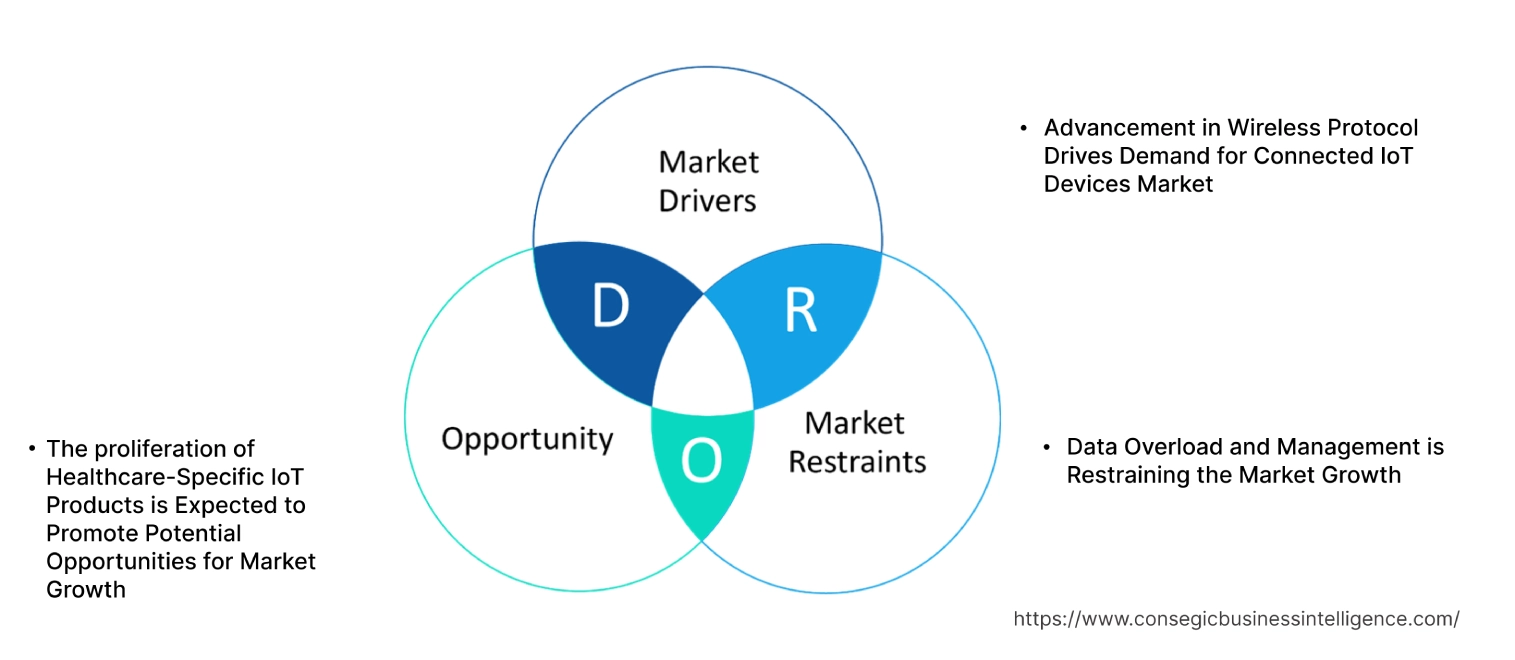
Advancement in Wireless Protocol Drives Demand for Connected IoT Devices Market
The advancement in wireless protocol is boosting the capabilities of connected IoT devices which has accelerated the integration of IoT applications. The wireless protocol is used for various applications in IoT devices including cloud computing, wireless video sensors, and wearable sensors as well as machine-to-machine communication among others. Further, the wireless communication protocols including 5G, Wi-Fi-Direct, LTE, 6LoWPAN, and others are prevailing in the connected IoT devices for easy interoperability between devices which in turn drives the market. Moreover, the advantages of adopting wireless protocol include improved security, increased scalability, enhanced flexibility, and cost-saving among others.
- In January 2023, Monogoto partnered with RAKwireless to drive innovation in Private Lora connectivity to public cellular LTE-M / NB-IoT for connected IoT devices.
Therefore, the advancement in wireless protocol is driving the connected IoT devices in turn proliferating the market.
Key Restraints :
Data Overload and Management is Restraining the Market Growth.
The growing development of smart cities and increasing adoption of automation of buildings is driving the demand for IoT devices. Moreover, IoT devices generate a huge amount of data which leads to data overload and management issues. Moreover, the number of IoT devices working in the cities or industries determines the volume of data generated. Additionally, the devices generate various types of data including text-based data, static images, video, and audio which require unique data management. Further, the factors that hamper the data storage infrastructure are the rate at which the data is processed, stored, and analyzed for real-time monitoring and control functions.
Therefore, data overload and management issues are restraining the connected IoT devices market expansion.
Future Opportunities :
The proliferation of Healthcare-Specific IoT Products is Expected to Promote Potential Opportunities for Market Growth
Internet of Things (IoT)-enabled device enables easy monitoring in the healthcare sector aiming to keep patients safe and healthy, as well as empowering physicians to deliver excellent care. The devices increase patient engagement and satisfaction with better services and real-time treatment which is made possible with the adoption of IoT-based connected devices in the healthcare sector. Further, the advancement is mainly benefiting patients, families, physicians, hospitals, and insurance companies among others.
- In July 2024, KORE launched mCareWatch 241 which features a personal emergency alarm system for providing connectivity and a provisioning platform to connect wearable devices. The more enables virtual monitoring of patients at homes or healthcare facilities.
Hence, the rise of healthcare-specific IoT products is anticipated to increase the utilization in turn propelling the connected IoT devices market opportunity during the forecast period.
Connected IoT Devices Market Segmental Analysis :
By Component:
Based on the component, the market is segmented into hardware, software, and service.
Trends in the component:
- Smart cities are increasingly leveraging IoT sensors to optimize traffic flow, lessen congestion, and increase safety.
- The trend towards advanced technology such as edge computing, artificial intelligence, and blockchain is propelling the component segment of connected IoT devices market demand.
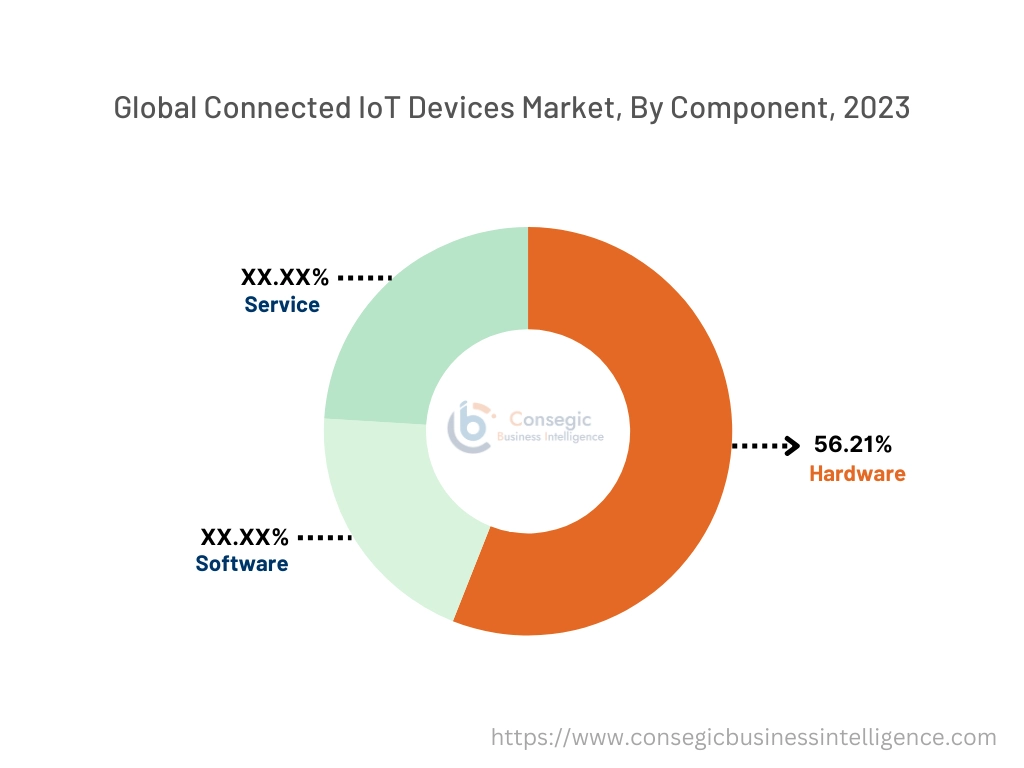
The hardware accounted for the largest revenue share of 56.21% in the year 2023.
- The hardware components comprise sensors, processors, communication modules, and actuators among others. Moreover, components play a crucial role in the innovation of soft robotics which is utilized in industries for enhancing flexibility capabilities. Additionally, the rising adoption of Microelectromechanical Systems (MEMS) technology as well as the reduced size of sensors is propelling the connected IoT devices market size in the hardware segment.
- The sensors are utilized in various end-use industries including automotive, healthcare, and consumer products among others. Moreover, the primary function of sensors is to collect and transmit real-time data for monitoring and controlling various systems, optimize operations, and improve decision-making.
- In April 2023, MultiTech launched Radio Bridge LoRaWAN which is a wireless temperature sensor product line engineered to detect ambient air temperature or humidity, utilizing air flow to measure levels.
- Thus, the rising adoption of microelectromechanical systems and the ability to collect and transmit data is driving the hardware segment of connected IoT devices market trends.
The service segment is anticipated to register the fastest CAGR during the forecast period.
- The IoT-based connected devices generate a huge amount of data which is processed, stored, and analyzed for real-time monitoring and control activities. Businesses leverage IoT to enhance decision-making and improve the service offered to the customers which has led to rising cyber-attacks and threats of data breach driving the service segment.
- The service segment will experience significant growth due to the evolution of various advanced technologies integrated into IoT devices including artificial intelligence, machine learning, blockchain, and edge computing.
- In September 2021, Silicon Labs launched Zero Trust security architectures which is a new security service for IoT companies aiming to meet emerging cybersecurity standards and combat the rising tide of threats.
- Therefore, as per the analysis, the emergence of advanced technology and rising security concerns are anticipated to boost the market during the forecast period.
By Deployment:
Based on the deployment, the market is bifurcated into on-premise and cloud.
Trends in the Deployment:
- Businesses are leveraging multi and hybrid cloud deployment for optimizing usage and portability over the cloud.
- Cloud computing is using blockchain technology to improve the security and safety of transactions over the cloud.
The cloud accounted for the largest revenue share in the year 2023 and is anticipated to register the fastest CAGR during the forecast period.
- The cloud enables storing data and files on the internet through a cloud computing provider which is accessed through public internet or a dedicated private network connection. They offer a range of benefits including scalability, flexibility, cost-effectiveness, and security.
- The rapid evolution in technologies is promoting the cloud segment for sorting, storing, analyzing, computing, and transmitting data for real-time monitoring and controlling of various IoT devices.
- In August 2024, Oracle partnered with AT&T to integrate Oracle's industry cloud application with AT&T network to provide a single cloud platform for IoT devices.
- Thus, the aforementioned benefits and ability to store and analyze huge volumes of data are driving the cloud segment of connected IoT devices market expansion.
By Technology:
Based on the technology, the market is segmented into Wi-Fi, Bluetooth, ZigBee, Cellular, NFC, RFID, and others.
Trends in the Technology:
- The integration of ZigBee with the 5G network enhances security measures and increases interoperability.
- The advancing encryption and secure data transmission is promoting the adoption of the NFC segment.
Wi-Fi accounted for the largest revenue share in the year 2023 and is anticipated to register the fastest CAGR during the forecast period.
- The Wi-Fi segment plays a crucial role in the connected IoT-based devices ranging from phones and computers to homes and workplace devices. The Wi-Fi technology provides high performance with low latency connectivity which makes it efficient and reliable for various applications.
- Further, the development of Wi-Fi 6 technology is providing higher performance, lower latency, and faster data rates for ensuring seamless connectivity with IoT devices.
- In September 2024, Edgecore Networks launched an EAP112 device integrated with Wi-Fi HaLow access point and Matter IoT gateway functionalities. The device is engineered for growing IoT applications. The EAP112 offers long-range connectivity, energy efficiency, and robust performance for seamless IoT deployment.
- Thus, as per the analysis, the ability to provide high performance with low latency connectivity is driving the Wi-Fi segment.
By Application:
Based on the application, the market is segmented into smart home devices, industrial automation, smart retail, medical devices, connected logistics, and others.
Trends in the application:
- The rising automation and industrialization are increasingly adopting IoT-based connected devices to improve efficiency and productivity driving the connected IoT devices industry.
- Various IoT devices have the ability to sense soil moisture and nutrients which is boosting the connected IoT devices market for agriculture applications.
The smart home devices accounted for the largest revenue share of 23.42% in the year 2023.
- Smart home devices offer remote monitoring and control of appliances and systems including kitchen appliances, smart TVs, smartphones, and others.
- Additionally, the rise of connected home devices that can seamlessly manage and automate various household appliances is driving the growth of the IoT devices market in smart home applications.
- In October 2023, Samsung Electronics Co., LTD. introduced new features into SmartThings including AI energy mode, enhanced automatic demand response (DR) functionality, and others.
- Thus, the connected devices at homes and seamlessly manage and automate various home devices is driving the connected IoT devices market trends.
Medical device is anticipated to register the fastest CAGR during the forecast period.
- The IoT-embedded medical devices play a crucial role in the healthcare sector with an IoT-based monitoring system that tracks data and transmits data to cloud storage through a network.
- The devices provide real-time data to both doctors and patients which is beneficial for allowing urgent medical decisions by doctors at the right time. Further, growing medical infrastructure across the globe is providing a connected IoT devices market opportunity.
- In February 2024, KORE launched MGMini which is a medical alert device utilizing eSIM technology. The technology is designed to address healthcare access disparities and enable two-way communication enhancing the healthcare sector.
- Therefore, as per the analysis, the ability to track and transmit data in real-time and advancement in medical devices are anticipated to boost the market during the forecast period.
By End-Use:
Based on the end use, the market is segmented into consumer electronics, retail, logistics & transportation, automotive, healthcare, manufacturing and others.
Trends in the End Use:
- The sensor-based soil monitors and automated irrigation systems are spurring the adoption of connected devices for precision farming and improved resource management.
- The rising need for enhancing customer experience and enhanced supply chain management with real-time tracking is boosting the demand for connected devices in the retail sector.
Consumer electronics accounted for the largest revenue share of 27.12% in the year 2023.
- The role of IoT in consumer electronics is to connect devices to the internet and use sensors to collect, process, and share data. Moreover, IoT in consumer electronics creates communication protocols that allow seamless and uniform data sharing, regardless of device manufacturer or function.
- Further, the widespread adoption of voice assistants and other smart home technologies is driving the growth of connected IoT devices market share. Additionally, the growing demand for luxury and convenience to enhance lifestyle is boosting the segment.
- In August 2023, Samsung launched Crystal Vision 4K UHD TV embedded with voice assistant and video calling facility as well as various IoT features including IoT light sensors and a built-in IoT Hub.
- Thus, the rising adoption of voice assistants and other smart home technologies is driving the connected IoT devices market demand.
Healthcare is anticipated to register the fastest CAGR during the forecast period.
- The connected devices play a crucial role in the healthcare sector with features including remote patient monitoring, glucose monitoring, heart rate monitoring, and Parkinson’s disease monitoring among others.
- Regulatory compliance such as HIPAA and others have stringent rules for healthcare devices which includes the data collected by medical devices.
- In October 2024, Heterogeneous, launched a connected ambulance solution. The ambulance is embedded with advanced 5GIoTTM technology with real-time patient monitoring, and data transmission facility.
- Therefore, according to connected IoT devices market analysis, stringent rules and the aforementioned features are anticipated to boost the market during the forecast period.
Regional Analysis:
The regions covered are North America, Europe, Asia Pacific, the Middle East and Africa, and Latin America.
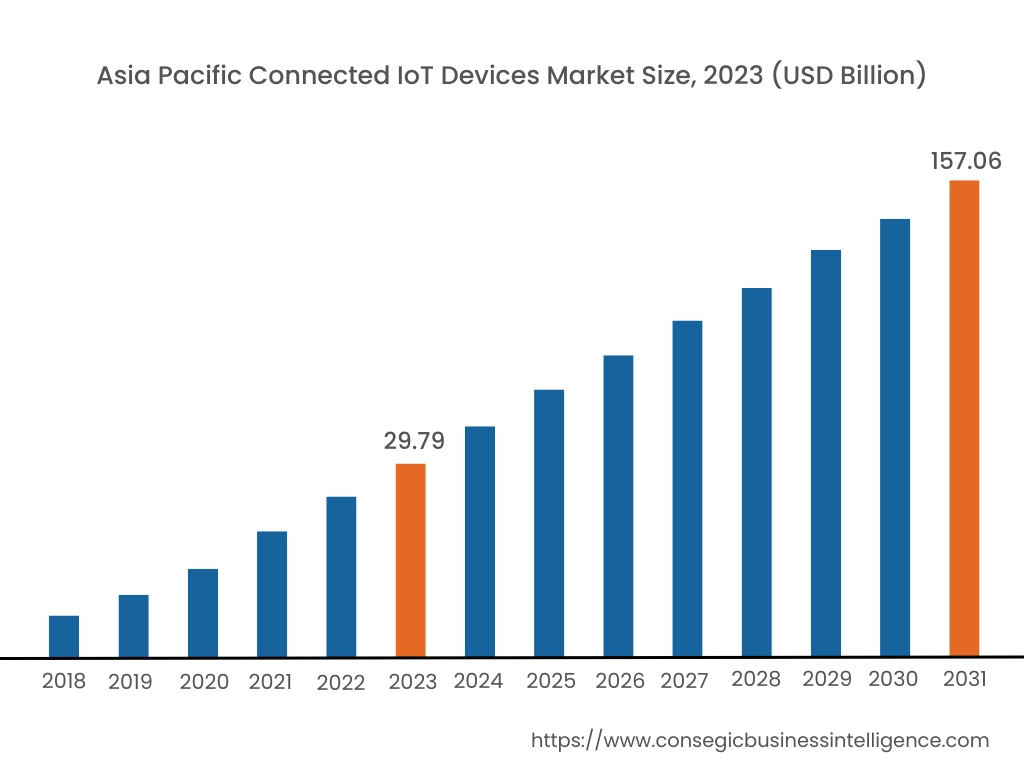
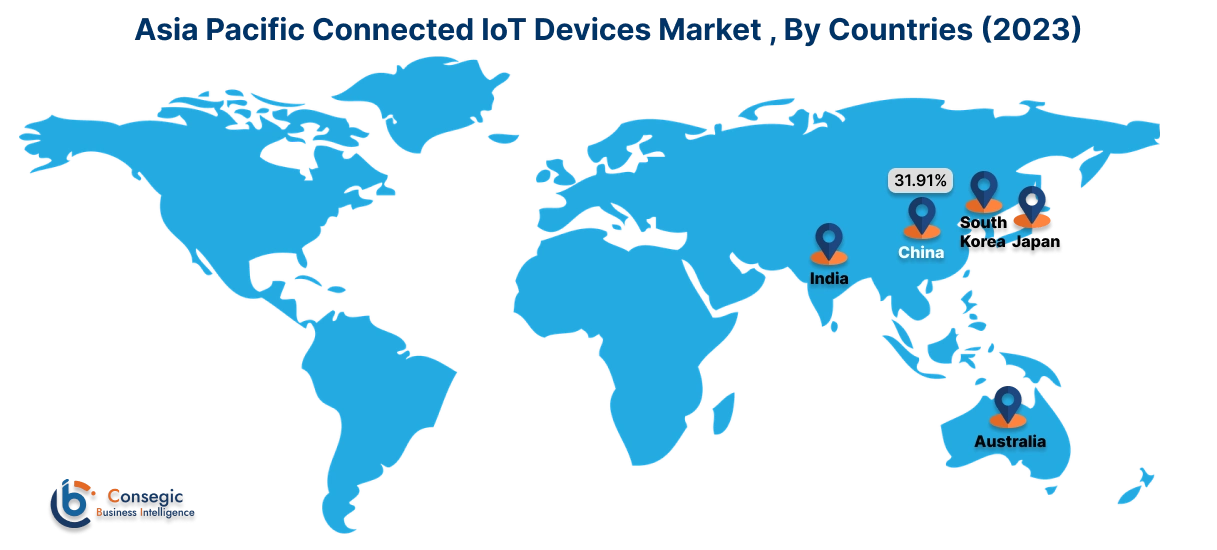
Asia Pacific region was valued at USD 29.79 Billion in 2023. Moreover, it is projected to grow by USD 36.10 Billion in 2024 and reach over USD 157.06 Billion by 2031. Out of this, China accounted for the maximum revenue share of 31.91%. The Asia Pacific region's growing consumer electronics sector with the rising adoption of smartphones and other IoT devices including kitchen appliances, lighting systems, and others offers lucrative growth prospects for the market. Additionally, the emergence of cloud computing is driving connected IoT devices market growth.
- For instance, ORing based out in China launched OL-Z1D603D1-NBGTF-1 smart street light controller with Zhaga-D4i certified luminaires designed for IoT and smart city platforms to support smart applications and improve energy efficiency.
North America is estimated to reach over USD 188.35 Billion by 2031 from a value of USD 36.12 Billion in 2023 and is projected to grow by USD 43.73 Billion in 2024. The market development for connected devices is mainly driven by their deployment in consumer electronics manufacturing and other industries.
- For instance, In September 2023, Lexmark based out in the U.S. partnered with HARMAN Digital Transformation Solutions to expand its IoT portfolio of technology for specific projects in various industries. The collaboration integrated AI and IoT to cater to various challenges faced by enterprises and public institutions.
Further, factors including IoT infrastructure development and rising adoption of widespread network technology are projected to drive the market in North America during the forecast period.
Additionally, according to the analysis, Europe is anticipated to witness substantial progress that is backed by growing smart building and smart city revolution as well as the rising adoption of NB-IoT networks for smart cities is surging demand for connected IoT-based devices across the region.
Further, as per the connected IoT devices market analysis, the Middle East and African region is experiencing rapid infrastructural development of data centers for IoT and digital transformation as well as boosting the 5G private network is driving the market in the region.
Furthermore, the Latin American region is expected to grow at a considerable rate owing to the growing industrial IoT in the agricultural and manufacturing sectors as well as digital transformation and smart city initiatives for real-time monitoring and controlling is driving the connected IoT devices market growth in the region.
Top Key Players & Market Share Insights:
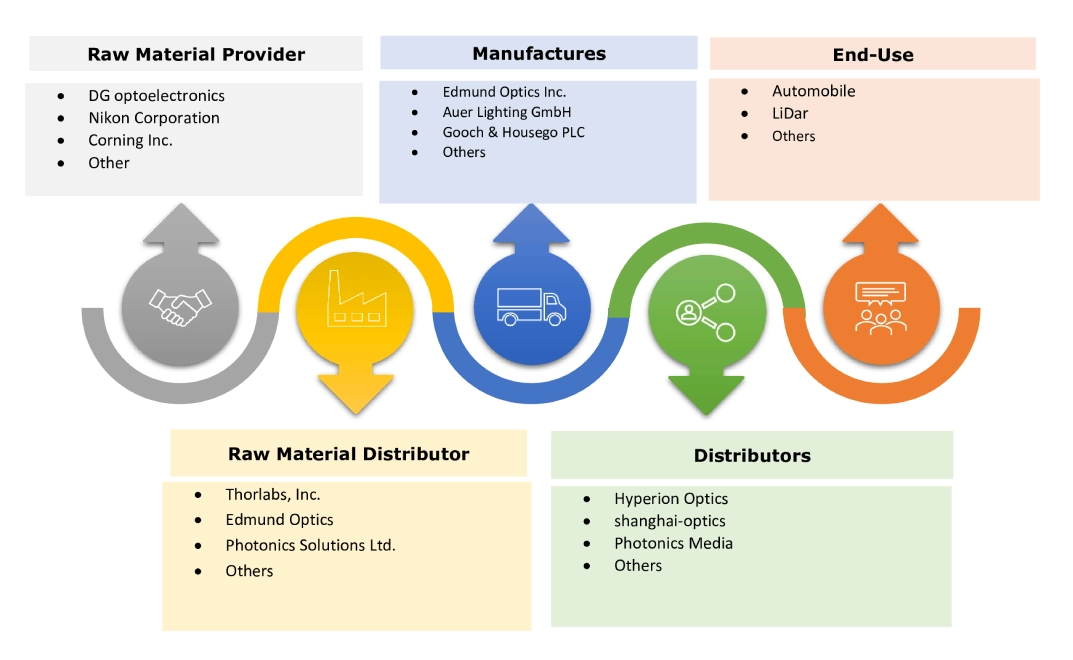
The global collimating lens market is highly competitive with major players providing lenses to the national and international markets. Key players are adopting several strategies in research and development (R&D), product innovation, and end-user launches to hold a strong position in the collimating lens market. Key players in the collimating lens industry include-
- Spectrum (Europe)
- Intel Corporation (U.S)
- PTC Incorporation (US)
- Oracle Corporation (US)
- LG Corporation (South Korea)
- Samsung Electronics Co. Ltd. (South Korea)
- Cisco Systems, Inc. (U.S)
- HTC Corporation (Taiwan)
- Apple Inc. (US)
- Dell Inc. (US)
Recent Industry Developments :
Product launches:
- In October 2024, Silicon Laboratories launched the Series 3 Platform for IoT expansion. The series 3 device caters to IIoT applications in commercial buildings, retail and warehouses, smart factories, and Industry 4.0 among others by providing better connectivity, enhanced computation, improved security, and others.
- In June 2023, Qualcomm launched satellite IoT solutions for remote monitoring and asset tracking to enable ultra-low power and superior connectivity for IoT devices across satellite and cellular networks. Additionally, the company has launched two new chipsets for IoT enterprises, developers, ODMs, and OEMs which include a 212S modem and a 9205S modem.
Partnerships & Collaborations:
- In October 2024, Batelco partnered with Thales to provide an IoT connectivity management platform that aims to simplify managing connections and improve IoT operations.
- In February 2024, BICS partnered with Skylo aiming to provide direct NB-IoT-to-satellite connectivity covering 13.7 Million square miles of land and sea for enterprise customers.
- In April 2022, ABB collaborated with Samsung Electronics to develop smart Internet of Things (IoT) connection for both residential and commercial buildings with benefits including features of energy savings and energy management
Connected IoT Devices Market Report Insights :
| Report Attributes | Report Details |
| Study Timeline | 2021-2034 |
| Market Size in 2034 | USD 1,058.53 Billion |
| CAGR (2026-2034) | 22.70% |
| Base Year | 2025 |
| By Component |
|
| By Deployment |
|
| By Technology |
|
| By Application |
|
| By End-Use |
|
| By Region |
|
| Key Players |
|
| North America | U.S. Canada Mexico |
| Europe | U.K. Germany France Spain Italy Russia Benelux Rest of Europe |
| APAC | China South Korea Japan India Australia ASEAN Rest of Asia-Pacific |
| Middle East and Africa | GCC Turkey South Africa Rest of MEA |
| LATAM | Brazil Argentina Chile Rest of LATAM |
| Report Coverage |
|
Key Questions Answered in the Report
How big is the Connected IoT devices market? −
The Connected IoT Devices Market size is estimated to reach over USD 573.02 Billion by 2031 from a value of USD 111.53 Billion in 2023 and is projected to grow by USD 134.86 Billion in 2024, growing at a CAGR of 22.7% from 2023 to 2031.
What specific segmentation details are covered in the Connected IoT devices report? +
The Connected IoT devices report includes specific segmentation details for component, deployment, technology, application, end-use, and regions.
Which is the fastest segment anticipated to impact the market growth? +
In the Connected IoT devices market, the hardware segment is the fastest-growing segment during the forecast period due to a surge in demand for IoT sensors and actuators as well as the rise in adoption in consumer electronics is driving the market.
Who are the major players in the Connected IoT devices market? +
The key participants in the Connected IoT devices market are Spectrum (Europe), Intel Corporation (U.S), Samsung Electronics Co. Ltd. (South Korea), Cisco Systems, Inc. (U.S), HTC Corporation (Taiwan), Apple Inc. (U.S), Dell Inc. (U.S), PTC Incorporation (US), Oracle Corporation (US), LG Corporation (South Korea) and others.
What are the key trends in the Connected IoT devices Market? +
The Connected IoT devices market is being shaped by several key trends including the rise of sensor-based soil monitors, automated irrigation systems, industrial IoT, and rising adoption across various sectors including, healthcare and consumer electronics are the key trends driving the market trend.
Overview
Reputation & Certifications


Our Services
- Market Intelligence & Forecasting
- Custom Research Solutions
- Market Entry Strategy
- Competitive Intelligence
- Customer Insights
- Industry Innovation Analysis
- Investment Advisory