Jump to Content
Diesel Lubricity Improver Market - Size, Share, Industry Trends, and Forecasts (2025-2032)
Diesel Lubricity Improver Market Size:
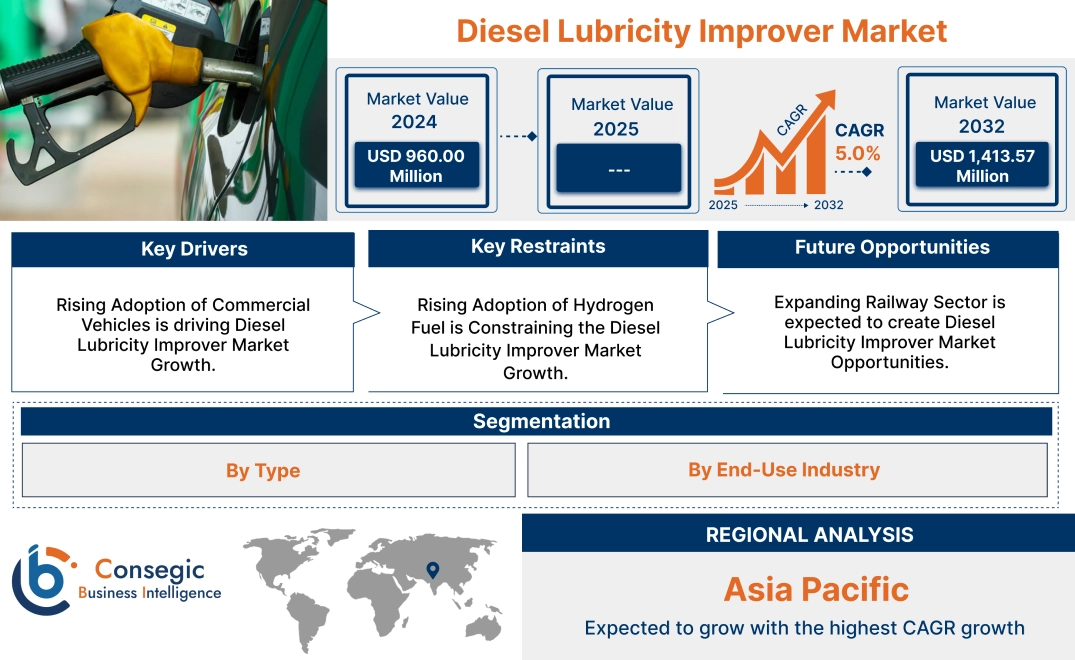
Diesel lubricity improver market size is estimated to reach over USD 1,413.57 Million by 2032 from a value of USD 960.00 Million in 2024, growing at a CAGR of 5.0% from 2025 to 2032.
Diesel Lubricity Improver Market Scope & Overview:
A diesel lubricity improver is an additive used in ultra-low sulphur diesel to enhance fuel lubricity and wear resistance. It works by forming a protective layer on metal surfaces thus reducing friction and wear on diesel engine components. There are mainly two types of diesel lubricity improver such as acidic lubricity improver and non-acidic lubricity improver. Furthermore, acidic lubricity improver consist of carboxylic acids and fatty acids while non-acidic lubricity improver consist of esters, amide and alcohol. Due to the features such as lubricity, thermal stability and corrosion resistance, diesel lubricity improver is widely used in industries such as automotive, marine, railways, industrial machinery, and others.
Diesel Lubricity Improver Market Dynamics - (DRO) :
Key Drivers:
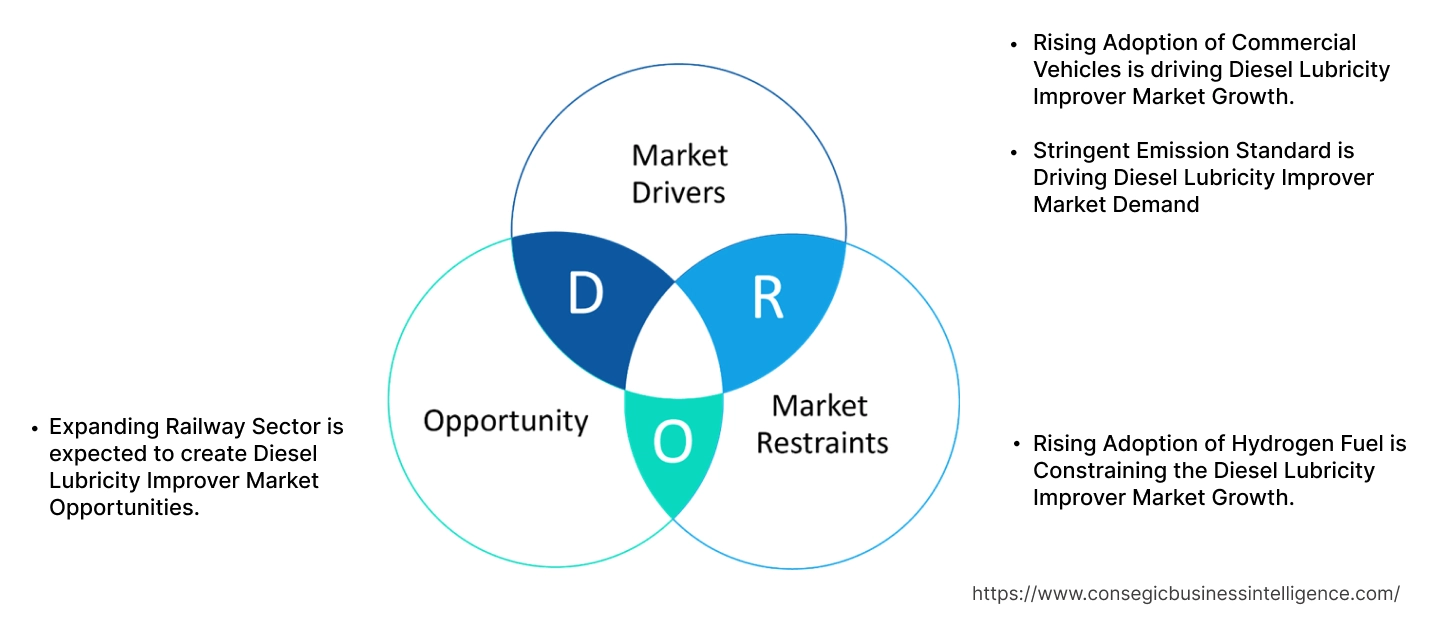
Rising Adoption of Commercial Vehicles is driving Diesel Lubricity Improver Market Growth.
Commercial vehicles, such as trucks, buses and heavy-duty vehicles, are vital for industries like logistics, transportation and others, which have been expanding globally. Diesel lubricity improver is used in commercial vehicles to reduce engine wear and enhance diesel efficiency. Factors such as the rise in e-commerce and increasing global transportation are further driving the adoption of commercial vehicles.
- In 2023, according to the Society of Indian Automobile Manufacturers, the overall commercial vehicle sales increased from 7,16,566 units in 2022 to 9,62,468 units in the year 2023 in India. It is driving the use of diesel lubricity improver to improve diesel combustion and reduce maintenance costs in commercial vehicles.
Thus, the rising adoption of commercial vehicles is leading to diesel lubricity improver market demand by reducing maintenance costs and improving diesel combustion.
Stringent Emission Standard is Driving Diesel Lubricity Improver Market Demand
Stringent emission standards such as Euro 6d enforce reductions in the sulphur contents in diesel used for vehicles. It mandates the use of ultra-low sulphur diesel in engines which contain less than 10 parts per million of sulphur. It is leading to increased consumption of diesel lubricity improver to maintain the lubricity in the ultra-low sulphur diesel.
- In 2023, according to the International Trade Administration, China’s Ministry of Ecology and Environment (MEE) implemented 6a emission standards for vehicles including light-duty trucks, passenger vehicles and others. These emission standards mandate the use of ultra-low sulphur diesel. It is driving the market growth, as diesel lubricity improver is used in ultra-low sulphur diesel to improve its lubricity and wear resistance.
Thus, stringent emission standards such as Euro 6d are driving diesel lubricity improver market expansion, by enforcing the diesel engines to lo ultra-low sulphur diesel.
Key Restraints:
Rising Adoption of Hydrogen Fuel is Constraining the Diesel Lubricity Improver Market Growth.
The rising adoption of hydrogen fuel in transportation, and power generation is restraining the market demand. Governments and automakers worldwide are heavily investing in hydrogen fuel production to achieve zero emission goals. This shift reduces the consumption of ultra-low sulfur diesel, which requires lubricity improvers. Hydrogen fuel eliminate the need for an internal combustion system, reducing reliance on diesel engines, thereby reducing the demand for diesel lubricity improver. Further, stringent environmental regulations and consumer demand for green transportation are driving the demand for hydrogen fuel.
Thus, the growing adoption of hydrogen fuel is constraining the diesel lubricity improver market expansion, by reducing the dependence on diesel-powered engines.
Future Opportunities :
Expanding Railway Sector is expected to create Diesel Lubricity Improver Market Opportunities.
The railway sector is expanding rapidly due to government support, technological advancements and economic development. The railways are adopting ultra-low sulphur diesel in rail engines to maintain engine performance and reduce wear. This has led to the adoption of diesel lubricity improver to improve lubricity in the engines.
- In 2024, according to Rail Analysis, the railway sector in India is expected to grow at a compound annual growth rate of 45.94% from 2024 to 2029. They will require diesel lubricity improver in railways to improve lubricity and reduce friction in rail engines. It further enhances fuel efficiency and reduces maintenance costs in rail engines.
Thus, expanding the railway sector is expected to create diesel lubricity improver market opportunities due to the need for high-performance railway engines.
Diesel Lubricity Improver Market Segmental Analysis :
By Type:
By type, the market is divided into acidic lubricity improver and non-acidic lubricity improver.
Trends in Type:
- According to diesel lubricity improver market trends, acidic lubricity improver offers wear resistance and fuel efficiency in diesel engines.
- Adoption of non-acidic lubricity improver is growing to provide thermal stability and higher oxidative stability in diesel engines as per market trends.
The acidic lubricity improver accounted for the largest market share in the year 2024.
- An acidic lubricity improver is a kind of lubricity improver that contains carboxylic acids and fatty acids.
- This improver works by forming a protective layer on boundary surfaces which prevents the wear resistance in diesel engines.
- An acidic lubricity improver also offers better compatibility with diesel fuel while meeting environmental standards.
- This improver also enhances diesel efficiency and maintenance costs in commercial vehicles and industrial applications.
- Further, global preference for cleaner fuels is driving the need for acidic lubricity improver to reduce carbon emissions.
- Thus, acidic lubricity improver is commonly used in the market due to wear resistance and enhancement in fuel efficiency.
The non-acidic lubricity improver is expected to grow at the fastest CAGR over the forecast period.
- The non-acidic lubricity improver is a kind of lubricity improver that includes esters, amide and alcohol.
- It is highly effective in providing thermal stability and preventing oxidation in high-performance diesel engines.
- The non-acidic lubricity improver also offers higher oxidative stability and corrosion resistance for heavy-duty applications such as heavy trucks, buses, and vans.
- Further, the growing adoption of heavy trucks is contributing to the use of non-acidic lubricity improver.
- For instance, in 2022, European Automobile Manufacturers' Association, the sales of heavy trucks in Spain increased by 5.9% as compared to the year 2021. Non-acidic lubricity improver is widely used in heavy trucks to improve thermal stability and diesel efficiency.
- Thus, the adoption of non-acidic lubricity improver is growing in the market due to higher oxidative stability and corrosion resistance as per trends.
By End Use Industry:
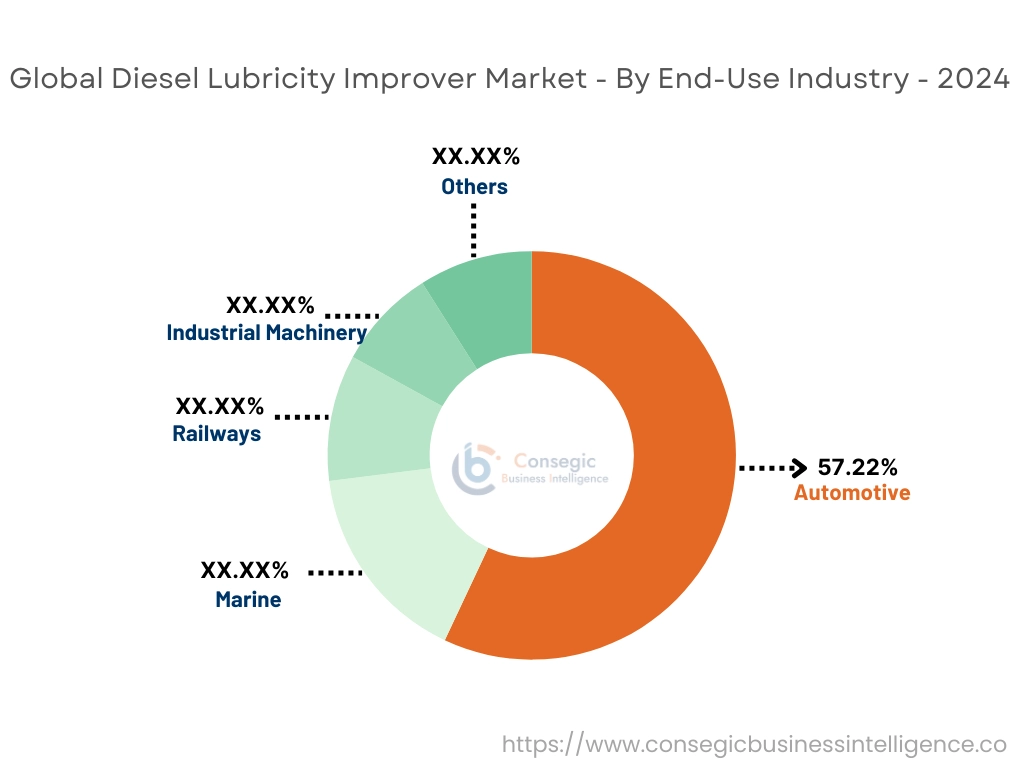
By end-use industry, the market is divided into automotive, marine, railways, industrial machinery, and others.
Trends in End-Use Industry:
- According to diesel lubricity improver market trends, lubricity improver is commonly used in diesel-powered vehicles to improve engine performance.
- The use of diesel lubricity improver is growing in commercial ships, ferries, and cargo carriers due to heavy reliance on diesel-powered engines as per trends.
The automotive accounted for the largest market share of 57.22% in the year 2024.
- The automotive industry includes organizations associated with the production, wholesaling, retailing, and maintenance of motor vehicles.
- Diesel lubricity improver is widely used in the automotive due to reliance on diesel engines for passenger vehicles, trucks, and heavy-duty buses.
- Diesel engines typically use ultra-low sulphur diesel which has less natural lubricity, mandating the use of lubricity improver to maintain engine performance and longevity.
- The lubricity improver increases wear resistance in diesel engines thus enhancing diesel efficiency and lowering maintenance costs in vehicles.
- Hence, diesel lubricity improver is widely used in the automotive industry due to the heavy reliance on diesel engines in motor vehicles.
The marine is expected to grow at the fastest CAGR over the forecast period.
- The marine industry encompasses all the activities related to shipping, offshore energy, shipbuilding and maritime trade.
- Diesel lubricity improver is being used in the marine industry for diesel-powered engines in commercial ships, ferries, and cargo carriers.
- It is used in marine diesel engines to reduce wear and friction resistance thereby protecting fuel injectors, pumps, and other engine components.
- Further, growing maritime trade globally is driving the use of diesel lubricity improver in diesel-powered ships, containers, and others.
- For instance, in 2023, according to United Nations Trade & development, global marine trade is increased by 2.4% as compared to the year 2022. Diesel lubricity improver is used in marine trade to improve lubricity and wear resistance in commercials ships, ferries, and cargo carriers.
- Thus, use of diesel lubricity improver is growing in marine industry to reduce wear and friction resistance in marine diesel engines as per trends.
Regional Analysis:
The regional segment includes North America, Europe, Asia Pacific, the Middle East and Africa, and Latin America.
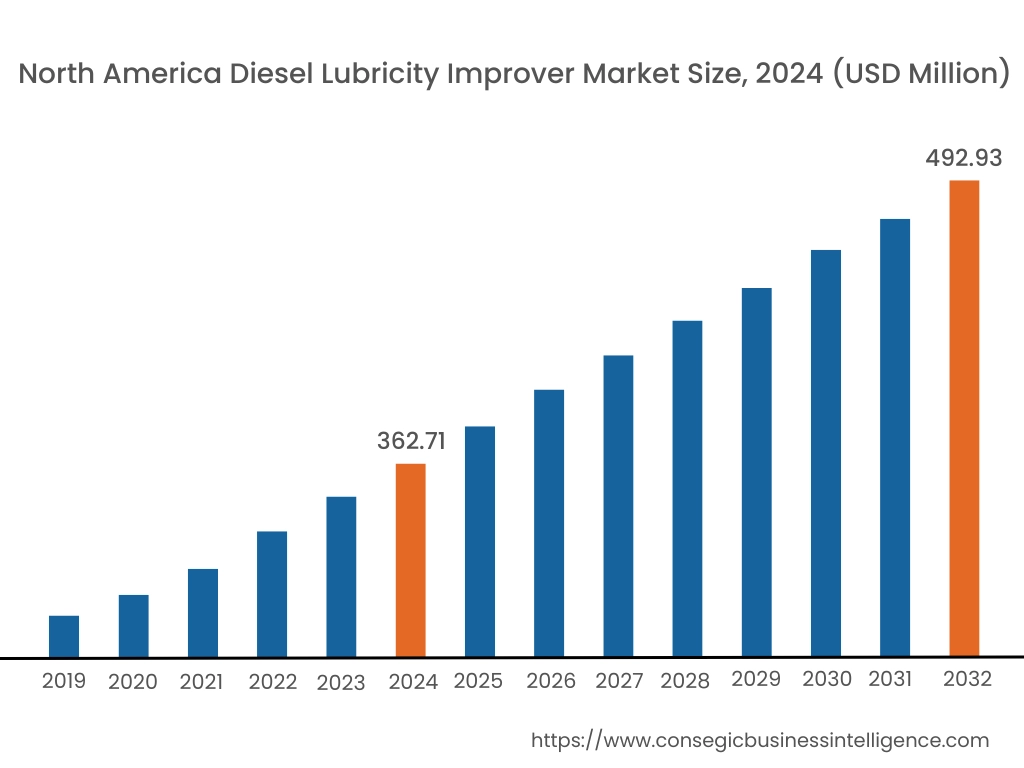
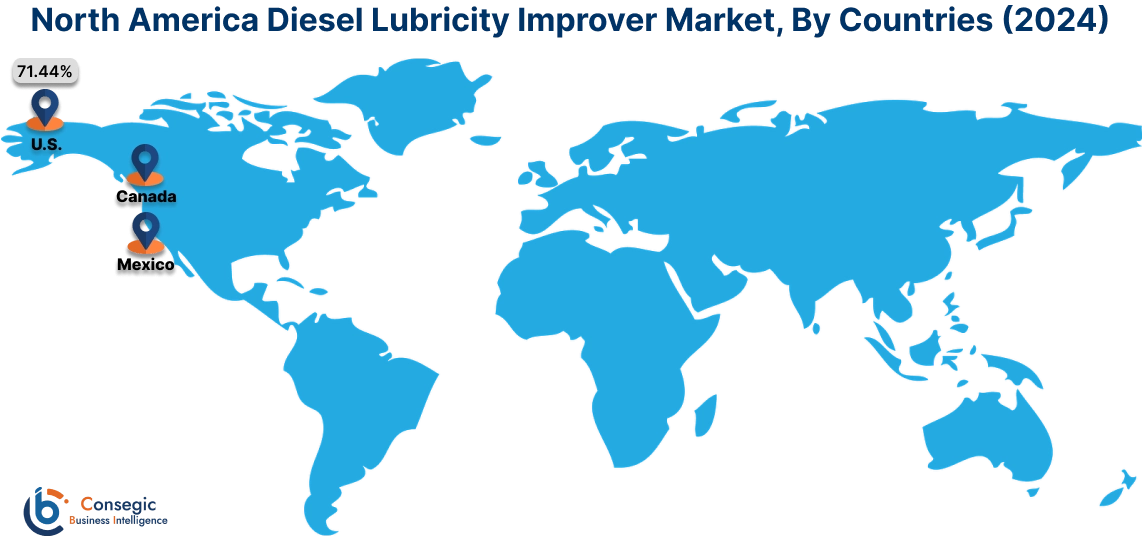
In 2024, North America accounted for the highest market share of 37.79% and was valued at USD 362.71 Million and is expected to reach USD 492.93 Million in 2032. In North America, United States accounted for the highest market share of 71.44% during the base year of 2024.
The diesel lubricity improver market share of North America is significant due to technological advancements. Advancements in additive formulations are focusing on improving the performance of ultra-low sulphur diesel. Development of advanced ester-based and amide-based lubricity improver is driving adoption of ultra-low sulphur diesel in engines. Further, rising adoption of passenger cars in the region is driving the market.
- In 2023, according to CEIC data, the passenger cars sales in the United States is increased by 9% as compared to the year 2022. The diesel lubricity improver is incorporated in passenger cars to improve lubricity in ultra-low sulphur diesel and increasing wear resistance.
Thus, North America is dominating the market, driven by technological advancements and industrial developments.
Asia-Pacific is expected to witness the fastest CAGR of 6.87% over the forecast period of 2025-2032. As per diesel lubricity improver market analysis, Asia-Pacific region is experiencing rapid growth driven by growing automotive and manufacturing sectors. The expanding automotive industry particularly in countries such as China, India, and Japan are leading to more consumption of diesel lubricity improver in diesel-powered vehicles. With the increasing adoption of ultra-low sulphur diesel vehicles in the automotive sector, the need for high performance lubricity improver is growing. Further, rising growth of diesel-powered industrial machinery and equipment is driving the market in the region. Thus, diesel lubricity improver market share of Asia-Pacific is expanding due to growing automotive and manufacturing sector as per analysis.
According to diesel lubricity improver market analysis, the Europe region is growing rapidly driven by environmental regulations and sustainable concerns. The environmental regulations in European Union mandates the use of ultra-low sulphur diesel in vehicles to reduce carbon emissions. This has led to adoption of diesel lubricity improver to improve the lubricity in vehicles, ships, and containers. Moreover, sustainability initiatives by government and private sector are driving the growth of bio-based and sustainable resources for the production of diesel lubricity improver in the region.
The Middle East and Africa region is experiencing gradual expansion in the market, driven by mining sector. The growing mining sector especially in countries like UAE, South Africa, and Saudi Arabia, relies on diesel-powdered engines for excavation, drilling, and transportation of materials in mining. This has led to the adoption of diesel lubricity improver considerably to reduce wear and maintenance cost in diesel-powered mining equipment as per analysis.
As per market analysis, the market in Latin America is driven by expanding railway infrastructure, leading to increased demand for high-performance diesel lubricity improver. Countries like Brazil and Argentina are investing heavily in railway projects to enhance logistics and transportation efficiency. This investment is driving the need for advanced diesel engine oils and lubricants in railway engines, leading to more consumption of diesel lubricity improver in the region.
Top Key Players and Market Share Insights:
The diesel lubricity improver industry is highly competitive with major players providing products to the national and international markets. Key players are adopting several strategies in research and development (R&D) and product innovation to hold a strong position in the global diesel lubricity improver market. Key players in the diesel lubricity improver industry include-
- Afton Chemical (United States)
- TotalEnergies (France)
- Huntsman Corporation (United States)
- Ecolab (United States)
- Baker Hughes Company (United States)
- BASF (United States)
- Innospec Inc. (United States)
- Dow Inc. (United States)
- The Lubrizol Corporation (United States)
- Chevron Corporation (United States)
Recent Industry Developments :
Product Launches:
- In 2023, TotalEnergies launched RUBIA OPTIMA in Europe. It is a diesel lubricity improver suitable for diesel engines running on ultra-low sulphur diesel.
Diesel Lubricity Improver Market Report Insights :
| Report Attributes | Report Details |
| Study Timeline | 2019-2032 |
| Market Size in 2032 | USD 1,413.57 Million |
| CAGR (2025-2032) | 5.0% |
| By Type |
|
| By End Use Industry |
|
| By Region |
|
| Key Players |
|
| North America | U.S. Canada Mexico |
| Europe | U.K. Germany France Spain Italy Russia Benelux Rest of Europe |
| APAC | China South Korea Japan India Australia ASEAN Rest of Asia-Pacific |
| Middle East and Africa | GCC Turkey South Africa Rest of MEA |
| LATAM | Brazil Argentina Chile Rest of LATAM |
| Report Coverage |
|
Key Questions Answered in the Report
How big is the diesel lubricity improver market? −
In 2024, the diesel lubricity improver market is USD 960.00 million.
Which is the fastest-growing region in the diesel lubricity improver market? +
Asia-Pacific is the fastest-growing region in the diesel lubricity improver market.
What specific segmentation details are covered in the diesel lubricity improver market? +
Type and end-use industry are covered in the diesel lubricity improver market.
Who are the major players in the diesel lubricity improver market? +
Afton Chemical (United States), TotalEnergies (France), and BASF (United States) are some of the major players in the market.
Overview
Reputation & Certifications


Our Services
- Market Intelligence & Forecasting
- Custom Research Solutions
- Market Entry Strategy
- Competitive Intelligence
- Customer Insights
- Industry Innovation Analysis
- Investment Advisory