Jump to Content
Ethernet Phy Chip Market Size & Industry Share - Growth Trends & Forecasts (2026 - 2034)
Ethernet PHY Chip Market Size:
The Ethernet PHY Chip Market is expected to expand from 12,114.88 (US$M) in 2025 to 13,142.22 (US$M) in 2026, and is forecast to surpass 25,203.82 (US$M) by 2034, growing at a CAGR of 8.5% between 2026 and 2034, according to a recent report from Consegic Business Intelligence.
Ethernet PHY Chip Market Scope & Overview:
An Ethernet PHY chip is a critical component in networking equipment, responsible for the physical layer of the Ethernet communication process. These chips enable the transmission and reception of data over Ethernet cables by converting digital data from devices into signals suitable for transmission and vice versa. Ethernet PHY chips are widely used in various networking applications, including switches, routers, servers, and industrial automation systems, where reliable and high-speed data communication is essential.
These chips support multiple Ethernet standards, ranging from Fast Ethernet to 10 Gigabit Ethernet, catering to different bandwidth requirements across industries. They are engineered to provide low latency, energy efficiency, and robust signal integrity, ensuring optimal network performance in both consumer and enterprise-grade applications. Modern Ethernet PHY chips also feature advanced capabilities like auto-negotiation, error correction, and compatibility with different media types, enhancing their versatility.
End-users of Ethernet PHY chips include data centers, telecommunication providers, industrial equipment manufacturers, and consumer electronics producers. These chips are essential for enabling seamless and efficient data transfer across diverse networking environments, forming a backbone for modern digital communication systems.
How is AI Transforming the Ethernet PHY Chip Market?
AI is being increasingly used in the ethernet PHY chip market. AI and machine learning solutions are being integrated into ethernet PHY chips to optimize performance, enable predictive maintenance, and enhance network efficiency, particularly in industrial and high-bandwidth applications.
Moreover, AI also plays a role in the design and development of these chips, with machine learning algorithms optimizing layouts and predicting performance. Additionally, the integration of AI in these chips offers a range of benefits, including adaptive signal processing, predictive maintenance, optimized power consumption, and others. Thus, the above factors are projected to drive the market growth during the forecast period.

Ethernet PHY Chip Market Dynamics - (DRO) :
Key Drivers:
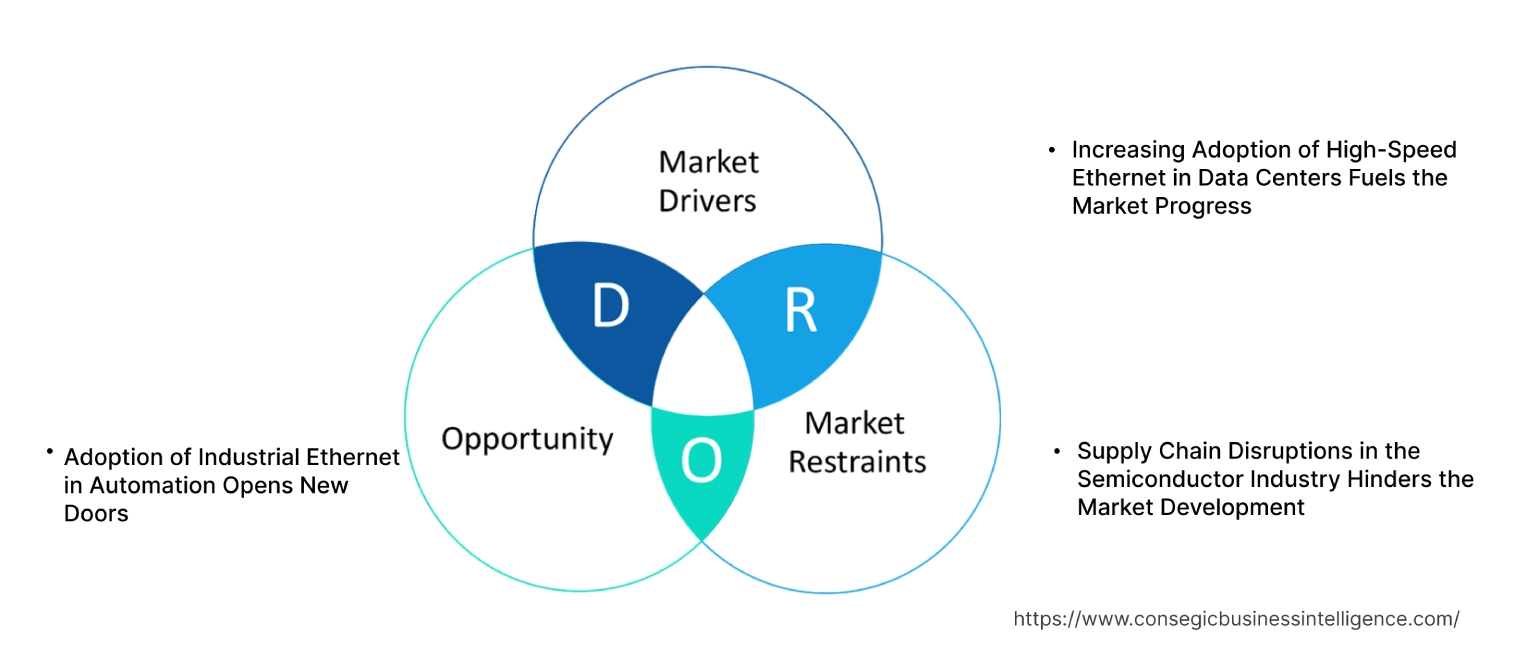
Increasing Adoption of High-Speed Ethernet in Data Centers Fuels the Market Progress
The rapid growth of data centers, fueled by cloud computing, digital transformation, and data-intensive applications, is driving the demand for high-speed Ethernet solutions. Data centers require advanced networking systems to handle massive data volumes, low-latency communication, and seamless connectivity between servers and storage systems. Ethernet PHY chips, designed for 10G, 25G, 40G, and 100G networks, are crucial in meeting these needs by enabling high-speed data transfer and efficient bandwidth utilization.
As industries adopt applications like AI, machine learning, and big data analytics, the need for scalable and high-performance Ethernet solutions has intensified. These chips ensure the reliability and speed required for real-time processing and data-driven decision-making. Furthermore, trends in edge computing and hybrid cloud environments are increasing the focus on robust and energy-efficient Ethernet PHY technologies, positioning them as essential components in modern data center infrastructures. Therefore, the aforementioned factors drive the ethernet PHY chip market growth.
Key Restraints :
Supply Chain Disruptions in the Semiconductor Industry Hinders the Market Development
The global semiconductor shortage has created significant constraints for the production and availability of Ethernet PHY chips. Supply chain bottlenecks, caused by increased demand for semiconductors across industries such as automotive, consumer electronics, and telecommunications, have led to delays in the procurement of critical components. These disruptions have directly impacted manufacturers’ ability to meet the growing need for Ethernet PHY solutions, particularly for high-speed and industrial applications.
Fluctuating raw material costs and limited production capacities further exacerbate the issue, resulting in extended delivery timelines and higher operational costs for manufacturers. The shortage has also prompted companies to prioritize high-margin or high-demand products, limiting the availability of advanced Ethernet PHY chips in niche or emerging markets. These restraints pose significant risks to the supply chain stability and delay the adoption of next-generation Ethernet solutions in critical industries like data centers and industrial automation, hampering the ethernet PHY chip market demand.
Future Opportunities :
Adoption of Industrial Ethernet in Automation Opens New Doors
The shift toward Ethernet-based connectivity in industrial automation is transforming manufacturing, logistics, and oil & gas operations by enabling real-time data transfer and seamless machine-to-machine communication. Industrial Ethernet PHY chips are designed to meet the unique demands of these environments, offering high reliability, low latency, and robust performance under harsh conditions such as extreme temperatures, vibrations, and electromagnetic interference.
These chips are critical for modernizing operations and supporting advanced applications like predictive maintenance, process optimization, and robotic automation. As industries increasingly adopt smart manufacturing and Industrial IoT (IIoT) technologies, the requirement for Ethernet-based solutions is rising. Additionally, the ability of Industrial Ethernet to integrate with legacy systems while providing scalability for future expansions enhances its appeal. This transition aligns with trends in industrial digitalization, creating significant growth opportunities for manufacturers offering Ethernet PHY solutions tailored for automation. Thus, the above-mentioned factors contribute to the ethernet PHY chip market opportunities.
Ethernet PHY Chip Market Segmental Analysis :
By Data Rate:
Based on data rate, the market is segmented into 10 Mbps, 100 Mbps, 1 Gbps, 10 Gbps, and 25 Gbps and above.
The 1 Gbps segment held the largest revenue of the total ethernet PHY chip market share in 2024.
- 1 Gbps Ethernet PHY chips are widely used in enterprise networking equipment, such as switches and routers, for their balance of speed, efficiency, and cost.
- These chips are extensively adopted in data centers, enabling high-speed communication between servers and storage devices.
- The dominance of this segment is driven by its applicability in diverse end-user industries, including IT & telecom, industrial automation, and consumer electronics.
- As per ethernet PHY chip market trends, the 1 Gbps segment continues to thrive due to its widespread adoption in both legacy and modern networking infrastructures.
The 25 Gbps and above segment is expected to grow at the fastest CAGR during the forecast period.
- These chips cater to advanced networking needs, such as cloud computing, AI-based systems, and high-performance computing (HPC).
- Increasing deployment of 5G networks and edge computing is fueling the adoption of higher data rate Ethernet PHY chips.
- The segment benefits from ongoing innovations in data centers and hyperscale architectures, which require ultra-high-speed communication for optimal performance.
- The rapid adoption of 25 Gbps and above chips reflects their critical role in meeting the needs of next-generation networking technologies further boosting the ethernet PHY chip market demand.
By Port Type:
Based on port type, the market is segmented into Single-Port and Multi-Port.
The multi-port segment held the largest revenue of the total ethernet PHY chip market share in 2024.
- Multi-port Ethernet PHY chips are widely used in enterprise-grade switches, routers, and servers to enable multiple high-speed connections simultaneously.
- These chips are integral to network scalability, supporting complex infrastructures in data centers and telecom networks.
- The segment's dominance is attributed to the rising adoption of multi-port chips in IoT and smart devices, where seamless connectivity is essential.
- As per ethernet PHY chip market analysis, the multi-port chips provide a cost-effective solution for high-density environments, making them the preferred choice in large-scale deployments.
The single-port segment is expected to grow at the fastest CAGR during the forecast period.
- Single-port chips are commonly used in consumer electronics, IoT devices, and low-density networking applications.
- Their compact design and energy efficiency make them suitable for edge computing and industrial automation applications.
- The rapid growth of this segment is supported by the increasing need for connected devices in smart homes and industrial IoT environments.
- Single-port Ethernet PHY chips play a key role in enabling reliable and secure communication in decentralized networking setups, further fueling the ethernet PHY chip market expansion.
By Application:
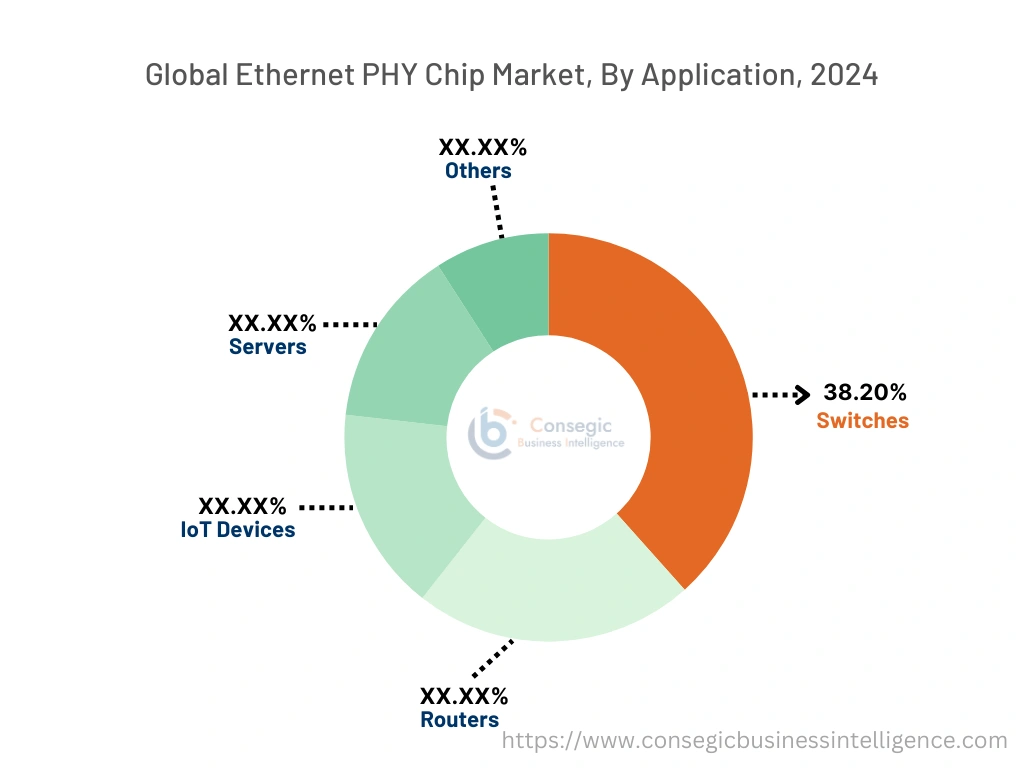
Based on application, the market is segmented into Switches, Routers, IoT Devices, Servers, and Others.
The switches segment accounted for the largest revenue share of 38.20% in 2024.
- Ethernet PHY chips in switches ensure seamless data transfer between network devices, making them indispensable in enterprise and data center networks.
- The segment benefits from the increasing adoption of managed and smart switches, which require high-speed and reliable connectivity.
- Integration of features such as power over Ethernet (PoE) and advanced security protocols enhances the appeal of Ethernet PHY chips in switches.
- As per ethernet PHY chip market trends, the dominance of this segment reflects its critical role in enabling efficient network management and scalability.
The IoT devices segment is expected to grow at the fastest CAGR during the forecast period.
- IoT devices rely on Ethernet PHY chips for high-speed, low-latency communication, supporting applications in smart homes, healthcare, and industrial automation.
- Increasing penetration of IoT in emerging markets and advancements in IoT networking standards are driving the adoption of Ethernet PHY chips in this segment.
- The segment benefits from trends such as the proliferation of edge computing and the integration of AI and ML into IoT ecosystems.
- As per market analysis, the rapid growth of this segment is fueled by its ability to enable real-time data processing and connectivity in diverse IoT applications, contributing to ethernet PHY chip market growth.
Regional Analysis:
The regions covered are North America, Europe, Asia Pacific, the Middle East and Africa, and Latin America.
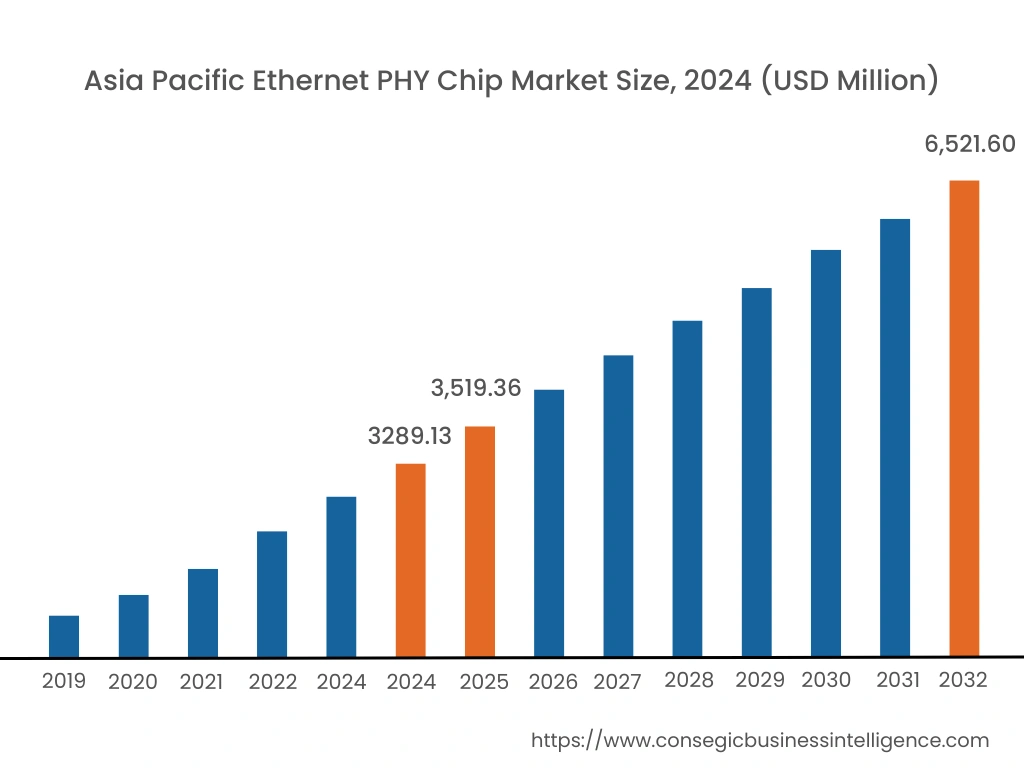
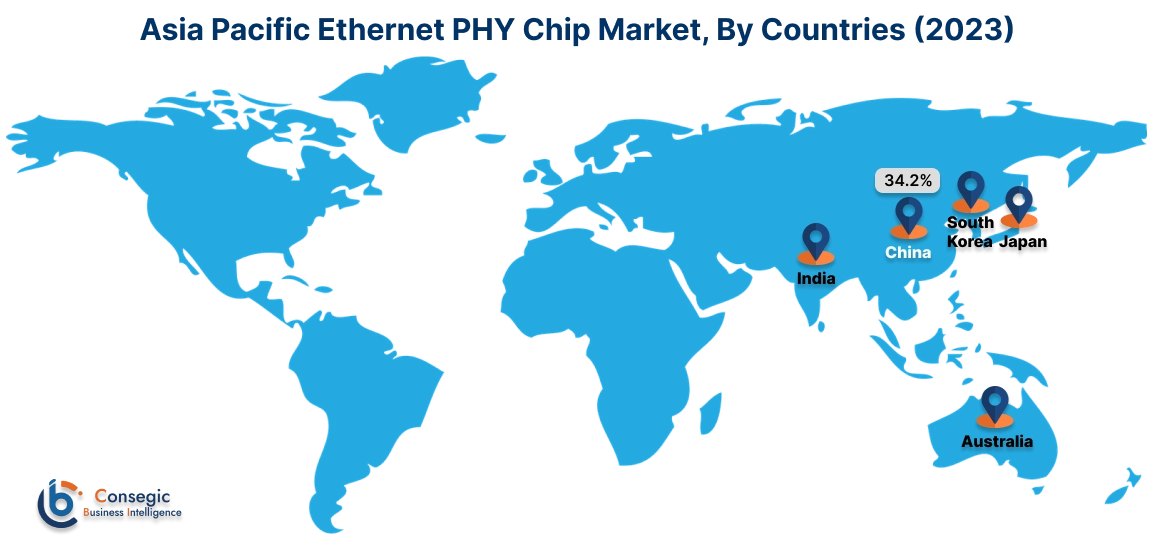
Asia Pacific region was valued at USD 3,289.13 Million in 2024. Moreover, it is projected to grow by USD 3,519.36 Million in 2025 and reach over USD 6,521.60 Million by 2032. Out of these, China accounted for the largest share of 34.2% in 2024. The Asia-Pacific region is experiencing rapid growth in the Ethernet PHY chip market, propelled by industrialization and technological advancements in countries like China, Japan, and South Korea. The region has become a global hub for electronics manufacturing, where Ethernet PHY chips are extensively used for high-speed data transmission and connectivity. As per ethernet PHY chip market analysis, government initiatives promoting digital transformation and smart city projects further influence market trends.
North America is estimated to reach over USD 6,941.38 Million by 2032 from a value of USD 3,704.59 Million in 2024 and is projected to grow by USD 3,945.17 Million in 2025. This region holds a significant share of the Ethernet PHY chip market, driven by the widespread adoption of high-speed internet and advanced networking solutions. The United States, in particular, has seen substantial integration of Ethernet PHY chips across sectors such as telecommunications, data centers, and enterprise networking. The trend towards cloud computing and the Internet of Things (IoT) has further propelled the ethernet PHY chip market opportunities.
Europe represents a substantial portion of the global Ethernet PHY chip market, with countries like Germany, France, and the United Kingdom leading in technological adoption. The region's strong emphasis on industrial automation and smart manufacturing drives the deployment of Ethernet PHY chips in various applications. The analysis indicates a growing trend toward integrating these chips in the automotive and consumer electronics sectors, aligning with the region's focus on innovation.
The Middle East & Africa region shows a growing interest in Ethernet PHY chips, particularly in the telecommunications and industrial automation sectors. Countries like the United Arab Emirates and Saudi Arabia are investing in advanced networking infrastructure to support digitalization efforts. The analysis suggests an increasing trend towards adopting Ethernet PHY chips to enhance connectivity and operational efficiency.
Latin America is an emerging market for Ethernet PHY chips, with Brazil and Mexico being key contributors. The region's expanding telecommunications sector and increasing internet penetration are driving the adoption of Ethernet PHY chips for improved network performance. As per market analysis, government policies aimed at enhancing digital infrastructure influence ethernet PHY chip market expansion.
Top Key Players & Market Share Insights:
The Ethernet PHY Chip market is highly competitive with major players providing products and services to the national and international markets. Key players are adopting several strategies in research and development (R&D), product innovation, and end-user launches to hold a strong position in the global Ethernet PHY Chip market. Key players in the Ethernet PHY Chip industry include –
- Broadcom Inc. (USA)
- Marvell Technology Group Ltd. (USA)
- NXP Semiconductors N.V. (Netherlands)
- Cirrus Logic, Inc. (USA)
- Silicon Laboratories Inc. (USA)
- Intel Corporation (USA)
- Texas Instruments Incorporated (USA)
- Microchip Technology Inc. (USA)
- Qualcomm Incorporated (USA)
- Realtek Semiconductor Corp. (Taiwan)
Recent Industry Developments :
Product Launches:
- In August 2024, Microchip Technology expanded its Single-Pair Ethernet (SPE) portfolio with the LAN887x PHY transceivers, supporting 100-1000 Mbps speeds and extended cable lengths up to 40m. These PHYs are ISO 26262 functional safety-ready, making them suitable for automotive and industrial applications. They offer diagnostics, low power consumption (16 µA standby), and enhanced reliability. Microchip's comprehensive SPE solutions include PHYs, microcontrollers, and development tools, enabling seamless integration into various industries, including automotive, robotics, and automation.
- In May 2024, MaxLinear expanded its Ethernet family by introducing 2.5G multi-port switches and Ethernet PHYs, including 7- and 10-port switches and a 2.5G octal-port PHY. These products enable faster, more efficient networking for applications in automotive, industrial, and enterprise sectors. The new switches and PHYs support higher bandwidth and energy efficiency, addressing the growing need for reliable, scalable Ethernet solutions in advanced networking environments.
- In February 2024, Synopsys launched the first complete 1.6T Ethernet IP solution designed to meet the high bandwidth demands of AI and hyperscale data center chips. This new offering delivers advanced performance, scalability, and power efficiency, enabling faster data transmission and supporting the growing needs of next-gen applications. It combines Synopsys’ Ethernet PHY and controller IP with AI-optimized features, positioning it as a critical solution for data-driven innovations in cloud and AI-driven infrastructures.
- In August 2023, Marvell introduced the industry’s first 5nm multi-gigabit PHY platform, enabling more energy-efficient and higher-performance enterprise networks. The Alaska M 3610 chip, the first based on this platform, reduces PHY power by over 50% while delivering up to 10 Gbps bandwidth, essential for Wi-Fi 7. This innovation supports increased performance and security, including MACsec encryption, for high-speed backhaul links. It promises significant power savings, reducing cooling requirements and enhancing network efficiency.
Ethernet PHY Chip Market Report Insights :
| Report Attributes | Report Details |
| Study Timeline | 2021-2034 |
| Market Size in 2034 | USD 25,203.82 Million |
| CAGR (2026-2034) | 8.48% |
| Base Year | 2025 |
| By Data Rate |
|
| By Port Type |
|
| By Application |
|
| By Region |
|
| Key Players |
|
| North America | U.S. Canada Mexico |
| Europe | U.K. Germany France Spain Italy Russia Benelux Rest of Europe |
| APAC | China South Korea Japan India Australia ASEAN Rest of Asia-Pacific |
| Middle East and Africa | GCC Turkey South Africa Rest of MEA |
| LATAM | Brazil Argentina Chile Rest of LATAM |
| Report Coverage |
|
Key Questions Answered in the Report
How big is the Ethernet PHY Chip Market? −
Ethernet PHY Chip Market size is estimated to reach over USD 21,417.41 Million by 2032 from a value of USD 11,168.21 Million in 2024 and is projected to grow by USD 11,916.28 Million in 2025, growing at a CAGR of 8.48% from 2025 to 2032.
What are the key segments in the Ethernet PHY Chip Market report? +
The Ethernet PHY Chip Market report includes segmentation by data rate (10 Mbps, 100 Mbps, 1 Gbps, 10 Gbps, 25 Gbps and above), port type (Single-Port, Multi-Port), application (Switches, Routers, IoT Devices, Servers, Others), and region (Asia-Pacific, Europe, North America, Latin America, Middle East & Africa).
Which segment is expected to grow the fastest in the Ethernet PHY Chip Market? +
The 25 Gbps and above segment is expected to grow at the fastest CAGR during the forecast period, driven by the increasing demand for higher data rates in applications like cloud computing, AI systems, and high-performance computing (HPC).
Who are the major players in the Ethernet PHY Chip Market? +
Key players in the Ethernet PHY Chip Market include Broadcom Inc. (USA), Marvell Technology Group Ltd. (USA), Intel Corporation (USA), Texas Instruments Incorporated (USA), Microchip Technology Inc. (USA), Qualcomm Incorporated (USA), Realtek Semiconductor Corp. (Taiwan), NXP Semiconductors N.V. (Netherlands), Cirrus Logic, Inc. (USA), and Silicon Laboratories Inc. (USA).
Overview
Reputation & Certifications


Our Services
- Market Intelligence & Forecasting
- Custom Research Solutions
- Market Entry Strategy
- Competitive Intelligence
- Customer Insights
- Industry Innovation Analysis
- Investment Advisory