Jump to Content
Europe Aluminum Foil Packaging Market - Size, Share, Industry Trends, and Forecasts (2025-2034)
Europe Aluminum Foil Packaging Market Executive Summary
The European aluminum foil packaging industry contains broad product lines such as domestic household foil roll, flexible packaging laminates comprising of aluminum and polymer substrate, rigid containers such as ready meals and catering, pharmaceutical blister packaging of tablets and capsule, and technical specific applications. The manufacturing network extends to the primary aluminum foil rolling mills, converting plants, printing and lamination plant and distribution channels between manufacturers and end-user industry in 27 of the European Union member states and related territories.
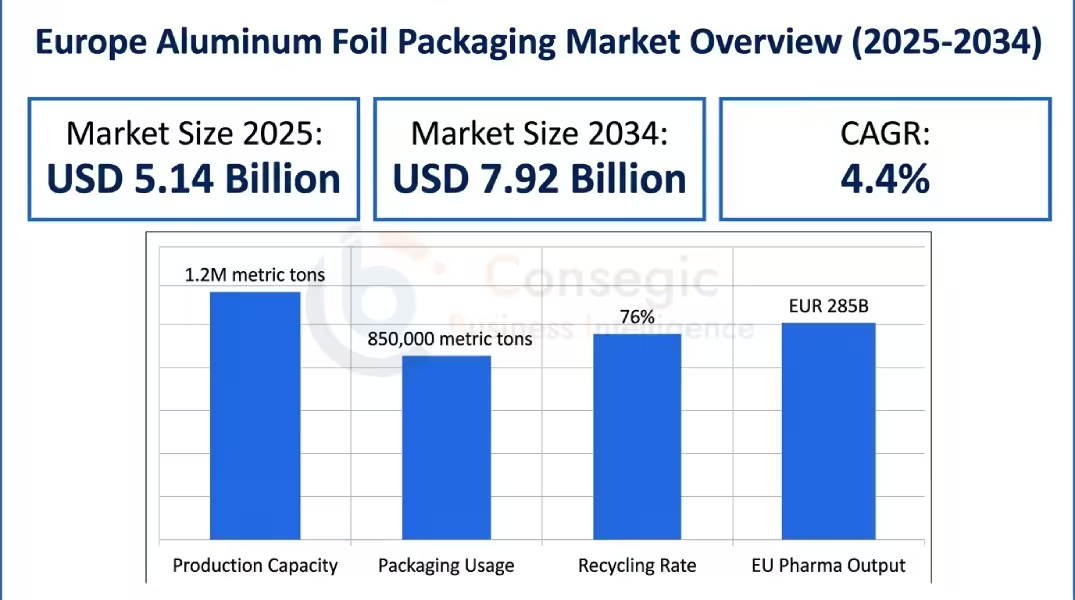
The market size of the Europe aluminum foil packaging is expected to be USD 5.14 Billion in the year 2025 (base year) and it is expected to grow to USD 7.92 Billion by the year 2034; this implies a compound annual growth rate (CAGR) of 4.4 per cent in the period 2026-2034. The European aluminum foil is estimated to have a production capacity of about 1.2 million metric tons per year as of 2024 with the packaging being the primary usage of about 850,000 metric tons, which is 71 percent of total aluminum foil usage. The industry has high environmental standards with a recycling rate of aluminum packings at 76 percent in 2024 significantly higher than plastic packaging substitutes and contributes to the goals of the EU in terms of a circular economy.
Key Market Insights
- Europe aluminum foil packaging market expected to grow from USD 5.14 billion (2025) to USD 7.92 billion by 2034 (CAGR 4.4%)
- Western Europe dominates with USD 2.83 Billion (55%) in 2025, projected to reach USD 4.36 Billion by 2034
- Eastern Europe holds USD 1.39 Billion (27%) in 2025 and is the fastest-growing region (5.1% CAGR)
- Germany leads the region with USD 1.02 Billion, supported by a strong pharmaceutical industry and major manufacturers
Market Scope & Overview
The aluminum foil packaging market in Europe is characterized by a very stringent regulatory environment that is represented by the Packaging and Packaging Waste law of the EU, Green Deal and Circular Economy Action Plan. The market caters to a variety of end-use markets with food and beverage applications constituting the greatest portion with the pharmaceutical applications (demographic trends and regulatory considerations) being the fastest growing applications.
Newer developments in aluminum foil packaging are associated with the addition of high-order barrier characteristics of less than 0.5 cubic centimeters per square meter per 24 hours as the oxygen permeability, less than 0.05 grams per square meter per 24 hours as the moisture vapor permeability, and total UV absorption of photosensitive products. Modern manufacturing techniques take advantage of cold rolling technology with tolerances of foil thickness of plus-minus 0.5 microns, high-speed converting lines of 400-600 meters per minute and have precision printing technology of plus-minus 0.25 millimeters.
Its technological advancement goes as far as specialized applications such as pharmaceutical cold-form blister packaging with oxygen transmission rates of less than 0.1 cubic centimeters per square meter per 24 hours to keep moisture-sensitive drugs dry, and also advanced laminate structures with aluminum and compatible polymers to the high-performance of flexible packaging applications.
Key Market Driver
Expansion of Pharmaceutical Industry and Requirements of Regulatory Compliances.
The high demand acceleration of aluminum foil packaging is present in the pharmaceutical sector across the European markets coupled with the growing trend in medication usage, the demographic trends, and the regulatory frameworks enforced on the protection of pharmaceutical products. In 2024, the European pharmaceutical manufacturing industries produced over EUR 285 billion worth of manufacturing output, with Germany producing EUR 52 billion, Switzerland EUR 48 billion, France EUR 38 billion, and Italy EUR 34 billion accounting to the overall pharmaceutical manufacturing activity in Europe.
Blister packaging with the support of aluminum foil backing substances is the most common primary packaging form of solid oral dosage products such as tablets, capsules and lozenges, which gives it better moisture barrier properties, oxygen exclusion properties and dose blocking properties than other packaging systems. The European Medicines Agency has specified packaging requirements such as provision of proven data on stability to support shelf-life claims, child-resistant packaging on selected classes of medications and tamper-evident features that ensure protection of the product.
The population demographic trends have a significant boost on the demand of pharmaceutical packaging as European population aged 65 years and above numbered up to 90.5 million people in the year 2024 which is equivalent to 20.3 percent of the total population, and 129.6 million individuals in the year 2050 is equivalent to 29.4 percent of total population. This aging population has been taking up more than average amounts of prescription drugs with people above 65 years on average 4.8 types of prescription drugs per day versus 1.2 types of prescription drugs per day by those below 65 years.
The growth of generic pharmaceuticals further boosts the packaging of aluminum foils in view of the generic drugs that will be 72 percent of prescription volume in European markets by 2024 compared to 64 percent in 2020. Cost-effective packaging options are favored by generic manufacturers, and at the same time, they need to be in line with regulations; aluminum foil blister packaging provides the best combination of product protection, manufacturing efficiency, and material costs.
Key Market Restraint
Volatility in raw material prices and pressures in energy cost.
Aluminum foil packaging producers face large scale operations factor due to unstable commodity prices of aluminum, and the rising energy prices due to the primary aluminum production and foil rolling processes. Primary aluminum prices showed high volatility of USD 2,150 to USD 2,680 per metric ton in January 2024 and September 2024 respectively, indicating a price change of 24.7 percent in the course of one calendar year.
European producers of aluminum have structural disadvantages against those in the world, as electricity costs are high with the average industrial electricity prices in Germany standing at EUR 0.185 per kilowatt-hour, in Italy at EUR 0.168 per kilowatt-hour and in France at EUR 0.142 per kilowatt-hour in 2024. In primary smelting of aluminum, the electricity cost per kilowatt-hours to melt one metric ton of material is about 15,000 kilowatt-hours of electricity, which equals the cost of EUR 2,130 to EUR 2,775 in terms of energy.
Carbon allowance prices of the European Union Emissions Trading System are expected to create further cost pressures of EUR 85 per metric ton of CO2 equivalent in 2024 and place an extra burden of about EUR 1,530-1,870 on the cost of primary aluminum. These together led to 650,000 metric tons of European primary smelting capacity of aluminum being curtailed in 2021 to 2024, which boosted European reliance on imported aluminum and weakened the possibility of vertical integration.
Profit margins of packaging converters are squeezed by the pressure of raw material costs that are struggling to impose price increases at the hands of big customers who are operating under long-term supply contracts. According to industry analysis, the operating margins of packaging converters have dropped to 5.7 percent in 2024 compared to 8.2 percent in 2020 because of the failure to fully impart the increase in raw material costs.
Key Market Opportunity
Integrating Circular Economy and Sustainable Packaging Transition.
The rapid shift towards sustainable packaging products creates significant growth prospects for the manufacturer of aluminum foil packaging because aluminum has proven to be more recyclable than plastic products in accordance with the European Union circular economy goals and corporate sustainability promise. Aluminum has endless recyclability and it does not reduce the quality of the made item and the recycled aluminum needs 5 percent less energy than primary aluminum production, meaning that it uses 95 percent less energy and accordingly, carbon emissions are 95 percent less.
The European Union had a set of extensive packaging policies such as the prohibition of some single-use packages and the establishment of at least 50 per cent recycling policies. Proposed Packaging and Packaging Waste Regulation All packaging must be recyclable by 2030, and minimum rates of recycled aluminum packaging must be 30 percent by 2030 and 50 percent by 2040.
In 2024, the European rate of recycling aluminum packages stood 76 percent, significantly higher than the rates of recycling plastic containers (42 percent), which generated a positive image among consumers who are environmentally aware. Large food and beverage corporations made public pledges such as Nestle establishing 95 percent recyclable or reusable packaging by 2025, Unilever making a commitment to half virgin plastic use by 2025 and Danone committing to 100 percent circular packaging by 2025.
The new sorting facilities, expansion of recycling capacity, and technology upgrades were specially focused on aluminum packaging to enhance the recovery of aluminum in mixed packaging waste streams and accounted for over EUR 450 million of investments between 2023 and 2024. These infrastructure enhancements provide more opportunities for closed-loop recycling of post-consumer aluminum packaging back to packaging uses as opposed to downcycling to low-value uses.
The Market Segmentation Analysis.
By Type of Product: Diversified Portfolio Analysis.
Flexible Packaging Monopolizes market value.
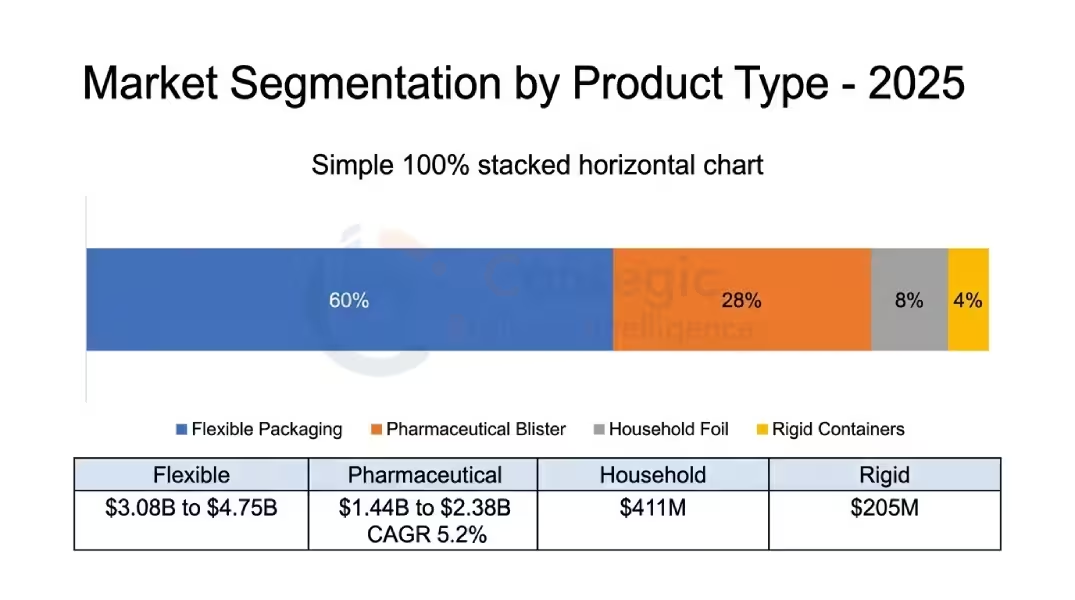
The largest market share will be Flexible aluminum foil packaging, which will have USD 3.08 Billion worth 60.0 percent of total market value in 2025, which is expected to be USD 4.75 Billion in 2034. The category includes stand-up coffee and pet food pouches, flow-wrap films to confectionery, laminated film to the dairy product, and lidding foils to the yogurt cups and ready-metal containers. The segment has the advantage of having better barrier properties that ensure protection of sensitive products but with lightweight features which save on costs of transportation and environmental effects.
Pharmaceutical Blister Packaging demonstrates the best growth.
Pharmaceutical blister packaging is projected at USD 1.44 Billion in terms of market value of 28.0 percent in 2025 which is expected to rise to USD 2.38 Billion in 2034 reflecting the highest growth rate of 5.2 percent CAGR. This segment comprises cold-form blister packs offering optimum barrier protection to moisture-sensitive drugs, tropical blister packs that are designed to be used in high-moisture settings, and child-resistant blister packs that are certified by the European safety standards.
Household Foil and Rigid Containers Full Portfolio.
The Aluminum foil rolls used in households USD 411 Million that is equal to 8.0 percent of market value and are aimed at storing and cooking food at home. Rigid aluminum containers USD 205 Million and constitute 4.0 percent of market value and are mostly used in airline catering activities, ready-meal package and take-away food service applications with a consumption of over 15 billion units annually spread across the market in Europe.
By Application: End-Use Market Dynamics.
Food Packaging Retains Market Leadership.
In 2025 and 2034, food packaging applications dominated at USD 2.57 Billion and USD 3.96 Billion correspondingly; the total value of the market is USD 50.0 percent and USD 62.98 percent respectively. This segment includes dairy product packaging, wrapping of confectionery, and packing of coffee and tea where the need to maintain aroma is required, and containers containing ready-made meals that have to be refrigerated or frozen to maintain their convenience. The segment enjoys the rising consumer demand of convenient meal solution with European ready-meal market projected to EUR 38.5 billion in 2024.
Premium Value is Driven by Pharmaceutical Applications.
Pharmaceutical packaging will be USD 1.54 Billion with 30.0 percent market value at 2025 and USD 2.53 Billion in 2034. The application segment attracts a high price with the average selling price of EUR 18 to EUR 35 per kilogram of finished blister packaging application as opposed to EUR 8 to EUR 15 per kilogram in food packaging applications.
Other and Industrial Applications.
Industrial markets such as electronic component packaging and technical wrapping USD 1.03 Billion in 2025, USD 1.43 Billion in 2034 which is 20.0 percent of market value.
Regional Market Analysis
Western Europe: Market Leader and Innovation Centre.
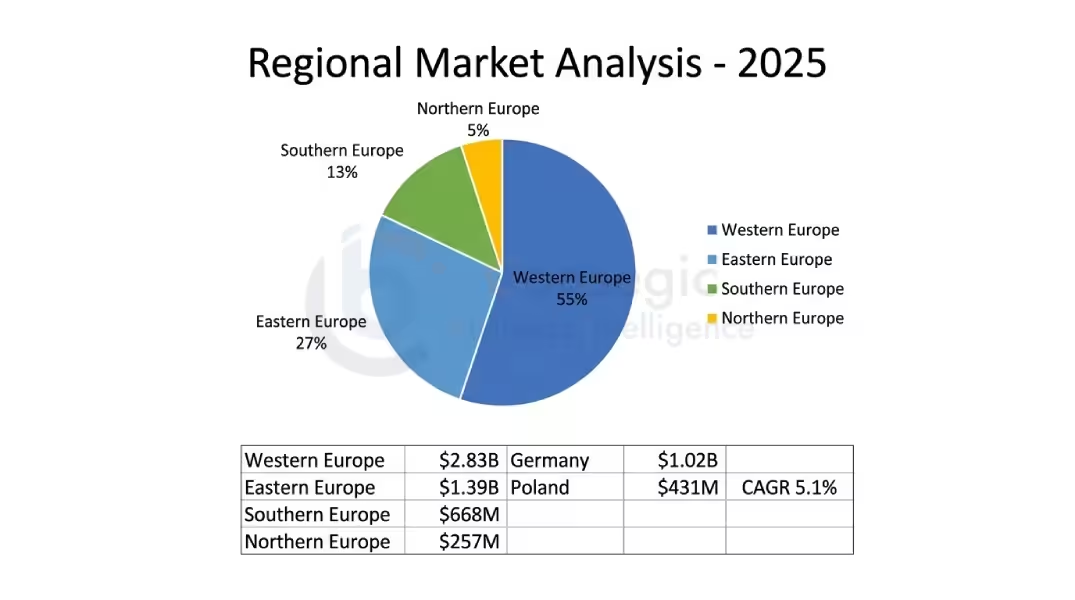
Western Europe is dominating the market with USD 2.83 Billions at 55.0 percent of the total market value in 2025 which is expected to achieve USD 4.36 Billions by 2034. Germany is the leading in the region with USD 1.02 Billion 36 per cent value of Western Europe and with a strong pharmaceutical manufacturing industry with a yearly turnover of more than EUR 185 billion.
The German market is advantageous with the presence of large-scale aluminum foil manufacturers such as Hydro Aluminum which has a capacity of 180,000 metric tons in a year, Novelis having a capacity of 95,000 metric tons as well as a well-developed infrastructure of converting. France will symbolize USD 737 Million representing 26 percentage of Western European market worth, with robust food packaging market due to high-end dairy market and advanced readymade market worth EUR 8.2 billion.
With the manufacturing capacity of 210,000 metric tons per year in terms of aluminum foil and high food processing industry, Italy provides USD 623 Million which is equivalent to 22 percent Western European value. The United Kingdom has a USD 452 Million or 16 percent of the value of the Western European market.
Eastern Europe constitutes USD 1.39 Billion of total market value of 27.0 percent in 2025 and is set to grow to USD 2.29 Billion in 2034 with the highest rate of growth of 5.1 percent CAGR. This has been fueled by faster growth in terms of pharmaceutical manufacturing investment, augmented food processing capacity and rise in consumer purchasing power coupled with almost the shifts in near shoring of production units.
Poland is the top Eastern European performance with USD 431 Million contribution to the region value of 31 percent with the help of the fast-growing pharmaceutical industry of production value, PLN 18.5 billion 2024 and fear-growing food processing industry. Romania has USD 292 Million of the East Europe market value of 21 percent translating to a robust growth momentum due to the growth in manufacturing of pharmaceuticals and automotive parts.
Current Trends and Industry Movement.
Integration of Sustainability Initiatives and Recycled Content (2024-2025).
- In 2024, Novelis declared that it will invest USD 365 million in capacity expansion and recycling activities in all its facilities throughout Europe, with the aim of achieving 50 percent recycled content in all its product lines by 2026. The company has ordered high-tech sorting technology, which has raised the rate of recycling of aluminum mixed packaging waste streams to 87 percent against 68 percent.
- In March 2024, Hydro Aluminum introduced HydroCircal product line, which is aluminum foil with at least 75 percent post-consumer recycled content that is specifically intended to be used in food packaging and passed a regulatory approval of European Food Safety Authority to be used in direct food contact with food.
Capacity Expansion and Manufacturing Investments (2024-2025).
- In January 2024, Aleris declared an investment of EUR 180 million to modernize cold rolling mill at Koblenz facility in Germany, which installed new technology to advance the annual capacity to 115,000 metric tons with a gauge tolerance capacity enhanced to 85,000. In June 2024, Amcor announced the construction of a new pharmaceutical packaging manufacturing plant in Poland, which will have a EUR 95 million investment with the capacity of 12 billion blister cavities per year.
Digital Incorporation and Smart Packing (2024-2025).
- A number of packaging producers offered smart packaging solutions using digital technologies and aluminum foil packaging materials. Constantia Flexibles introduced the SmartCycle platform in February 2025 that has QR codes and NFC tags that allow interacting with the consumer, authenticating the product, and recycling instructions. Amcor designed the blister packaging of pharmaceuticals with European Union Falsified Medicines Directive serialization capability.
Mergers, Acquisitions, and Strategic Partnerships (2023-2025)
- In April 2023, Amcor acquired Moda Systems, a high-barrier cold-form blister packaging manufacturer, increasing its high-barrier cold-form blister packaging capabilities. In November 2023, Constantia Flexibles bought Afripack and diversified its product lines in upscale food packaging. In March 2024, Coveris declared a strategic collaboration with Tomra Sorting Solutions, with whom it works on the optimization of a packaging design when it comes to automated sorting systems.
Europe Aluminum Foil Packaging Market Report Insights
| Report Attributes | Report Details |
|---|---|
| Study Timeline | 2022–2034 |
| Base Year | 2025 |
| Forecast Period | 2026–2034 |
| Market Size in 2024 | USD 4.87 Billion |
| Market Size in 2025 | USD 5.14 Billion |
| Market Size in 2034 | USD 7.92 Billion |
| CAGR (2026–2034) | 4.4% |
| By Product Type | Flexible Packaging (60.0%), Pharmaceutical Blister (28.0%), Household Foil (8.0%), Rigid Containers (4.0%) |
| By Application | Food Packaging (50.0%), Pharmaceutical (30.0%), Industrial & Others (20.0%) |
| By Distribution Channel | Direct B2B Sales (65.0%), Distributors (25.0%), Retail (10.0%) |
| By Region | Western Europe (55.0%), Eastern Europe (27.0%), Southern Europe (13.0%), Northern Europe (5.0%) |
| Key Players | Novelis, Hydro Aluminum, Amcor, Constantia Flexibles, Aleris, Coveris, Hindalco |
| Report Coverage |
|
Key Questions Answered in the Report
What is the current size and growth projection of the Europe aluminum foil packaging market? −
The Europe aluminum foil packaging market demonstrates substantial commercial scale with valuation reaching USD 5.14 Billion in 2025 serving as the base year for market analysis. The market exhibits consistent growth trajectory with projections indicating expansion to USD 7.92 Billion by 2034, representing a compound annual growth rate of 4.4 percent throughout the 2026-2034 forecast period. This growth momentum reflects increasing demand across pharmaceutical applications, food packaging innovations, and sustainability-driven material substitution from plastic alternatives. The market encompasses annual consumption of approximately 850,000 metric tons of aluminum foil across packaging applications.
What are the primary growth drivers for aluminum foil packaging in Europe? +
The market experiences multiple converging growth drivers including pharmaceutical industry expansion with European pharmaceutical production reaching EUR 285 billion annually, requiring high-barrier blister packaging for moisture-sensitive medications serving aging population demographics. Sustainability initiatives create competitive advantages for aluminum packaging with 76 percent recycling rate substantially exceeding plastic alternatives, aligning with European Union circular economy objectives. Regulatory frameworks including proposed Packaging and Packaging Waste Regulation mandate recyclable packaging by 2030, favoring aluminum foil solutions demonstrating infinite recyclability. Food industry demand for extended shelf-life packaging drives adoption providing superior oxygen and moisture barrier properties enabling ambient storage of perishable products.
Which regions demonstrate strongest market performance and growth potential? +
Western Europe commands dominant market position representing 55.0 percent of total market value led by Germany contributing 36 percent of regional value supported by robust pharmaceutical manufacturing and advanced food processing infrastructure. Eastern Europe demonstrates fastest regional growth rate at 5.1 percent CAGR throughout forecast period, driven by expanding pharmaceutical manufacturing investments, increasing food processing capacity, and nearshoring trends relocating production facilities. Poland leads Eastern European performance with pharmaceutical production valued at PLN 18.5 billion attracting foreign direct investment in manufacturing facilities requiring substantial packaging volumes.
How does aluminum foil packaging compare to alternative materials in sustainability performance? +
Aluminum foil packaging demonstrates superior sustainability credentials through infinite recyclability without quality degradation, with recycled aluminum requiring only 5 percent of energy needed for primary production translating to 95 percent energy savings. European aluminum packaging recycling rates reached 76 percent in 2024 substantially exceeding plastic packaging rates of 42 percent, supported by established collection infrastructure. However, multi-layer laminate structures combining aluminum with polymer substrates present recycling challenges requiring specialized processing, with industry investments exceeding EUR 450 million announced for advanced sorting facilities addressing these technical requirements.
What are the key challenges and opportunities facing manufacturers? +
Primary challenges include raw material price volatility with aluminum prices fluctuating 24.7 percent within 2024, elevated energy costs reaching EUR 0.185 per kilowatt-hour in Germany disadvantaging European producers, and carbon allowance costs adding EUR 1,530 to EUR 1,870 per metric ton to production costs. Key opportunities include growing demand for recycled-content products with regulations mandating 30 percent recycled content by 2030, pharmaceutical sector expansion driven by aging demographics, and smart packaging integration incorporating digital technologies for consumer engagement and supply chain tracking.
What recent developments are shaping the competitive landscape? +
Recent developments include major capacity expansions with Novelis investing USD 365 million in recycling capacity and Aleris investing EUR 180 million in rolling mill modernization. Sustainability initiatives feature prominently with Hydro Aluminum launching product lines containing 75 percent post-consumer recycled content and multiple companies implementing comprehensive circular economy programs. Strategic acquisitions continue with Amcor acquiring specialized pharmaceutical packaging capabilities and Constantia Flexibles expanding premium food packaging portfolios through targeted acquisitions valued at EUR 145 million.
Overview
Reputation & Certifications


Our Services
- Market Intelligence & Forecasting
- Custom Research Solutions
- Market Entry Strategy
- Competitive Intelligence
- Customer Insights
- Industry Innovation Analysis
- Investment Advisory