Jump to Content
Europe Automotive Composites Market - Size & Industry Share Growth Trends & Forecasts (2025 - 2034)
Executive Summary
The Europe automotive composites market is a crucial component in the advanced materials and automotive manufacturing system, and it is a cornerstone technology in vehicle lightweighting, structural improvement, and electrification enablement. This dynamic market includes carbon fiber reinforced polymers (CFRP), glass fiber reinforced polymers (GFRP), natural fiber composites, and hybrid composite systems which are applied in passenger vehicles, commercial vehicles and electric mobility across applications ranging from structural body parts to battery cases.
The market is experiencing strong growth with the market valued at USD 6.95 billion in 2025 and it is projected to grow strongly to USD 12.85 Billion by 2034 indicating a compound annual growth rate (CAGR) of 7.1 percent in the 2026 forecast period. The main factors in this growth trend include the tough European Union emissions rules that will force fleet-average CO2 levels to less than 95 grams per kilometer, the rapid move toward electric vehicles necessitating lightweight battery enclosures and structural housing, technological advancements in automated composite manufacturing that will cut the cost of production by 30-40 percent, and the new phenomenon known as the circular economy that will encourage the use of recyclable thermoplastic composite systems.
Western Europe leads the market, accounting for approximately 58% of total value of the total market value and this is based on the strength of the automotive manufacturing sector and high-quality car manufacturing in Germany. Eastern Europe has the fastest-growing sub-region with the CAGR of about 9 per cent due to the increased automotive manufacturing process, FDI, and technological transfer by the western European parent firms.
The competitive environment includes integrated material suppliers and Tier-1 component suppliers, with the largest players in the market being SGL Carbon, Toray Industries, Teijin Limited, and automotive integrators (Faurecia and Plastic Omnium) that are investing heavily in next-generation thermoplastic composites and automated production technologies to seize the opportunity presented by electrification.
Regional Trends and Insights
- Western Europe dominates the market with USD 4.03 billion (58% share) in 2025, projected to reach USD 7.45 billion by 2034
- Growth driven by premium automotive manufacturers, strict emission regulations, and high adoption of lightweight vehicle technologies
- Germany leads with around 36% share, supported by major automakers such as BMW Group, Mercedes-Benz, Audi, and Porsche and strong composite material production
- France holds about 21% share, with companies like Stellantis and Renault focusing on affordable composite materials such as glass and natural fibers
- Eastern Europe market valued at USD 1.95 billion (28% share) in 2025 and expected to reach USD 3.86 billion by 2034, growing at 8.9% CAGR
- Growth supported by rising automotive production, foreign investments, and cost-efficient manufacturing
- Poland leads with around 30% share, hosting manufacturing operations of major global automotive companies
- Czech Republic holds about 28% share, supported by strong engineering expertise and vehicle production by Škoda Auto, Hyundai, and Toyota

Market Scope & Overview
This section introduces the European automotive composites ecosystem.
The Europe automotive composites market is the one that involves high-end lightweight materials that are developed to substitute the traditional metals in the construction of vehicles with the idea to rely on the fiber-reinforced polymer systems that provide the superior level of strength-weight ratios, corrosion and design flexibility. The market caters to various vehicle markets such as passenger cars (conventional ICE, hybrid, and battery electric vehicles), light commercial vehicles, heavy commercial vehicles, specialty markets (motorsport and performance variants).
The important composite material frameworks are carbon fiber reinforced polymers which offer tensile strengths ranging 3,500-6,000 megapascals and reduction in density by 50-60 percent over steel, glass fiber reinforced polymers which provide cost effective reinforcement with tensile strengths of 3,100-3,800 megapascals, natural fiber composites with hemp, flax and kenaf fibers which are used in interior applications, and hybrid composite arrangements which optimize the performance-cost trade-offs with strategic fiber placement.
The market covers the entire value chain, from production of raw materials to component manufacturing and integration into final vehicles. Revenue figures encompass sales of the composite raw materials (fibers, resins, preforms) that are processed into automotive parts in Europe, the sales of finished composite parts sold to the European OEMs by Tier-1 and Tier-2 manufactures and exported composite parts produced in Europe to be used globally.
Technological Innovation and Manufacturing Advancements
Modern automotive composite manufacturing uses advanced automation technology such as high-pressure resin transfer molding (HP-RTM) systems capable of producing structural parts in 2–4 minutes, automated fiber placement (AFP) systems of 25-100 kilograms per hour in carbon fiber placement rates, compression molding technology processes sheet molding compounds at temperatures of 140-160 degrees Celsius and at pressures up to 150 bar, and thermoplastic composite stamping that allows cycle times of 60-180 seconds and retains recyclability.
The European automotive industry with an annual turnover of around EUR 2.1 trillion and employing 13.8 million people directly is facing the pressure of change that has not been seen before including electrification mandates, increased global competition by Asian manufacturers, the need to make their supply chains resilient and the need to comply with the circular economy. These industry forces create both challenges and opportunities for composite material suppliers, as they have to balance between performance, cost competitiveness, manufacturing scalability, end-of-life recyclability, and at the same time, help the automotive industry switch to sustainable mobility solutions.
In 2024, European investment in the development of composite technologies was over EUR 520 Million, and the major material suppliers were spending 5-9 percent of revenues on development activities aimed at cost reduction approaches, recyclability advances, high-speed manufacturing operations, and the next-generation fiber and resin systems that would be optimized to the use of automotive components.
Key Drivers
Lightweighting and Battery System Lightweighting -Electrification Imperatives.
The market growth is driven by the prevailing power of the European automotive market switching to the new trend of electric mobility and the urgent necessity of lightweight solutions to compensate the heavy battery systems. Electric vehicle battery packs commonly increase the mass of the vehicle by 300-600 kilograms, which directly affects the range of the vehicle, its energy consumption, and corresponding dynamic performance. Composite materials offer the key benefits of weight reduction, and each kilogram of weight cut would allow 15-20 kilometers of driving range of battery electric vehicles.
The regulation framework of the European Union provides a progressively tightening emissions targets, with fleet-average CO2 emissions of 95 grams per kilometer in passenger cars in 2025, which will fall to 81 grams per kilometer in 2030 and finally in 2035, will have 100 percent zero-emission vehicles sales. Such rules provide hefty monetary fines of EUR 95 per gram per kilometer of overrun emissions times aggregate vehicle enrolments, which would constitute potential EUR 1 billion yearly liabilities to implementers who will not meet compliance benchmarks.
A new application known as composite battery enclosures has become critical and offers structural protection, thermal management, electromagnetic shielding and fire safety advantages at a lighter system weight of 30-45 percent of a steel alternative. The i-series vehicles by BMW Group proved that carbon fiber passenger cells can be made to decrease the weight of the structure by 130 kilograms, and a carbon fiber battery casing can be made in the ID platform of Volkswagen Group to achieve a reduction in the structural mass per vehicle by 65 kilograms. Mercedes-Benz EQS also uses carbon fiber battery enclosures that decrease by 45 kilograms and increase crash protection and thermal runway containment.
In Europe, automotive manufacturers manufactured 2.1 million electric vehicles in 2024, which is 18 percent market penetration with forecasts of more than 50 percent by 2030 under existing regulatory schedules. This acceleration in electrification generates a long-term necessity of lightweight composite materials to be used in the optimization of EV efficiency, battery system protection, and a high driving range that directly affects consumer acceptance and market penetration of electric mobility solutions.
Key Restraints:
Material Cost Premium and Economic Obstacles.
The first obstacle in limiting wider use of composites relates to high-cost premiums with the advanced composite materials over the traditional automotive materials. Carbon fiber reinforced polymers are in the EUR 18-35/kg market price of standard modulus automotive grade fibers and EUR 45-120/kg of high-performance aerospace grade materials, which is a multiplication of 10-20 times the price of steel at EUR 0.80-1.20/kg and 4-8 times the price of aluminum at EUR 2.50-3.80/kg.
The economics of manufacturing processes adds to the material cost issues and the conventional autoclave curing processes that take 4-8 hours under high temperatures and high pressure constrained production throughput with 2-4 parts per day per unit of autoclave. Such sophisticated automated systems like high-pressure resin transfer molding demand special tooling investments of EUR 200,000-1.2 million per tool set and have cycle times of 2-4 min, still slower than steel stamping operations of 12-18 parts per minute.
The automotive industry is characterized with high costs pressure as target component costs may be formulated as between EUR 0.60-2.50 per kilogram body panels and in the range of EUR 4.00-12.00 per kilogram structural components. The economic factors restrict the use of composite materials mainly to high-end segments of vehicles where automobile manufacturers can cover the increased material costs with increased vehicle prices, or to certain applications where the weight content saved is what makes the difference between regulatory compliance or performance.
Glass fiber reinforced polymers will be found to be more cost competitive at EUR 2.80-4.80/kg but still higher than steel prices by 2-4 folds without the high stiffness to weigh ratio of carbon fiber systems. Mass-market vehicle segments, which comprise 65-70 percent of European new vehicle registrations, can be approached by glass fiber composites (non-structural use) or natural fiber composites (interior use) with little difficulty.
Future Opportunities
Recycled Material Systems and Circular Economy Integration.
There is a significant market potential in the development of an overall approach to recycling and the creation of circular economy solutions of automotive composite materials that fulfills end-of-life vehicle management needs under the European Union End-of-Life Vehicles Directive that requires 95 percent of vehicle weight to be recycled. Traditional thermoset composite materials pose a problem to recycling because of polymer structures of cross-linkage and thus not amenable to remelting, which means that currently, the approximately 200,000-250,000 tonnes of composite waste every year in European automotive applications is going to landfill disposal or into energy recovery through incineration.
New recycling technologies open opportunities to sustainable composite lifecycle, such as pyrolysis, which recovers carbon fibers with 90-95 percent of original mechanical properties at 50-60 percent of the cost of virgin fiber, solvolysis, which dissolves resin matrices and preserves fiber integrity to be reintegrated into new composite systems, and mechanical recycling, which creates chopped fiber materials, which can be injection molded and which can be used in secondary structural applications.
The Circular Economy Action Plan provided by the European Commission sets certain requirements that should be met by the proportion of recycled materials to include in new vehicles, i.e. 25 percent recycled materials by 2030 and provides extended producer responsibility models to provide responsibility to manufacturers regarding management of the materials at the end of product life. These regulatory trends have led to investment in recycling systems and closed loop material management systems, with Volkswagen Group declaring an EUR 180 Million investment in composite recycling plants aiming to create 50,000 tonne per annum processing skill by 2028.
Thermoplastic composite systems prove to be the most promising market with 12-15 percent growth rates and have inherent recyclability benefits in terms of remelting and reformability abilities as with traditional thermoplastics. They can be used in the welding and joining of materials that make the assembly process less complex, compression molding, which has a cycle time of 60-180 seconds, and mechanical recycling into injection molding granulates. The shift to thermoset to thermoplastic matrices already constituting 35 percent of automotive composite use presents prospects to material suppliers working on high-performance thermoplastic resin systems and manufacturers making investments in thermoplastic processing equipment.
Market Segmentation Analysis
By Material Type: Composite Technology Platforms
Glass Fiber Reinforced Polymers: Volume Market Foundation
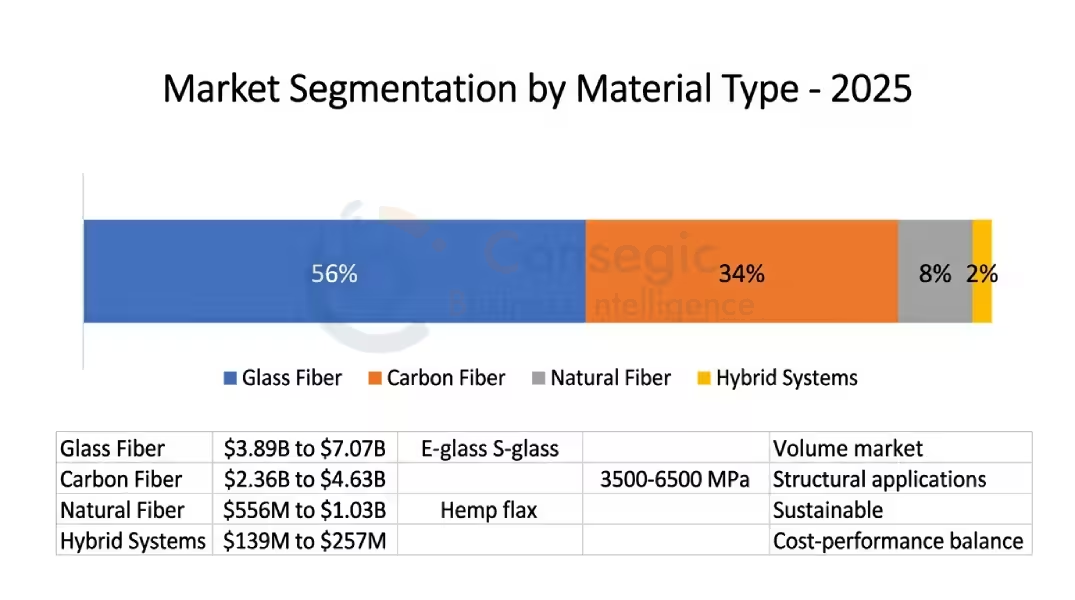
Glass fiber reinforced polymer materials will have USD 3.89 Billion (56.0 percent of market value) in 2025 with a projection of USD 7.07 Billion in 2034. These include E-glass fibers that are cost-effective through reinforcement that includes tensile strength of 3,100-3,800 megapascals and elastic modulus of 70-85 gigapascals, S-glass with increased mechanical properties that have tensile strength of 4300-4800 megapascals and elastic modulus of 70-85 gigapascals and continuous fiber mat thermoplastics that require fewer processing steps.
Applications are concentrated in high-volume body parts such as hoods, fenders and tailgates with 25-35 percent weight savings over steel counterparts, interior parts such as seat structures and instrument panel carriers with cost-effective lightweighting, and semi-structural parts such as front-end modules and underbody shields. VWG employs the use of glass fiber reinforced polymer tailgates in several model lines that save 28-35 kilograms per unit vehicle. Renault has glass fiber composite front-end modules with several functions combined and weight is lessened by 18 percent as compared to metal assemblies.
Carbon Fiber Reinforced Polymers: Performance Leadership
Carbon fiber reinforced polymer composites will make USD 2.36 Billion (34.0 percent of market value) in 2025, which increases to USD 4.63 Billion in 2034. This category has the standard modulus carbon fibers with tensile strength of 3,500-4,500 megapascals and 230-240 gigapascals elastic modulus, intermediate modulus carbon fibers with tensile strength of 250-290 gigapascals and high-strength carbon fibers with tensile strength of 5,500-6,500 megapascals.
Applications are designed around structural features such as body-in-white parts, roof designs, battery compartments in electric vehicles, and structural reinforcements of the chassis where the reduction of weight is balanced with cost additions. BMW i-series models have passenger cells made of carbon fiber reinforced polymer with a 30 percent weight reduction over steel models that are more than twice the impact protection standards. In its AMG models, Mercedes-AMG uses carbon fiber hood and roof panels, which save 25-40 kilograms per car. Tesla Model S includes composite battery enclosure that guards the cells, but only a few mass additions are added to the car body.
Natural Fiber Composites: Sustainable Innovation
The natural fiber composite materials will include USD 556 Million (8.0 percent of the market value) which will raise to USD 1.03 Billion in 2034. This type has hemp, flax, kenaf and jute fiber reinforcements that provide renewable material source, carbon neutral production character and density cuts of 25-35 percent over glass fibers and great acoustic damping interior utility.
Applications are also focused on interior trim elements such as door panels, package shelves, seat backs, and trunk liners where sustainability credentials give a brand difference and benefits in regulations. The Mercedes-Benz Company introduced natural fiber composites, which are installed in 50 interior parts of every model range, and reduced the weight of the parts by 20-30 percent as compared to the traditional composition. BMW Group uses flax fiber door-panels and interior trim elements across several of its vehicle lines and contributes to the circular economy and lower lifetime emissions.
Hybrid and Advanced Composite Systems
Hybrid composite arrangements are USD 139 Million (2.0 percent of the market value) with an outlook of USD 257 Million by 2034. These systems incorporate carbon and glass fibers in strategic arrangement maximizing performance/cost trade-offs with carbon fibers placed in high stress zones and glass fibers in low-load areas with a 40-50 percent cost saving relative to full carbon fiber construction whilst retaining 75-85 percent weight saving.
By Application: End-Use Market Segments
Exterior Body Panels and Structural Components
Exterior and structural applications USD 3.48 Billion (50.0 percent of market value) are body panels, closures, structural reinforcements and battery enclosures. Such components are focused on surface, Class-A finish, crash, and dimensional stability over temperature ranges of -40 to +80 degrees Celsius. The manufacturing process focuses on compression molding of sheet molding compounds with cycle times of 2-5 minutes, resin transfer molding to meet complex geometry, and automated fiber placement to meet structural components.
Interior Components and Systems
Interior applications are USD 1.74 Billion (25.0 percent of market value) which includes instrument panels, door trim, seat structures, center consoles and acoustic elements. These applications lay focus on aesthetic look, the soft-touch surface mandates, sound performance as well as low volatile organic compound emission to the interior air quality norms. Natural fiber composites find the necessary momentum in the segment where they could provide sustainability claims and similar performance to glass fiber solutions.
Powertrain and Battery Enclosures
Powertrain and battery system applications account for USD 1.74 billion (25.0 percent of market value) comprising of battery housings, electric motor covers, thermal management systems, and structural mounting components. Such applications demand outstanding thermal, electrical insulation, fire resistance and ability to work at temperatures up to 150-200 degrees Celsius and offer electromagnetic shielding.
By Vehicle Type: Platform Segmentation
Passenger Cars: Volume Market Foundation
Passenger cars have the highest value of USD 4.73 Billion (68.0 percent of the market value) occupying compact, mid-size, and luxury segments with composite applications that vary according to vehicle position and price range. In 2024, the European passenger cars manufacturing had 11.8 million vehicles, and the volume segments had an average composite content of 18-28 kilograms, whereas in the premium applications, the composite content was 85-150 kilograms.
Electric Vehicles: Growth Acceleration Platform
Electric vehicle applications account for USD 1.46 billion (21.0 percent of market value) with the highest rate of increase, 12.8 percent CAGR, due to the battery system weight necessitating equivalent reductions, structural enclosures around battery protecting it against impact and environmental influences, and optimization of range with each kilogram saved affording 150-200 meters of additional range.
Commercial Vehicles: Emerging Application Territory
Commercial vehicle segments USD 764 Million (11.0 percent of market value) include light commercial vans, medium-duty trucks, and special purpose vehicles in which the payload capacity advantages directly contribute to increasing the economics of operations by use of composite body panels, cargo floors, and structural components that allow savings of 200-400 kilograms of weight.
Regional Market Analysis
Western Europe: Market Leadership and Innovation Hub
Dominating Position and Premium Attention.
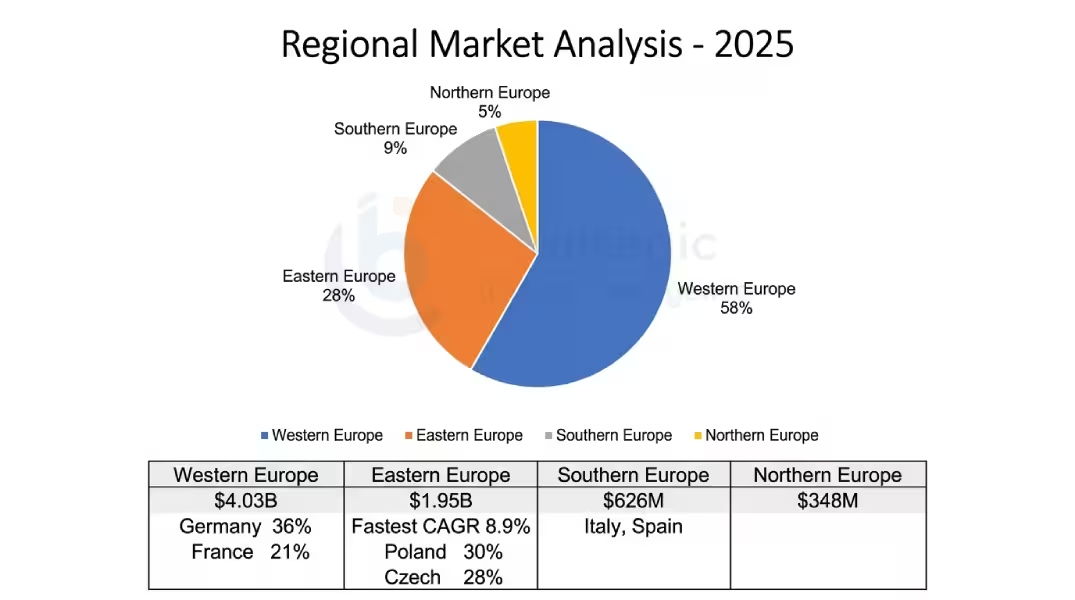
Western Europe holds USD 4.03 Billion (58.0 percent of market value) of the market in 2025 with an outlook of growing USD 7.45 Billion in 2034, the highest regional market fueled by concentration of premium automotive manufacturers, advanced engineering capabilities, strict emission laws and high acceptance of lightweight vehicle technologies among consumers. The 76 percent of market value in Western Europe in terms of Germany, France, Italy, and the United Kingdom is comprised increasing automotive manufacturing ecosystems and network of composite material suppliers.
Germany leads with around 36 percent of market value in Western Europe with high value manufacturers such as BMW Group, Mercedes-Benz, Audi and Porsche installing high levels of composites. In 2024, German car output was 4.1 million vehicles, including 38-48 kilograms of composite in all models and 125-185 kilograms in high-end vehicles. Major composite suppliers have been located in the country such as SGL Carbon that has an annual output of 24,000 tonnes carbon fiber and Toray Carbon Fibers Europe with a complex manufacturing plant.
It is in France that 21 percent of the Western European market value is explained, with Stellantis Group activity that yields 1.8 million vehicles each year and Renault Group that yields 1.2 million vehicles each year. The French producers focus on more affordable composite options such as the usage of glass fiber and natural fibers in mass-produced vehicles with the government facilitating lightweight materials use with the EUR 280 Million automotive modernization initiatives.
Eastern Europe: Fastest Growth Trajectory
Newcomer Manufacturer.
Eastern Europe captures USD 1.95 Billion (28.0 percent of market value), which grows to USD 3.86 billion by 2034, with the region showing the highest growth of 8.9 percent CAGR, due to the increasing automotive production, foreign direct investment in production plants, low-cost production, and a growing local supplier base. The core manufacturing cluster consists of Poland, Czech Republic, Slovakia, and Hungary, and it produces 4.3 million vehicles annually in 2024.
Poland dominates the Eastern European markets with a 30 percent regional value share with manufacturing operations of Stellantis, Volkswagen Group, Toyota, and many Tier-1 suppliers. In 2024, Polish automotive manufacturing amounted to 450,000, and composite application increased due to the transfer of technology with parent companies in Western Europe, and provided manufacturing labor costs at EUR 8-12 per hour compared to EUR 35-45 in Western Europe.
Czech Republic holds 28 per cent of the Eastern European market value with 1.4 million vehicles being produced by Skoda Auto, Hyundai and Toyota. The nation has strong engineering capabilities and well-established networks of suppliers that assist in production of composite components with the government encouraging the use of advanced technology in manufacturing.
Competitive Landscape and Key Market Players
Strategic Positioning and Market Leadership
SGL Carbon SE (Germany) - Integrated Carbon Fiber Leader.
SGL Carbon holds market leadership in automotive carbon fiber material with forecasted 2024 European revenues of EUR 385-425 Million, which is about 23-26 percent of the market share in carbon fiber reinforced polymer solutions. The company works on an integrated production with carbon fiber production to the final product with the intermediate material, and it produces carbon fiber in 24,000 tonnes per year with a facility in Scotland and Germany and processing in the facility such as automated fiber placement, resin transfer and compression molding.
Competitive positioning puts a focus on long-term supply partnerships with the BMW Group over 15 years of i-series vehicle carbon fiber passenger cell, joint development programs with the Volkswagen Group over next-generation electric vehicle construction, and technical cooperation with Mercedes-Benz on battery enclosure systems. The strategic areas of focus include cost reduction by automation of processes that have cut manufacturing costs by 35 percent since 2020, technology development of recycling, and diversification into thermoplastic composite systems that process at faster rates.
Toray Industries (Europe Operations) - Leadership of Material Innovation.
Toray European automotive business attains projected EUR 265-295 Million revenues in 2024 with about 15-17 percent market share through vertically integrated business with carbon fiber production to finished components. The company has carbon-fiber manufacturing plants in France with a capacity of 2,400 tonnes per year and composite processing plants in Germany, France and Hungary that cater to the European customers of the automotive industry.
The strategy positioning is focused on technical cooperation with the European car makers such as Mercedes-Benz, Audi, and BMW on structural and interior applications. The manufacturing capacities are automated tape laying units, compression molding units, resin transfer molding units to support high volume production needs in automobile manufacturing. The areas of investment are in increasing thermoplastic composite capacity and recycling technologies in the end-of-life material recovery.
Teijin Limited (Europe Operations) - Thermoplastic Composite Pioneer.
The projected revenues of Teijin European automotive composites operations are EUR 245-275 Million in 2024 at approximately 14-16 percent market share specifically in thermoplastic composite systems and hybrid materials. One of the company innovations was the continuous fiber reinforced thermoplastic technology with cycle times of 60-90 seconds using compression molding as opposed to 4-8 hours with thermoset autoclave processing.
Some of the competitive advantages include proprietary thermoplastic processing knowledge, developed relationships with automotive system manufacturers, and overall technical support services. German and Czech Republic manufacturing plants have 45,000 tonne/per year capacity of thermoplastic composite materials, and the strategic programs are based on the development of electric vehicle battery enclosure systems, and cooperation with Tier-1 suppliers in the development programs of components.
Other Major Market players.
- Hexcel Corporation (Europe Operations): It has about EUR 185-210 Million European automotive revenues, well established in carbon fiber prepreg materials and structural components terms of high-end automotive usage.
- Solvay (Syensqo) Belgium: EUR 155-175 Million automotive composites revenues, specialty resin and high-performance thermoplastics market leader in composite system.
- Faurecia (FORVIA): EUR 135-155 Million global composite part revenues, electric car interior system and battery container integration market leader.
- Plastic Omnium: EUR 125-145 Million automotive composites, is an exterior body panel and fuel system component producer using high-technology composite technologies.
Recent Industry Developments
Capacity Expansion and Strategic Partnerships (2024-2025).
Key suppliers of composite materials released large capacity expansions and strategic alliances responding to increasing electric vehicle platform demand. SGL Carbon opened EUR 35 Million state-of-the-art manufacturing plant in Bavaria, Germany, that had automated fiber placement systems and high-pressure resin transfer molding systems to assist in producing 450,000 square meters of carbon fiber parts to serve the automotive industry every year.
Toray Industries increased its presence in Europe by investing in a facility in Czech Republic, EUR 28 Million, which would add 15,000 tonnes per year capacity of thermoplastic composite materials specially designed in battery casing and structural parts of the electric vehicles. The plant has integrated state of the art compression molding technologies with 90-second cycle times and automated material handling with 60 percent less labour needs.
Teijin Limited reported on strategic collaboration with Stellantis on the next-generation electric vehicle platforms, that contains long-term supply dealings of thermoplastic composites battery enclosures and structural reinforcements. The partnership involves the joint development programs that aim at achieving 40 percent weight reduction over steel options but with the same crash performance and thermal management systems.
Recycling Technology Commercialization (2024-2025)
European composite producers have invested in recycling facilities that support the aspects of the circular economy needs and waste disposal laws on vehicles. SGL Carbon now has a 4,500-tonne capacity pyrolysis plant in Germany worth EUR 22m that recovered carbon fibers re-riching 95 percent of pyrolysis scrap and end-of-life part production scrap, and the final product obtained a fiber content exceeding 95 percent that performed at 88-92 percent of the virgin material performance.
BMW Group developed an integrated composite recycling system in collaboration with material suppliers, and aimed at the recovery and reintegration of carbon fiber materials of the production wastes and the end-of-life i-series vehicles. The program recycles 8,000 tonnes of composite materials each year via mechanical and chemical recycling techniques to produce recycled carbon fiber priced at 35-40 percent of that of the virgin materials.
Integration of Electric Vehicles Platforms (2024-2025).
In the next-generation electric vehicle platforms to be launched by 2026-2028, automotive manufacturers hurried to use composite. Mercedes-Benz made a battery enclosure design with hybrid carbon-glass fiber with a result of 42 percent less weight than aluminum and even lower material costs than the full carbon fiber systems.
Volkswagen Group announced that all vehicles based on MEB+ platform such as ID.7 and Audi Q6 e-tron models are fully composed of carbon fiber battery encasings, roof panels, and structural reinforcements that lower the weight of each vehicle by 68 kilograms. Its implementation has long term material supply contracts in the value of EUR 195-225 Million per year of composite material.
Europe Automotive Composites Market Report Insights
| Report Attributes | Report Details |
|---|---|
| Study Timeline | 2022–2034 |
| Base Year | 2025 |
| Forecast Period | 2026–2034 |
| Market Size in 2024 | USD 6.45 Billion |
| Market Size in 2025 | USD 6.95 Billion |
| Market Size in 2034 | USD 12.85 Billion |
| CAGR (2026–2034) | 7.1% |
| By Material Type | Glass Fiber (56.0%), Carbon Fiber (34.0%), Natural Fiber (8.0%), Hybrid Systems (2.0%) |
| By Application | Exterior & Structural (50.0%), Interior Components (25.0%), Powertrain & Battery (25.0%) |
| By Vehicle Type | Passenger Cars (68.0%), Electric Vehicles (21.0%), Commercial Vehicles (11.0%) |
| By Region | Western Europe (58.0%), Eastern Europe (28.0%), Southern Europe (9.0%), Northern Europe (5.0%) |
| Key Players | SGL Carbon, Toray Industries, Teijin Limited, Hexcel Corporation, Solvay, Faurecia, Plastic Omnium |
| Report Coverage |
|
Key Questions Answered in the Report
What is the size of the Europe automotive composites market and what is its growth driver? −
The European automotive composites market shows strong expansion features with a future worth of USD 6.95 Billion in 2025 and a growth of USD 12.85 Billion in 2034 at 7.1 percent CAGR. This expansion is an indicator of the long-term demand due to EU emission laws that necessitate the need to decrease vehicle weight, the introduction of electric cars that necessitate the lightweight battery enclosures, and the technological development that has made the use of composite manufacturing 30-40 percent cheaper. The market includes about 425,000–475,000 tonnes of annual material usage in passenger or commercial and electric cars.
Which are the most influential market growth factors? +
The electrification of the European automotive industry is the major force that needs solutions based on lightweight to balance the heavy battery systems. The battery packs of electric vehicles contribute to the mass of the vehicle in the range of 300-600 kilograms, necessitating the use of composite materials to ensure the vehicles are efficient in terms of range. The EU laws require the fleet-average CO2 level to be lower than 95 grams per kilometer which reduces to 81 grams per kilometer in the year 2030 with a penalty of EUR 95/gram/kilometer on the surpassing emissions. Composite substitution of vehicle lightweighting has the best compliance pathway, where 100 kilogram weight-reduction allows an 8-10 grams per kilometer reduction of emissions and 15-20 kilometers more EV range.
What are the most performing regional markets? +
Western Europe controls the highest market share of 58.0 percent with USD 4.03 Billion value and is a highly concentrated premium automotive manufacturer, with a high level of composite processing. Germany dominates with 36 percent of Western European value by having BMW, Mercedes-Benz, Audi, and Porsche operations that have adopted widespread carbon fiber operations. The Eastern Europe shows the highest growth rate at 8.9 percent CAGR and USD 1.95 Billion market value due to automotive manufacturing that produces 4.3 million vehicles every year, and low cost operations that provides manufacturing benefits and yet does not compromise on the EU quality.
What is the competitive dynamics which form the structure of the market? +
The automotive composites market in Europe has concentrated competitive structure with the leading five market suppliers controlling 70-75 percent of total market share. SGL Carbon dominates with 23-26 percent share in its combined production of carbon fiber and the strategic alliances with BMW Group, Volkswagen, and Mercedes-Benz. Toray and Teijin have 15-17 percent and 14-16 percent share respectively, in vertically integrated operations and thermoplastic composites respectively. Rivalry escalates against recyclable thermoplastic systems, self-driven manufacturing technologies, and the long-term availability partnership with automotive firms to the next generation electric vehicle project.
What are the future trends in technology that will impact on future market development? +
Notable advances in technology are thermoplastic composite systems which are increasing by 12-15 percent annually, with a cycle time of 4-8 hours to thermoset processing, compression moulding requires a half to one minute, as well as inbuilt recycling benefits. Automated deployment of manufacturing includes fiber placement systems with 25-100 kilogram per hour deposition rate and resin transfer molding with 2-4 minute cycle times. The technology commercialization is recycling of end-of-life materials by the use of pyrolysis plants that are able to recover 95 percent of the fiber and recycling through mechanical means that create materials used in the secondary process.
Overview
Reputation & Certifications


Our Services
- Market Intelligence & Forecasting
- Custom Research Solutions
- Market Entry Strategy
- Competitive Intelligence
- Customer Insights
- Industry Innovation Analysis
- Investment Advisory