Jump to Content
Europe Centrifugal Pump Market - Size, Share, Industry Trends, and Forecasts (2025 - 2034)
Executive Summary
The European centrifugal pump market is a vital industrial infrastructure sector that incorporates rotating mechanical equipment that transforms mechanical energy into kinetic energy using centrifugal force that forms the hydraulic foundation for water management, power generation, chemical processing, and manufacturing industries on the continent. It is an all-inclusive market with pumps such as end-suction with flow rates of 5-500 cubic meters per hour serving general industrial and building services, split-case pumps with flow rates of 100-5000 cubic meters per hour that are used in the municipal water supply and fire protection system, multistage pumps with discharge pressures of 10–150 bar used in buildings and industrial processes, vertical turbine pumps with capacities of 50–2000 cubic meters per hour used in water wells.
The modern European centrifugal pump market has experienced significant changes due to digitalization efforts, including the integration of Internet of Things (IoT) sensors to monitor vibration, temperature, and flow rates in real-time, energy efficiency requirements under the EU Energy-Related Products Directive, which mandates minimum levels of efficiency index (MEI) of 0.4-0.7 based on application type and the use of advanced materials such as duplex stainless steel with excellent corrosion resistance. Recent generations of pump systems introduce variable frequency drives with the potential to save 25-60 percent of the energy cost by ensuring speed optimization, predictive maintenance strategies that reduce unplanned downtime by 40–70 percent, and remote monitoring features that enable centralized management of distributed installations.
The European market is valued at USD 8.50 billion in 2025 (base year), and the growth is expected to reach USD 13.05 Billion in the year 2034. This growth reflects a compound annual growth rate (CAGR) of 4.8 percent during the forecast period of 2026-2034, due to aging infrastructure replacement requirements, industrial growth in pharmaceutical, chemical, and food processing industries with aggregate capital expenditure of EUR 85-120 billion/year, integration of renewable energy sources, which require cooling systems in solar thermal plants and specialized pumps in hydrogen production; wastewater treatment capacity growth in response to the requirements of the EU Urban Wastewater Treatment Directive; digitalization and adoption of Industry 4.0 technologies.
The competitive environment is characterized by an advanced ecosystem with global manufacturers of industrial equipment, such as Grundfos, KSB, Sulzer, Flowserve, and Xylem, possessing technological advantage through high levels of research and development, alongside established European regional players, such as Wilo, DAB Pumps and Ebara Europe, which provide building services and municipal markets and new digital platform providers, which offer predictive maintenance services, energy management services and fleet management services as recurring revenue streams to the traditional equipment sales.
Regional Trends and Insights
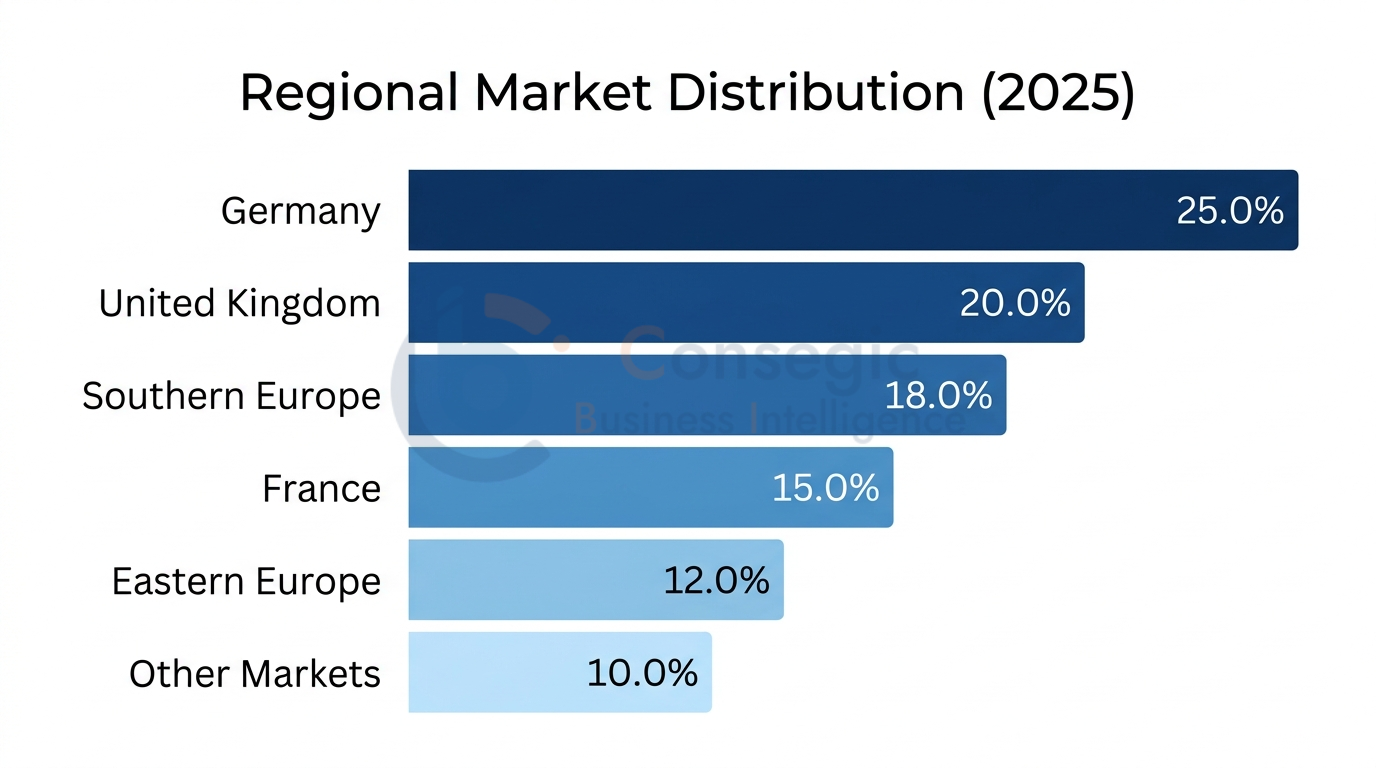
- Germany: ~25.0% of Europe market (USD 2.13 Billion); market leader driven by strong manufacturing, large chemical industry, and advanced infrastructure
- United Kingdom: USD 1.70 Billion; 20.0% share, driven by aging water infrastructure and industrial demand
- Southern Europe: USD 1.53 Billion; 18.0% share, driven by desalination, tourism, and agriculture

Market Scope & Overview
The Europe centrifugal pump market includes the entire ecosystem of rotodynamic pumping technology that utilizes centrifugal force to impart velocity to fluids by means of rotating impellers, including the product design and engineering, product manufacturing and assembly, sales and distribution via direct channels and authorized distributors, installation and commissioning, and ongoing maintenance and repair, and end-of-life management including life optimization, component replacement, and final equipment disposal. There are approximately 850,000–1,200,000 installed industrial and commercial pumping systems in the market which include replacement rates of 4-7 percent per annum due to equipment approaching the end of their design life, changes in processes requiring capacity increase or reduction, and efficiency improvements required by energy regulations.
Modern centrifugal pump systems exhibit advanced engineering with computational fluid dynamics optimization achieving 70–85 percent hydraulic efficiency at optimal duty points in well-designed systems, advanced impeller designs with 4-12 vanes designed to optimize performance at individual duty points, wear-resistant materials such as hardened steel, tungsten carbide, and ceramic composites to extend component life by 300-500 percent in abrasive service and mechanical seal systems with silicon carbide faces and elastomeric secondary seal systems to provide leak-free service life Performance features include flow rates of 1–10,000 cubic meters per hour, head pressure of 5-2000 meters, power of 0.5-5000 kW and operating temperatures of -100°C in cryogenic systems up to +400degC in thermal fluid systems.
The participation in the market is regulated by quality standards and certifications that cover products that comply with European Union directives such as the Machinery Directive 2006/42/EC that defines the necessary standards of health and safety and the Pressure Equipment Directive 2014/68/EU that regulates the equipment working with pressure over 0.5 bar and the ATEX Directive 2014/34/EU that regulates equipment used in potentially explosive atmospheres and the Ecodesign Directive 2009/125/EC Refinery and petrochemical industry certifications include American Petroleum Institute API 610 and EN 733 specifying dimensional and performance standards of end-suction centrifugal pumps and ISO 9906 specifying hydraulic performance test procedures respectively.
Key Drivers:
Infrastructure Regulations, Energy Efficiency, and Modernization
The key structural force that is driving the European centrifugal pump market is the overlap between infrastructure replacement demand and high demand for energy efficiency that would require the deployment of high performance pumping systems. The industrial and municipal infrastructure of Europe is a product of decades of capital investment with 35-45 percent water supply networks having design lives of over 50 years, 40-55 percent wastewater treatment plants in need of capacity upgrades to support population growth and regulatory standards, and 30–40 percent of industrial facilities have pumping equipment installed prior to 2000 with 15-35 percent lower efficiency than current best-available standards.
Municipal water infrastructure presents significant replacement potential with the European water utilities controlling 4.5-5.5 million kilometers of water main, 2.8-3.5 million kilometers of sewer systems, and 85,000-110,000 pumping stations that serve 450–500 million people in Europe. 23–28 percent of water in distribution networks in Europe is equivalent to 15-25 billion cubic meters a year worth between EUR 8-15 billion and is prompting wholesale rehabilitation efforts of 150,000-250,000 pump replacements in the next 10 years. European Commission estimates that the infrastructure needs in the water and wastewater systems alone require EUR 255-290 billion by 2030 with the with pumping equipment accounting for 12–18 percent of total capital expenditure.
Regulations on energy efficiency through the EU Ecodesign Directive develop attractive replacement drivers which impose minimum efficiency index (MEI) requirements that phase out inefficient designs, and require efficiency improvements of 10-25 per cent of their performance under pre-regulation baseline. The industrial pumping systems absorb 8-12 percent of the total European industry electricity equivalent to 180- 250 TWh per year, which is equivalent to the electricity costs of EUR 18-30 billion at an average industrial cost. Replacement of inefficient legacy equipment with high efficiency pumps with variable frequency drives, improved hydraulic, and permanent magnet motors with energy savings of EUR 3.6-12 billion/year payback periods of 2–5 years justify the capital investment even though the equipment costs 40-80 percent more than standard efficiency options.
Key Restraints:
Economic Uncertainty and Capital Budget Constraints
The biggest obstacle to market growth is the economic uncertainty, capital spending limitations on the industrial investment decision and municipal infrastructure financing in the European markets. The sentiment indicators of the manufacturing sector indicate a sense of ongoing uncertainty with the natural gas prices staying 150-250 percent higher than in 2020, the recovery of supply chains after recent disruptions, and the competitive pressure from lower-cost manufacturing regions on investment security. Economic forecasts of Europe show that the GDP will grow 1.2-2.5 percent per year up to 2026-2028, which is by far lower than the historical rates, leading to cautious capital allocation strategies in terms of industrial operators and municipal governments.
The funding of municipal infrastructure is structurally challenged as European local governments are now faced with budget constraints that restrict the amount of money available to fund capital projects, competing demands such as digitalization and renewable energy projects and political unwillingness to increase water tariffs to fund wholesale upgrades of infrastructure. In most European markets, capital expenditure by the water utility is 30-50 percent lower than that needed to keep infrastructure in good condition, and backlog of rehabilitation arrears continues to be accumulated. The European Investment Bank has approximated that infrastructure investment gaps of EUR 90-150 billion per year occur in water/wastewater sectors and related areas limiting the pump replacement rates, which can be enhanced through technical obsolescence and efficiency improvements opportunities.
The complexity of total cost of ownership that introduces barriers to adoption with the purchase price accounts for only 15–25 percent of lifecycle costs and energy consumption 40-60 percent and maintenance 20-30 percent of common 15-20 years operating life. Nevertheless, procurement decisions often prioritize initial capital expenditure over lifecycle optimization because of the organizational budget frameworks dividing the cost of capital and the operating cost, the lack of technical expertise in lifecycle cost analysis in the purchasing departments, and accounting methods tend to favor lower initial investment at the expense of higher operating costs.
Key Market Opportunity:
Intelligent Pumping Systems and Renewable Energy Systems.
The European centrifugal pump market offers unprecedented opportunities with the integration of digitalization efforts and renewable energy facilities development supported by high climate goals and investments in digital transformation. Combining Internet of Things sensor and cloud-based analytics with artificial intelligence-based predictive maintenance is turning pumps into data-rich assets that can be connected to enable performance optimization and predictive maintenance efforts to be implemented.
To address the timing of equipment breakdowns, smart pumping systems with condition monitoring capabilities allow vibration analysis of bearing wear 4-8 weeks prior to failure, temperature monitoring of abnormal operating conditions, flow meters of performance and pressure transducers of efficiency allow real-time calculation of efficiency. Modern analytics tools, which use machine learning models that have been trained on large bases of installed equipment, can help reduce unplanned downtime by a factor of 30-50 percent and maintenance expenses by a factor of 15-25 percent in well-executed programs, and provide the opportunity to make performance-based contracting models, where customers are charged by uptime, delivered volume, or realized energy savings, and not equipment itself.
The growth of renewable energy infrastructure results in large-scale specialised pumping needs with Europe interested in large offshore wind capacity necessitating cooling systems, hydraulic power units and lubrication pumps to power turbines, geothermal energy development necessitating high temperature pumps to handle geothermal brines at 150-300degC and green hydrogen production infrastructure necessitating specialised pumps to treat water, circulate electrolytes and compress hydrogen and to cool energy infrastructure. These large renewable energy plants use 15-45 special purpose pumps made of materials that cannot corrode in a harsh environment, have large maintenance periods due to access issues and cost high services at 80-150 per cent higher than the traditional counterparts.
Market Segmentation Analysis
By Product Type: Technology and Application Analysis
End-Suction Pumps: Market Volume Leader
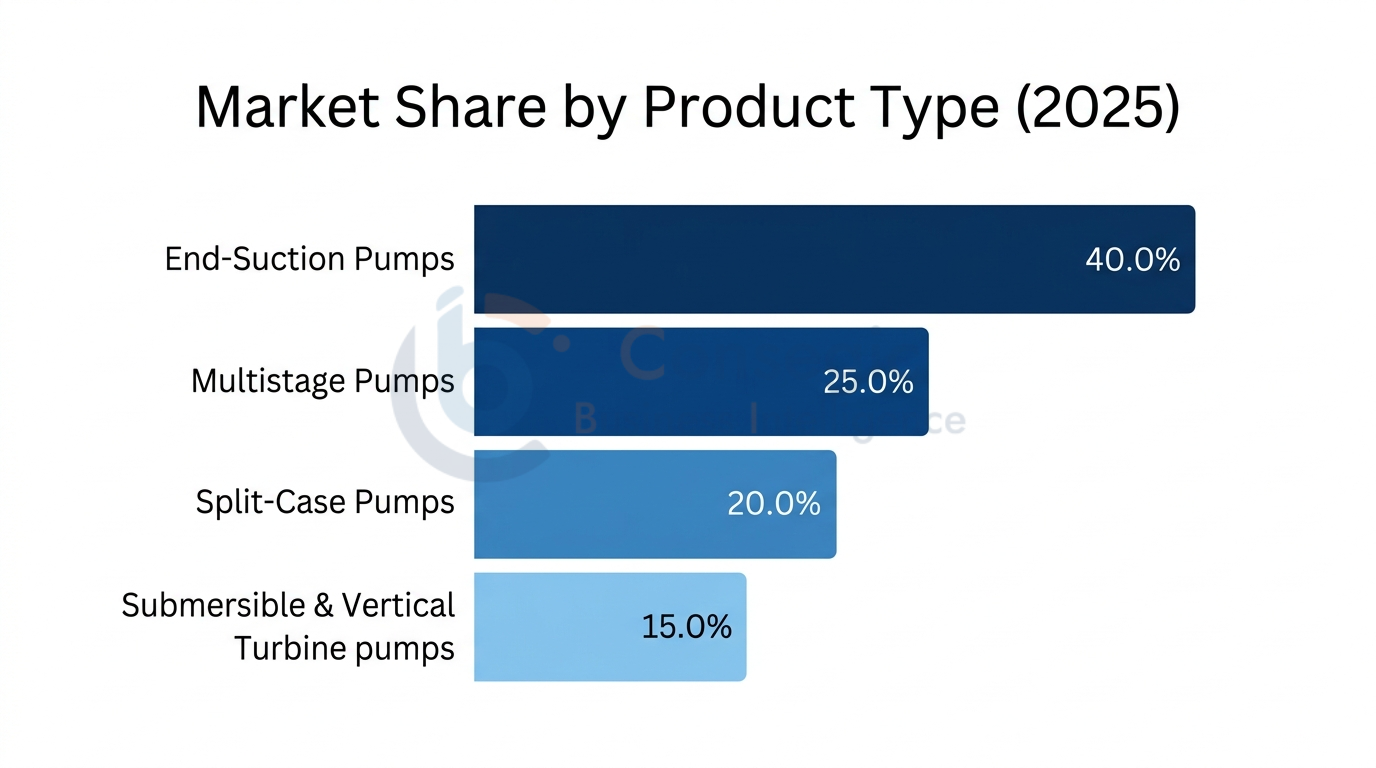
The end-suction centrifugal pump has been leading the market with USD 3.40 Billion of the total market value of USD 40.0 percent in 2025 and USD 5.22 Billion in 2034 at 4.8 percent of CAGR. In general, industrial use, building service, irrigation, and light chemical processing they have single stage impeller designs with 5-500 cubic meters per hour flow rates, heads of 10-120 meters, and power requirement of 1-200 kW. The market has the advantage of having standardized designs, which allow it to offer competitive prices, highly available due to its large distributor networks, and usable in a wide range of industries.
Multistage Pumps: High-Pressure Applications
Multistage centrifugal pumps USD 2.13 Billion equivalent to 25.0 percent of market value Multistage centrifugal pumps are used in high pressure systems such as the supply of water to high rising buildings, reverse osmosis desalination plants, boiler feedwater systems and in industrial processes. These pumps have 2-15 stages in series with discharge pressure of 10-150 bar and head of 100-1,500 meters and the design configuration can be either horizontal split-case (high flow) or vertical multistage (optimisation of footprint).
Split-Case Pumps: Municipal and Industrial Workhorse
Split-case centrifugal pumps are USD 1.70 Billion (20.0 percent) with a features of the municipal water supply, fire protection, irrigation, industrial cooling, centrifugal pumps with flow rates of 100-5,000 cubic meters per hour. They have horizontally divided casings that allow maintenance with no need to disconnect piping and axially balanced impellers of double suction.
Submersible and Vertical Turbine Pumps: Specialized Applications
Submersible and vertical turbine pumps USD 1.27 Billion equivalent to 15.0 percent of the market value represent the extraction of groundwater, dewatering of mines, cooling tower circulation, and the supply of municipal water to the market using deep wells that require special design of the motor and pump in a sealed housing or above ground motors that are used to drive the submerged bowl assembly.
By End-Use Industry: Application Market Analysis
Water and Wastewater: Largest Application Segment
Water and wastewater applications are USD 3.40 Billion equivalent to 40.0 percent of total market value in 2025 which include municipal water supply system of 450-500 million people, wastewater treatment plant of 35-45 billion cubic meters/year, and industrial water management. There are 85,000-110,000 pumping stations managed by municipal water utilities with 350,000-450,000 installed pumps that have a 15-25 year replacement cycle that generates an annual replacement demand worth EUR 550-850 million.
Oil, Gas and Chemicals: High-Value Premium Segment
The oil, gas and chemical processing uses are USD 2.13 Billion equivalent to 25.0 percent of the market worth, where special pumps are needed, with corrosion resistant materials, API 610 certification and reliability in critical services. The European chemical industry has 25,000-35,000 production facilities and 180,000-250,000 installed process pumps which demand special materials and certifications.
Power Generation and Building Services: Infrastructure Applications
The USD 1.28 Billion as 15.0 percent of the market worth is power generation applications that serve fossil fuel plants, nuclear plants, renewable energy plant, and a combined heat and power system. Building services and HVAC USD 1.02 Billion (12.0 percent of market value) includes heating systems, ventilation, and air conditioning systems in commercial and residential buildings.
Other Industrial Applications: Diverse End-Use Segments
Other uses include USD 0.68 Billion of 8.0 percent of the market value, or food and beverage processing, pharmaceutical production, pulp and paper production and general manufacturing in need of special pumps of the sanitary standard and clean-in-place compatibility.
Regional Market Analysis
Germany: Leader-Member Exchange and Engineering Excellence.
Germany is equivalent to 25.0 percent of the total European market value of USD 2.13 billion and demonstrates that it is a market leader with advanced manufacturing industry that consumes 35-45 percent of the industrial pump demand, large chemical industry with 3,500-4,500 production facilities, and sophisticated municipal infrastructure of 84 million population and concentration of major pump manufacturing facilities such as KSB, Wilo and Grundfos. German manufacturing plants attach more importance to high quality efficiency devices and intelligent pumping systems, 65-70 percent of the new installations feature variable frequency drives as opposed to the European average of 40-50 percent.
United Kingdom and France: Well-developed Infrastructure Markets.
United Kingdom accounts USD 1.70 Billion equivalent to 20.0 percent of market value, which is the old water infrastructure with 35-40 percent of assets over design life, regulatory pressure to enhance efficiency, and industrial sector such as chemicals, pharmaceuticals, and food processing. France will have USD 1.28 Billion equating to 15.0 per cent of market value due to nuclear power plant industry in need of specialized cooling water circulation pump, chemical industry and municipal infrastructures serving 68 million individuals.
Eastern Europe: The Quickest-Expanding Regional Marketing.
In the year 2025, the market of North American 55 was estimated at USD 897 Million which is 18.0 percent of the market value and is expected to reach USD 1,665 Million in the year 2035 at the CAGR of 6.4 percent. The US has taken majority of market value of 82.5 and there is high concentration on advanced biofuel production and use of waste to energy.
Other Markets Southern Europe.
The Italy, Spain and other Southern European markets reflect USD 1.53 Billion equivalent of 18.0 percent of market value, which is typified by challenges of water scarcity that drives investments to desalination, tourism sector that generates demand peaks on a seasonal basis and agriculture irrigation. Nordic countries and other markets present USD 0.85 Billion equivalent to 10.0 percent market value with premium efficiency solutions and sophisticated digital monitoring systems.
Recent Industry Developments
Smart Pump Technology and Digital Platform Launches (2024-2025).
The major pump makers unveiled all-encompassing digital environments that combine Internet of Things connectivity with cloud-based analytics and artificial intelligence-based predictive maintenance in 2024-2025. Grundfos launched Grundfos Machine Intelligence platform with vibration sensors, thermal sensors and energy consumption sensors on 25,000-plus interconnected pumps in installations across Europe, achieving maintenance savings of 30-50 percent through predictive maintenance interventions and energy savings of 15-25 percent through optimization programs.
KSB introduced KSB Guard digital monitoring system in 8,000-plus industrial pump installations, relying on machine learning algorithms that forecasted bearing failures 4-8 weeks before they occurred, seal failures 2-4 weeks before they happened and cavitation conditions that allowed preventive measures to be taken. The platform may provide EUR 1,200-3,500 per pump/year in average reduction in maintenance costs and 60-80 percent in reduction in unanticipated downtimes.
Strategic Acquisitions and Consolidation in the Market (2024-2025).
There was a lot of consolidation activity in the European pump industry in 2024-2025 with large players in the sector engaging in strategic acquisitions to increase geographic reach, technological application, and expertise. Xylem has bought Evoqua Water Technologies USD 7.5 billion and integrated water infrastructure and treatment systems to establish extensive water solutions provider with improved wastewater treatment capabilities and greater digital solution presence.
Sustainability Programs and energy efficiency Programs (2024- 2025).
Manufacturers of European pumps declared far-reaching sustainability engagements by 2030-2040, manufacturing operations with carbon neutrality, product lifecycle carbon cut of 30-50 percent, and a circular economy strategy to the end-of-life equipment management. Three key aspects of the carbon neutrality have been adopted by Grundfos: 100 percent renewable energy use, product design optimization with 10-20 percent efficiency improvements in new pump generations, and carbon neutrality in operations by 2030.
Hydrogen Economy Infrastructure Investments (2024-2025).
Makers of pumps set up dedicated departments to focus on some new hydrogen economy deployments. KSB established a strategic alliance with the manufacturers of electrolyzers, which spent time in designing pump systems specialized in the alkaline and PEM electrolyzers to use high-purity water, caustic solutions, and compression of hydrogen. Sulzer declared EUR 30-50 Million funds setting up hydrogen competency facility creating pumps to generate hydrogen, liquefaction and fueling stations.
Competitive Landscape and Key Market Players
Strategic Positioning and Market Leadership
Grundfos: Global Innovator and Leader in the European Market.
Grundfos has held domineering market share in Europe with assumed revenues of USD 1.40-1.55 Billion that portrays around 17-19 percent market share, extensive product range that work in residential, commercial, industrial, and municipal utilization, a wide assortment of distribution, and digital leadership in Grundfos Machine Intelligence platform. Some of the competitive advantages are the high efficiency designs of the pump that has a premium efficiency that is 5-15 percent higher than the designs of other products, integrated variable frequency drives, and sustainability leadership, where it has carbon-neutral manufacturing processes.
KSB: Leadership in Engineering and Process Industry.
KSB has a good market standing in Europe with a market share of 15-17 percent estimated revenues of USD 1.20 -1.35 Billion in the form of engineered pumps with demanding applications and process industry experience and in-house aftermarket services. Competitive advantages are that it has API 610 certified oil and gas pumps, nuclear certified pumps, and significant material experience such as duplex stainless steel and exotic alloys.
Wilo: Municipal Infrastructure and Building Services Specialist.
Wilo is French with an approximate of USD 1.00-1.15 Billion in revenues, which constituted 13-15 percent in the market and specialized in building services and municipal water supply as well as HVAC applications. The focus of strategic positioning is energy efficiency where the products have energy efficiency index (EEI) of 0.19-0.23 and municipal infrastructure expertise that serves 5,000+ water utilities in Europe.
Other Important Market players:
- Sulzer- Swiss based engineering firm that has approximated European revenues of USD 750-850 Million specializing in process pumps and services.
- Flowserve - International head of pump industrial, estimated European sales of USD 650-750 Million.
- Xylem - European based water technology company, having estimated revenues of USD 550-650 Million in Europe.
- Ebara Corporation - this is a Japanese company whose estimated European revenues stand at USD 400-500 Million.
Europe Centrifugal Pump Market Report Insights
| Report Attributes | Report Details |
|---|---|
| Study Timeline | 2022–2034 |
| Base Year | 2025 |
| Forecast Period | 2026–2034 |
| Market Size in 2025 | USD 8.50 Billion |
| Market Size in 2034 | USD 13.05 Billion |
| CAGR (2026–2034) | 4.8% |
| By Product Type | End-Suction Pumps (40.0%), Multistage Pumps (25.0%), Split-Case Pumps (20.0%), Submersible & Vertical Turbine (15.0%) |
| By End-Use Industry | Water & Wastewater (40.0%), Oil, Gas & Chemicals (25.0%), Power Generation (15.0%), Building Services (12.0%), Other Industrial (8.0%) |
| By Power Rating | Up to 10 kW (35.0%), 10-100 kW (40.0%), 100-500 kW (18.0%), Above 500 kW (7.0%) |
| By Region | Germany (25.0%), United Kingdom (20.0%), France (15.0%), Southern Europe (18.0%), Eastern Europe (12.0%), Other (10.0%) |
| Key Players | Grundfos, KSB, Wilo, Sulzer, Flowserve, Xylem, Ebara Corporation, DAB Pumps, Pentair, Weir Group |
| Report Coverage |
|
Key Questions Answered in the Report
What is the size of the market of Europe centrifugal pumps and its growth rate? −
In 2025, the Europe centrifugal pump market will be USD 8.50 Billion and it will increase to USD 13.05 Billion with the forecast period being 2026-2034 at a rate of 4.8% CAGR. The factors contributing to this growth are the replacement of aging infrastructure, which requires a 35-45% efficiency improvement over the 50-year design limit, energy efficiency regulations requiring a 10-25 percent improvement in efficiency over the pre-implementation of regulations baseline, the growth of the industry in chemicals and pharmaceuticals, and the adoption of digitalization with 58 percent of industrial facilities using smart manufacturing systems.
What is the best product segment market position? +
End-suction centrifugal pumps hold market dominance with 40.0% of total market worth, due to their versatility, standardized designs that make them able to sell at competitive prices and wide range of applications that cut across general industry needs, building services and light chemical processing. The advantages of using these pumps are its universal nature as there are many distributors around and its flow of 5-500 cubic meters/hour, that can be applied to varied purposes.
What are the main benefits of the current centrifugal pumps over the old ones? +
Recent centrifugal pumps offer 20-40% energy savings through optimized hydraulics that at 70-85 efficiency, variable frequency drives that allow optimization of speed and energy savings of 25-60, and high efficiency motors. Improvements to its reliability would comprise of sophisticated mechanical seals that offer 15, 000- 25,000 operating hours between parts replacement, vibration-resistant bearings and choices of materials that will allow the equipment to last 20- 30 years as opposed to 10-15 years. Digital capabilities can be used to predictive maintenance that lowers unplanned downtime by 40-70 percent and energy optimization that achieves annual EUR 800-2,500 pump savings.
Which are the main challenges that are influencing the adoption of the market? +
The main problem is that economic uncertainty is leading to conservative allocation of capital, municipal financing of infrastructure re-oriented on the limitations, and the procurement culture focused on first cost rather than lifecycle optimization. Premium efficiency pumps are 40-80 per cent higher than standard options even when they give 2-5 years payback in the form of energy savings, which poses a barrier to its adoption, especially by small and medium enterprises. Disruption of supply chains has increased lead-times but now it is stabilized at 10- 20 weeks.
What are the market leaders in the European centrifugal pump? +
Grundfos with 17-19% market share which retains the market leadership due to its comprehensive product portfolio, innovation on digital platform and sustainability leadership. KSB has a 15-17% market share of demanding engineered pumps, and API 610 certification. Wilo has 13-15% market share in building services and municipal infrastructure building that is highly energy-efficient. Other main participants are Sulzer that deals in process pumps, Flowserve that has led in the industrial pumps, Xylem that deals with water infrastructure, and Ebara Corporation.
What is the implication of renewable energy infrastructure in the development of the market? +
The renewable energy usage is an area that is developing at a very fast pace, and the turbines are in need of cooling systems, hydraulic power units, and lubrication pumps in the offshore wind business and, to each installation, 15-45 specialized pumps demand high prices, 80-150 percent higher than conventional ones. Green hydrogen energy needs special pumps to circulate water, process electrolytes, and cooling systems, whereas geothermal energy needs high temperature pumps that process 150-300 o C geothermal brines. Such applications present large prospects of specialized pumping equipment.
What is changing the market with digital technologies and smart pumps? +
The use of smart pumps that have the ability to connect to the IoT provides vibration analysis that identifies bearing wear 4-8 weeks before failure, temperature, flow, and pressure monitoring to calculate real-time efficiency. There are 30-50% maintenance cost reductions brought about by predictive interventions, 15-25% energy savings due to optimisation algorithms and 60-80% unplanned downtime reduction that is brought about by digital platforms. Annual subscription fees of EUR 150-450 per pump create recurring streams of revenues and make it possible to implement performance-based contracting forms.
What area has the best growth potential? +
The highest growth rate of 6.5% CAGR is in the regional growth rate, which can be attributed to the EU cohesion funding that will help in facilitation of infrastructure upgrades, industrial development with foreign direct investment and upgrade of the older infrastructure. Poland is the leader with EUR 2.5-3.8 billion on the yearly investment in water and wastewater infrastructure. Western Europe is also the biggest one with Germany contributing 25.0% of the total value with a stable market due to substitution of the old assets and efficiency improvement
What is the influence that sustainability issues and energy efficiency policies have on the market? +
EU Ecodesign Directive requires minimum efficiency index (MEI) rating of 0.4-0.7, the elimination of inefficient designs and efficiency increase of 10-25% to prior regulation base. The energy savings potential of efficiency upgrades of industrial pumping used in 8-12% of European industrial electricity is estimated at EUR 3.6-12 billion per year. Manufacturers will ensure carbon neutrality by 2030-2040 by adopting renewable energy and improving manufacturing efficiency and reducing the emissions of their products by 30-50 percent of their lifetime.
Which are the current trends and opportunities until 2034? +
There are great opportunities in smart pumping systems with 12-18% CAGR due to the inclusion of IoT and predictive maintenance, hydrogen economy-based implementation that needs special high-pressure and cryogenic pumps, industrial heat pump implementation that needs special circulation pumps, expansion of the desalination capacity that requires special high-pressure reverse osmosis pumps, and the performance-based contracting models that allow the provision of recurring revenue streams. Emerging business models through digital services and condition monitoring can offer a new business model outside of the traditional equipment selling, and new materials such as ceramic coatings and composite materials can increase the life of equipment and decrease maintenance needs.
Overview
Reputation & Certifications


Our Services
- Market Intelligence & Forecasting
- Custom Research Solutions
- Market Entry Strategy
- Competitive Intelligence
- Customer Insights
- Industry Innovation Analysis
- Investment Advisory