Jump to Content
Europe Distributed Energy Resource Management System Market - Size, Share, Industry Trends, and Forecasts (2025-2034)
Executive Summary
The Europe Distributed Energy Resource Management System (DERMS) market is an important illustration of technology that creates vital infrastructure through which utilities and system operators can integrate, coordinate, and optimize the fast-growing ecosystem of distributed energy resources across more and more complex electrical grids. These advanced software platforms can control a wide range of distributed energy sources such as rooftop solar photovoltaic systems, battery-based energy storage systems, electric vehicle charging networks, demand response programs, combined heat and power units, and controllable loads to improve grid stability, energy flow, and renewable energy utilization.
DERMS systems include advanced functionality including real-time control of 10,000–500,000 distributed resources per system, predictive analytics with 5-15% mean absolute error at 1-hour horizons, automated control algorithms with 1,000-50,000 dispatch commands per hour, 2-way communication protocols at 1-15 seconds, and integration interfaces between utility operations systems, wholesale energy markets, and customer engagement platforms. These systems allow the operators of the distribution systems to regulate both inbound and outbound flows of power, ensure stability of voltage in ranges of 0.95-1.05 per unit, best reactive power compensation, and orchestrate distributed assets delivering grid services worth EUR 15-45 per megawatt-hour.
Europe DERMS market has a value of USD 1.85 Billion in 2025 (base year) and is estimated to grow by USD 6.80 Billion by 2034 representing a compound annual growth rate (CAGR) of 15.8%. This growth is fueled by the expansion in distributed solar capacity to 285-320 gigawatts installed in Europe by 2030, expedited battery storage capacity additions of 65-85 gigawatts of capacity, electric vehicle fleet expansion of 45-60 million vehicles generating 150-220 gigawatts of elastic load, mandatory renewable energy ambitions, requiring 42.5% renewable electricity in 2030 under REPowerEU and grid modernization investments of EUR 375–425 billion.
The technical issues covered by DERMS platforms are quite different from classical centralized grid management where distribution networks experience voltage swings of 8-15% due to distributed solar generation, frequency swings of 0.15-0.35 hertz during cloud transients covering 5–20 megawatts of photovoltaic load, reverse power flows of 30-60 percent of transformer ratings during high solar production conditions, and coordination needs of 500-5,000 distributed assets per distribution feeder. Projection models show that by 2034, European utilities would have to deal with 85-120 million distributed energy resources and this would demand state-of-the-art DERMS capability that aligns assets with total capacity of 650-850 gigawatts.
Regional Trends and Insights
- Western Europe
- Largest regional market with USD 1.11 billion (60% of Europe) in 2025, expected to reach USD 4.08 billion by 2034
- Strong distributed renewable energy adoption and advanced regulatory frameworks supporting DERMS deployment
- Germany leads the region driven by large distributed solar capacity and renewable energy targets
- Southern Europe
- Fastest-growing region with 19.8% CAGR due to high solar resources and rapid solar installations
- Countries like Spain and Italy expanding distributed solar and battery storage capacity
- Regulatory reforms enabling self-consumption and energy community models
- Eastern Europe
- Emerging market valued at USD 0.22 billion (12% share) with 18.5% CAGR
- Growth supported by EU funding for grid modernization and increasing distributed solar deployment
- Poland leads the region with rapidly expanding solar capacity
- Northern Europe
- Smaller but high-tech market with USD 0.15 billion (8% share)
- Focus on grid resilience, renewable integration, and sustainability goals
- DERMS systems managing millions of distributed energy assets and renewable capacity

Market Scope & Overview
The Europe DERMS market is an all-inclusive software platform, as well as hardware infrastructure, communication networks, and professional services that allow the utilities, aggregators, and system operators to monitor, forecast, optimize and control distributed energy resources in both transmission and distribution networks. In contrast to traditional energy management systems that support centralized generation facilities that have predictable output trends, DERMS platforms support highly variable, weather-driven, customer-owned resources that are distributed across millions of connection points at a range of output and consumption patterns that vary on 1–15-minute time scales.
Modern DERMS implementations show the capability of 50,000-500,000 distributed assets per instance of a platform, 100,000-2,000,000 sensors and meters being telemetered at 1-15 second intervals, 10,000-100,000 variable constraints problems being solved with 30-300 second compute windows, and trading in day-ahead, intraday, or real-time energy markets with 15–60-minute settlement periods. These platforms allow utilities to combine distributed solar generation that minimizes carbon emissions by 45-65, optimize battery storage dispatch, increasing renewable utilization by 15–25%, coordinate EV charging minimizing peak demand by 20-35, and consolidate demand response resources providing 5–15% system flexibility.
The technical architecture has several functional layers such as asset databases tracking technical requirements and operational parameters of 10,000–500,000 devices, predictive engines forecasting solar generation and load profiles, optimization models to maximize operational goals given network constraints, control systems to dispatch setpoints to distributed assets with latency of 5–30 seconds, and visualization interfaces to display the operational status of 500–5,000 distribution feeders. The advanced implementations can improve forecast accuracy by 40-60 percent over persistence models, provide voltage regulation at 0.97-1.03 per unit ranges, distribute power flow optimally, and generate grid services of EUR 25-75 per kilowatt-year of revenue on distributed assets.
Key Market Driver
Accelerating Distributed Solar and Battery Storage Implementation.
The prevailing structural power behind the growth in the DERMS market is driven by the exponential development in distributed solar photovoltaic installations and battery energy storage systems which are radically changing the nature of the distribution network development character by transforming distribution networks from passive consumption systems into active energy systems. In 2024, European distributed solar capacity had hit 185-205 gigawatts, with installations of 35-45 gigawatts per annum of 65-75% of total solar additions, including residential rooftop systems of 5-8 kilowatts, commercial installations of 50-500 kilowatts, and community solar projects of 1-10 megawatts.
Germany has the largest deployment of 75-85 gigawatts of distributed solar capacity to 2.5-3.0 million installations, Spain has 25–30 gigawatts to 1.2-1.5 million installations, Italy displays 24-28 gigawatts to 1.1-1.4 million installations and The Netherlands, despite its limited land area, exhibits 18-22 gigawatts due to its high penetration rates of 30-40 percent of households. These facilities produce 180-220 terawatt-hours per year, which equates to 22-28% of the European power production, creating management challenges at peak production levels when distributed generation surpasses local demand by 150-300%.
The use of battery energy storage is growing exponentially, with European capacity of 28-35 gigawatts in 2024 and expected to grow to more than 65-85 gigawatts in 2030, including residential systems of 8-12 kilowatt-hours, commercial systems of 50-500 kilowatt-hours, and utility-scale distributed batteries of 1-10 megawatts. The resulting operational complexity of such distributed resources is significant, including 8-15 percent voltage variations between periods of minimum loads and peak demand, a range of 30-60 percent reverse power flows compared to the transformer ratings, and protection coordination concerns due to changes in fault currents by 200-400 percent whenever the distributed generation is offline.
The REPowerEU project and domestic energy policies require ambitious renewable energy implementation levels, and the solar power in the EU is set to reach over 750 gigawatts by 2030 and the proportion of electric vehicles sales are set to rise to over 20 percent of new car sales in Western Europe. In the absence of coordinated operation, utilities are subject to curtailment requirements that reduce distributed solar generation by 5-15% during high generation periods which is equivalent to EUR 45-85 million of annual renewable energy value lost in Europe. DERMS systems provide solutions to these issues: through coordinating distributed battery dispatch, reactive power of inverter-based resources, and aggregated distributed flexibility, a solution is available to supply grid services worth EUR 15-45 per megawatt-hour.
Key Market Restraint
Complexity and Interoperability of the Legacy Infrastructure Integration.
The greatest impediment to DERMS implementation is technical and organizational issues with deploying advanced software platforms with legacy utility operating systems, various types of distributed assets, and fragmented communication infrastructure. The IT/OT landscape of European distribution utilities consists of 15-35 disparate systems such as SCADA systems deployed 10-25 years earlier, outage management systems based on proprietary data models, geographic information systems with incongruent asset databases, and customer information platforms with no real-time data on operational activities.
Its integration needs would require 20-50 bespoke interfaces per deployment of DERMS, which uses 30-45 percent of implementation budgets and adds 18-36 months to project schedules with greenfield installations taking 6-12 months. Data quality issues exacerbate integration challenges, and utility asset databases show the inaccuracy rates of equipment specifications of 15-30% and location coordinates with 10–50-meter errors negatively influencing network modeling, as well as the lack of connectivity information of 20-40 percent of distributed resources.
Limitations of communication infrastructure impose constraints on DERMS capabilities in rural distribution systems where 15-25 percent of geographic area is covered by gaps in cellular coverage, broadband penetration ranges are 60-75 percent of premises, and current communication systems are capable of only supporting data rates too low to support real-time monitoring demands. Communication infrastructure improvements cost EUR 500- 2,000 per asset under monitoring, which is equivalent to an investment of EUR 50- 200 million in utilities with 100,000 distributed resources.
Standardization does not fully resolve interoperability issues, with distributed energy resources using a variety of communication protocols such as Modbus, DNP3, IEC 61850, IEEE 2030.5, SunSpec and proprietary interfaces having protocol translation gateways costing EUR 5,000-25,000 per installation. Network segmentation, encrypted communications, and authentication systems that are required by cybersecurity requirements increase the costs of communication infrastructure by 20-35%. Industry surveys have identified the complexity of integrating with legacy IT/OT systems as the main obstacle of DERMS implementation (45%), 6-18 months delays in the projects (35-45%), and 20-50-percent overruns (25-35%).
Key Market Opportunity
Virtual Power Plants Emerge as an Opportunity
European utilities and energy aggregators are confronted with highly attractive opportunities to capitalize on distributed energy resources by means of virtual power plant business models that combine thousands of distributed resources to offer grid services, engage in wholesale energy markets, and contribute capacity to the operators of those systems. The EU Clean Energy Package sets up regulation frameworks and allows the participation of distributed resources in any electricity market where technical capabilities allow, requiring that the operators of the system must acquire balancing services and capacity on equal terms with conventional generation using aggregated distributed resources.
A number of European countries are testing or deploying local flexibility platforms in which DSOs have to buy flexibility services offered by distributed resources in order to provide congestion and voltage management, TSO-DSO coordination schemes enabling DERs to provide both local and system-level ancillary services, and dynamic tariffs and time-of-use price signals to motivate customers to shift their consumption and increase their self-consumption. The balancing market in Germany tolerates bids down to 1 megawatt with 5-minute activation time so the aggregated residential batteries and controllable loads can offer frequency containment reserves with an annual payment of EUR 50,000-150,000/megawatt.
The implementations of virtual power plants show that revenue can be substantial, as residential battery aggregations can achieve EUR 150-350 per system/year through energy arbitrage, frequency response, and demand markets and commercial building aggregations can achieve EUR 8,000-25,000 per megawatt through demand response and load shifting, and industrial facility coordination can achieve EUR 35,000-75,000 per megawatt through interruptible load programs. Such sources of revenues enhance the economics of distributed asset by shortening battery storage payback periods to 7-11 years and raising annual solar-plus-storage returns to 6-9%.
The market opportunity extends beyond traditional utility operations to third-party aggregators, energy retailers as well as technology providers who develop the products of the virtual power plant. European aggregators control 12-18 gigawatts of dispersed capacity in 2024, estimated at 45-65 gigawatts in 2030, which is equivalent to EUR 1.5-2.8 billion in service incomes. The providers of white-label DERMS platforms have gross margins of 60-75% on software licensing, ensure recurring revenues of EUR 2-8/managed kilowatt/year, and share revenues of participation in the market at performance-based prices by 15-25%.
Market Segmentation Analysis
By Component: Technology Stack Analysis
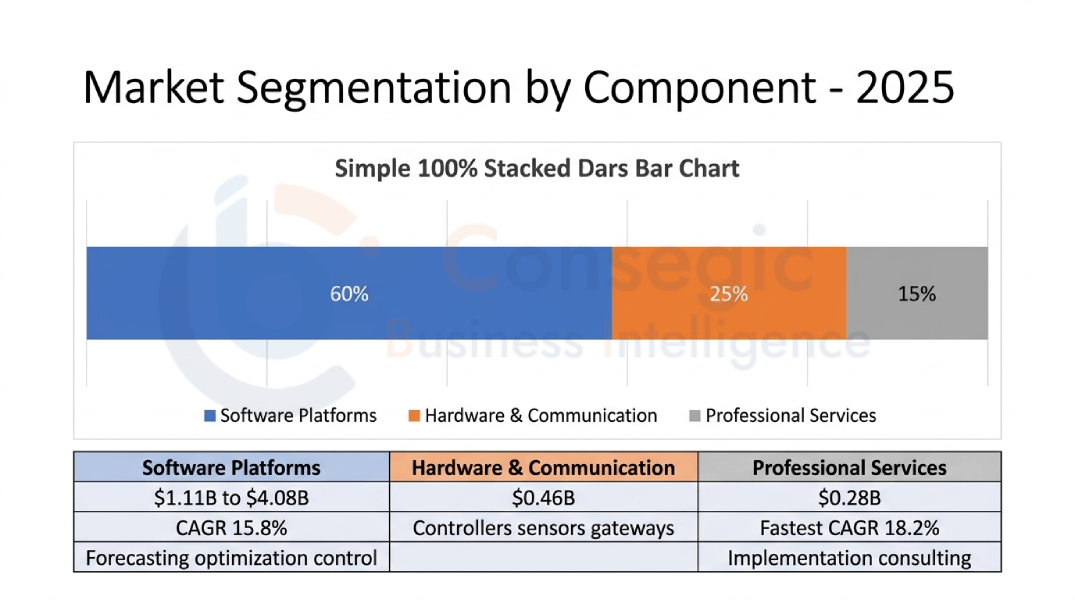
Software Platforms: Market Leadership
DERMS software platforms have equivalent market dominance at USD 1.11 Billion (60.0% of total market value) in 2025, which is expected to have USD 4.08 Billion in 2034 at 15.8% CAGR. Such platforms include essential functional modules such as forecasting engines that predict distributed generation and load with 5-15% mean absolute error, optimization algorithms that coordinate 10,000-100,000 distributed assets under network and market constraints, control systems that dispatch setpoints with 5-30 second latency and analytics dashboards that visualize the operational status of 500-5,000 distribution feeders.
Enhanced implementations use machine learning algorithms, which increase the accuracy of the forecast by 25-40 percent based on pattern recognition of historical data (2-5 years’ time), artificial intelligence optimizers that can solve multi-objective problems by balancing reliability, economics and environmental objectives, and digital twin capabilities that can simulate network-effect of control actions prior to execution. Cloud-native systems allow elastic scaling that supports 100,000-2,000,000 managed assets and API-first systems that support 20-50 external systems integration.
Hardware Infrastructure and Communication Systems
Field hardware such as controllers, sensors, communication gateways, and edge computing devices amounts to USD 0.46 Billion (25.0% of market value) with its products consisting of intelligent electronic devices that control 5,000-50,000 distributed assets at once, advanced metering infrastructure to measure consumption and generation at 1-15 minutes, communication networks to transport telemetry information, and edge computing platforms to run local control algorithms at response times of 100-500 milliseconds.
Professional Services and System Integration
Services in the implementation category, including USD 0.28 Billion (15.0% of market value), with the highest growth rate of 18.2% CAGR, include implementation services, consulting, training and managed services that reflect the complexity of DERMS deployments with 12–36-month implementation process, integration with 15-35 utility systems, network modeling assuring control algorithms, and organizational change management of 150 operations staff.
By Application: Use Case Analysis
Grid Operations and Congestion Management: Largest Application Segment
Grid optimization software has USD 0.83 Billion (45.0% of total market value) in 2025, including voltage and VAR optimization to maintain 0.97-1.03 per unit voltages ranges, and congestion management to avoid transformer and line overloads, minimize losses to reduce distribution losses by 8-15 per cent, and power quality management to reduce voltage variations and harmonics. Applications These applications organize distributed solar inverters that support reactive power, battery storage systems that absorb excess generation or supply peak demand, and controllable loads that move consumption off-peak to peak periods.
Virtual Power Plants and Market Participation
Energy market applications such as virtual power plant, demand response aggregation, and ancillary service provision have USD 0.50 Billion (27.0% of market value) and a highest growth rate of 19.5% CAGR. Such use cases combine 5000-50000 distributed assets that provide 10-500 megawatts of flexible capacity, engage day-ahead markets with 24-hour bidding horizons, intraday balancing with 1–4-hour dispatch notice and frequency response with 5-30 second activation requirements.
EV and Flexible Load Management
Electric vehicle charging control and flexible load coordination show USD 0.37 Billion (20.0% of market value) with 21.5% CAGR, which is load shifting, managed charging, and vehicle-to-grid pilot. With the pace of EV penetration, EVMS is implemented by DSOs and retailers to reduce the effects of peaking and maximize charging in relation to renewable generation and tariff arrangements.
Microgrids and Community Energy Systems
Microgrid and community energy uses take USD 0.15 Billion (8.0% of market value), which is coordination of distributed resources in times of outages to deliver backup power, formation of microgrids that isolate customers to grid disturbances, and black start restoration with distributed generation and storage.
By Deployment Model: Infrastructure Analysis
On-Premises DERMS Solutions
On-premises deployments account for USD 0.83 billion (45.0% of market value) On-premises deployments are preferred by large utilities that need direct control of operational systems, integration with legacy SCADA infrastructure, and compliance with cybersecurity regulations that demand air-gapped networks of critical infrastructure. These deployments serve 100,000-2,000,000 controlled assets and attain 99.95-99.99% system shares by means of redundant systems.
Cloud-Based DERMS Platforms
Cloud deployments have a market value of USD 0.65 billion (35.0% of market value) and fastest growth rate of 22.8% CAGR, which provides elastic scalability to support rapid increase in assets under management between 10,000 and 500,000 with subscription pricing of EUR 2-8 per kilowatt/year, and 3-9 months faster deployment schedules than 12-24 months on-premises systems.
Hybrid DERMS Architectures
The mid-way models of on-premises control systems and cloud analytics at USD 0.37 Billion (20.0% of the market value) are the balancing element of real-time operational demands and the advanced analytics whereas the critical control functions are kept on the local infrastructure to guarantee 5-30 second response times.
Regional Market Analysis
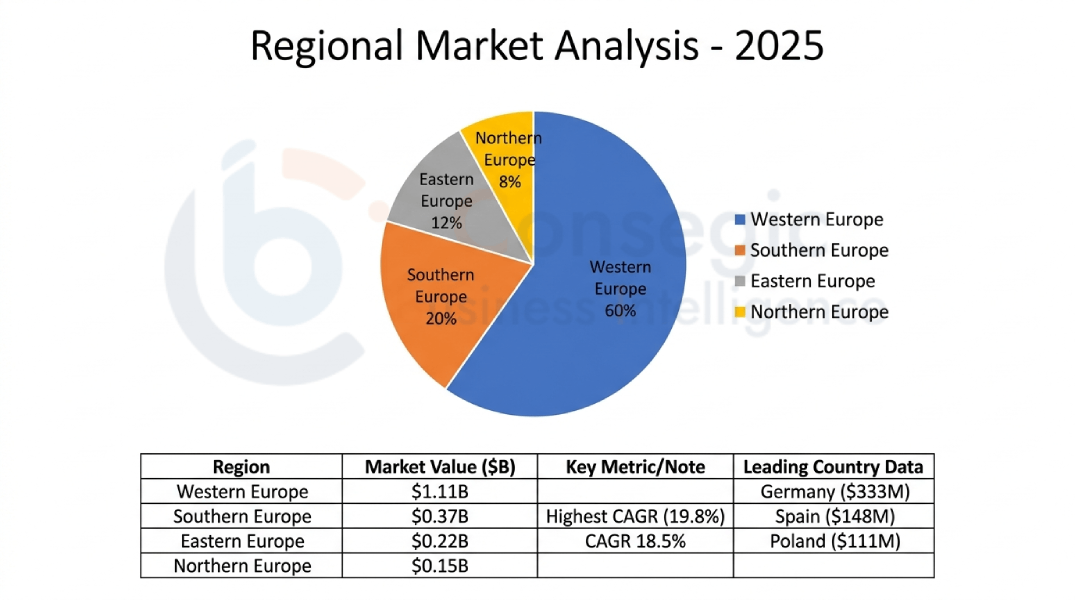
Western Europe: Market Maturity and Technology Leadership.
Western Europe markets such as Germany, United Kingdom, France, Netherlands, and Belgium will comprise of USD 1.11 Billion (60.0% of total European market value) in 2025, with an estimated USD 4.08 Billion in 2034 at 15.8% CAGR. Market leadership in the region is demonstrated by 85-120 deployed DERMS controlling 15-22 million distributed energy resources, developed regulatory frameworks permitting market participation, deep top-down penetration by distributed solar energy which manages 30-45 percent of electricity generation in top markets, and consolidated technology expertise as 15-25 major DERMS vendors are based in the region.
Germany is the largest market in Western Europe, having USD 333 Million market value and is being driven by 75-85 gigawatts of distributed solar power, 5-7 gigawatts of battery-based storage, regulatory mandates that distribution system operators include renewable energy, and by the Energiewende policy that requires 80% of electricity generation to come from renewable energy by 2030. Large utilities such as E.ON, EnBW and Vattenfall have DERMS platforms controlling 500,000-2,000,000 distributed assets and organize virtual power plants of 2-4 gigawatts of flexible capacity.
United Kingdom is the second largest Western European market with USD 278 Million market value which is enabled by 18-24 gigawatts distributed solar, 4-6 gigawatts battery storage and regulatory policies such as Distribution System Operator transition which requires active management of the network. France shows market worth of USD 222 Million where 15-25 deployments are prompted by regulatory changes that allow aggregator market entry and utility investment by Enedis and regional distribution companies.
Southern Europe: Most Rapid Regional Market.
The Southern European markets such as Spain, Italy, Portugal and Greece exhibit the highest regional growth rate of 19.8% CAGR of USD 0.37 Billion (20% of total European market value) with self-exceptional solar resources with capacity factors of between 18-24% as opposed to 10-14% in Northern Europe, distributed solar deployment is rapidly adding 8-15 gigawatts of power per year and regulatory reforms are facilitating self-consumption and energy community models.
Spain has the highest Southern European development with USD 148 Million market value, and 25-30 gigawatts distributed solar capacity developing at 15-20 percent per year, 2-4 gigawatts of battery storage development by 2030, and regulatory framework allowing aggregators to contribute to balancing markets. Italy has a market value of USD 111 Million in control of 24-28 gigawatts of distributed solar on 1.1-1.4 million installations and organizing 3-5 gigawatts of battery storage.
Eastern Europe: New High Growth Market.
Eastern European markets such as Poland, Czech Republic and Romania show USD 0.22 Billion (12.0% of market value) with the growth rate of 18.5% CAGR due to EU funding to enhance grid modernization, acceleration of the distributed solar deployment that are at low start-up positions as well as harmonization of regulation with the western European systems. Poland has the highest market value of USD 111 Million and has 8-12 gigawatts of distributed solar capacity which is increasing by 25-35% per annum.
Northern Europe: High-end Market with Sustainability Policy.
Northern European markets, such as those in Scandinavia, USD 0.15 Billion (8.0% of market value) with premium DERMS implementations with grid resilience, renewable integration and sustainability goals. The area has 12-20 DERMS operations that oversee 1.5-2.5 million distributed assets and coordinates 8-12 gigawatts of distributed renewable capacity.
Recent Industry Developments
Major Utility DERMS Deployments and Platform Upgrades (2024-2025)
Major DERMS announcements: European utilities announced significant investments of EUR 450-650 million in DERMS in 2024-2025. E.ON installed state-of-the-art DERMS on German distribution systems with 1.2-1.8 million distributed solar systems, 400,000-600,000 battery storage installations, 800,000-1,200,000 electric vehicle chargers and coordinated 12-18 gigawatts of flexible capacity and was involved in balancing markets bringing 500-1,500 megawatts of frequency containment reserves.
In France, Enedis finished the implementation of DERMS in 95 percent of distribution network serving 38-42 million customers, operating 800,000-1,200,000 distributed solar installations of 15-20 gigawatts and controlling 200,000-400,000 battery installations. The platform handles 2-4 terabytes of metering data every day and implements optimization code that manages 500,000-1,000,000 assets.
Virtual Power Plant Market Expansion (2024-2025).
Major virtual power plant platforms aggregating residential and commercial distributed resources were initiated by energy aggregators. Next Kraftwerke (Shell) extended operations in Europe to 15,000-25,000 linked assets with 3-5 gigawatts of aggregate capacity in Germany, Belgium, Netherlands, and Austria taking part in day-ahead markets with 500-1,500 megawatts-hour daily volumes and frequency containment reserves with 200-600 megawatts of qualified capacity.
Advancement of regulatory framework (2024-2025).
European regulators developed schemes that facilitated distributed resource involvement in the electricity markets. The European Commission released guidance on distribution system operator functions, under which member states would have to set regulatory frameworks enabling active management of the distribution network and a requirement to actively discriminate on the distribution flexibility markets. The Federal Network Agency of Germany changed balancing market regulations under which the minimum bid size was decreased to 1 megawatt instead of 5 megawatts.
Technology Innovation and AI Integration (2024-2025).
The vendors of DERMS presented new sophisticated features that included artificial intelligence and machine learning. Siemens released EnergyIP DERMS 8.0 with machine learning forecasting that can raise the accuracy of solar generation predictions by 30-45, AI-based optimization algorithms that can coordinate assets with 50-70 times less time to calculate, and the digital twin that can simulate the effects of network placement in advance of control action implementation.
Competitive Landscape and Key Market Players
Strategic Positioning and Market Leadership
Siemens: International Technologies.
In its European markets Siemens is the leader, having approximated DERMS revenues of USD 203 -240 million in 2024, which equates to about 12-13% market share, via its end-to-end EnergyIP platform in 50+ utilities operating 15-25 million distributed assets. One of the competitive advantages is end-to-end portfolio spanning transmission and distribution management system, demonstrated scalability to 2,000,000+ managed assets per instance, and rich analytics with machine learning and artificial intelligence.
Schneider Electric: Solutions Provider.
Schneider Electric enjoys good market presence having estimated revenues of USD 185-222 Million, market share of about 11-12 percent that focuses on integrated offerings of DERMS, ADMS and micro grid management solutions. Some of its competitive advantages are its full software portfolio that covers utility operations, EcoStruxure platform that allows integration of IoT across interconnected devices, and excellent presence in Europe with 200+ utility customers.
GE Vernova: Digital and Innovation.
GE Vernova grid software unit has annual DERMS revenues of USD 167-203 Million, estimated market share of 10-11 percent, that is oriented to cloud-native applications and digital transformation. Some competitive advantages are the GridOS platform that works with elastic scaling, advanced optimization algorithms, and machine learning that increases the accuracy of the forecasts by 25-40%.
Other Important Market Competitors:
- ABB(Hitachi Energy)-One-stop grid management solutions with approximate revenues USD 148-185 Million.
- Oracle Utilities - Cloud platform consultant with projected revenues of USD 130-167 Million.
- Enel X - European demand response and aggregation leader.
- AutoGrid (Schneider Electric) - AI-based flexibility platform.
- Kraken (Octopus Energy) - Software-based disruptive platform that is growing in Europe.
Europe Distributed Energy Resource Management System Market Report Insights
| Report Attributes | Report Details |
|---|---|
| Study Timeline | 2022–2034 |
| Base Year | 2025 |
| Forecast Period | 2026–2034 |
| Market Size in 2025 | USD 1.85 Billion |
| Market Size in 2034 | USD 6.80 Billion |
| CAGR (2026–2034) | 15.8% |
| By Component | Software Platforms (60.0%), Hardware & Communication (25.0%), Professional Services (15.0%) |
| By Application | Grid Management (45.0%), Virtual Power Plants (27.0%), EV Management (20.0%), Microgrids (8.0%) |
| By Deployment | On-Premises (45.0%), Cloud-Based (35.0%), Hybrid (20.0% |
| By Region | Western Europe (60.0%), Southern Europe (20.0%), Eastern Europe (12.0%), Northern Europe (8.0% |
| Key Players | Siemens, Schneider Electric, GE Vernova, ABB, Oracle Utilities, Enel X, AutoGrid, Kraken |
| Report Coverage |
|
Key Questions Answered in the Report
What is the size of the Europe DERMS market and the projected market size? −
Europe Distributed Energy Resource Management System market is estimated to be USD 1.85 Billion in 2025 and is estimated to have USD 6.80 Billion in 2034 with a CAGR of 15.8 in the prognostication period 2026-2034. The distribution solar capacity will reach 285-320 gigawatts by 2030, the battery storage will reach up to 65-85 gigawatts, the electric vehicles will reach 45-60 million vehicles, and the investment in grid modernization will amount to EUR 375-425 billion by 2030.
What is the market segment with the greatest growth rate? +
The Southern Europe is projected to grow at the highest regional growth of 19.8% CAGR, due to the outstanding solar potential, the high rate of distributed solar adoption of 8-15 gigawatts every year, and regulatory changes allowing the models of self-consumption. EV and flexible load management shows the highest growth at 21.5% CAGR, in the area of application segments due to the increasing adoption of electric vehicles and the need to have managed charging solutions.
What are the major advantages of DERMS platforms to utilities? +
DERMS systems allow utilities to maintain voltage stability within 0.97-1.03 per-unit control bands, minimize distribution losses (8-15 percent) in optimum power flows, defer infrastructure upgrades (annually EUR 15-35 million) in utility with large customer bases, and maximize renewable utilization (15-25 percent) in coordinated curtailment and storage dispatch. Platforms organize 10,000-500,000 distributed assets, run telemetry data at 1-15 seconds time periodicity, and run optimization algorithms at 30-300 second periods of computation.
What are the major technical issues in the implementation of DERMS? +
The main difficulties are integration with 15-35 legacy utility systems that consumed 30-45 percent of implementation budgets, data quality problems with 15-30 percentage inaccuracies in asset databases, communication infrastructure issues with rural coverage gaps that cover 1535 percent of geographic territory, and interoperability problems that demand protocol translation gateways that cost EUR 5,000-25,000 to install. Timelines of implementation go up to 18-36 months with 35-45% of the projects lagging behind.
What are the ways through which virtual power plants make profit out of distributed resources? +
Virtual power plants make money by generating energy arbitrage of EUR 150-350/ residential battery/year, frequency containment reserve of EUR 50,000-150,000/ megawatt/year in German markets, and demand response of EUR 35,000-75,000/ megawatt-year in France. Aggregations provide 5,000-50,000 distributed assets with 10-500 megawatts of capacity that generates flexible capacity.
Overview
Reputation & Certifications


Our Services
- Market Intelligence & Forecasting
- Custom Research Solutions
- Market Entry Strategy
- Competitive Intelligence
- Customer Insights
- Industry Innovation Analysis
- Investment Advisory