Jump to Content
Europe Membranes Market - Size, Share, Industry Trends, and Forecasts (2025-2034)
Market Scope & Overview
The Europe membranes market is a high-tech and sophisticated market in the industrial filtration and separation industry that includes synthetic and semi-synthetic permeable barriers designed to selectively separate molecules, particles, and ions based on their size, charge, or chemical affinity. These membrane systems have important applications in water and wastewater treatment systems that handle more than 50 billion cubic meters/year, pharmaceutical manufacturing that requires ultra-pure production environments, food and beverage processing that ensures product safety and quality, chemical processing that needs selective separation and new energy sources such as fuel cells and hydrogen production.
The market itself has proven to be quite resilient with a valuation of USD 2.85 billion in 2024 and projected to achieve USD 3.05 billion in 2025, which is the base year of this overall analysis. It is projected that the market will keep experiencing a robust growth to USD 5.12 billion by 2034, which is a compound annual growth rate of 5.9 percent over the forecasts of 2026-2034. The source of this growth trend is strict European water quality regulations, which require sophisticated treatment devices, the development of a circular economy, which is boosting industrial water reuse to 6.6 billion cubic meters by 2030, the expansion of the pharmaceutical industry with an output of manufacturing approaching EUR 280 billion per year, and the introduction of new membrane material technologies that provide improved performance such as resistance to fouling and an improvement in the energy efficiency.
Regional Trends and Insights
- Western Europe dominates with USD 1.68 billion (55%) in 2025, projected to reach USD 2.82 billion by 2034
- Germany, France, and United Kingdom hold the majority share due to strong industrial and water infrastructure
- Germany leads with advanced chemical and pharmaceutical industries and strong water regulations
- Southern Europe growing (6.2% CAGR), led by Spain and Italy due to desalination and water scarcity
- Eastern Europe is the fastest-growing (6.8% CAGR), driven by infrastructure investments and led by Poland
Technological Evolution and Material Innovation
Modern membrane technology incorporates advanced materials science with thin-film composite polymers with water permeability of 15–25 liters per square meter per hour and 99.7 percent salt rejection, ceramic membranes that operate at temperatures above 350°C and across a pH range of 0–14, suitable for harsh environments, and biomimetic aquaporin-based membranes that mimic natural water channel proteins with high selectivity. The system of industrial reverse osmosis works with the pressure of 55-85 bar and contaminant rejection ranges from 95% to 99.8%, whereas ultrafiltration and microfiltration membranes have lower pressure of 0.5-5 bar and a flow of 100-200 liters per square meter per hour.
The industrial environment of Europe, which includes water intensive industries that consume about 44 billion cubic meters of water each year in manufacturing, faces a growing pressure of water stress consuming 30 percent of the European territory, high energy prices, averaging EUR 0.15–0.25 per kilowatt-hour, impacting efficiency requirements, and tougher discharge requirements, discharge standards under the Urban Wastewater Treatment Directive, which demands 95 percent organics removal. Such systemic pressures provide strong market opportunities to the membrane manufacturers that are developing solutions to these issues, i.e. resource efficiency, regulatory compliance and optimization of operation costs.

Europe Membranes Market Executive Summary
The Europe membranes market is a mature but highly dynamic business sector that is led by regulatory requirements, sustainability undertakings, and technology. The current market value of USD 3.05 billion in 2025 indicates established adoption in the municipal water treatment, industrial processing, and specialized use with the growth expected to USD 5.12 billion in 2034 due to the rising application in the industrial water reuse processes, pharmaceutical manufacturing growth, desalination capacity expansions, and new material developments with enhanced performance features.
The overall regulatory frameworks such as EU Water Framework Directive of setting good status targets of water bodies, Urban Wastewater Treatment Directive of secondary and tertiary treatment to municipalities with populations above 2,000 population equivalents, Drinking Water Directive of setting strict quality parameters of 48 chemical and microbiological indicators, and Industrial Emissions Directive of best available techniques to prevent pollution reinforce market expansion. These laws introduce a systematic requirement for membrane technologies that provide consistent performance, regulatory compliance, and financial sustainability in an array of applications.
The action plan of the European Green Deal on the circular economy targets such ambitious goals as 50 percent decrease in residual municipal waste by 2030, the development of the full-scale industrial water reuse models to achieve 6.6 billion cubic meters of recycling each year, and zero pollution ambition with the adoption of high-tech treatment technologies. Such policy drivers will generate considerable market opportunities of an estimated EUR 2.8-3.5 billion increment in investment needs of membrane system deployment across municipal and industrial plants over the forecast period.
At the same time, the market also has limitations such as large capital investment needs whereby comprehensive membrane systems cost EUR 800-2,500 per cubic meter of treatment capacity per day, membrane fouling issues, where flux rates decrease by 15–35% over operational periods that require chemical cleaning and ultimate replacement and energy consumption where reverse osmosis systems consume 3–6 kilowatt-hours per cubic meter when they are operating on seawater.
Key Market Driver
Strict environmental policies and circular economy requirements.
The leading market force is the stringent regulatory framework engineered by the European Union, i.e., the European Green Deal and the Circular Economy Action Plan and the increasing water shortages in regions across Europe, which are propelling the systematized water recycling and reuse programs by industries. Contrary to other parts of the world where scarcity usually motivates the application of water treatment, the water treatment demand in Europe is legally driven by strict discharging limits and resource recovery requirement, which forms a structurally favorable environment of membrane technologies.
Amendments to Urban Wastewater Treatment Directive (UWWTD) and Industrial Emissions Directive (IED) will force municipal and industrial facilities to treat wastewater to the extent that it can be reused, or released without causing damage to the delicate ecosystem. The UWWTD will address smaller agglomerations and storm water overflows, which will directly expand the market that can be addressed by membrane bioreactor (MBR) and ultrafiltration modules. The IED requires heavy industries such as chemical processing, pulp and paper, and metal finishing to embrace Best Available Techniques (BAT), the membrane technology is often mentioned as BAT to seal water loops and extract valuable raw materials in waste streams.
According to extensive evaluation by European environment agency, water stress affects 30% of European land each year, and the Mediterranean states particularly in countries such as Spain, Italy, Greece, Cyprus, and Portugal, which are experiencing extreme water scarcity. The plan of the circular economy developed by the European Commission sets certain goals such as minimum 50% rate of industrial water recycling by 2030, with the current rates of 15-25 percent in most European countries pointing at the high growth perspectives. Economic factors support conservation motives by increasing water prices with industrial water tariffs at water stressed areas surging to EUR 2.50-4.80 per cubic meter, generating strong business arguments supporting the use of membrane-based water recycling as a payback period of 3-7 years.
Key Market Restraint
Prohibitive operating expenses and membrane fouling management.
The main limitation of the market is that it needs a significant amount of capital investment to implement the membrane systems fully as well as the problem of operation such as membrane fouling that needs high maintenance procedures and periodic replacement. Large-scale membrane treatment plants are capital-intensive, with costs ranging between EUR 800–2,500 per cubic meter of daily treatment capacity depending on the feed water quality, treatment goals, and complexity of the system configuration.
The most important problem associated with membrane fouling is the critical issue that affects the performance of the system and the rise in the cost of its lifecycle. Fouling, in the form of particulate matter, organic compounds, biological growth, and inorganic scaling, is deposited on the membrane surfaces and this percentage has been shown to decrease permeate flux by 15-35 percent over the course of operation and increases transmembrane pressure requirements by 20-50 percent. Severe fouling will require vigorous chemical cleaning regimens that use caustic solutions, acids and oxidizing agents at intervals of every 2-8 weeks based on the nature of the feed water and operating conditions.
The energy consumption of high-pressure membrane technologies especially reverse osmosis is a major issue of consideration in a fluctuating energy price in Europe. RO systems use 3–6 kilowatt-hours per cubic meter of seawater, and high electricity prices directly affect operating costs. The replacement of membranes is a significant recurrent expense with an average operating life of 3-7 years with polymeric membranes and 5-10 years with ceramic versions, which equates to EUR 120,000-360,000 to install a 3,000 square meter membrane installation to be used in manufacturing.
The technical experience requirements multiply operational issues, since the management of the membrane systems requires special knowledge that involves the water chemistry, membrane performance characteristics, cleaning procedures, and problem-solving skills. Lots of industrial plants do not have internal specialists, and they need to hire external services at EUR 25,000-85,000/year or provide training programs of operators.
Key Opportunity
Biopharmaceutical production and ultra-pure water.
The greatest growth potential comes from the growth of the European pharmaceutical industry and even more demanding purity standards of pharmaceutical grade water used in the manufacture, formulation and cleaning of equipment used in the pharmaceutical industry. The European pharmaceutical industry produced manufacturing output of over EUR 280 billion in 2024, which is 25 per cent. of the world pharmaceutical manufacturing, especially in the fields of biologics, specialty pharmaceuticals and active pharmaceutical ingredients.
Monoclonal antibodies, vaccines, and recombinant proteins are manufactured around the world in Europe with the largest manufacturing centers in Switzerland, Germany, Ireland, and the United Kingdom. Both upstream and downstream bioprocessing such as media sterilization, cell culture perfusion, product purification, concentration using ultrafiltration and buffer exchange using diafiltration are not possible without membrane technologies. The movement towards the idea of continuous bioprocessing as compared to the batch processing is highly dependent on the strength of the membrane systems that can be able to last longer without degeneration.
Water used in pharmaceutical manufacturing should be of different grades such as purified water that meets the criteria on conductivity of less than 1.3 microsiemens per centimeter and the total organic carbon of less than 500 parts per billion and water used in injection that should have bacterial endotoxin content at less 0.25 units of endotoxins per milliliter and they must be completely sterile. Market research suggests that the pharmaceutical market of water treatment systems is USD 675-785 million of the present market worth of the European membranes, with estimated growth of 7.8 percent CAGR which is much faster than the overall market growth rate.
The trend of personalized medicine and Cell and Gene Therapies (CGT) is a demand of single-use membrane technologies that do not involve validation of cleaning and minimize the risk of cross-contamination. European manufacturers are putting more and more investments in hollow fiber and cassettes membrane formats which are compatible with single-use assemblies, whereas capacity addition with 45 major pharmaceutical manufacturing facilities under construction in Ireland, Switzerland, Belgium, Germany, and Italy represent a collective investment of over EUR 8.5 billion in 2024-2027.
Market Segmentation Analysis
By Material Type: Technology Platform Analysis
Polymeric Membranes: Market dominance at USD 2.05 billion which is 67.0 percent of market value in 2025 which is forecast to increase to USD 3.43 billion in 2034. Such segment includes polyamide thin-film composite membrane used in reverse osmosis, polyvinylidene fluoride used in ultrafiltration and microfiltration, polyethersulfone used in pharmaceutical usage and cellulose acetate used in specific application. Polymeric membranes provide the following cost benefits: EUR 40-120/m 2, a wide range of chemical formulations allowing optimization to the application, and well-established manufacturing systems that support large-scale production.
Ceramic Membranes: USD 650 million with the highest market worth of 21.0 percent with the highest growth rate of 7.2 percent CAGR owing to use in harsh environment. Ceramic membranes made using aluminum oxide, titanium dioxide or zirconium oxide can be operated at temperatures over 350 degrees Celsius, pH 0-14 and harsh chemical conditions that polymeric membranes cannot withstand. The uses are chemical processing, pharmaceutical production that needs to be sterilized in steam, food and beverage processing of high mechanical strength and chemical inertness.
Metallic and Other Advanced Membranes: USD 365 million including 12.0 percent analysis of the market value that includes ion-exchange membranes that are utilized in the electrolysis process, gas separation membranes, which are utilized in industrial processes, and hybrid materials that have polymeric as well as inorganic components. These enhanced materials have high premium prices of EUR 150-350 per square meter with a higher performance nature.
By Technology: Process Analysis
Reverse Osmosis (RO): The largest market value segment at USD 1.22 billion that represents 40.0 percent of market value, is used in seawater and brackish water desalination, which yields 8.5 million cubic meters per day in European plants, industrial water treatment, which yields 95-99.8 percent dissolved solids removal, and ultra-pure water production, which is used in pharmaceutical and electronic manufacturing. RO membranes can work under pressures ranging between 15-85 bar based on the feed salinity with water permeability of 15-25 liters per square meter per hour and salt rejection of more than 99.5 percent.
Ultrafiltration (UF): USD 760 million, which constitutes 25.0 percent of market value, is used in municipal drinking water filtration with processing 18 billion cubic meters in a year, wastewater treatment having 99.99 percent pathogen elimination, and industrial usage such as food and beverage preparation. UF membranes that have pore sizes of 0.01-0.1 microns can work under low pressure of 0.5-5 bar and provide flux rates of 50-150 liters per square meter per hour.
Microfiltration (MF): USD 610 million making 20.0 percent of the market value, used in wastewater purification as membrane bioreactor, in beverages as a clearant, and in pharmaceuticals as a sterile-filter. MF membranes of pore sizes of 0.1-10 microns offer absolute filtration at high flux rates of 100-200 liters per square meter per hour and low operating pressure that are lower than 2 bar.
Nanofiltration (NF) and Others: USD 460 million of 15.0 percent of market value including water softening applications, industrial process separation, food processing such as dairy whey concentration and new uses in the removal of micropollutants in drinking water sources.
By Application: End-Use Market Analysis
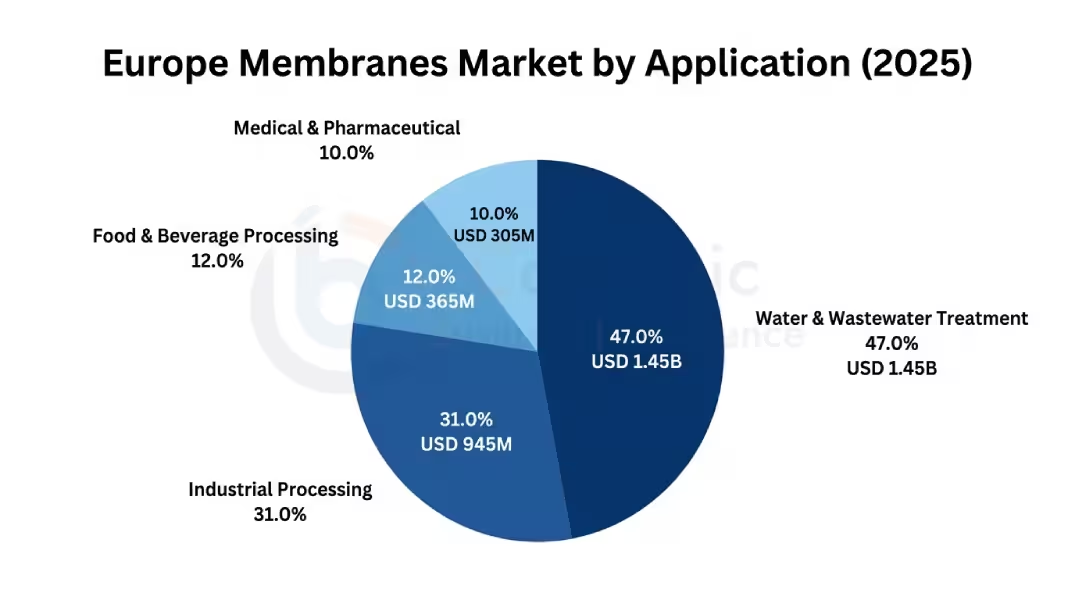
Water and Wastewater Treatment: Leading application with USD 1.45 billion that is 47.0 percent of the market value, which includes municipal drinking water treatment that serves 520 million European citizens, wastewater treatment processing 52 billion cubic meters each year, and industrial water treatment that fulfills the various needs of manufacturing. This part offers predictable basis of demand by regulation requirements, replacement cycles of infrastructures and capacity addition demands.
Industrial Processing: USD 945 million representing 31.0 percent of market value, to serve chemical separations, oil and gas usage, mining operation, metal finishing process, and zero liquid discharge system. The European chemical sector with EUR 565 billion turnover per year develops various applications of membranes to optimize processes and meet the environmental requirements.
Food and Beverage Processing: USD 365 million or 12.0 percent of market value, which includes dairy processing such as whey concentration and milk protein fractionation, beverage processing such as juice clarification and wine filtration, and process water treatment such as quality and safety of products. The European food and beverage sector with a turnover of EUR 1.2 trillion annually has a large market potential to be addressed.
Medical and Pharmaceutical: USD 305 million (10.0 percent of market value with highest growth rate of 7.8 percent CAGR) serving ultra-pure water production, bioprocessing uses such as cell culture media preparation, protein purification, sterile filtration of injectable drugs, and dialysis uses to support infrastructural needs in healthcare.
Regional Market Analysis
Western Europe: Dominance in the market and Innovation hub.
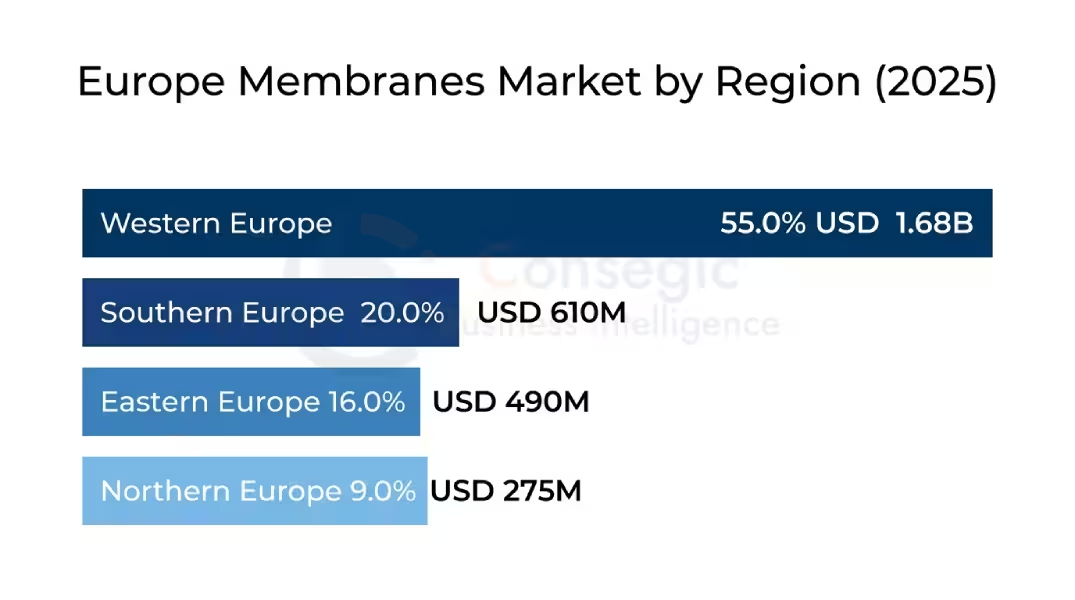
The North-Western Europe dominates the market at USD 1.68 billion representing 55.0 percent of the market value in 2025, estimated at USD 2.82 billion in 2034. The 68 percent market value of Western Europe is held by Germany, France and United Kingdom, which are characterized by high intensity of industrial base, strict environmental conditions, extensive municipal water supply system that caters to 320 million people and high development pharmaceutical and chemical industries.
Germany is the western European market leader with about 28 percent regional market share, proves strong chemical industry with market share of 28 percent of European chemical production, superb pharmaceutical manufacturing with 850 plants and overall water purification standards in the German Drinking Water Ordinance. The National Water Strategy by the German government suggests the use of water reuse technologies and some of the key domestic players such as BASF has well-established research and development functions that could help in market innovation.
France has 18 percent of Western European market value, is leader in water utility management provision with Veolia and SUEZ operations, extensive generation of nuclear power needs extensive cooling water purification, and has a high presence of the pharmaceutical industry. In 2019-2024, French water authorities spent EUR 2.8 billion on water infrastructure development that included the implementation of membrane technology to improve the quality of drinking water and the modernization of wastewater treatment.
Southern Europe: Desalination and Water Scarcity Area of Focus.
Southern Europe shows USD 610 million in 2025 reflecting 20.0 percent of market value, which is projected USD 1.07 billion in 2034 that is 6.2 percent CAGR due to its severe water scarcity, development of desalination capacity, use of agricultural water, and the tourism sector demands. Spain is a leader in regional markets which is running the most extensive desalination capacity in Europe 5.2 million cubic meters per day in 900 plants concentrated in Mediterranean coasts.
Italy has a large market share that is motivated by the concentration of the pharmaceutical industry with 450 manufacturing plants, food and beverage industry dominance especially in dairy production and wine production, and municipal water infrastructure modernization due to the aging systems. National Recovery and Resilience Plan by the Italian government has EUR 4.4 billion of investments in water infrastructure in 2021-2026, with substantial amounts of the same going to deployments of membrane technology.
Eastern Europe: Fast Infrastructure Thesis.
Eastern Europe would be USD 490 million representing 16.0 percent of market value in 2025 showing 6.8 percent CAGR as the fastest growing regional market. These growth drivers are EU accession-based infrastructure investments where the structural funds have been allocated with EUR 12.5 billion to water and wastewater infrastructure investments in 2021-2027, industrial development, harmonization of EU environmental directives regulations, and expansion of municipal treatment capacities.
The Eastern European markets are led by Poland which is advantageous due to the extensive water infrastructure modernization programs spending EUR 3.8 billion in 2020-2027, the expansion of pharmaceutical and chemical production, and the development of the food processing industry. Polish National Water Management Authority set up strategic plans to have 95 percent population connection to advanced wastewater treatment by 2027.
Northern Europe: Leadership on the field of Premium Quality and Sustainability.
The USD 275 million in the North Europe market value in 2025 (9.0 percent market value) reflecting the highest per capita membrane market values reflecting the highest quality standards, extensive environmental regulation, presence of advanced pharmaceutical industry especially in Denmark and Sweden and sustainability leadership leading to circular economy implementation resulting in 45-55 percent recycling rates of industrial waters.
Competitive Landscape and Key Market Players
Strategic Positioning and Market Leadership
DuPont de Nemours, Inc. (United States - Europe Operations) - Reverse Osmosis Technology Leader.
DuPont is a market leader with estimated 2024 European revenues of EUR 485-535 million, and this is a market share of about 16-18 percent with concentrated strength of 25-28 percent in reverse osmosis segment. The competitive positioning of the company is based on the brand name of FilmTec as a standard in the industry in RO membranes, a complete product range of seawater, brackish water, and ultra-low pressure, and technological leadership with thin-film composite technology that is able to provide a high level of performance features.
Toray industries, Inc. (Japan - Europe Operations) - Advanced Materials Innovation.
Toray has strong presence in Europe where it is estimated to have regional revenue of EUR 365-405 million, which comprise of 12-14 percent market share and leadership in new membrane materials. The competitive position of the company revolves around materials science with proprietary polyamide formulations, comprehensive reverse osmosis and nanofiltration portfolio and leadership in technology-based innovations in energy consumption-effective membrane designs.
Veolia Water Technologies and Solutions (France) Portfolio Comprehensive Solutions.
Veolia creates excellent market presence with projected 2024 European revenues of EUR 425-475 million, 14-16 percent market presence in all with specific market presence in municipal water treatment and industrial uses. The competitive positioning of the company is based on the integrated solutions strategy of combining membrane technologies with complementary treatment processes and a wide range of connections with the municipal utilities.
Mann+Hummel (Germany) - Membrane Specialist (Industrial).
Mann+Hummel is focused positioning in industrial membrane applications with a projected 2024 revenues of EUR 285-325 million with 9-11 percent market share and strength in ceramic membrane applications and harsh environment applications. The company strategy focuses on performance and life expectancy in harsh industrial setting.
Recent Industry Developments
Digital Integration and Sustainable Materials (2024-2025).
Key membrane producers adopted extensive sustainability policies that dealt with environmental effects in product life cycles. In May 2024, DuPont declared to recycle 50 percent of membrane housings and packing materials by 2027, decrease manufacturing water usage by 35 percent via closed-loop systems, and create membrane recycling initiatives that will take in end-of-life products to recover their materials.
In March 2024, Toray announced Smart Operation Platform that integrates the real-time monitoring of membrane performance, and fouling prediction algorithms using artificial intelligence with automated cleaning optimization recommendations. The system was successfully introduced into 45 industrial facilities in the first wave, and it was shown that it can reduce the frequency of chemical cleaning by 18 percent and increase the normalized permeate flux by 12 percent.
Expansion of Pharmaceutical Capacity (2024-2025).
Manufacturers of membranes increased the production capacity of pharmaceutical grade which was in response to the growth and quality of the industry. In 2024, Merck KGaA spent EUR 85 million to expand production capacity of ultrafiltration membranes used in biopharmaceutical applications and installed technologies to raise production capacity by 60 percent by expanding the pharmaceutical membrane manufacturing facilities in Ireland, adding new advanced cleanroom conditions to the facility, and complying with the ISO Class 7 standards.
Regulatory Compliance and Technology Development (2024-2025)
In October 2023, the European Commission introduced more severe limits on PFAS (per- and polyfluoroalkyl substances), which prompted some research and development efforts of membrane producers to create PFAS-free polymeric membranes to guarantee compliance and environmentally-safe usage in the future. Several manufacturers introduced next generation low-energy RO membranes that were able to operate on less energy (10-20 percent less) with the same salt rejection capabilities.
Europe Membranes Market Report Insights
| Report Attributes | Report Details |
|---|---|
| Study Timeline | 2022–2034 |
| Base Year | 2025 |
| Forecast Period | 2026–2034 |
| Market Size in 2024 | USD 2.85 Billion |
| Market Size in 2025 | USD 3.05 Billion |
| Market Size in 2034 | USD 5.12 Billion |
| CAGR (2026–2034) | 5.9% |
| By Material Type | Polymeric (67.0%), Ceramic (21.0%), Metallic & Others (12.0%) |
| By Technology | Reverse Osmosis (40.0%), Ultrafiltration (25.0%), Microfiltration (20.0%), Nanofiltration & Others (15.0%) |
| By Application | Water & Wastewater Treatment (47.0%), Industrial Processing (31.0%), Food & Beverage (12.0%), Medical & Pharmaceutical (10.0%) |
| By Region | Western Europe (55.0%), Southern Europe (20.0%), Eastern Europe (16.0%), Northern Europe (9.0%) |
| Key Players | DuPont, Toray Industries, Veolia Water Technologies, Mann+Hummel, Hydranautics (Nitto Denko), Koch Separation Solutions, Pentair, Alfa Laval |
| Report Coverage |
|
Key Questions Answered in the Report
What is the present size and future growth trend of the Europe membranes market? −
Regarding this, the Europe membranes market has the following steady growth characteristics of USD 3.05 billion in 2025 and USD 5.12 billion by 2034, which has a compound annual growth rate of 5.9 percent over the forecast period. Applications in the market can have different levels of maturity, with municipal water treatment at the stage of steady growth due to the replacement of infrastructure and regulatory measures and with pharmaceutical applications, a rapid growth due to the expansion of the industry and high-quality standards.
What are the key forces boosting the growth of the European membrane markets? +
The key growth force revolves around strict environmental policies of the European Union such as Urban Wastewater Treatment Directive, Industrial Emissions Directive and Water Framework Directive, which has legally imposed the requirement of sophisticated membrane technologies. Water shortages that have afflicted 30 percent of the European landmass and circular economy requirements which aim at achieving 50 percent recycling of industrial water by 2030 generate structural possibilities of water reuse applications through membrane processes. The growth in the pharmaceutical industry where the manufacturing output is more than EUR 280 billion a year would result in a high demand in ultra-pure water systems and bioprocessing applications.
What are the primary limitations to accelerated market development? +
The major limitations are high capital investment needs and total treatment systems of membranes costing EUR 800-2,500 per cubic meter of daily treatment rate, membrane contamination problems that cut flux rates by 15-35 percent and necessitate vigorous cleaning procedures and frequent replacement, and power use with reverse osmosis systems of 3-6 kilowatt-hours per cubic meter. The operational difficulties are complicated by the requirements in technical expertise, as the specialist knowledge will be a requirement to manage and maintain the systems.
What are the regional markets with the highest growth potential? +
Western Europe assumes the dominant market share of 55.0 percent that indicates the most mature adoption trends and extensive regulatory frameworks whereas Eastern Europe is the fastest growing with 6.8 percent CAGR due to the EU structural funding of EUR 12.5 billion in modernizing the water infrastructure and harmonizing regulatory requirements. Southern Europe is experiencing great growth due to the scarcity of water and expansion of desalination capacity, especially in Spain and Italy.
What are the technological trends that are influencing future development of the membrane market? +
Major technology improvement revolves around high-tech materials such as the use of ceramic membrane with high-resistance in harsh conditions, energy-efficient membrane structure with a 15-25 per cent lower cost of operation, and digitalization with real-time monitoring, artificial intelligence predictive fouling, and automated optimization that offers operational benefits. The focus on sustainability encourages the production of bio-based membrane materials, end-of-life membrane recycling programs, and/or improvements in the manufacturing processes that have less environmental impacts on the lifecycles of products.
Overview
Reputation & Certifications


Our Services
- Market Intelligence & Forecasting
- Custom Research Solutions
- Market Entry Strategy
- Competitive Intelligence
- Customer Insights
- Industry Innovation Analysis
- Investment Advisory