Jump to Content
Greenhouse Film Market - Size, Share, Industry Trends, and Forecasts (2025-2032)
Greenhouse Film Market Size:
Greenhouse Film Market size is estimated to reach over USD 14.09 Billion by 2032 from a value of USD 7.58 Billion in 2024 and is projected to grow by USD 8.06 Billion in 2025, growing at a CAGR of 8.1% from 2025 to 2032.
Greenhouse Film Market Scope & Overview:
The greenhouse film is a specialized plastic used in a regulated environment which aids in regulating temperature, transmission of light, humidity, and safeguarding against external environmental factors. It is typically made from polyethylene or of multiple polymer blends, which optimize crop yield and energy efficiency, usually used in production of UV-stabilized films, anti-condensate coatings, and infrared (IR) blocking layers, each contributing to specific microclimate control objectives.
The type of greenhouse film varies in mechanical strength, capability to diffuse light, and resistance to damage under prolonged exposure to sunlight. High-durability films are usually coated with additives to enhance heat retention and control the amount of light transmitted, having a direct effect on the plant physiology. The thickness of the film depends on crop type, climatic zone, and structural requirements of the greenhouse, often measured in microns or mms.
It plays an important role in protecting and controlling cultivation systems, ensuring consistent crop cycles and promoting sustainability. End-users of this industry mainly include the producers and operators of the agriculture and horticulture industries.

Greenhouse Film Market Dynamics - (DRO)
Key Drivers:
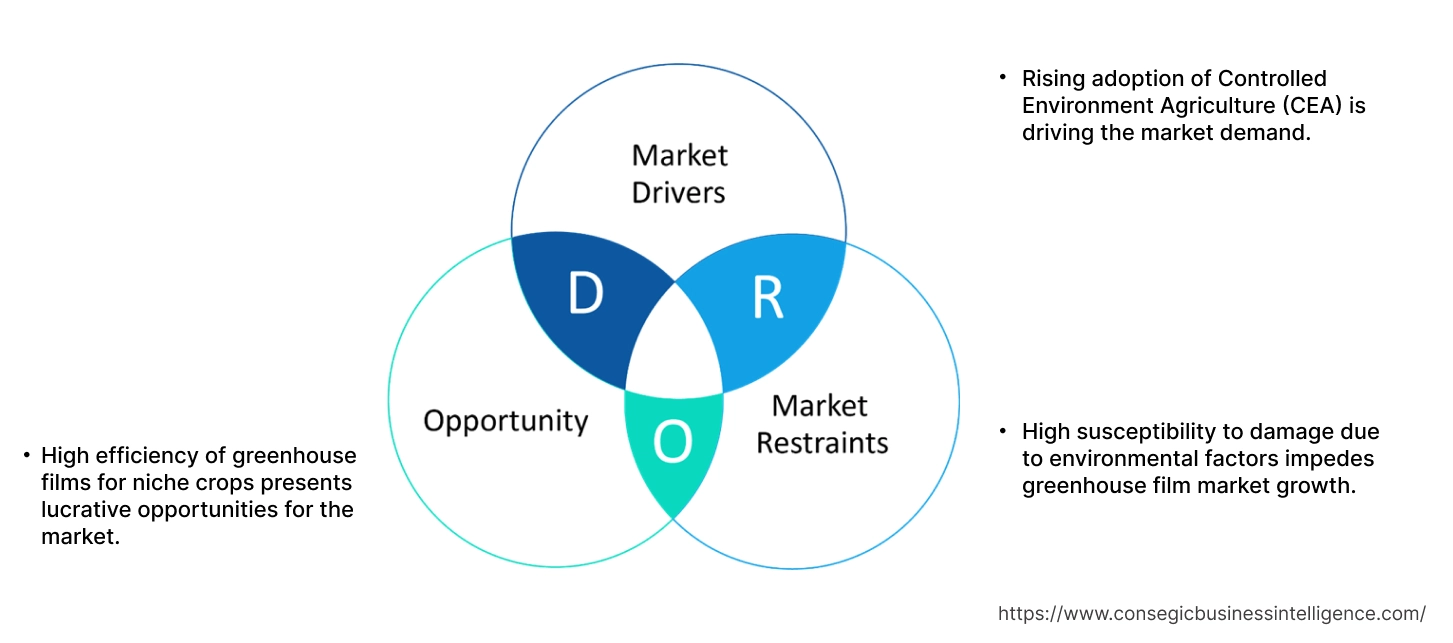
Rising adoption of Controlled Environment Agriculture (CEA) is driving the market demand.
Controlled environment agriculture is a revolutionary technique to produce crops as it boosts crop yield and efficiency while promoting sustainable food production, without the intervention of external environmental factors and weather changes. Additionally, the growing technical advances in these films like sustained coverage from UV light and thermal insulation provide better conditions for high-value crops. These films aid in creating conditions like regulated temperature, humidity, and UV exposure within the covered area.
- For instance, in June 2024, Little Leaf Farms announced the launch of their new greenhouse set in McAdoo, Pennsylvania. The new 10-acre greenhouse will be the largest set providing leafy greens through controlled environment agriculture (CEA).
Furthermore, with the rising concerns for food scarcity and deteriorating food quality, the farmers are driven extensively towards this technology. Therefore, the rising demand for controlled environment agriculture is fueling the greenhouse film market trend.
Key Restraints:
High susceptibility to damage due to environmental factors impedes greenhouse film market growth.
Greenhouse films are delicate and likely to be damaged by external environmental changes and seasonal weather conditions, affecting their effectiveness and lifespan. Extreme weather conditions like torrential rains, hailstorms, snowstorms, and extensive temperatures wear down the films. This leads to increased frequency in maintenance and replacements. Additionally, consistent exposure to UV rays degrades the film over time directly affecting the crops, leading to decreased crop efficiency, quality and overall development of plants. Furthermore, such damages require high capital investments for repairing and replacement of films, impacting the farmers largely in regions with extreme and unpredictable weather conditions. Therefore, the high vulnerability of greenhouse films to extreme weather conditions poses a significant hurdle in their global adoption, substantially impeding the market.
Future Opportunities:
High efficiency of greenhouse films for niche crops presents lucrative opportunities for the market.
The rise in trend for high-value crops like saffron, ginseng, hill garlic, aromatic rice, and many such plants, will subsequently increase the demand for advanced greenhouse films. These films protect the crops from environmental stress, pests, and the ever-changing weather conditions, providing accurate conditions for the crops to grow. Additionally, future technological advancements to enhance film durability, diffusion of light across the greenhouse, protection from pests, and control over humidity will aid in increasing crop yield.
- For instance, in February 2024, Berry Global, opened a “Circular Innovation and Training Center” in Tulsa, Oklahoma. This is a 12,000 sq.ft. center that will boost the development of high-tech greenhouse film products with cutting-edge stretch film projects.
Furthermore, these films provide a controlled environment which will enable producers to grow these high-value crops in any region regardless of the climate conditions. Therefore, with the shifting trend of the agricultural sector toward growing these specialized crops, the greenhouse film market opportunities are expected to rise.
Greenhouse Film Market Segmental Analysis :
By Resin Type:
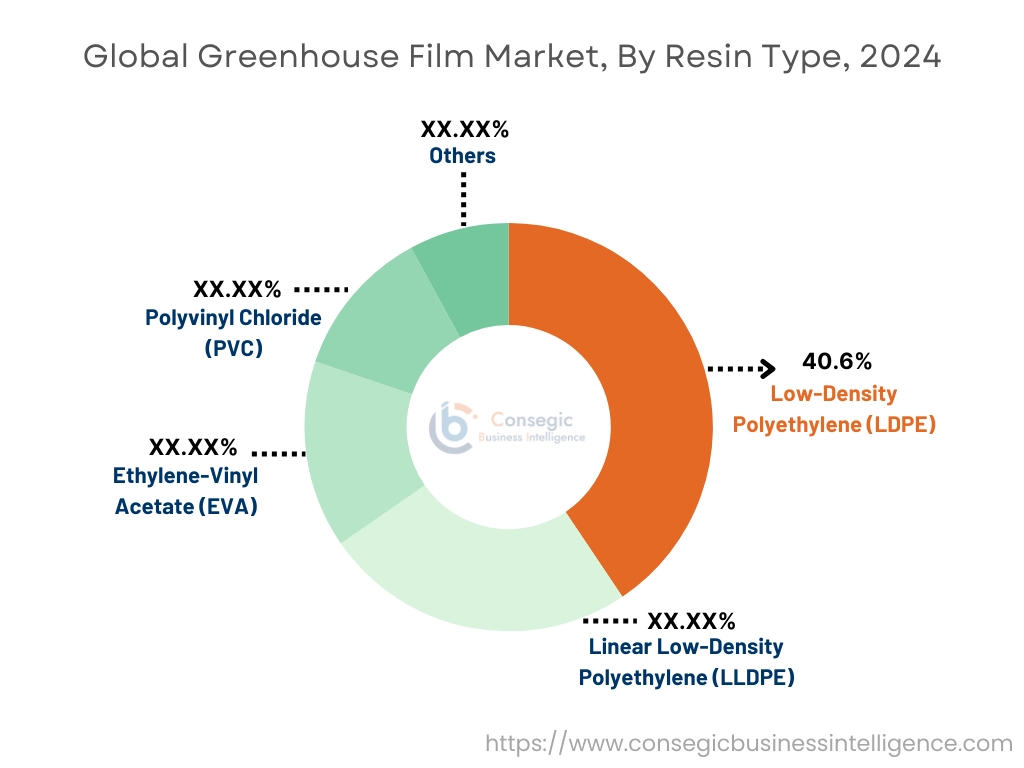
Based on Resin Type, the market is categorized into low-density polyethylene (LDPE), linear low-density polyethylene (LLDPE), ethylene-vinyl acetate (EVA), polyvinyl chloride (PVC), and others.
The low-density polyethylene (LDPE) segment holds the largest revenue of the overall Greenhouse Film Market share of 40.6% in the year 2024.
- LDPE greenhouse films are flexible, transparent or translucent, and durable polyethylene films of low density that trap heat and moisture from the environment, promoting plant growth.
- They are widely used due to their excellent light transmission, chemical resistance, and cost-effectiveness allow producers to largely rely on these films for greenhouses.
- For instance, in June 2024, Baystar, introduced Borstar performance resins to greenhouse films. Borstar technology delivers unique and broad molecular weight distribution of polyethylene copolymers, that allows better durability and increased toughness, reducing carbon footprint of the complete greenhouse area.
- Additionally, these films are widely preferred by farmers for agricultural purposes in regions of Asia-Pacific and Europe.
- As per greenhouse film market analysis, due to the balanced characteristics of efficiency and affordability, LDPE films contribute to the largest revenue share of the greenhouse film market.
The ethylene-vinyl acetate (EVA) segment is expected to grow at the fastest CAGR during the forecast period.
- EVA greenhouse films, or ethylene-vinyl acetate films are thick, durable, completely resistant to UV light, absorb infrared radiation and reduce heat loss.
- These films are preferred for their elasticity and resistance to cracking, especially under fluctuating temperature and humidity conditions.
- Furthermore, technological advancements have enabled EVA blends to incorporate UV stabilizers, infrared (IR) blockers, and anti-mist properties for year-round crop cultivation.
- For instance, in March 2024, J. Heute Greenhouses, constructed two high-tech greenhouses in South America. These ultra-advanced structures are well-equipped with advanced EVA plastic covering with high thermal efficiency, trapping optimal heat into the greenhouse.
- With increasing focus on season extension and crop yield optimization, EVA films are rapidly gaining traction across climate-sensitive agricultural segments, fueling the global greenhouse film market growth.
By Thickness Range:
Based on Thickness Range, the market is categorized into up to 100 microns, 100–200 microns, and above 200 microns
The 100-200 microns segment holds the largest revenue of the market share in the year 2024.
- The greenhouse films of 100-200 microns thickness provide the users with efficient insulation, durability, additional features like anti-drip, anti-dust, and better light diffusion within the greenhouse.
- They protect crops from sudden changes in weather and maintain the microclimate of the greenhouse.
- Additionally, they are widely employed in commercial settings like tunnel structures in horticulture and floriculture applications, with standardized parameters aligning to the global standards.
- According to the greenhouse film market analysis, the high efficiency, durable nature, and suitability to different climates is driving the progress of the 100-200 microns segment.
The above 200 microns segment is expected to grow at the fastest CAGR during the forecast period.
- The above 200 microns films deliver better mechanical strength and insulation and provide better protection from environmental stresses like heavy winds and extreme snow- and rainfall.
- The thick film acts as a barrier to dust, pests, and intense heat, giving rise to significantly improved crop health and reduced use of pesticides.
- Additionally, they are usually employed in advanced greenhouses where durability and long service life are essential for continuous cultivation and ROI protection.
- Therefore, as per the market analysis, high-performance, long-lasting films that reduce replacement intervals and maintenance costs, are significantly driving the market.
By Functions:
Based on functions, the market is categorized into Diffused films, UV-blocking films, Anti-dirt films, and others.
The UV-blocking films segment accounted for the largest revenue of the overall market share in the year 2024.
- UV-blocking films prevent harmful ultraviolet rays from entering the greenhouse, protecting plants from stress, photobleaching, and pest-related issues, while also improving working conditions for laborers.
- Additionally, UV stabilization enhances the longevity of plastic films by preventing degradation and brittleness, especially in regions with high solar intensity.
- For instance, in January 2025, J. Huete Greenhouses announced the completion of their largest greenhouse project in Southern Europe. These 15-hectare gothic style greenhouses are equipped with UV-protected plastic coatings, motorized roll-up doors, energy-efficient screens, air conditioning systems and a complete electrical system.
- As per greenhouse film market trends, the widespread application, need for protection of crops, and enhanced durability of films, significantly fuel the market growth.
The diffused films segment is expected to grow at the fastest CAGR during the forecast period.
- Diffused light films aid in scattering sunlight and uniform light diffusion, reducing hot spots and promoting plant growth.
- These films play a vital role in reducing localized heating, lowering the risk of leaf burning, and encouraging more uniform plant development, especially in densely packed cultivation systems.
- Additionally, these films are commonly used in tropical and sub-tropical regions, where the high intensity of sunlight needs to be controlled to promote crop yield.
- As per the market analysis, their versatile nature, suitability with multiple structures, and wide application in commercial sectors significantly boost the global greenhouse film market expansion.
By Application:
Based on application, the market is categorized into fruits, vegetables, flowers, and ornamentals.
The Vegetables segment accounted for the largest revenue of the Greenhouse Film Market share in the year 2024.
- Greenhouse films are most widely used in cultivation of vegetables due to the high sensitivity of crops like tomatoes, cucumbers, bell peppers, and lettuce to environmental fluctuations.
- These crops need regulated conditions, like humidity, temperature, and sunlight for proper yield and quality, which is effectively controlled by the greenhouse films.
- Additionally, frequent cultivation cycles and the rowing focus on pesticide-free produce further promote the adoption of greenhouse films in vegetable farming.
- For instance, in December 2024, BrightFarms, a pioneer in indoor farming industry, opened the first greenhouse in Texas. The greenhouse is equipped with cutting-edge cooling technology, the KUBO’s Ultra-Clima system which will allow the farm to produce greens in controlled growing conditions throughout the year.
- Therefore, growing commercialization of vegetables and their enhanced yield poses a viable application within the global greenhouse film market.
The Flowers segment is expected to grow at the fastest CAGR during the forecast period.
- Flower crops like roses, carnations, gerberas, and lilies are highly sensitive to light intensity, temperature, and disease control—conditions that are effectively managed using specialty greenhouse films.
- Anti-drip, UV-blocking, and light-diffusing films help ensure optimal flowering, improved color vibrancy, and extended shelf life, which are critical for market acceptance.
- Furthermore, shifting trend of consumer preferences toward decorative horticulture and events-based floristry has significantly scaled flower production.
- As per the market analysis, floriculture using greenhouse films is expanding rapidly due to rising demand for premium cut flowers and ornamental plants in domestic and export markets, in turn driving the market expansion.
Regional Analysis:
The regions covered are North America, Europe, Asia Pacific, Middle East and Africa, and Latin America.
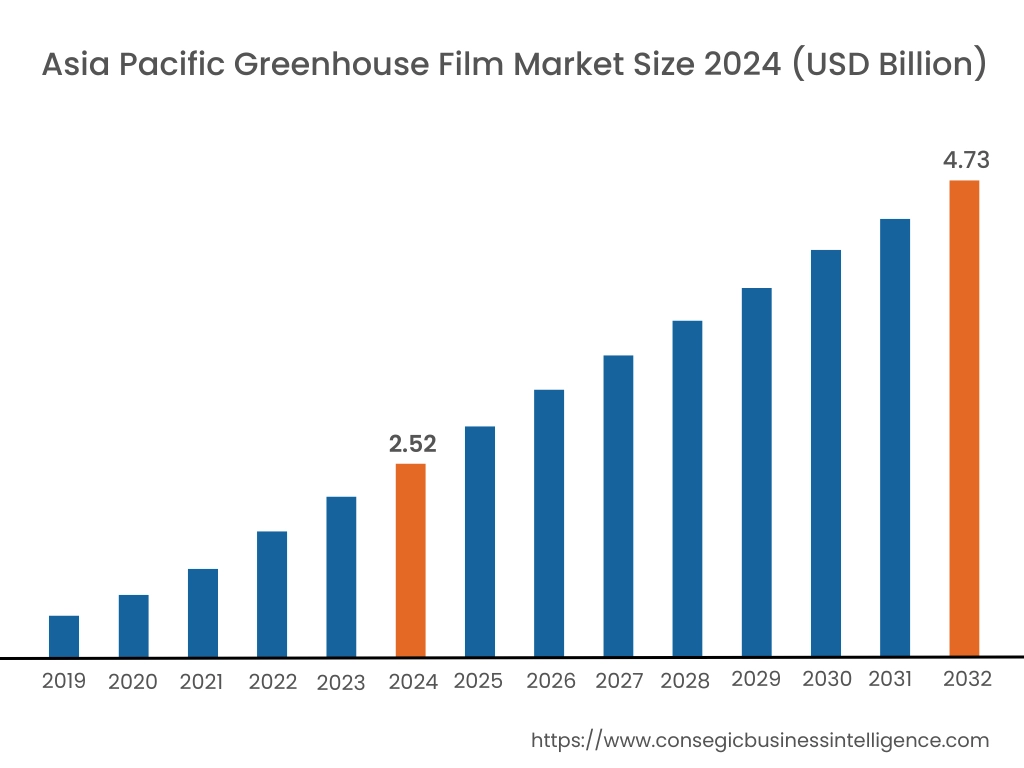
Asia Pacific region was valued at USD 2.52 Billion in 2024. Moreover, it is projected to grow by USD 2.68 Billion in 2025 and reach over USD 4.73 Billion by 2032. Out of this, China accounted for the maximum revenue share of 44.8%.
The Asia-Pacific region is greatly influenced by the growing infrastructure and the need for agricultural practices in densely populated regions. Additionally, the growing technological advances in greenhouse films offering superior durability and performance under varying climatic conditions has significantly driven the greenhouse film market demand.
- For instance, in October 2024, IPB University, Indonesia inaugurated the Smart Greenhouse and Plant Factory development project in collaboration with several institutions from South Korea and Indonesia. The smart technology used in the plant includes dynamic lighting technology, a quantum dot film and temperature control.
Furthermore, new policies and R&D expenditure led by the government and the implementation of modern agricultural practices are rapidly fueling the market trends in this region.

North America is estimated to reach over USD 4.15 Billion by 2032 from a value of USD 2.23 Billion in 2024 and is projected to grow by USD 2.37 Billion in 2025.
In North America, the market is influenced by the rising trend in sustainability and evolving agricultural landscape. Additionally, the rising focus on innovations in greenhouse films to improve film durability and enhanced light transmission properties, which are critical for optimizing crop yields in controlled environments has further fueled the market growth.
- For instance, M. Leonard and Ginegar have collaborated for over two decades, providing professional and premium-grade greenhouse films. These films constitute unique properties that make them fit for crop protection, boosting plant development, and catering to a variety of crops.
Furthermore, the regional analysis depicts that the shifting trend of consumer preferences toward specialized crops and organic produce and the rising environmentally friendly farming practices has driven the greenhouse film market size in this region.
Europe exhibits a strong presence in the market due to the growing importance of sustainable and eco-friendly greenhouse films that enhance thermal insulation while minimizing energy losses. Additionally, the initiatives taken by government agencies to reduce carbon footprints and Adherence to stringent environmental regulations have further fueled the market growth.
The Greenhouse Film Market in the Middle East and Africa experiences steady development mainly due to the extreme climate conditions in regions including UAE, Saudi Arabia, and Egypt. The manufacturers of greenhouse films strive to focus on producing films that are designed to optimize water usage and protect crops from harsh environmental factors. Additionally, investments in films that provide UV protection and thermal regulation along with other customizations to suit the local climate and soil conditions support significant market trends. Furthermore, the increasing focus on sustainable development and crop protection have fueled market growth.
Latin America witnesses growing focus on modern agriculture techniques and improving crop productivity, thereby boosting the adoption of greenhouses. Additionally, the increasing focus on cutting-edge innovations in greenhouse films and utilization of high-performance films designed to operate effectively in diverse climatic conditions fuel the market in this region. Furthermore, the growing technological advancements and strategies to implement sustainable development are substantially driving the greenhouse film industry.
Top Key Players & Market Share Insights:
The Greenhouse Film Market is highly competitive with major players providing products and services to the national and international markets. Key players are adopting several strategies in research and development (R&D), product innovation, and end-user launches to hold a strong position in the global Greenhouse Film Market. Key players in the greenhouse film industry include –
- Ginegar Plastic Products Ltd. (Israel)
- Plastika Kritis S.A. (Greece)
- RKW Group (Germany)
- Essen Multipack Limited (India)
- Polifilm Group (Germany)
- Lumite Inc. (USA)
- FarmTek (USA)
- Thai Charoen Thong Karntor Co. Ltd. (Thailand)
- Agripolyane (France)
- Fvg Folien Vertriebs GmbH (Germany)
Recent Industry Developments :
Product Launches:
- In November 2023, UbiQD, launched a new roofing product, UbiGro Cover. It is a type of fluorescent film made with UbiQD’s quantum dot technology that aids in increasing the photosynthetic efficiency of the greenhouse glass.
Greenhouse Film Market Report Insights:
| Report Attributes | Report Details |
| Study Timeline | 2019-2032 |
| Market Size in 2032 | USD 14.09 Billion |
| CAGR (2025-2032) | 8.1% |
| By Resin Type |
|
| By Thickness Range |
|
| By Function |
|
| By Application |
|
| By Region |
|
| Key Players |
|
| North America | U.S. Canada Mexico |
| Europe | U.K. Germany France Spain Italy Russia Benelux Rest of Europe |
| APAC | China South Korea Japan India Australia ASEAN Rest of Asia-Pacific |
| Middle East and Africa | GCC Turkey South Africa Rest of MEA |
| LATAM | Brazil Argentina Chile Rest of LATAM |
| Report Coverage |
|
Key Questions Answered in the Report
How big is the Greenhouse Film Market? −
Greenhouse Film Market size is estimated to reach over USD 14.09 Billion by 2032 from a value of USD 7.58 Billion in 2024 and is projected to grow by USD 8.06 Billion in 2025, growing at a CAGR of 8.1% from 2025 to 2032.
What specific segments are covered in the Greenhouse Film Market? +
The Greenhouse Film Market specific segments are Resin Type, Thickness Range, Function, Application, and Region.
Which is the fastest-growing region in the Greenhouse Film Market? +
Asia pacific is the fastest growing region in the Greenhouse Film Market.
What are the major players in the Greenhouse Film Market? +
The key players in the Greenhouse Film Market are Ginegar Plastic Products Ltd. (Israel), Plastika Kritis S.A. (Greece), RKW Group (Germany), Essen Multipack Limited (India), Lumite Inc. (USA), Thai Charoen Thong Karntor Co. Ltd. (Thailand), Agripolyane (France), Fvg Folien Vertriebs GmbH (Germany), FarmTek (USA), Polifilm Group (Germany), and others.
Overview
Reputation & Certifications


Our Services
- Market Intelligence & Forecasting
- Custom Research Solutions
- Market Entry Strategy
- Competitive Intelligence
- Customer Insights
- Industry Innovation Analysis
- Investment Advisory