Jump to Content
Poultry Brooders, Feeders, And Waterers Market - Size, Share, Industry Trends, and Forecasts (2025-2032)
Poultry Brooders, Feeders, And Waterers Market Size:
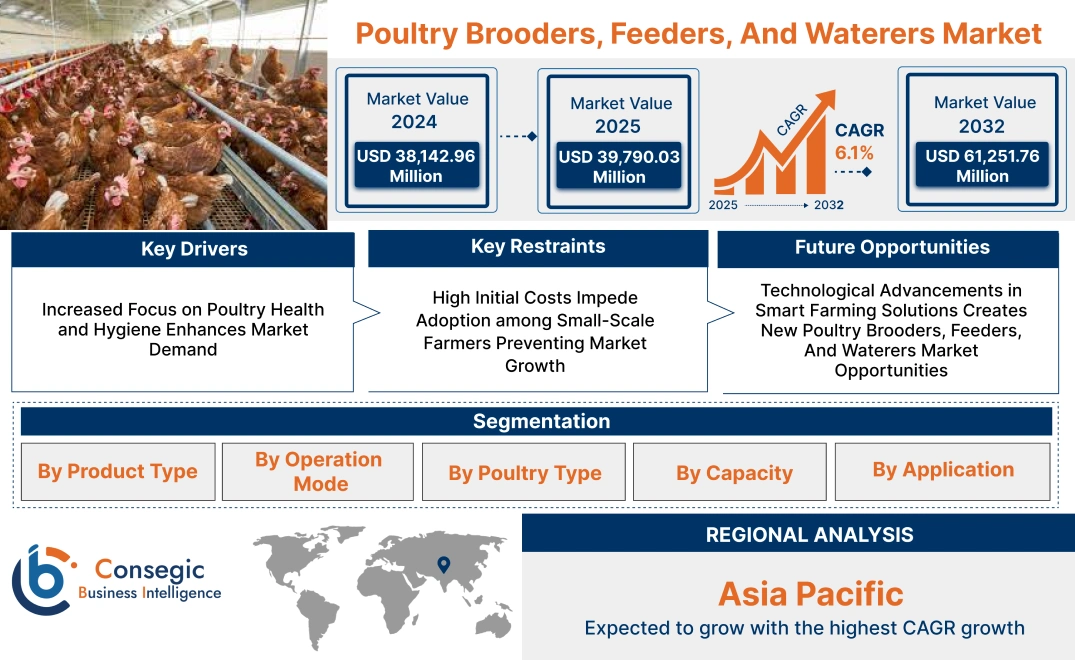
Poultry Brooders, Feeders, And Waterers Market size is estimated to reach over USD 61,251.76 Million by 2032 from a value of USD 38,142.96 Million in 2024 and is projected to grow by USD 39,790.03 Million in 2025, growing at a CAGR of 6.1% from 2025 to 2032.
Poultry Brooders, Feeders, And Waterers Market Scope & Overview:
Poultry brooders, feeders, and waterers are essential equipment designed to ensure optimal care and feeding for poultry in various farming operations. These products provide controlled heating, efficient feed distribution, and clean water supply, promoting healthy growth and reducing waste. Poultry brooders are used to maintain optimal temperatures for chicks during their early development stages. Feeders are designed to evenly distribute feed while minimizing spillage and contamination. Waterers ensure a consistent and hygienic water supply, critical for the health of poultry.
The benefits of these solutions include improved productivity, reduced labor requirements, and enhanced hygiene. They support the efficient management of large-scale poultry operations by ensuring consistent care. Applications of these products span across commercial poultry farming, backyard poultry rearing, and hatcheries. The end-use industries include agriculture, animal husbandry, and specialized poultry farming businesses. These products are integral to modern poultry farming practices, ensuring better outcomes and streamlined operations.
Poultry Brooders, Feeders, And Waterers Market Dynamics - (DRO) :
Key Drivers:
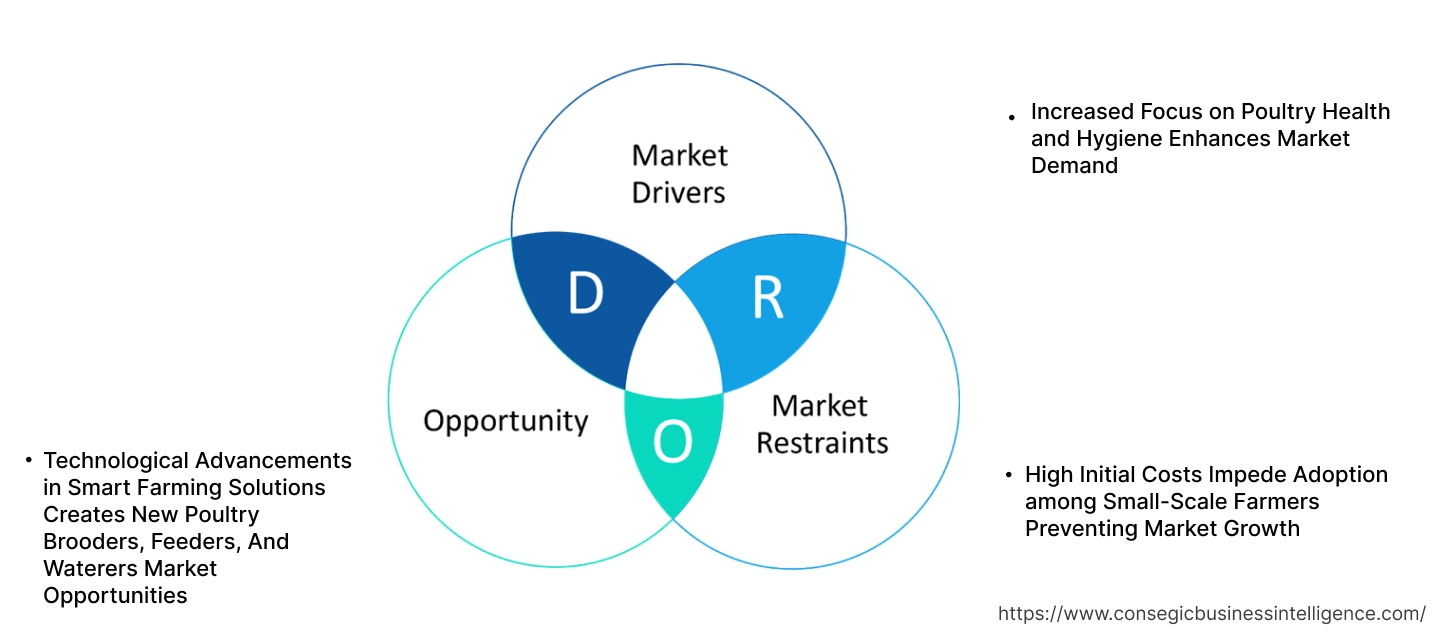
Increased Focus on Poultry Health and Hygiene Enhances Market Demand
Maintaining optimal health and hygiene in poultry farming is crucial to prevent disease outbreaks and improve productivity. Poultry brooders, feeders, and waterers provide controlled environments and precise feeding mechanisms that reduce contamination risks and ensure uniform growth. For example, automated feeders minimize feed spillage, reducing the risk of feed spoilage and contamination, which are common causes of bacterial infections in poultry.
Thus, the growing emphasis on poultry health and hygiene bolsters the adoption of advanced equipment, supporting market growth.
Key Restraints:
High Initial Costs Impede Adoption among Small-Scale Farmers Preventing Market Growth
The advanced design and technology of modern poultry brooders, feeders, and waterers come with high initial investment costs. These expenses include the procurement, installation, and setup of the equipment, which can be prohibitively expensive for small-scale farmers. For instance, automated feeding systems, while efficient, require significant upfront investment that many small-scale farmers cannot afford, forcing them to rely on manual feeding practices.
Therefore, the high cost of advanced poultry equipment limits its adoption among small-scale farmers, restraining the market growth.
Future Opportunities :
Technological Advancements in Smart Farming Solutions Creates New Poultry Brooders, Feeders, And Waterers Market Opportunities
The integration of IoT and AI technologies in poultry equipment is set to revolutionize the market. Future innovations in brooders, feeders, and waterers will enable real-time monitoring of temperature, humidity, and feed levels, allowing farmers to optimize poultry rearing conditions. For instance, smart feeders with AI-based sensors will automatically adjust feed distribution based on poultry behavior, improving feed efficiency and reducing wastage.
As smart farming solutions gain traction, they will create significant poultry brooders, feeders, and waterers market growth opportunities in the near future.
Poultry Brooders, Feeders, And Waterers Market Segmental Analysis :
By Product Type:
Based on product type, the poultry brooders, feeders, and waterers market is segmented into brooders, feeders, and waterers.
The feeder segment accounted for the largest revenue in poultry brooders, feeders, and waterers market share in 2024 and is anticipated to register the fastest CAGR during the forecast period
- Feeders are designed to provide poultry with a consistent supply of feed, ensuring proper nutrition and growth.
- The poultry brooders, feeders, and waterers market trend for feeders is driven by the increasing adoption of automated systems that enhance efficiency and reduce labor costs.
- Innovations such as adjustable feeders, designed to accommodate different sizes of poultry, and enhanced materials to minimize feed wastage, are also contributing to the market’s growth.
- Additionally, feeders are increasingly used in both small-scale and commercial poultry farms, where scalability and ease of operation are crucial.
- As poultry farming becomes more mechanized, the feeder segment is expected to expand in revenue.
- Therefore, according to poultry brooders, feeders, and waterers market analysis, the feeder segment holds the largest revenue share due to its critical role in maintaining poultry health and ensuring consistent feed supply. The market is expected to continue growing as automation and innovations drive greater efficiency in poultry farming.
The waterer segment is anticipated to register the fastest CAGR during the forecast period.
- Waterers are essential in providing clean and consistent water to poultry.
The development of automated waterers and nipple drinkers is gaining momentum, addressing the challenges of water wastage and contamination. - Innovations such as self-regulating systems that adjust the water flow based on the bird’s consumption levels are expected to fuel the segment's growth.
- These systems contribute to better poultry health by providing constant access to clean water, reducing disease risk, and enhancing production efficiency.
- Thus, according to poultry brooders, feeders, and waterers market analysis, waterers are anticipated to grow rapidly due to the increasing poultry brooders, feeders, and waterers market demand for automated systems that ensure optimal water supply to poultry while improving health and reducing labor.
By Operation Mode:
Based on operation mode, the market is segmented into automatic, manual, and semi-automatic systems.
The automatic operation mode accounted for the largest revenue in poultry brooders, feeders, and waterers market share in 2024 and is anticipated to register the fastest CAGR during the forecast period.
- Automatic systems are designed to reduce labor costs and improve operational efficiency.
- These systems are preferred in commercial poultry farming due to their ability to operate continuously without human intervention, minimizing errors and maximizing output.
- Automated systems are also highly scalable and customizable, making them ideal for large-scale operations.
- The growing adoption of smart farming technologies and the Internet of Things (IoT) further drives the demand for automatic systems in the poultry farming sector.
- Therefore, according to market analysis, the automatic operation mode continues to dominate the market, offering significant advantages in terms of cost efficiency and operational ease, making it the preferred choice for commercial poultry farms.
By Poultry Type:
Based on poultry type, the market is segmented into chicken, turkey, duck, and other poultry.
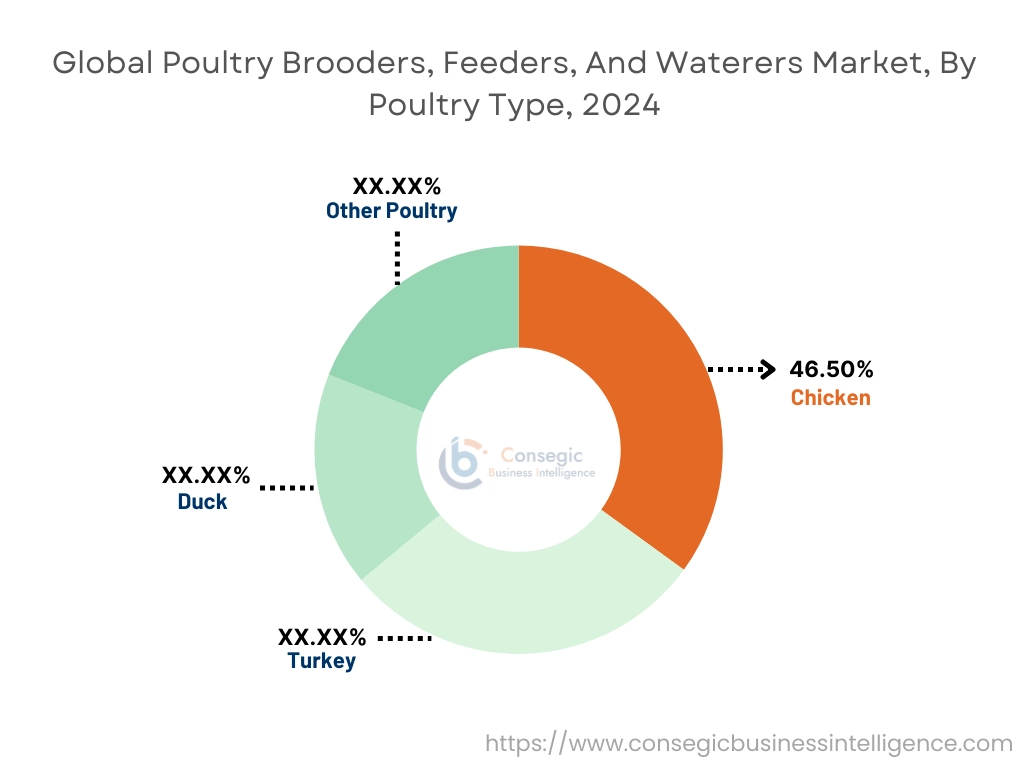
The chicken segment accounted for the largest revenue share by 46.50% in 2024 and is anticipated to register the fastest CAGR during the forecast period.
- Chicken farming is the most common type of poultry farming worldwide, driven by both broiler and egg production.
- Equipment used for chickens must cater to their size and behavior, ensuring that feeding, watering, and heating systems are optimized for their needs.
- The large scale of chicken farming operations and the trend for high-efficiency systems are responsible for driving poultry brooders, feeders, and waterers market growth in this segment.
- Thus, according to market analysis, the chicken segment holds the largest revenue share and is poised for significant growth due to its prominence in global poultry farming and the increasing demand for automated and efficient farming solutions.
By Capacity:
Based on capacity, the market is segmented into small capacity (up to 50 birds), medium capacity (50-500 birds), and large capacity (over 500 birds).
The large capacity segment accounted for the largest revenue share in 2024 and is anticipated to register the fastest CAGR during the forecast period.
- Large-scale poultry farms require equipment that can support high numbers of birds, with systems that ensure efficient feed and water supply, heating, and overall care for the poultry.
- The growing demand for poultry products worldwide and the shift towards industrialized farming models are driving the trend for high-capacity brooders, feeders, and waterers.
- Additionally, advancements in technology have made it easier for large-scale operations to adopt automated systems that improve efficiency and reduce operational costs.
- Therefore, according to market analysis, the large capacity segment is expected to continue dominating the market, driven by the increasing shift towards commercial poultry farming and the need for scalable, automated solutions.
By Application:
Based on application, the market is segmented into broiler production, layer production, and breeder production.
The broiler production segment accounted for the largest revenue share in 2024 and is anticipated to register the fastest CAGR during the forecast period.
- Broiler production requires optimized feeding, heating, and watering systems to ensure that poultry grow quickly and healthily.
- The growing global trend for chicken meat and the expansion of large-scale poultry farms are key drivers for the broiler production segment.
- Additionally, the focus on improving feed conversion ratios and minimizing disease outbreaks in broiler production is pushing the adoption of advanced poultry equipment.
- Thus, according to market analysis, broiler production remains the largest revenue-generating segment, and its growth is expected to accelerate as demand for poultry meat continues to rise, fostering the adoption of efficient farming equipment.
Regional Analysis:
The regional segment includes North America, Europe, Asia Pacific, Middle East and Africa, and Latin America.
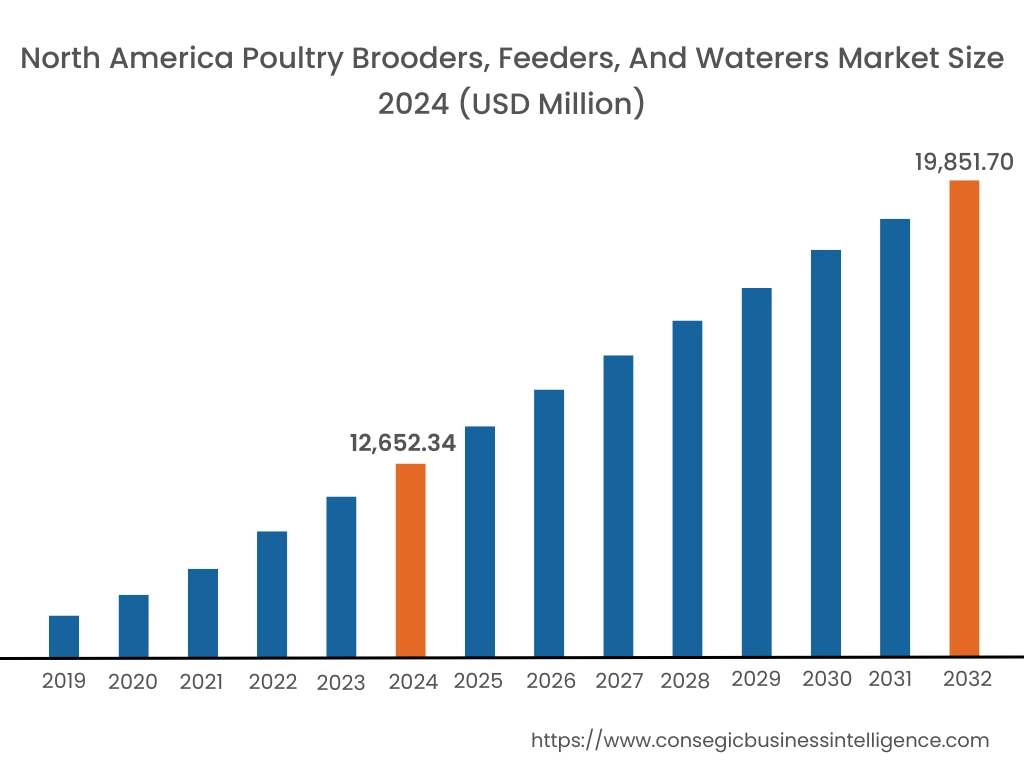
In 2024, North America was valued at USD 12,652.34 Million and is expected to reach USD 19,851.70 Million in 2032. In North America, the U.S. accounted for the highest share of 74.30% during the base year of 2024.
North America holds a significant share of the poultry brooders, feeders, and waterers market, driven by the region’s advanced poultry farming industry. The United States leads the market, with a strong focus on automated systems for poultry management. Poultry brooders, feeders, and waterers market demand for efficient, energy-saving equipment is high among large-scale poultry producers. Government regulations and initiatives supporting sustainable farming practices further bolster market growth.

In Asia Pacific, the market is experiencing the fastest growth with a CAGR of 6.5% over the forecast period.
The Asia-Pacific region shows promising potential in the poultry brooders, feeders, and waterers market. Countries like China, India, and Thailand are seeing an increase in poultry consumption and production. As the trend for poultry products rises, the need for efficient poultry farming equipment also intensifies. Adoption of automated systems is accelerating as farmers aim to improve productivity and reduce labor costs.
Europe demonstrates steady growth in the poultry equipment market. Countries such as France, Germany, and the United Kingdom prioritize animal welfare and sustainability in poultry farming. Stringent regulations surrounding poultry management and increasing consumer demand for high-quality products drive the need for modern brooders, feeders, and waterers. Technological advancements in automated systems are in trend among commercial poultry farms.
In the Middle East and Africa, the poultry brooders, feeders, and waterers market is expanding, particularly in countries with growing poultry industries like South Africa, Egypt, and Saudi Arabia. Poultry brooders, feeders, and waterers market trend for poultry products is rising as the population grows, prompting investments in more efficient poultry farming equipment. However, challenges related to infrastructure and financing hinder widespread adoption of advanced equipment.
Latin America shows a growing trend for poultry equipment, particularly in Brazil and Argentina, where large-scale poultry farming is prevalent. The need for efficient and cost-effective poultry management tools drives poultry brooders, feeders, and waterers market expansion. As the trend for poultry products increases, farmers are investing in modern brooders, feeders, and waterers to optimize production and ensure better animal welfare.
Top Key Players & Market Share Insights:
The Global Poultry Brooders, Feeders, And Waterers Market is highly competitive with major players providing products and services to the national and international markets. Key players are adopting several strategies in research and development (R&D), product innovation, and end-user launches to hold a strong position in the Global Poultry Brooders, Feeders, And Waterers Market. Key players in the Poultry Brooders, Feeders, And Waterers industry include-
- Chore-Time Brock (United States)
- Plasson Ltd. (Israel)
- Skov A/S (Denmark)
- S.I.P. (Società Italiana Plastici) (Italy)
- GSI Group (United States)
- Big Dutchman (Germany)
- FarmTek (United States)
- Petersime (Belgium)
- Valli Srl (Italy)
- Aviagen (United States)
Recent Industry Developments :
Product Launches:
- In August 2023, Denvik Technology Pvt Ltd., an India-based company, introduced IoT-based smart solutions for poultry farms. These solutions enable farmers to monitor and manage operations more effectively, leading to optimal growth and reduced disease risk.
Poultry Brooders, Feeders, And Waterers Market Report Insights:
| Report Attributes | Report Details |
| Study Timeline | 2019-2032 |
| Market Size in 2032 | USD 61,251.76 Million |
| CAGR (2025-2032) | 6.1% |
| By Product Type |
|
| By Operation Mode |
|
| By Poultry Type |
|
| By Capacity |
|
| By Application |
|
| By Region |
|
| Key Players |
|
| North America | U.S. Canada Mexico |
| Europe | U.K. Germany France Spain Italy Russia Benelux Rest of Europe |
| APAC | China South Korea Japan India Australia ASEAN Rest of Asia-Pacific |
| Middle East and Africa | GCC Turkey South Africa Rest of MEA |
| LATAM | Brazil Argentina Chile Rest of LATAM |
| Report Coverage |
|
Key Questions Answered in the Report
How big is the Poultry Brooders, Feeders, And Waterers Market? −
In 2024, the Poultry Brooders, Feeders, And Waterers Market was USD 38,142.96 million.
What will be the potential market valuation for the Poultry Brooders, Feeders, And Waterers Market by 2032? +
In 2032, the market size of Poultry Brooders, Feeders, And Waterers Market is expected to reach USD 61,251.76 million.
What are the segments covered in the Poultry Brooders, Feeders, And Waterers Market report? +
The product type, operation mode, poultry type, capacity, and application are the segments covered in this report.
Who are the major players in the Poultry Brooders, Feeders, And Waterers Market? +
Chore-Time Brock (United States), Plasson Ltd. (Israel), Big Dutchman (Germany), FarmTek (United States), Petersime (Belgium), Valli Srl (Italy), Aviagen (United States), Skov A/S (Denmark), S.I.P. (Società Italiana Plastici) (Italy), GSI Group (United States) are the major players in the Poultry Brooders, Feeders, And Waterers market.
Overview
Reputation & Certifications


Our Services
- Market Intelligence & Forecasting
- Custom Research Solutions
- Market Entry Strategy
- Competitive Intelligence
- Customer Insights
- Industry Innovation Analysis
- Investment Advisory