Jump to Content
Home Audio Equipment Market - Size, Share, Industry Trends, and Forecasts (2025-2032)
Home Audio Equipment Market Size:
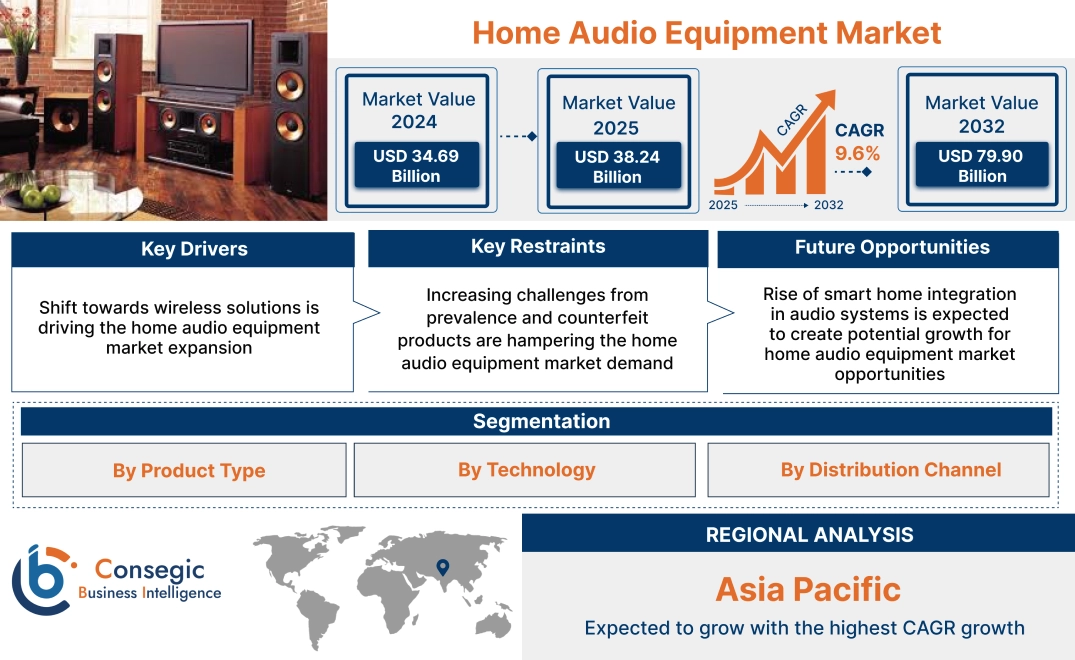
Home Audio Equipment Market Size is estimated to reach over USD 79.90 Billion by 2032 from a value of USD 34.69 Billion in 2024 and is projected to grow by USD 38.24 Billion in 2025, growing at a CAGR of 9.6% from 2025 to 2032.
Home Audio Equipment Market Scope & Overview:
Home audio equipment includes various devices aimed at improving audio experiences in residential environments, such as speakers, soundbars, amplifiers, and home theater systems. Technological advancements like wireless connectivity, voice recognition, and high-definition audio formats have transformed the industry, providing consumers with unmatched convenience and enhanced sound quality. Further, rising disposable incomes, especially in emerging economies, have driven the need for premium audio solutions as consumers focus on entertainment and home improvement spending. The trend towards smart homes has further accelerated the global market, with consumers increasingly incorporating audio equipment into smart home systems for effortless control and improved functionality. This integration of audio technology with IoT (Internet of Things) capabilities has resulted in a significant increase in need for connected devices that provide versatile and intuitive user experiences.
Home Audio Equipment Market Dynamics - (DRO) :
Key Drivers:
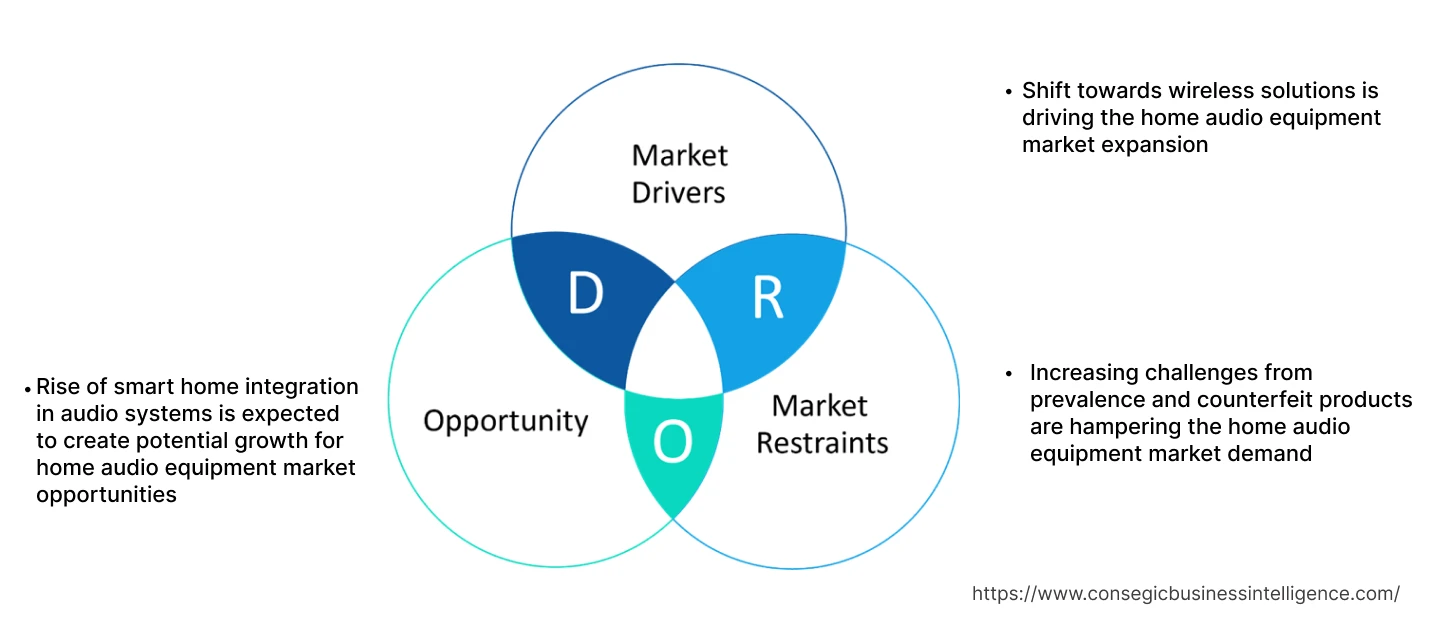
Shift towards wireless solutions is driving the home audio equipment market expansion
The transition to wireless solutions is a notable trend in the home audio equipment market, fueled by advancements in wireless communication technologies and evolving consumer preferences. Traditional wired systems are increasingly being replaced by wireless options due to their convenience and flexibility. Consumers appreciate the straightforward setup and installation that wireless speakers and sound systems provide, eliminating the hassle of cumbersome cables and facilitating seamless integration into contemporary home environments. Additionally, the growth of wireless standards like Bluetooth and Wi-Fi has enhanced the functionality of home audio systems. Wireless speakers can now connect effortlessly to various devices, including smartphones, tablets, and smart TVs, enabling diverse usage scenarios throughout the home. This flexibility not only improves user experience but also aligns with the rising trend of smart home ecosystems, where interconnected devices can be managed and coordinated through central hubs or mobile apps.
- For instance, in March 2023, Sonos introduced two new speakers, the Era 100 and Era 300, which offer multi-room audio, Bluetooth, and USB-C line-in. The Era 300 includes Dolby Atmos Spatial Audio, while the Era 100 is designed to replace the well-liked Sonos One.
Thus, according to the home audio equipment market analysis and trends, the advancement in wireless solutions is driving the home audio equipment market size.
Key Restraints:
Increasing challenges from prevalence and counterfeit products are hampering the home audio equipment market demand
Unauthorized dealers sell counterfeit versions of well-known brands such as Sony, JBL, and SAMSUNG. Vendors provide tutorials to help identify these fakes, but the problem adversely affects original concepts and profits. Additionally, counterfeit products often utilize inferior components and manufacturing methods, leading to poor sound quality, decreased durability, and an increased likelihood of malfunction. Moreover, counterfeit items damage the reputation of legitimate brands, as consumers may link negative experiences to the authentic brand, even if they unknowingly bought a fake. Thus, the above factors are affecting the home audio equipment market growth.
Future Opportunities :
Rise of smart home integration in audio systems is expected to create potential growth for home audio equipment market opportunities
The rise of voice assistants, like Amazon Alexa and Google Assistant, has emerged as a significant trend. Consumers are increasingly seeking audio systems that integrate effortlessly with other smart devices, facilitating cohesive smart home management. This demand has spurred growth in products that offer voice control and compatibility with smart home technology, allowing users to manage music, smart appliances, and connected devices using simple voice commands. Consequently, manufacturers and consumers face growing challenges. This trend has inspired the creation of smart audio systems tailored for optimal integration within smart home ecosystems. Additionally, brands are partnering with smart home solution providers to develop interoperable devices, further promoting adoption.
- For instance, in May 2023, Amazon announced the sale of 500 billion Alexa devices, highlighting the increasing consumer preference for voice-controlled technology.
Thus, based on the above analysis and trends, technological advancements in audio systems are driving the home audio equipment market opportunities.
Home Audio Equipment Market Segmental Analysis :
By Product Type:
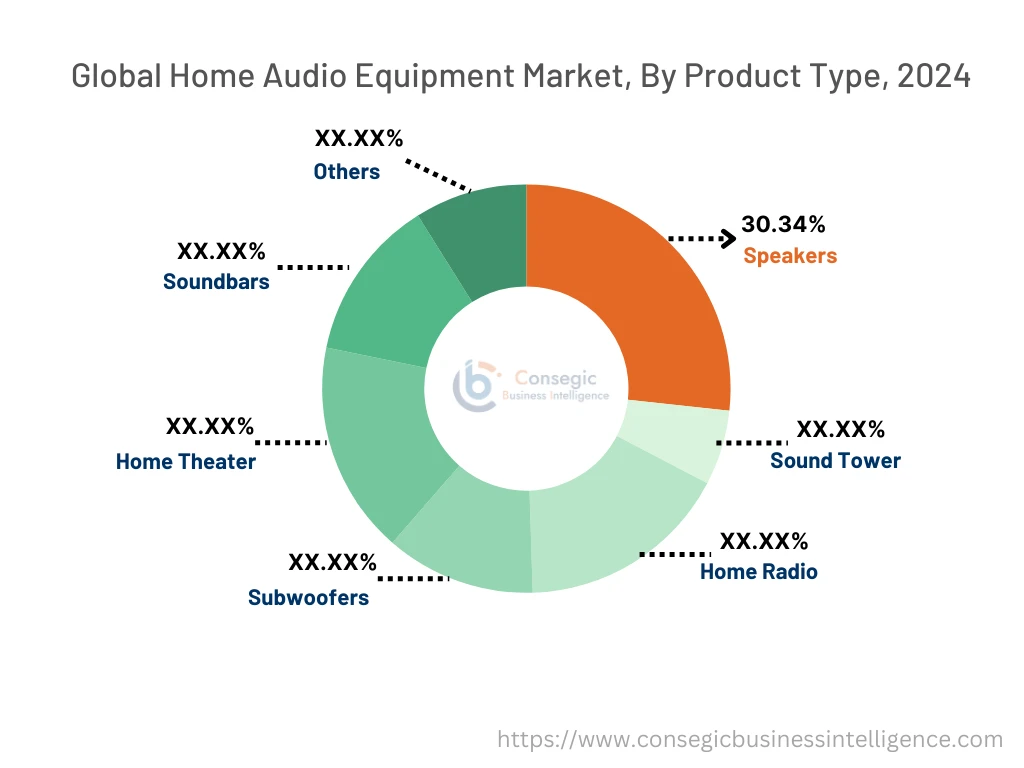
Based on product type, the home audio equipment market is segmented into home theater, soundbars, speakers, sound tower, home radio, subwoofers, and others
Trends in the product type:
- As lifestyles change and technology advances, people seek improved audio solutions that enhance their entertainment experiences and seamlessly integrate into their homes. This trend has led to a rise in various audio devices, including soundbars, wireless speakers, home theater systems, and multi-room audio setups.
- The demand for portable and lightweight electronic products is rapidly increasing among consumers, driving the growth of the home audio equipment market.
Speakers segment accounted for the largest revenue share of 30.34% in the year 2024.
- Home audio speakers and systems have significantly progressed in terms of innovation over the years. The emergence of smart devices and voice-controlled assistants like Google Home and Amazon Echo has enabled audio systems to incorporate voice control and smart home connectivity.
- Users can use voice commands to manage their audio systems, stream music from various platforms, and interact with different smart devices in their homes. Additionally, high-resolution audio formats, such as Free Lossless Audio Codec (FLAC) and Master Quality Authenticated (MQA), have become popular due to their superior sound quality compared to traditional compressed formats.
- For instance, in July 2024, JBL, a prominent brand of HARMAN, has launched JBL Modern Audio AV Receivers and Stage 2 Loudspeakers to enhance the home theater experience. These products feature straightforward installation and connectivity options for consumers and can be easily upgraded. The AV receivers come in four different models, while the loudspeakers offer five choices for customers.
- These trends and analysis in the smart audio devices would further drive the home audio equipment market size during the forecast period.
Home theater segment is anticipated to register the fastest CAGR during the forecast period.
- The segment growth can be attributed to the user-friendliness of this equipment. Home-Theater-in-a-Box systems (HTiB's) setup requires only a basic understanding of technology for installation and operation, with manufacturers providing detailed instructions and color-coded connections to simplify the process.
- This ease of setup typically attracts tech-savvy individuals or those who favour a plug-and-play system. HTiB caters to a wide range of customers seeking a well-organized home theater experience. It offers improved technology and functionality, including high-definition audio decoding, wireless connectivity, HDMI support, and compatibility with various media formats. These advancements have elevated the audiovisual experience provided by HTiB, enhancing its appeal among consumers.
- Thus, growing demand for high-performance home theater experiences would further drive the segment trends during the forecast period.
By Technology:
Based on technology, the home audio equipment market is segmented into wired and wireless.
Trends in technology:
- As smart home technology becomes increasingly common in households, consumers are seeking audio solutions that can be voice-controlled or seamlessly integrated into their existing home automation systems. This trend has prompted manufacturers to develop smart speakers equipped with built-in voice assistants, enabling users to interact with their audio devices and manage other smart devices in their homes using their voice.
- The fusion of audio technology with smart home applications is fostering significant development in the market, prompting major players in the audio equipment manufacturing sector to increase their investments in research and development.
Wireless segment accounted for the largest revenue share in the year 2024 and is expected to register the highest CAGR during the forecast period.
- Wireless audio systems frequently provide multi-room capability, allowing users to play synchronized audio across multiple areas or create separate audio zones.
- Users can stream audio to various parts of their home through wireless speakers connected to a centralized system or networked devices, enabling control of playback from a single device or app.
- The advancements in wireless audio technologies have led to better sound quality. High-quality wireless audio codecs like Lossless Digital Audio Codec (LDAC), aptX, and Advanced Audio Coding (AAC) deliver improved audio performance and reduced latency, enhancing the overall listening experience.
- For instance, in September 2024, Sennheiser announced Spectra bidirectional wireless system. It offers professionals compact and versatile wireless solution that deliver high channel counts with a single 1 RU base station transceiver as its core. This simplifies the task for technicians, eliminating the need to manage large racks of transmitters.
- Thus, trends and factors such as focus on advancements in wireless technologies would further supplement the global market during the forecast period.
By Distribution Channel:
Based on the distribution channel, the home audio equipment market is segmented into online and offline.
Trends in the distribution channel:
- Brick-and-mortar stores, such as electronics retailers and specialty audio shops, remain essential. They allow customers to experience products directly and obtain expert guidance.
- Certain manufacturers are progressively embracing direct-to-consumer strategies by selling through their own websites and physical locations. This method enables them to foster stronger brand connections and manage the customer experience.
- E-commerce platforms like Amazon, Flipkart, and Best Buy have emerged as leading distribution channels. They provide a vast selection of products, competitive pricing, and the convenience of home delivery, drawing in a significant consumer audience.
Online segment accounted for the largest revenue share in the year 2024 and is expected to register the highest CAGR during the forecast period.
- Home audio products are available for purchase through online marketplaces and e-commerce sites like Flipkart, eBay, Amazon.com, and Best Buy. These platforms provide a wide range of products, along with customer reviews and ratings, enabling consumers to explore and compare various options.
- They often offer these products at competitive prices and discounts, appealing to shoppers’ sensibilities. For instance, specialized online electronics retailers such as B&H Photo & Electronic Corp., Best Buy, and Crutchfield excel in marketing and selling in-home audio equipment.
- Thus, the global requirement for home audio systems across the online segment would further drive the home audio equipment market share during the forecast period.
Regional Analysis:
The regions covered are North America, Europe, Asia Pacific, the Middle East and Africa, and Latin America.
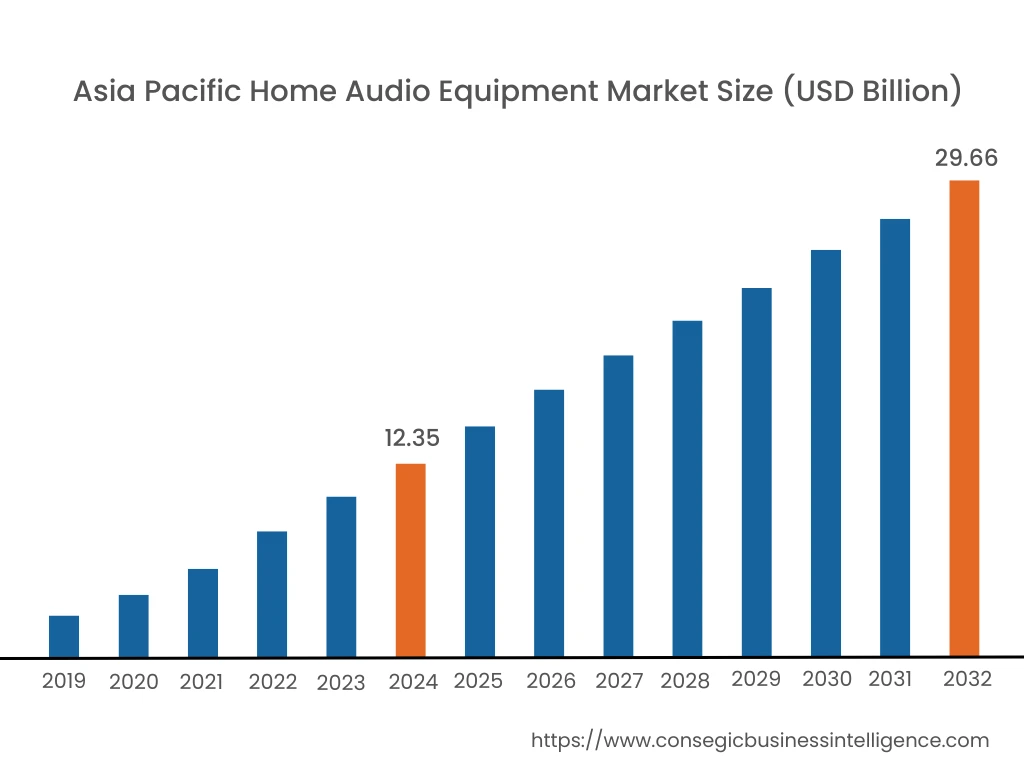
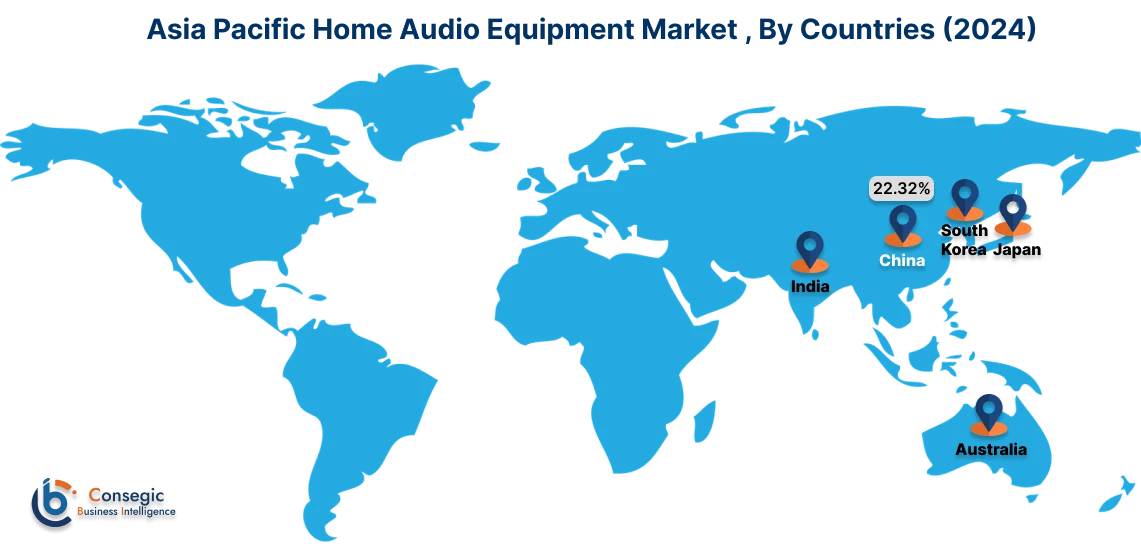
Asia Pacific home audio equipment market expansion is estimated to reach over USD 29.66 billion by 2032 from a value of USD 12.35 billion in 2024 and is projected to grow by USD 13.66 billion in 2025. Out of this, the Chinese market accounted for the maximum revenue split of 22.32%. As the need for wireless speakers rises, Bluetooth technology has gained significant popularity in the regional market due to its compatibility with various mobile devices, including iPhones and Android smartphones. Additionally, the advent of Bluetooth 5.0 has introduced a feature that allows audio playback on two connected devices simultaneously, enabling sound to be played from two separate speakers in different rooms. Furthermore, continuous advancements in soundbar technologies and the introduction of premium features such as 3D surround sound, virtual assistant integration, and multi-room audio support provide promising growth opportunities in the market. Moreover, collaborations between soundbar manufacturers and streaming service providers or gaming companies are fostering cross-industry synergies, improving product visibility and user engagement. These factors and analysis would further drive the regional home audio equipment market growth during the forecast period.
- For instance, in July 2024, LG Electronics India has launched its latest soundbar range for 2024. The new lineup includes five advanced models: the S77TY, SQ75TR, SG10Y, SQ70TY, and S65TR. Built to seamlessly integrate with LG TVs, these soundbars deliver outstanding sound quality and an elevated cinematic experience. With their robust audio performance, extensive features, and stylish designs, LG's new soundbars aim to transform home entertainment for enthusiasts throughout India.
North America market is estimated to reach over USD 19.33 billion by 2032 from a value of USD 8.53 billion in 2024 and is projected to grow by USD 9.39 billion in 2025. Advances in digital audio technology and changing consumer preferences from traditional to modern audio systems are anticipated to propel the regional market. Additionally, the increasing need for portable home audio equipment that can support USB drives and access high-quality audio content online is favorable for market development. To enhance their regional market presence, manufacturers of home audio equipment are creating more user-friendly and less visually intrusive audio systems. Further, the U. S. is home to notable audio equipment brands like Bose, Harman, and Dolby, which consistently offer high-quality audio devices for consumers. The existence of major retailers such as Amazon and Best Buy has facilitated effective market access for these innovative products. Key sales events, including Black Friday and Amazon Prime Day, see a considerable increase in sales of electronic devices, particularly home audio equipment. Additionally, the rising trend of adopting AI-driven interactive devices has fueled the need for smart home audio solutions. These factors and developments would further drive the regional home audio equipment market share during the forecast period.
- For instance, in January 2025, Samsung Electronics America introduced latest advancements in home audio equipment technology with the new Q series soundbars (HW-QS700F and HW-Q990F). These flagship models integrate cutting-edge hardware with smart AI-driven features, aimed at enhancing home entertainment with exceptional sound quality.
According to the home audio equipment industry analysis, the European market has seen robust progression in the coming years. This can be credited to the diverse regional consumer base's strong affinity for music and home entertainment. The willingness of consumers to invest in premium products, along with high disposable income, enhances the region's significant market share. Furthermore, the rising popularity of smart homes and wireless audio technologies drives market need as consumers increasingly desire seamless and connected audio experiences. A convincing distribution network, a solid retail infrastructure, and the presence of various e-commerce platforms facilitate the regional market penetration and accessibility for high-tech audio devices.
Additionally, in Latin American region, the growing consumer need for premium audio products, fueled by increasing disposable incomes and urbanization, contributes to regional market expansion. Moreover, technological advancements, such as the incorporation of wireless systems and smart features, boost the attractiveness of home audio devices, appealing more to consumers. Furthermore, Consumers in the MEA region are progressively pursuing immersive, high-fidelity audio experiences at home. This need is driven by the growing popularity of streaming services, gaming, and home theater systems. Additionally, the development of the entertainment industry in the MEA region, encompassing film, music, and gaming, is further enhancing the need for high-quality audio equipment. Thus, on the above home audio equipment market analysis, these factors would further drive the regional home audio equipment market trends during the forecast period.
Top Key Players and Market Share Insights:
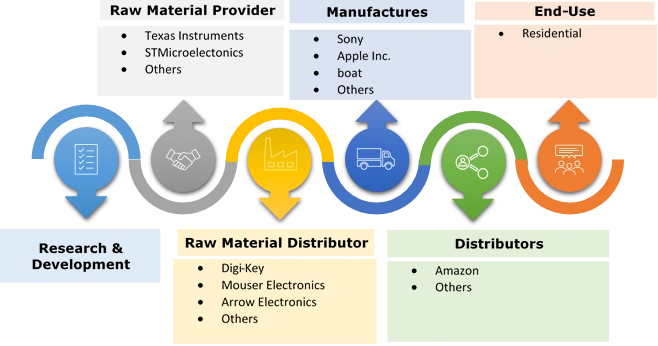
The global home audio equipment market is highly competitive with major players providing home audio solutions to the national and international markets. Key players are adopting several strategies in research and development (R&D), product innovation, and end-user launches to hold a strong position in the market. Key players in the home audio equipment industry include-
- Bose (U.S.)
- Samsung Electronics Co., Ltd. (South Korea)
- LG Corporation (South Korea)
- Sony (Japan)
- Sennheiser (Germany)
- Panasonic Holdings Corporation (Japan)
- JBL (Samsung) (South Korea)
- Apple Inc. (U.S.)
- Boat (India)
- Noise (India)
- Dolby Laboratories, Inc. (U.S.)
- Koninklijke Philips N.V. (The Netherlands)
- Sharp Corporation (Japan)
Recent Industry Developments :
Partnership:
- In May 2024, Dolby Laboratories and VIZIO have announced a partnership to integrate Dolby Atmos technology into VIZIO’s full lineup of soundbars set to launch in 2024. This collaboration follows the addition of Dolby Vision to VIZIO's entire 4K TV range, enhancing the overall visual and audio experience for consumers.
Home Audio Equipment Market Report Insights :
| Report Attributes | Report Details |
| Study Timeline | 2018-2032 |
| Market Size in 2032 | USD 79.90 Billion |
| CAGR (2025-2032) | 9.6% |
| By Product Type |
|
| By Technology |
|
| By Distribution Channel |
|
| By Region |
|
| Key Players |
|
| North America | U.S. Canada Mexico |
| Europe | U.K. Germany France Spain Italy Russia Benelux Rest of Europe |
| APAC | China South Korea Japan India Australia ASEAN Rest of Asia-Pacific |
| Middle East and Africa | GCC Turkey South Africa Rest of MEA |
| LATAM | Brazil Argentina Chile Rest of LATAM |
| Report Coverage |
|
Key Questions Answered in the Report
How big is the Home Audio Equipment market? −
Home Audio Equipment Market Size is estimated to reach over USD 79.90 Billion by 2032 from a value of USD 34.69 Billion in 2024 and is projected to grow by USD 38.24 Billion in 2025, growing at a CAGR of 9.6% from 2025 to 2032.
Which is the fastest-growing region in the Home Audio Equipment market? +
Asia-Pacific is the region experiencing the most rapid growth in the market. The regional growth can be attributed to the rise in disposable income and spending power of middle-class consumers. Additionally, the increasing consumer preference for high-quality audio devices has resulted in greater demand for premium brands like Sony, Bose, and Harman.
What specific segmentation details are covered in the Home Audio Equipment report? +
The Home Audio Equipment report includes specific segmentation details for product type, technology, distribution channel, and region.
Who are the major players in the Home Audio Equipment market? +
The key participants in the market are Bose (U.S.), Samsung Electronics Co., Ltd. (South Korea), LG Corporation (South Korea), Sony (Japan), Sennheiser (Germany), Panasonic Holdings Corporation (Japan), JBL (Samsung) (South Korea), Apple Inc. (U.S.), Boat (India), Noise (India), Dolby Laboratories, Inc. (U.S.), Koninklijke Philips N.V.(The Netherlands), Sharp Corporation (Japan) and others.
Overview
Reputation & Certifications


Our Services
- Market Intelligence & Forecasting
- Custom Research Solutions
- Market Entry Strategy
- Competitive Intelligence
- Customer Insights
- Industry Innovation Analysis
- Investment Advisory