Jump to Content
Humic-based Biostimulants Market - Size, Share, Industry Trends, and Forecasts (2025-2032)
Humic-based Biostimulants Market Size:
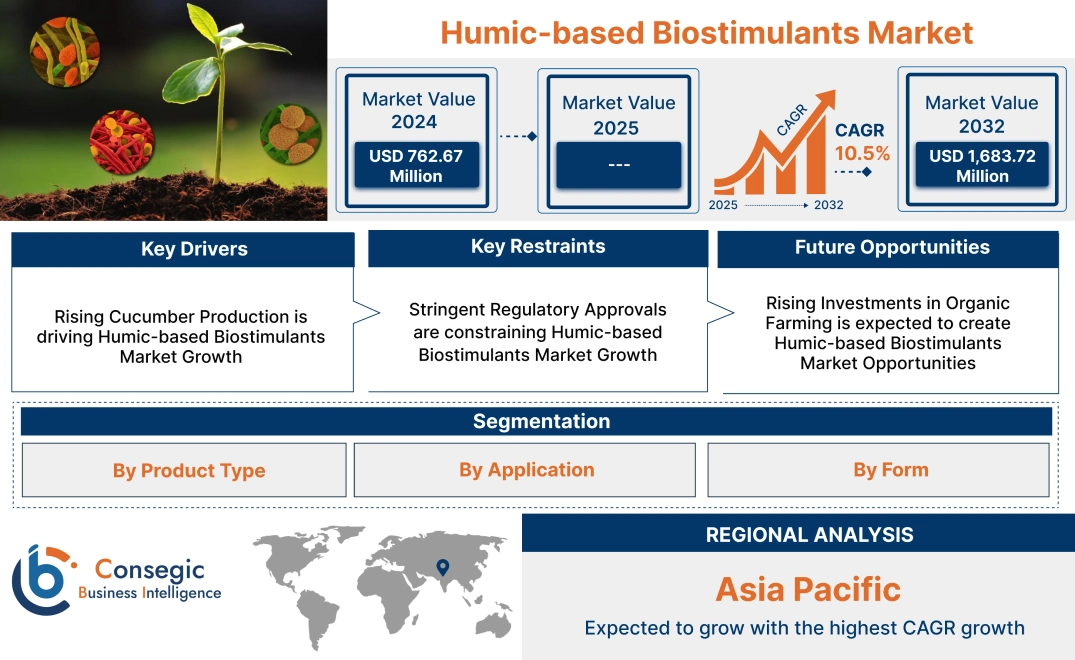
Humic-based biostimulants market size is estimated to reach over USD 1,683.72 Million by 2032 from a value of USD 762.67 Million in 2024, growing at a CAGR of 10.5% from 2025 to 2032.
Humic-based Biostimulants Market Scope & Overview:
Humic-based biostimulants are products which are derived from humic substances and used to enhance plant growth, improve nutrient uptake, and strengthen plants resistance to environmental stresses. These biostimulants are natural in origin and are eco-friendly. There are different types of humic-based biostimulants such as humic acid, fulvic acid, and potassium humate. Due to their versatility and stress resistance, they are widely used in production of fruits & vegetables, cereals, fiber crops, oilseeds, and others. Humic-based biostimulants are available in both liquid and dry form. With the growing focus towards sustainability and eco-friendly farming practices, farmers are widely adopting these biostimulants in the crop production further driving the market.
Humic-based Biostimulants Market Dynamics - (DRO) :
Key Drivers:
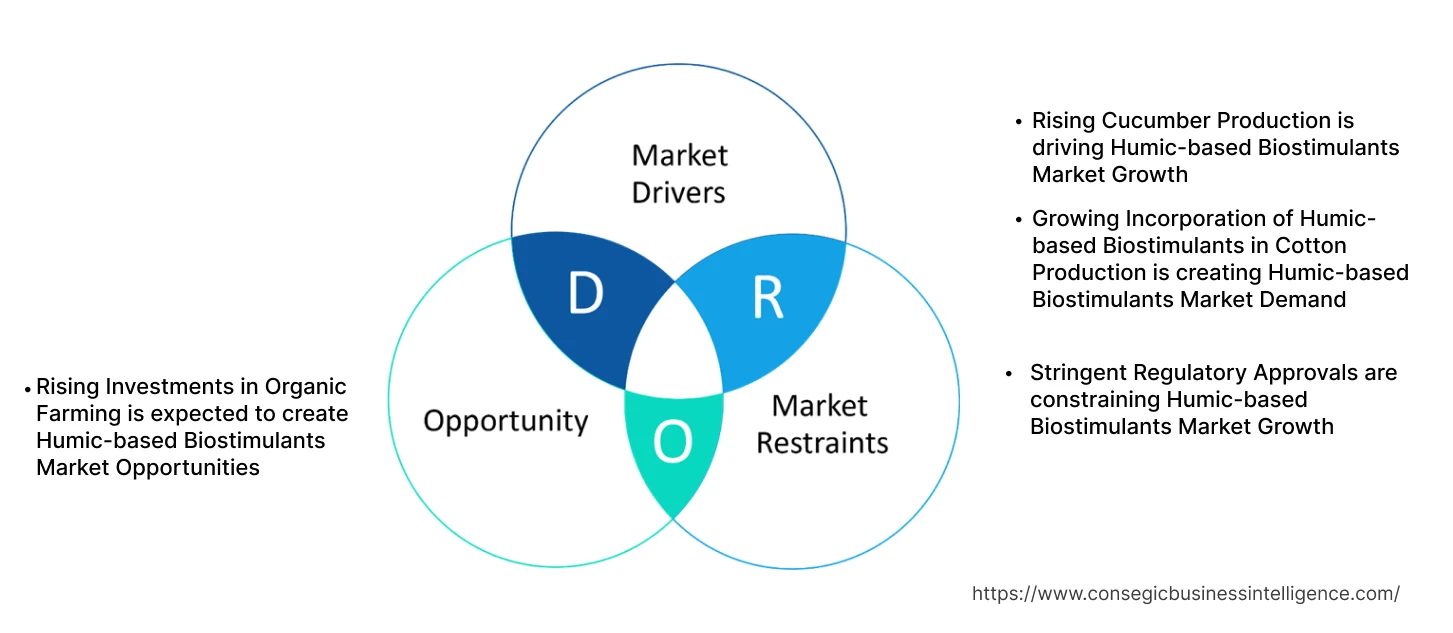
Rising Cucumber Production is driving Humic-based Biostimulants Market Growth
Cucumber production requires healthy soil and balanced growing conditions. Humic-based biostimulants are widely used in the production of cucumber to speed up growth by improving cell division and facilitating nutrient uptake in the plants.
- In 2022, according to Food and Agriculture Organization Corporate Statistical Database, the estimated total world production for cucumbers is increased by 2.3% as compared to the year 2021. As global demand for cucumber increases due to population proliferation, farmers are adopting humic-based biostimulants to enhance root development, nutrient uptake and crop tolerance to environmental stresses.
Thus, rising cucumber production is leading to humic-based biostimulants market demand supported by higher yields and better root development in plants.
Growing Incorporation of Humic-based Biostimulants in Cotton Production is creating Humic-based Biostimulants Market Demand
Cotton production refers to the process of harvesting and cultivating cotton which is obtained from the seed hair of cotton plants. Humic-based biostimulants are used in cotton production to promote root development and nutrient uptake. Cotton production is growing due to increased population, increasing globalization and government support further driving the market.
- In 2022, according to Ministry of Textiles, global production of cotton is increased by 6.20% as compared to the year 2021. Humic-based biostimulants are widely used in cotton production for healthy root development in the cotton plants to enhance crop productivity and improved yields.
Hence, the growing incorporation of humic-based biostimulants in cotton production is leading to humic-based biostimulants market expansion supported by rising production and enhanced crop productivity.
Key Restraints:
Stringent Regulatory Approvals are constraining Humic-based Biostimulants Market Growth
Regulatory approvals are significant restraint in the market demand due to stringent requirements for the approval of humic-based biostimulants across various regions. Some countries have unique requirements and regulations for the approval and use of biostimulants in agriculture. These validations delay the approval of biostimulants, as companies need to navigate through complex approval processes, conduct trails and obtain certifications for their products. Additionally, changing regulations requires huge investment in compliance sources, adding to operational cost which hinders innovation and product development.
Thus, regulatory approvals are constraining humic-based biostimulants market expansion by increasing the time and operational cost for the humic-based biostimulants manufacturers.
Future Opportunities :
Rising Investments in Organic Farming is expected to create Humic-based Biostimulants Market Opportunities
Organic farming is defined as an agricultural process that uses biological fertilizers and pest control acquired from animal or plant waste. With the growing consumer preferences for chemical-free, sustainable, and organic food products, farmers are increasingly adopting eco-friendly humic-based biostimulants.
- In 2024, according to IFOAM Organics Europe, annual budget of USD 44 Million is allocated by European Commission for the organic farming. Humic-based biostimulants are extensively used in the organic farming to improve soil fertility, promoting nutrient absorption, and enhancing plant development naturally. The use of these biostimulants aligns with the sustainable farming practices in organic farming.
Thus, rising investments in organic farming is expected to create humic-based biostimulants market opportunities supported by improvement in soil fertility and sustainable farming practices.
Humic-based Biostimulants Market Segmental Analysis :
By Product Type:
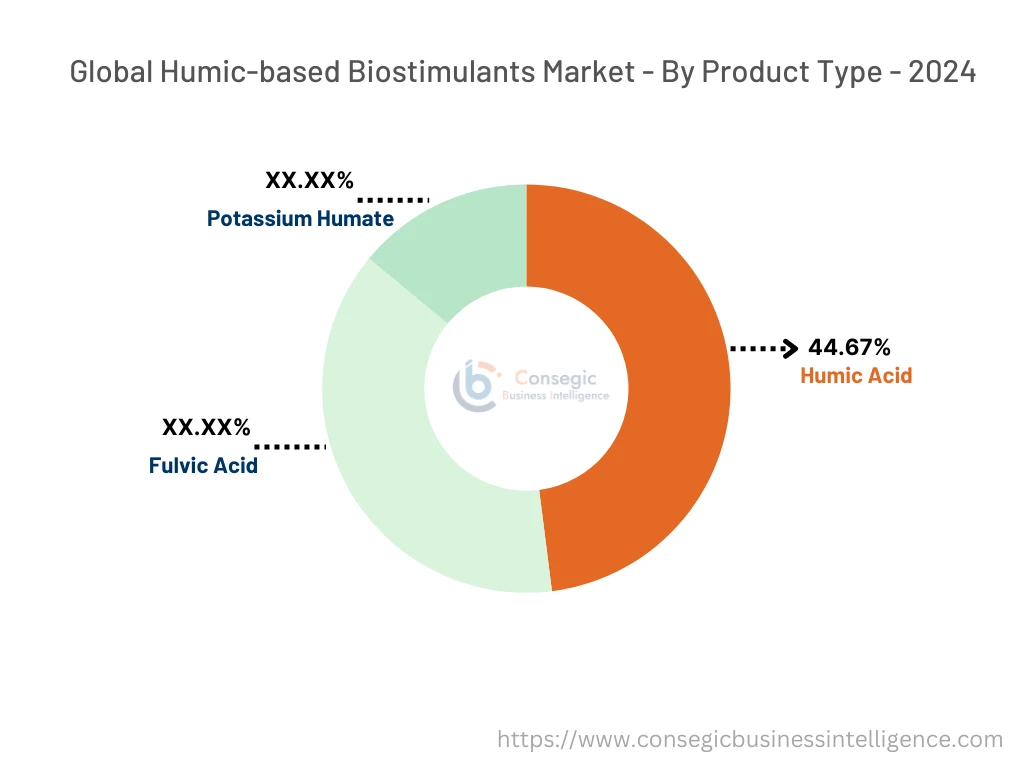
By product type, the market is divided into humic acid, fulvic acid, and potassium humate.
Trends in Product Type
- According to humic-based biostimulants market trends, humic acid is most commonly used biostimulant to improve soil structure and nutritional uptake.
- Use of fulvic acid biostimulants is growing considerably in vertical farming and hydroponics as per market trends.
The humic acid accounted for the largest market share of 44.67% in the year 2024.
- Humic acid is an organic compound naturally formed during long-term decomposition and transformation of biomass residues.
- Humic acid biostimulantsimprove soil health by enhancing soil structure, nutritional uptake and microbial activity.
- Further, growing investments in the production of humic acid is contributing to the use of these biostimulants in the market.
- For instance, in 2021, Grupa Azoty launched production unit for humic acid with an annual capacity of 2,500 tonnes in Poland. This humic acid is used for the production of humic acid biostimulantsto improve soil fertility in the crop production.
- Thus, humic acid biostimulantsare widely used in the market to improve root system and water uptake in the plants.
The fulvic acid is expected to grow at the fastest CAGR over the forecast period.
- Fulvic acid is a chemical compound that is formed when microorganisms in plants and animals break down over long periods of time.
- The adoption of fulvic acid biostimulants is growing in the market particularly for increasing soil microbial activity and improving plant resistance to stress factors like drought and salinity.
- It also increases substrate nutrient storage capacity and nutrient uptake by the plant and promotes plant development.
- The fulvic acid biostimulants are also used due to expanding sustainable farming practices which reduce reliance on inorganic fertilizers, improving soil & plant health.
- Thus, use of fulvic acid biostimulants is growing in the market due to sustainable farming practices and eco-friendliness.
By Application:
By application, the market is divided into fruits & vegetables, cereals, fiber crops, oilseeds, and others.
Trends in Application
- Humic-based biostimulants are widely used in the production of fruits & vegetables to improve fruit size and microbial activity in the plants.
- Fiber crops are rapidly adopting biostimulants for improving nutrient uptake and stress resistance as per humic-based biostimulants market trends.
The fruits & vegetables accounted for the largest market share in the year 2024.
- Fruits are mature ovary-bearing seeds which are consumed raw or processed, while vegetables are edible parts of plants such as roots, stems, or leaves.
- Humic-based biostimulants are widely used in the cultivation of fruits and vegetables to improve plant development including root growth and root diameter.
- These biostimulants improve soil water holding capacity, increased microbial activity leading to increased nutrient availability and many more.
- Further, a rise in the production of fruits like blueberries is contributing to the proliferation of the market.
- In 2021, according to International Blueberry Organization, production of blueberries in China is increased by 61% as compared to the year 2020. Humic-based biostimulants are widely used in the production of blueberries to improve fruit size and self-life.
- Thus, humic-based biostimulants are widely used in the cultivation of fruits and vegetables to improve root system and increase microbial activity.
The fiber crops is expected to grow at the fastest CAGR over the forecast period.
- Fiber crops are the crops that are specifically grown in fields for their fibers that are used to make ropes, paper, cloth, etc.
- These crops include cotton, hemp, jute, flax, & others and humic-based biostimulants are being rapidly used in the production of fiber crops to improve nutrient uptake enabling higher yields and healthier plants.
- These biostimulants also increase plant growth, resistance to water and abiotic stresses, leading to an increase in crop tolerance to infections.
- Thus, the adoption of humic-based biostimulants is growing in the production of fiber crops such as cotton, hemp, and jute for improving nutrient uptake and growth in the plants.
By Form:
By form, the market is divided into liquid and dry.
Trends in Form
- According to market trends, liquid humic-based biostimulants are most commonly used due to easy application on the plants.
- Adoption of humic-based biostimulants in dry form is rising due to easy storage and handling capacity as per trends.
The liquid accounted for the largest market share in the year 2024.
- Liquid humic-based biostimulants are derived primarily from humic substances that are dissolved in water, making them easy to apply through irrigation or foliar spraying.
- The liquid form of these biostimulants allows for faster absorption, offering more immediate benefits as compared to the dry form in the plants such as jute, cotton, tomatoes, and others.
- Further, rising production of jute in the countries is driving the use of liquid humic-based biostimulants in the market.
- For instance, in 2023, according to India Brand Equity Foundation, the jute production in India is increased by 15.4% as compared to the year 2022. Liquid humic-based biostimulants are used in the production of jute for improving nutritional uptake and stress resistance in the crops.
- Thus, humic-based biostimulants in liquid form are dominating in the market due to easy application and immediate benefits.
The dry is expected to grow at the fastest CAGR over the forecast period.
- Dry humic-based biostimulants refer to the humic substances that are processed and formulated into a dry form, making them easier to store, handle and apply.
- It reduces soil erosion and increases the water holding capacity of the soil, thus enhancing the drought resistance of crops.
- Dry humic-based biostimulants also reduce the requirement of inorganic fertilizers in the root zone and release the nutrients to plants when needed.
- The use of these biostimulants is growing in vertical faming and hydroponics to improve soil fertility and nutritional intake in the plants.
- Thus, the adoption of humic-based biostimulants in dry form is growing in the market supported by sustainable farming and reduction in soil erosion.
Regional Analysis:
The regional segment includes North America, Europe, Asia Pacific, Middle East & Africa, and Latin America.
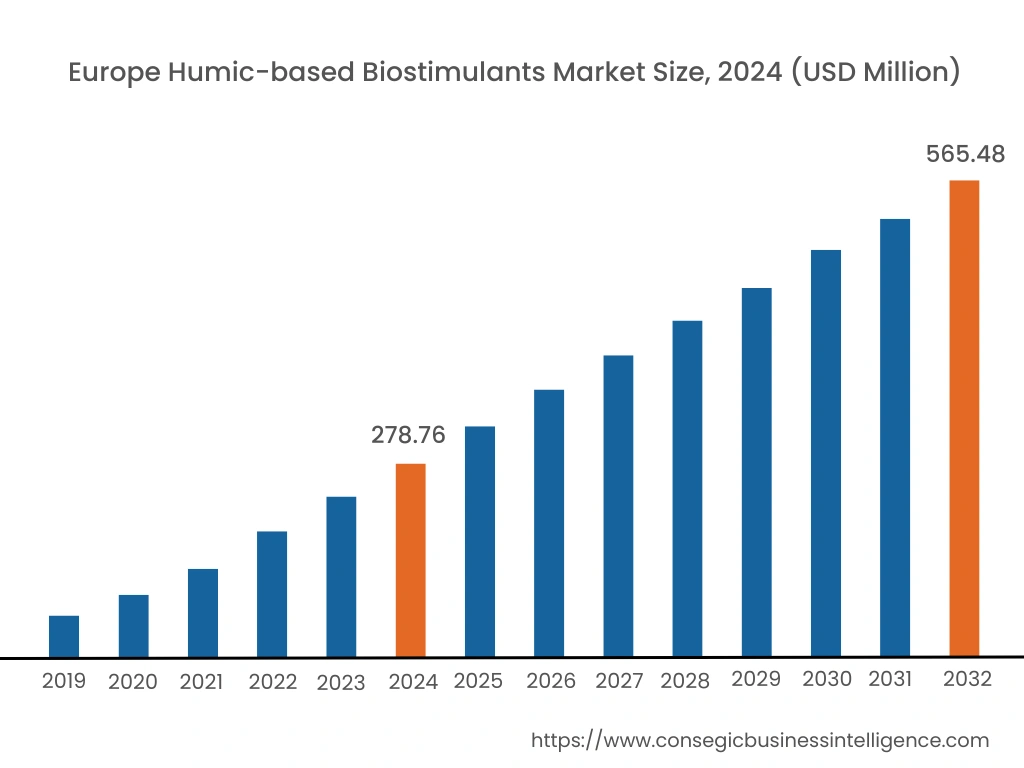
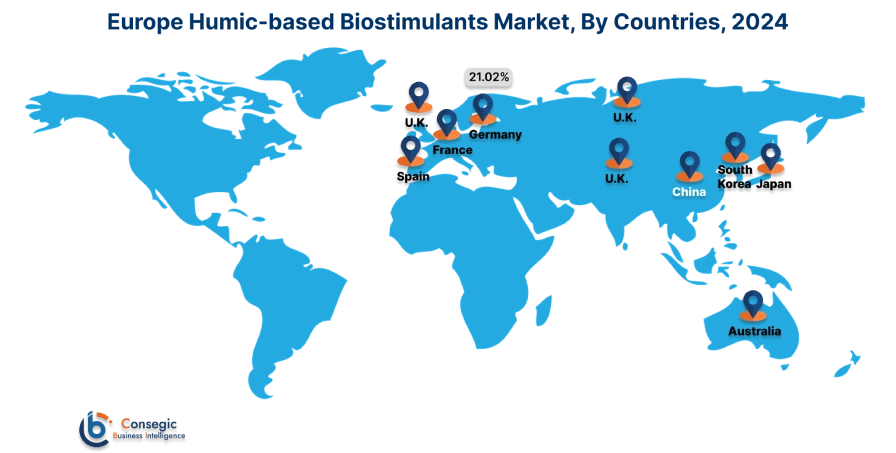
In 2024, Europe accounted for the highest market share at 36.55% and was valued at USD 278.76 Million and is expected to reach USD 565.48 Million in 2032. In Europe, Germany accounted for the highest market share of 21.02% during the base year of 2024.
The humic-based biostimulants market share of Europe is significantly driven by the rising adoption of advanced farming practices and strong focus on sustainability. Stringent environmental regulations such as the European Green Deal promote the use of eco-friendly and sustainable biostimulants, minimizing the environmental impact. Additionally, an increase in the production of crops such as corn, cotton, tomatoes, and strawberries is driving the use of humic-based biostimulants in the region.
- In 2023, according to United States Department of Agriculture, the corn production in Europe is increased by 18% as compared to the year 2022. Humic-based biostimulants are widely used in the production of corn to improve nutrition uptake and root health.
Hence, Europe is dominating in the market driven by sustainable farming practices and government initiatives as per analysis.
Asia-pacific is expected to witness the fastest CAGR of 12.2% over the forecast period of 2025-2032. According to the humic-based biostimulants market analysis, Asia-pacific is growing considerably in the market driven by its large population and increasing food demand. Countries such as China and India are leading in agricultural output, supported by favorable climatic conditions and government initiatives. Governments in the region are encouraging modern farming practices such as organic farming in the production of various crops to reduce environmental impact. This has led to the adoption of sustainable and eco-friendly humic-based biostimulants by farmers to enhance plant development, crop resistance, and higher yield. Hence, humic-based biostimulants market share of Asia-pacific is expected to emerge rapidly through advanced farming practices and increasing population as per analysis.
As per humic-based biostimulants market analysis North America is growing rapidly in the market driven by advancements in technology. Advancements in biostimulants such as fulvic acid biostimulants, have enhanced soil fertility and crop productivity. These advanced biostimulants offer precise root development, nutrient absorption, and improved crop yield. Additionally, advanced farming industries such as vertical and rooftop farming have led to the adoption of humic-based biostimulants in farming practices.
The Middle East & Africa region is experiencing moderate growth in the market driven by increasing crop production, exports, and government initiatives. Countries such as South Africa, Egypt, and Saudi Arabia are focusing on boosting agricultural productivity to meet rising food demand and strengthen exports. Governments are providing subsidies to agricultural organizations and private firms. Additionally, growing investments in precision agriculture and rooftop farming is fueling demand for humic-based biostimulants as per analysis.
As per market analysis, Latin America is growing steadily in the market driven by rising disposable incomes and steady economic development across the region. Increasing purchasing power enables farmers to invest in humic-based biostimulants such as humic acid biostimulants and fulvic acid biostimulants to enhance crop productivity and reduce crop losses. Countries such as Brazil, Mexico, and Argentina are leading the market supported by government initiatives and funding for sustainable farming practices.
Top Key Players and Market Share Insights:
The humic-based biostimulants industry is highly competitive with major players providing products to the national and international markets. Key players are adopting several strategies in research and development (R&D) and product innovation to hold a strong position in the global humic-based biostimulants market. Key players in the humic-based biostimulants industry include-
- Koppert (Netherlands)
- Bayer AG (Germany)
- Humintech (Germany)
- Borregaard AS (Norway)
- FMC Corporation (United States)
- Bionema (United Kingdom)
- Valagro SpA (Italy)
- UPL (India)
- Novozymes (Denmark)
- Biolchim SPA (Italy)
Recent Industry Developments :
Launches:
- In 2023, Bionema launched Floretocare™ in Europe. It is a humic-based biostimulant derived from vermicompost which provides bioenergy for fetter flower retention, attracts pollinators, promotes healthy flowers and fruit formation.
Humic-based Biostimulants Market Report Insights :
| Report Attributes | Report Details |
| Study Timeline | 2019-2032 |
| Market Size in 2032 | USD 1,683.72 Million |
| CAGR (2025-2032) | 10.5% |
| By Product Type |
|
| By Application |
|
| By Form |
|
| By Region |
|
| Key Players |
|
| North America | U.S. Canada Mexico |
| Europe | U.K. Germany France Spain Italy Russia Benelux Rest of Europe |
| APAC | China South Korea Japan India Australia ASEAN Rest of Asia-Pacific |
| Middle East and Africa | GCC Turkey South Africa Rest of MEA |
| LATAM | Brazil Argentina Chile Rest of LATAM |
| Report Coverage |
|
Key Questions Answered in the Report
How big is the humic-based biostimulants market? −
In 2024, the humic-based biostimulants market is USD 762.67 million.
Which is the fastest-growing region in the humic-based biostimulants market? +
Asia-pacific is the fastest-growing region in the humic-based biostimulants market.
What specific segmentation details are covered in the humic-based biostimulants market? +
Product type, application, and form are covered in the humic-based biostimulants market.
Who are the major players in the humic-based biostimulants market? +
Koppert (Netherlands), Bayer AG (Germany), and Humintech (Germany) are some of the major players in the market.
Overview
Reputation & Certifications


Our Services
- Market Intelligence & Forecasting
- Custom Research Solutions
- Market Entry Strategy
- Competitive Intelligence
- Customer Insights
- Industry Innovation Analysis
- Investment Advisory