Jump to Content
Indoor Location-based Services Market - Size, Share, Industry Trends, and Forecasts (2025-2032)
Indoor Location-based Services Market Size:
Indoor Location-based Services Market size is estimated to reach over USD 42,604.37 Million by 2032 from a value of USD 18,412.98 Million in 2024 and is projected to grow by USD 20,128.33 Million in 2025, growing at a CAGR of 12.2% from 2025 to 2032.
Indoor Location-based Services Market Scope & Overview:
Indoor location-based services use hardware and software to track assets and people within buildings. This is achieved using beacons, indoor positioning systems, and indoor localization. The services include asset tracking, advertising, analytics, automotive services, campaign management, location and alerts, and geo-targeting. These services are used in warehouse management, shopping, and navigation. Further, the services offered use a wide range of technologies including RFID, Wi-Fi, Bluetooth, Zigbee, UWB, ultrasound, infrared, and geomagnetic fields.
How is AI Transforming the Indoor Location-based Services Market?
The integration of AI is considerably transforming the indoor location-based services market. Moreover, the integration of AI helps in facilitating more accurate, personalized, and efficient navigation within buildings. AI algorithms analyze data from various sources such as sensors and cameras to create dynamic, real-time maps that can guide users, predict congestion, and personalize recommendations. This leads to improved customer experiences, enhanced operational efficiency, and new opportunities for businesses to leverage location data. Consequently, the above factors are anticipated to drive the market growth in upcoming years.

Indoor Location-based Services Market Dynamics - (DRO) :
Key Drivers:
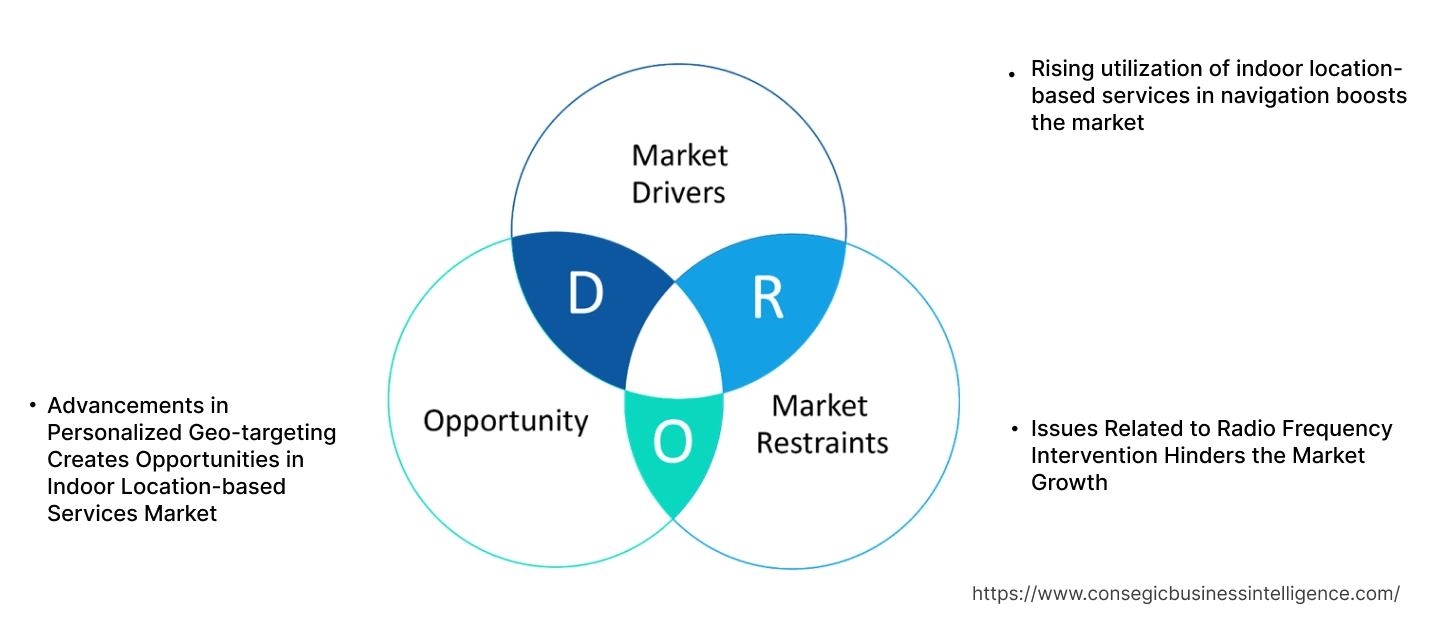
Rising utilization of indoor location-based services in navigation boosts the market
The location services are used for navigation in retail, airports, shopping malls, and others to guide users to specific sections of the building for route guidance, wayfinding indications, proximity alerts. Further, devices including smartphones and tablets are able to detect signals from beacons. Using the analysis of signal strength from multiple beacons, the device can detect its exact location. This data is then integrated with a digital map of the building to provide navigation instructions.
- For instance, in January 2022, Ersi introduced a new indoor positioning system ArcGIS IPS. This system assists in real-time positioning and localization, navigation, and wayfinding.
Thus, the aforementioned factors are boosting the services in navigation in turn driving the indoor location-based services market growth.
Key Restraints:
Issues Related to Radio Frequency Intervention Hinders the Market Growth
Indoor environments are prone to radio frequency interventions due to the heavy presence of electronic devices, metals, walls, and other obstacles. As RF signals bounce off from these obstacles it leads to the generation of multiple copies of the same signal, leading to inaccurate measurement of distance. Moreover, obstacles also cause weakening of signal strength, impacting the accuracy. Furthermore, environmental factors including temperature and humidity also cause fluctuations in turn hampering the signal quality.
Therefore, the high costs of setup and installation of human resource management system utilized in various industries is restraining the market growth.
Future Opportunities :
Advancements in Personalized Geo-targeting Creates Opportunities in Indoor Location-based Services Market
Geo-targeting using indoor location services enables highly personalized marketing and experiences to customers based on the location in the building. This enhances the product-based marketing and promotion of deals and discounts creating an interactive experience for the customers. Moreover, businesses can leverage this technology for real-time triggers and mobile notifications to drive immediate attention of customers.
Thus, the ongoing advancements in geotargeting are projected to drive indoor location-based services market opportunities during the forecast period.
Indoor Location-based Services Market Segmental Analysis :
By Product:
Based on the product, the market is segmented into Analytics and Insights, Automotive Services, Campaign Management, Consumer Services, Enterprise Services, Location and Alerts, Location-based Advertising Services, Maps, Precision Geo-targeting, Proximity Beacons, and Secure Transactions and Redemptions.
Trends in the Product:
- Rising adoption of indoor location services for personalized offer redemptions in the retail sector boosts the market growth.
- Increasing adoption of indoor location services to monitor, manage, and plan location-specific campaigns.
The location-based advertising services segment accounted for the largest revenue share in the indoor location-based services market share in 2024.
- In location-based advertising targets advertisements for users based on their accurate location in the building. This results in higher targeted reach, improved customer engagement, and enhanced customer experience.
- Moreover, it is used for retail store navigation, product discovery, loyalty programs, precise targeting, and personalized offers.
- Therefore, wide applications offered by location-based advertising are driving the market trends.
The proximity beacons segment is expected to register the fastest CAGR during the forecast period.
- A proximity beacon is a small device that transmits Bluetooth Low Energy (BLE) signals to nearby devices including tablets and smartphones to determine their accurate location. Based on the detected location, the app provides further triggers including push notifications, advertisements, or promotions.
- It is used in indoor navigation to provide directions within a building by guiding users to specific locations.
- Thus, the benefits offered by these proximity beacons are driving the adoption of indoor location services, in turn boosting the indoor location-based services market trends during the forecast period.
By Technology Outlook:
Based on the technology outlook, the market is segmented into Context-Aware Technology, OTDOA and E-OTDOA, RFID and NFC, Satellite, Microwave, and Infrared Sensing, and Wi-Fi/WLAN, UWB, BT/BLE, Beacons, and A-GPS.
Trends in the Technology Outlook:
- Rising trend in the utilization of infrared technology to achieve high accuracy in line-of-sight scenarios.
- Rising adoption of context-aware technology for smart building navigation boosts the indoor location-based services market size.
The Wi-Fi/WLAN, UWB, BT/BLE, Beacons, and A-GPS segment accounted for the largest revenue in the indoor location-based services market share in 2024.
- The Wi-Fi, Ultra-Wideband (UWB), Bluetooth Low Energy (BLE), Beacons, and Assisted GPS (A-GPS) are used to determine the location of a device in the building.
- UWB offers the highest precision for close-range positioning and the highest accuracy among other indoor location technologies.
- For instance, in February 2023, Radisys Corporation introduced ReachPoint indoor navigation for enterprises. This is achieved using geospatial data from cell towers and Wi-Fi nodes.
- Therefore, the benefits and wide applications offered by these technologies are driving the market trends.
The RFID and NFC segment is expected to register the fastest CAGR during the forecast period.
- RFID and NFC are technologies used to precisely track location using tags attached to objects or people within a building.
- RFID provides better accuracy for large areas due to its range. NFC requires near-contact between the tag and the device to read data.
- For instance, in February 2025, OKI launched an inventory management system that uses RF tags to track assets. This system allows centralized management of inventory information using smartphones.
- Thus, indoor location-based services market analysis shows that the applications offered by RFID and NFC technologies are driving the indoor location-based services market growth during the forecast period.
By Application:
Based on the application, the market is segmented into Monitoring, Navigation, Proximity, Tracking, and Others.
Trends in the Application:
- Rising adoption of indoor location-based services for monitoring due to its wide applications in retail analytics, emergency response, and workplace efficiency.
- Increasing trend in adoption of indoor location services in navigation in commercial places including shopping malls, airports, and educational institutions.
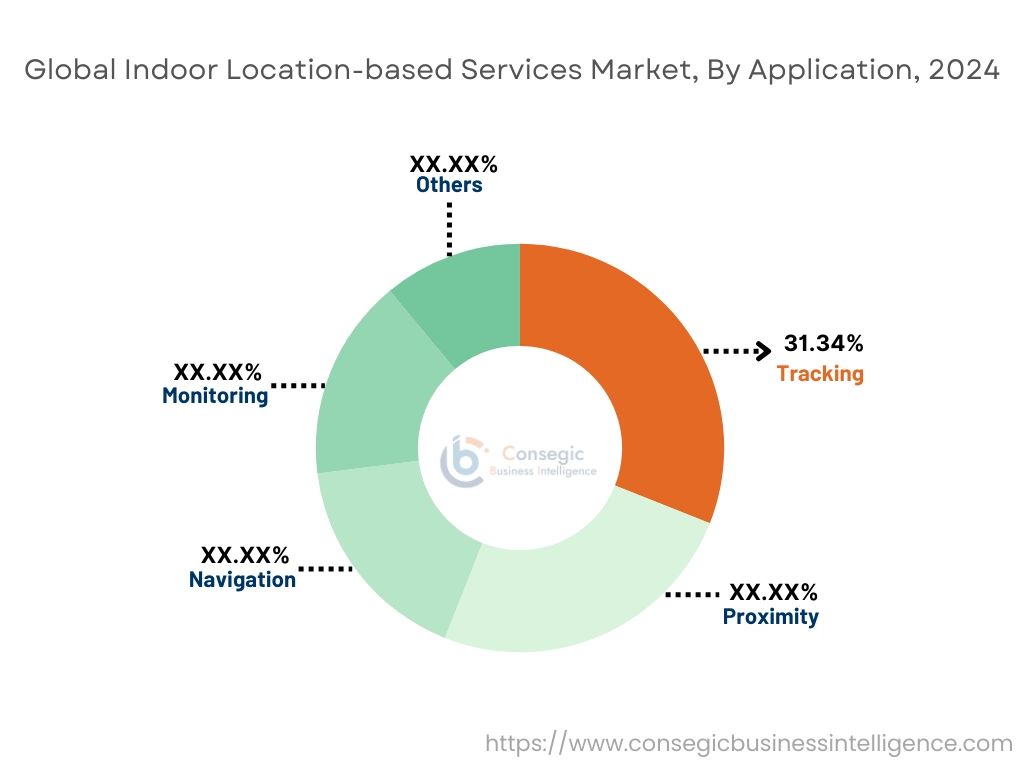
The tracking segment accounted for the largest revenue share of 31.34% in the market in 2024.
- The tracking refers to monitoring the precise position of assets or people in a building and is used to track assets in retail and manufacturing.
- The tracking uses technologies including beacon, UWB, infrared systems, RFID, NFC, and geofencing.
- Therefore, the indoor location-based services market analysis depicts that the benefits including improved efficiency, asset tracking, enhanced safety measures offered by tracking are driving the market.
The proximity segment is expected to register the fastest CAGR during the forecast period.
- Proximity refers to the detection of how close a user is to a specific point or area and gives a general idea of where someone is within a building.
- This is achieved using Bluetooth beacons that emit signals to determine closeness to a specific location.
- Proximity offers benefits including highly targeted information delivery, improved navigation within buildings, efficient asset tracking, personalized experiences based on surroundings, and enhanced customer engagement through context-aware interactions.
- Thus, the benefits offered are driving the adoption of these services, in turn boosting the indoor location-based services market trends during the forecast period.
By End-User:
Based on the end user, the market is segmented into Aerospace and Defense, BFSI, IT and Telecommunication, Energy and Power, Government, Healthcare, Hospitality, Retail, Transportation & Logistics, and Others.
Trends in the End User:
- Rising adoption of indoor location services for crowd management, and public safety applications drives the market growth.
- Increasing adoption of indoor location-based services in BFSI for customer engagement and branch optimization boosts the market.
The retail segment accounted for the largest revenue in the market in 2024.
- In retail, indoor location-based services are used for proximity marketing, personalized shopping experience, asset management, and customer analytics, among others.
- Benefits including improved conversion rates, increased customer engagement, and enhanced customer experience driving the market.
- Therefore, benefits offered by these services in retail are driving the indoor location-based services market demand.
The transportation and logistics segment is expected to register the fastest CAGR during the forecast period.
- In transportation and logistics, the services are used for tracking the movement of personnel, goods, assets, equipment, and others within a building.
- This optimizes real-time inventory management, and staff management, and improves operational efficiency across warehouses.
- The rising trend in the adoption of asset tracking using indoor location services in transportation and logistics boosts the indoor location-based services market expansion during the forecast period.
Regional Analysis:
The regions covered are North America, Europe, Asia Pacific, the Middle East and Africa, and Latin America.
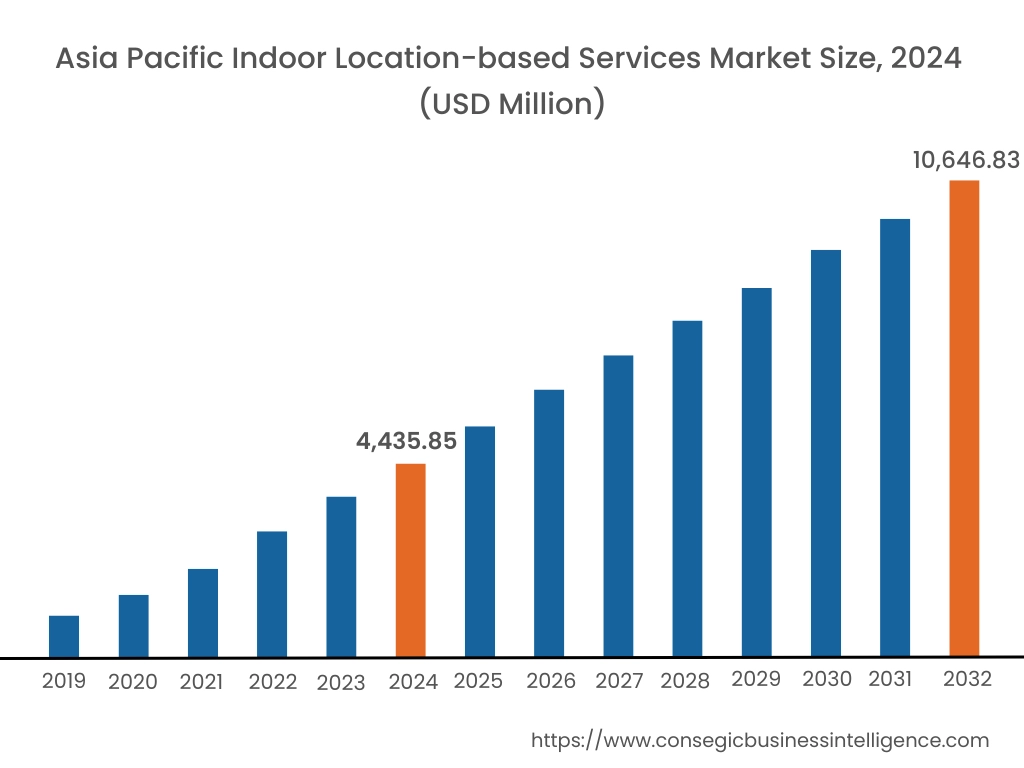
Asia Pacific region was valued at USD 4,435.85 Million in 2024. Moreover, it is projected to grow by USD 4,864.18 Million in 2025 and reach over USD 10,646.83 Million by 2032. Out of this, China accounted for the maximum revenue share of 32.5%. The market growth for indoor location-based services in Asia Pacific is mainly driven by the rapid urbanization and expansion of smart city initiatives, rising e-commerce and retail sectors, and demand for enhanced customer experiences. Further, the growing need for efficient asset tracking and management in logistics and manufacturing is driving the indoor location-based services market expansion.
- For instance, according to the Logistics Sector Skill Council of India, the logistics sector accounts for USD 354 billion and contributes 18.4% to the overall GDP of the country. The presence of a large logistics industry is resulting in the increased demand for location-based services.

North America is estimated to reach over USD 15,763.62 Million by 2032 from a value of USD 6,879.33 Million in 2024 and is projected to grow by USD 7,514.15 Million in 2025. The North American region's growth is driven by the increasing technological advancements in smartphones and the demand for enhanced customer experience in retail and hospitality. Further, there is a rising need for asset tracking and management across various industries including retail, BFSI, IT, and transportation & logistics among others.
- For instance, Microsoft Corporation in May 2024 announced a vision for its next-generation maps for enterprises. Further, the company is consolidating its offering in enterprise mapping services into Azure Maps, which will become the sole platform for these offerings.
The regional trends analysis depicts that the increasing retail personalization, enhanced healthcare efficiency, and improved public safety through location-based technology in Europe are driving the indoor location-based services market size.
Additionally, the primary factors driving the market in the Middle East and African region are growing retail digitalization, improved logistics efficiency, and enhanced public safety measures. Further, rapid urbanization and the development of smart city infrastructure are paving the way for the progress of market trends in the Latin America region.
Top Key Players & Market Share Insights:
The indoor location-based services industry is highly competitive with major players providing solutions and services to the national and international markets. Key players are adopting several strategies in research and development (R&D), product innovation, and end-user launches to hold a strong position in the global indoor location-based services market. Key players in the indoor location-based services industry include -
- Apple Inc. (US)
- Cisco Systems, Inc. (US)
- Inside Secure (France)
- Invigor (Australia)
- Microsoft (US)
- CommScope, Inc. (US)
- Glopos Technologies (India)
- Google LLC (US)
- HERE Technologies (Netherlands)
- IndoorAtlas (Finland)
Recent Industry Developments :
Mergers and Acquisitions:
- In April 2023, MapsPeople acquired all of Point Inside's, Inc customer contracts and indoor mapping assets. This adds to MapsPeople’s current portfolio by providing accurate Point of Interests (POI) data for location-based services.
Indoor Location-based Services Market Report Insights:
| Report Attributes | Report Details |
| Study Timeline | 2019-2032 |
| Market Size in 2032 | USD 42,604.37 Million |
| CAGR (2025-2032) | 12.2% |
| By Product |
|
| By Technology |
|
| By Application |
|
| By End-User |
|
| By Region |
|
| Key Players |
|
| North America | U.S. Canada Mexico |
| Europe | U.K. Germany France Spain Italy Russia Benelux Rest of Europe |
| APAC | China South Korea Japan India Australia ASEAN Rest of Asia-Pacific |
| Middle East and Africa | GCC Turkey South Africa Rest of MEA |
| LATAM | Brazil Argentina Chile Rest of LATAM |
| Report Coverage |
|
Key Questions Answered in the Report
How big is the indoor location-based services market? −
Indoor Location-based Services Market size is estimated to reach over USD 42,604.37 Million by 2032 from a value of USD 18,412.98 Million in 2024 and is projected to grow by USD 20,128.33 Million in 2025, growing at a CAGR of 12.2% from 2025 to 2032.
What are the major segments covered in the indoor location-based services market report? +
The segments covered in the report are product, technology, application, and end user.
Which region holds the largest revenue share in 2024 in the indoor location-based services market? +
North America holds the largest revenue share in the indoor location-based services market in 2024.
Who are the major key players in the indoor location-based services market? +
The major key players in the market are Apple Inc. (US), Cisco Systems, Inc. (US), CommScope, Inc. (US), Glopos Technologies (India), Google LLC (US), HERE Technologies (Netherlands), IndoorAtlas (Finland), Inside Secure (France), Invigor (Australia), and Microsoft (US).
Overview
Reputation & Certifications


Our Services
- Market Intelligence & Forecasting
- Custom Research Solutions
- Market Entry Strategy
- Competitive Intelligence
- Customer Insights
- Industry Innovation Analysis
- Investment Advisory