Jump to Content
Iot Identity Access Management Market Size & Industry Share - Growth Trends & Forecasts (2026 - 2034)
IoT Identity Access Management Market Size:
The IoT Identity Access Management market size was valued at 9,146.71 (US$M) in 2025 and is projected to grow from 11,497.41 (US$M) in 2026 to 71,660.93 (US$M) by 2034, at a CAGR of 25.7% from 2026 to 2034, according to a recent report from Consegic Business Intelligence.
IoT Identity Access Management Market Scope & Overview:
IoT Identity Access Management (IAM) refers to a set of policies, tools, and technologies designed to manage and secure the identities and access rights of IoT devices within a network. As IoT networks expand, with devices ranging from smart home appliances to industrial sensors, the need for robust IAM systems becomes paramount. These systems authenticate devices, assign them unique identities, and enforce access controls that dictate what resources each device can access. Additionally, IoT identity access management plays a vital role in compliance and operational efficiency. Organizations implement and enforce security policies that are consistent across all devices, ensuring data protection regulations. Furthermore, the scalability of IAM solutions allows efficient management of a growing number of IoT devices, reducing the manual effort required to maintain security. The aforementioned factors of access management are major determinants for increasing their deployment in large, small, and medium enterprises.
IoT Identity Access Management Market Insights:

IoT Identity Access Management Market Dynamics - (DRO) :
Key Drivers:
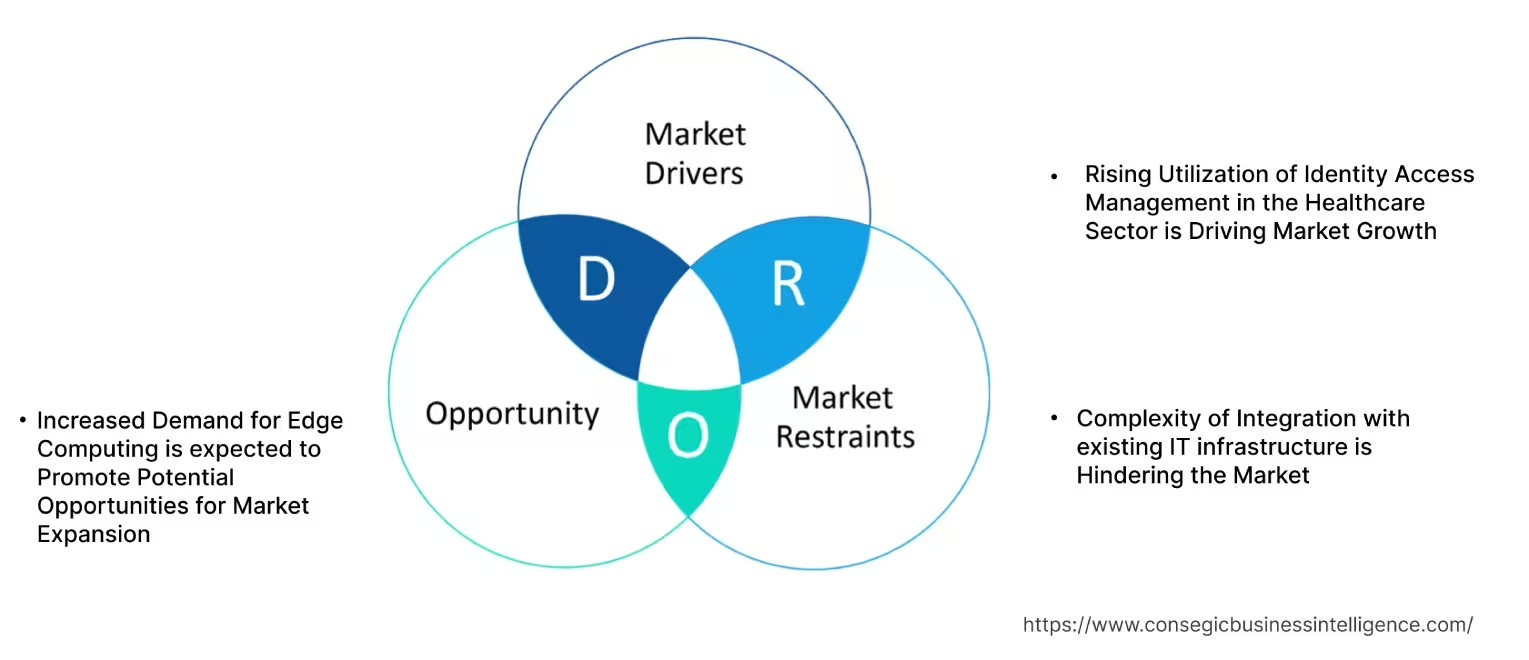
Rising Utilization of Identity Access Management in the Healthcare Sector is Driving Market Growth
Healthcare organizations prioritize securing sensitive patient data and complying with stringent regulatory requirements, and the demand for robust IAM systems continues to rise. These solutions help manage and safeguard access to critical healthcare systems ensuring that only authorized operators can interact with confidential information. Additionally, the integration of IAM solutions in the healthcare sector by improving efficiency with a growing reliance on Electric Health Record (EHR), telemedicine, and other digital health technologies, managing user identities and access has become crucial.
- In September 2023, Oracle expanded Oracle Access Governance, designed specifically to address the complex security needs. This solution provides comprehensive identity governance and administration capabilities, enabling organizations to manage user access across diverse IT environments.
Therefore, the increasing use of identity access management solutions in the healthcare sector is proliferating the IoT identity access management market growth.
Key Restraints :
Complexity of Integration with existing IT infrastructure is Hindering the Market
Organizations with legacy systems, face significant challenges when implementing IoT identity access management solutions. Integrating these management systems with diverse and often outdated IT environments is complicated, time-consuming, and high-cost. This complexity leads to delays in deployment, increased operational costs, and potential disruptions to business operations. Additionally, organizations struggle with the need for specialized expertise to manage and maintain these integrated systems. Hence, these factors hinder the widespread adoption of IoT identity access management market growth.
Future Opportunities :
Increased Demand for Edge Computing is expected to Promote Potential Opportunities for Market Expansion
Edge computing is a distributed framework that involves processing data closer to the source including IoT devices or edge servers. This approach reduces latency, improves real-time analysis, and optimizes the network. As edge computing becomes prevalent, there is a growing demand for robust identity and access management solutions that secure identities and manage access. Additionally, IAM solutions offer scalability and distributed security measures that maintain the integrity and confidentiality of data processed. This includes providing localized authentication and access controls, monitoring and managing device identities in real-time analysis, and ensuring secure communication between devices and central systems.
- In March 2022, Hewlett Packard Enterprise enhanced HPE GreenLake edge-to-cloud service with AI-powered network management. It is now incorporated with 12 cloud services including network-as-a-service, data services, high-performance computing functions, and compute operation management. It provides advanced access management solutions that protect data and manage device identities across edge computing environments, providing scalable and secure access control.
Thus, the increasing demand for access management solutions in edge computing is expected to show potential opportunities for IoT identity access management market share.
IoT Identity Access Management Market Segmental Analysis :
By Component:
Based on components the market is bifurcated into solutions and services.
Trends in the component:
- Access management solutions are gaining prominence as organizations seek to control and monitor who can access various IoT devices and data. These solutions provide control over permission and help prevent unauthorized access.
The service component segment accounted for the largest revenue share in 2024 and is anticipated to register the fastest CAGR during the forecast period.
- Services refers to managed support offerings that assist organizations in implementing, managing, and maintaining IAM solutions.
- These include consulting, integration, monitoring, compliance, and incident response services tailored to the specific needs of IoT environments.
- In October 2023, IBM expanded Managed security services to include advanced IoT identity access management support, offering comprehensive management, automated security alerts, monitoring, and incident response services for IoT environments.
- Therefore, as per the analysis, these factors suggest that the services segment is expected to show potential growth in IoT identity access management market demand.
By Deployment Type:
Based on deployment type the market is segmented into on-premises and cloud-based.
Trends in the Deployment Type:
- Organizations with existing legacy systems require seamless integration and local control over security measures, these prefer on-premises IAM solutions. This trend reflects a preference for maintaining control over sensitive data and system configurations.
- Cloud-based IAM solutions are increasingly popular due to scalability and flexibility. It enables organizations to scale IAM capabilities to accommodate growing numbers of IoT devices and users without significant infrastructure investment.
The cloud-based deployment segment accounted for the largest revenue share in the year 2024 and is anticipated to register the fastest CAGR during the forecast period.
- Cloud-based IAM solutions are preferred due to scalability, cost-effectiveness, and flexibility.
- Organizations increasingly adopt this deployment enabling them to rapidly scale and offer advanced features including automated updates and AI-driven security enhancements.
- In November 2022, Okta, Inc. unveiled Okta Workforce Identity Cloud for managing identity across all enterprise resources. The Workforce provides secure, scalable cloud-based identity access management solutions.
- Hence, the ease of deployment and access management makes cloud-based a preferred choice in the IoT identity access management market trend.
By Authentication Method:
Based on authentication method the market is segmented into password-based authentication, biometric authentication, multi-factor authentication (MFA), token-based authentication, certificate-based authentication, and others.
Trends in the Authentication Method:
- Certificate-based authentication is increasingly used for securing communication between IoT services and networks. This trend provides strong authentication and encryption essential for protecting sensitive data in the IoT ecosystem.
The Multi-Factor Authentication (MFA) segment accounted for the largest revenue share in 2024.
- Multi-factor authentication is a multi-step access process that requires two or more verification factors to gain access to the resource.
- It enhances the organization's security by requiring users to identify by enforcing MFA factor including thumbprint or physical hardware key along with username and password.
- It provides a higher level of security by requiring multiple verification, reducing the risk of unauthorized access.
- In April 2023, Cisco introduced advancements in Cisco Security Cloud, an AI-driven cross-domain security platform. This release included the launch of Cisco's XDR solution and the introduction of advanced features with Duo MFA including an enhanced and adaptive authentication system.
- Thus, the analysis shows that the multiple verification feature of MFA is fueling the IoT identity access management industry.
Biometric authentication is anticipated to register the fastest CAGR during the forecast period.
- Biometric authentication refers to the identification of unique physical characters including fingerprints, facial recognition, voice recognition, and iris patterns.
- The biometric technology provides accurate, faster, and affordable security across various devices.
- Additionally, this biometric technology is increasingly being incorporated with smart devices including smart home appliances, smartphones, and others which provide enhanced security and access.
- In June 2022, Apple introduced iOS 16 with advanced Face ID technology improving lock screen experience in iPhone models. This feature enhances security with improved facial and touch recognition.
- Thus, accurate, faster, and affordable security offered by biometric authentication is boosting the IoT identity access management market opportunities.
By End-User:
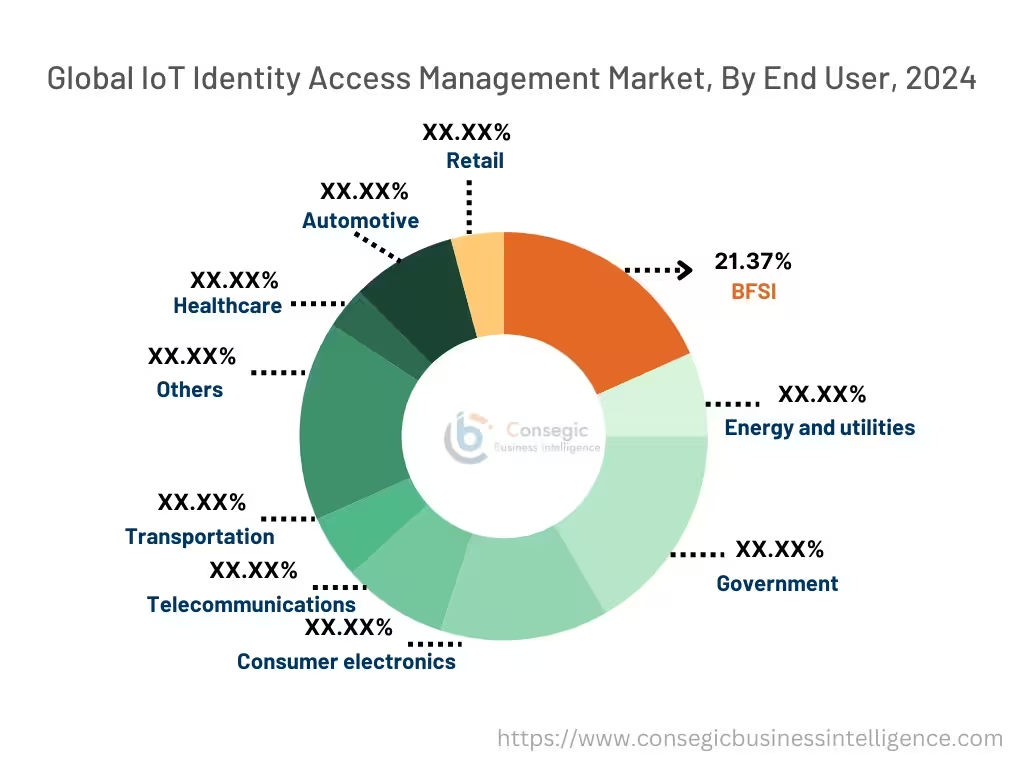
Based on end-user the market is segmented into healthcare, automotive, retail, BFSI, energy and utilities, government, consumer electronics, telecommunications, transportation, and others.
Trends in the End-User:
- IAM solutions are being used to secure e-government services, enabling citizens to access services online while ensuring the security of their personal information.
- As smart homes become common, IoT IAM is being utilized to secure home automation systems, ensuring control over smart devices including smart locks, cameras, and thermostats for authorized users.
The BFSI segment accounted for the largest revenue share of 21.37% in 2024.
- The BFSI (Banking, Financial Services, and Insurance) sector needs robust security measures to protect sensitive data and customer information.
- The sector faces stringent regulatory requirements driving the adoption of access management technologies to ensure compliance with data protection and privacy issues.
- For instance, Ping Identity's IAM Solution for Financial Services is integrated with advanced features including multi-factor authentication and AI-driven identity verification to enhance security and compliance.
- Therefore, increasing demand for high security in the BFSI sector is proliferating the IoT identity access management market trend.
The healthcare segment is anticipated to register the fastest CAGR during the forecast period.
- The proliferation of IoT-enabled medical devices and remote patient monitoring systems drives the need for robust identity access management systems.
- Additionally, the healthcare sector faces strict regulations like HIPAA (Health Insurance Portability and Accountability Act), which necessitates IAM solutions.
- In November 2021, IBM Watson Health launched IBM Imaging AI Orchestrator, a cloud-based AI service. Integrated with advanced success management capabilities to secure medical imaging data and enhance workflow management in healthcare facilities.
- Hence, according to the analysis, the need for access management solutions in the healthcare sector is driving the global IoT identity access management market.
Regional Analysis:
The regions covered are North America, Europe, Asia Pacific, the Middle East and Africa, and Latin America.
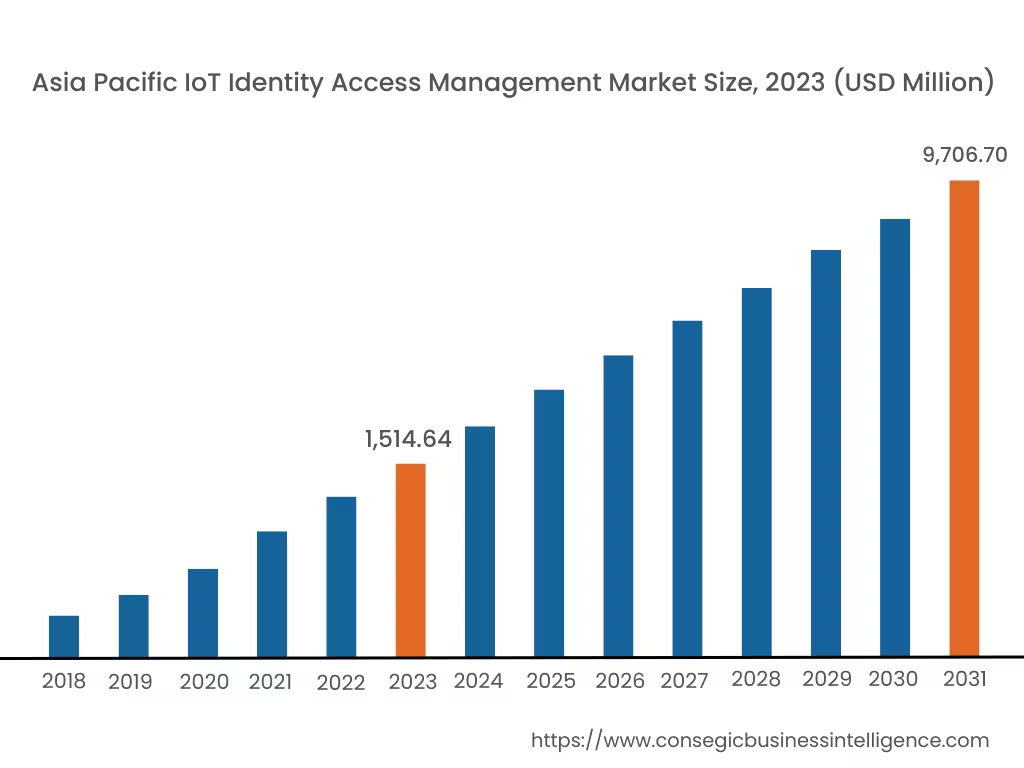
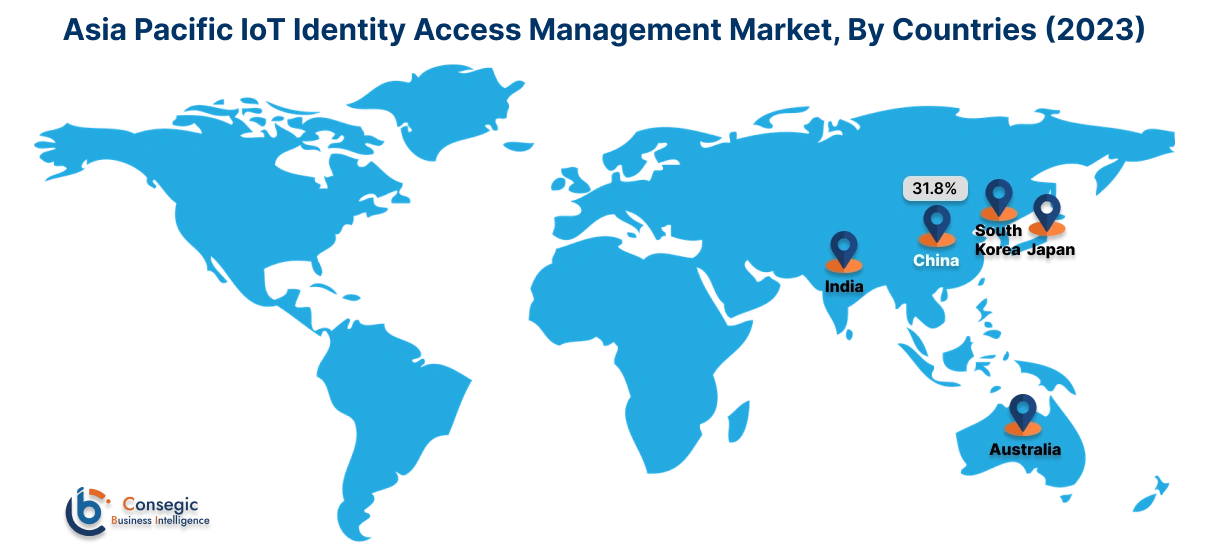
Asia Pacific region was valued at USD 2,148.43 Million in 2024. Moreover, it is projected to grow by USD 2,668.96 Million in 2025 and reach over USD 13,810.17 Million by 2032. Out of this, China accounted for the maximum revenue share of 31.8%. According to the IoT identity access management market analysis, the region is witnessing rapid growth fueled by the increasing deployment of IoT technologies across various sectors, including smart cities. Healthcare, financial services, and industrial automation. The increasing advancements in authentication methods including biometric authentication for efficient management of security measures are propelling the market.
In June 2023, Samsung Electronics unveiled Biometric Card, featuring advanced fingerprint authentication technology. This card integrates biometric sensors to provide enhanced security and seamless access for financial transactions and identity verification.
North America is estimated to reach over USD 14,699.11 Million by 2032 from a value of USD 2,419.81 Million in 2024 and is projected to grow by USD 2,991.88 Million in 2025. The IoT identity access management market is primarily driven by the region's advanced technological infrastructure and high adoption rates of IoT devices. The United States and Canada are at the forefront of this growth, with a strong emphasis on multi-factor authentication securing sensitive data across various industries.
- In June 2024, Cisco (US) unveiled advanced features in Cisco Security Cloud including an AI-driven cross-domain security platform and enhanced capabilities in its multi-factor authentication solutions, aimed at improving identity access management across the IoT environment.
Europe has significant market growth in the IoT identity access management market, driven by the region's strong emphasis on data protection and regulatory compliance. The General Data Protection Regulation (GDPR) has intensified the need for advanced IAM solutions to safeguard data and ensure privacy.
In Latin America, the IoT identity access management market is emerging rapidly, boosted by the rising digital technologies and IoT deployments. In the Middle East and Africa, the industry is propelled by the increasing adoption of IoT technologies and smart infrastructure projects. The region is focusing on enhancing cybersecurity and addressing challenges related to data privacy and regulatory compliance.
Top Key Players & Market Share Insights:
The IoT identity access management market is highly competitive with major players providing identity and access management to the national and international markets. Key players are adopting several strategies in research and development (R&D), product innovation, and end-user launches to hold a strong position in the IoT identity access management market. Key players in the IoT identity access management industry include-
- IBM Corporation (US)
- Microsoft Corporation (US)
- Oracle Corporation (US)
- Amazon Web Services, Inc (US)
- Intel Corporation (US)
- Huawei Technologies Co. (China)
- Cisco Systems, Inc (US)
- Alibaba Cloud (China)
- ZTE Corporation (China)
- Siemens (Germany)
- Thales Group (France)
- Hikvision Digital Technology Co. LTD (China)
Recent Industry Developments :
Product Launches:
- In August 2024, Microsoft launched multi-factor authentication (MFA) for Azure, incorporated with Secure Future Initiatives (SFI) to protect identities. It ensures that Azure accounts are protected with securely managed MFA which blocks 99.22% of account compromise attacks.
- In March 2024, Deloitte launched CyberSphere, a vendor-neutral services and solutions platform. It is designed to help organizations manage risk analysis with artificial intelligence and machine learning algorithms. It enables digital identity management, managed extended detection and response (MXDR), attack surface management (ASM), managed secure access services edge (MSASE), and incident response
Product Enhancements:
- In August 2024, Google introduced new features inGoogle Cloud to enhance identity access management capabilities. The update included advanced role-based access control features, enabling more granular permission settings and improved management of user access.
Collaborations:
- In May 2024, Palo Alto Networks collaborated with IBM to provide an AI-powered security platform. It is incorporated with Watsonx large language models (LLMs) in Cortex XSIAM to deliver additional Precision AI solutions. IBM ensures AI security and access management for businesses featuring Palo Alto Networks platforms.
- In July 2023, Samsung and Microsoft partnered to introduce the First On-Device Attestation Solution for Enterprise. The solution integrated Samsung's hardware security features with Microsoft's software platforms, offering robust defense against potential security breaches and ensuring secure access to enterprise environments.
IoT Identity Access Management Market Report Insights :
| Report Attributes | Report Details |
| Study Timeline | 2021-2034 |
| Market Size in 2034 | USD 71,660.93 Million |
| CAGR (2026-2034) | 25.70% |
| Base Year | 2025 |
| By Component |
|
| By Deployment Type |
|
| By Authentication Method |
|
| By End-User |
|
| By Region |
|
| Key Players |
|
| North America | U.S. Canada Mexico |
| Europe | U.K. Germany France Spain Italy Russia Benelux Rest of Europe |
| APAC | China South Korea Japan India Australia ASEAN Rest of Asia-Pacific |
| Middle East and Africa | GCC Turkey South Africa Rest of MEA |
| LATAM | Brazil Argentina Chile Rest of LATAM |
| Report Coverage |
|
Key Questions Answered in the Report
How big is the IoT Identity Access Management Market? −
IoT Identity Access Management Market size is estimated to reach over USD 45,353.61 Million by 2032 from a value of USD 7,294.98 Million in 2024 and is projected to grow by USD 9,036.89 Million in 2025, growing at a CAGR of 25.70% from 2025 to 2032.
Which region/country is anticipated to witness the highest CAGR during the forecast period, 2023-2031? +
Asia-Pacific is anticipated to register the fastest CAGR during the forecast period due to the increasing deployment of IoT technologies across various sectors, including smart cities, healthcare, financial services, and industrial automation.
What is the key market trend? +
Cloud-based IAM solutions are increasingly popular due to scalability and flexibility. It enables organizations to scale IAM capabilities to accommodate growing numbers of IoT devices and users without significant infrastructure investment.
Who are the major key players in IoT Identity Access Management Market? +
The key players in IoT Identity Access Management Market are IBM Corporation (US), Microsoft Corporation (US), Cisco Systems, Inc (US), Oracle Corporation (US), Amazon Web Services, Inc (US), Intel Corporation (US), Huawei Technologies Co. (China), Alibaba Cloud (China), ZTE Corporation (China), Siemens (Germany), Thales Group (France), Hikvision Digital Technology Co. LTD (China) and others.
Overview
Reputation & Certifications


Our Services
- Market Intelligence & Forecasting
- Custom Research Solutions
- Market Entry Strategy
- Competitive Intelligence
- Customer Insights
- Industry Innovation Analysis
- Investment Advisory