Jump to Content
Latex Allergy Market - Size, Share, Industry Trends, and Forecasts (2025-2032)
Latex Allergy Market Size:
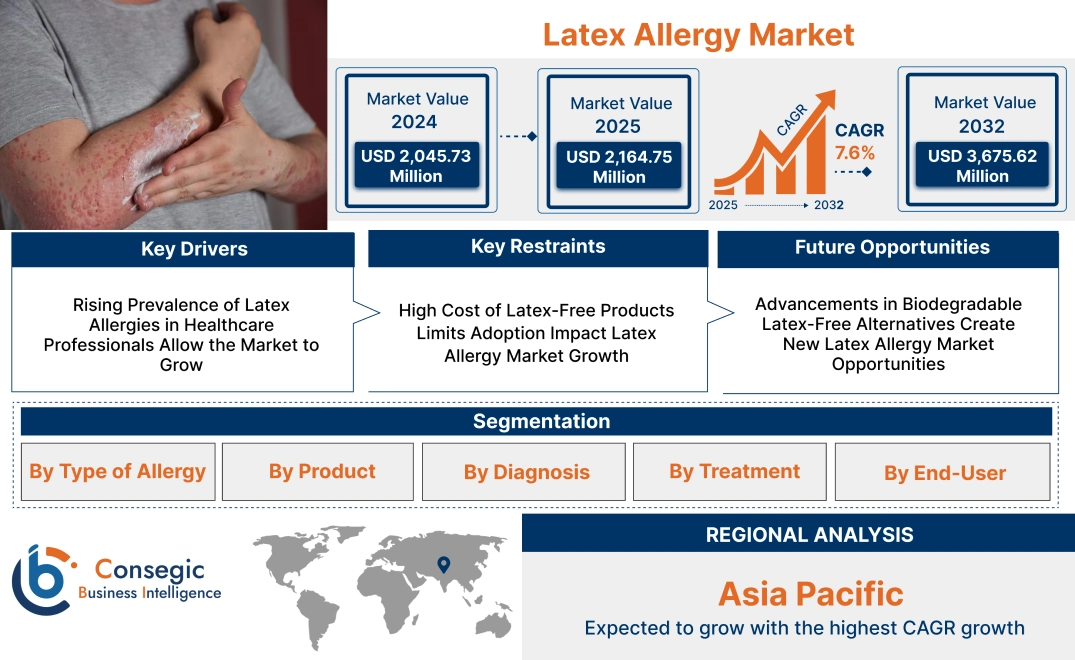
Latex Allergy Market size is estimated to reach over USD 3,675.62 Million by 2032 from a value of USD 2,045.73 Million in 2024 and is projected to grow by USD 2,164.75 Million in 2025, growing at a CAGR of 7.6 % from 2025 to 2032.
Latex Allergy Market Scope & Overview:
Latex allergy is a hypersensitive reaction to proteins found in natural rubber latex. It causes symptoms ranging from skin irritation to severe anaphylactic reactions. Products used for diagnosing and managing latex allergy include medical devices, allergy testing kits, and alternative non-latex materials. These products are designed to minimize exposure and ensure patient safety.
Benefits of these products include reduced allergic reactions, improved quality of life, and enhanced safety during medical procedures. Testing kits help in early detection, enabling timely management and prevention strategies. Applications include hospitals, diagnostic centers, and research institutions. End-use industries involve healthcare, pharmaceuticals, and biotechnology, focusing on patient safety and effective allergy management solutions.
How is AI Impacting the Latex Allergy Market?
AI is poised to significantly impact the latex allergy market by enhancing various aspects from research and development to patient care and market intelligence. AI's ability to analyze vast datasets, predict allergic reactions, and personalize treatment plans could lead to more effective and efficient management of latex allergies. Furthermore, AI-powered tools can improve market research, optimize supply chains, and potentially even detect allergens in food, offering a more proactive approach to managing latex allergies.
Latex Allergy Market Dynamics - (DRO) :
Key Drivers:
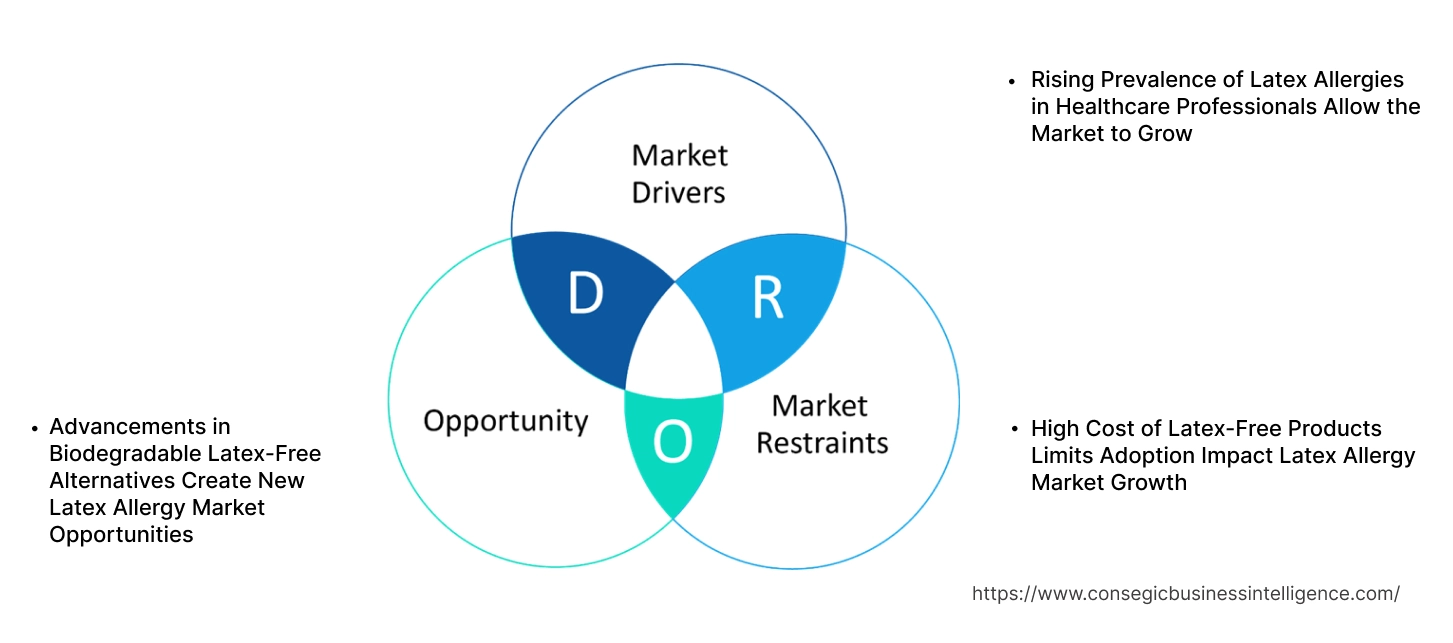
Rising Prevalence of Latex Allergies in Healthcare Professionals Allow the Market to Grow
Healthcare professionals are at a heightened risk of developing latex allergies due to frequent exposure to latex-based medical gloves and other equipment. Prolonged contact with latex products increases sensitization, leading to allergic reactions such as contact dermatitis, asthma, or anaphylaxis. Latex-free alternatives, including nitrile or vinyl gloves, are increasingly used to mitigate these risks. For instance, hospitals in developed regions have adopted latex-free policies, ensuring safer working environments for their staff.
This growing awareness among healthcare institutions is boosting the latex allergy market demand for alternative products, fueling the market for latex allergy management solutions.
Key Restraints:
High Cost of Latex-Free Products Limits Adoption Impact Latex Allergy Market Growth
Latex-free alternatives, including nitrile and vinyl gloves, are significantly costlier than their latex counterparts. This price disparity poses challenges for smaller healthcare facilities or those operating in resource-constrained settings, where budget limitations restrict the adoption of safer alternatives. For example, while large hospitals in developed regions transition to latex-free options, smaller clinics in emerging economies continue to rely on latex products due to their affordability.
This cost-related barrier hampers the widespread implementation of latex-free solutions, restricting the latex allergy market growth potential.
Future Opportunities :
Advancements in Biodegradable Latex-Free Alternatives Create New Latex Allergy Market Opportunities
The development of biodegradable latex-free products represents a significant latex allergy market growth avenue. These alternatives aim to address both the environmental concerns associated with traditional latex products and the health risks posed by latex allergies. Emerging innovations focus on creating sustainable and allergy-safe materials that retain the durability and flexibility of latex. For instance, biodegradable nitrile gloves are under research to meet healthcare standards while reducing environmental impact.
The introduction of such environmentally friendly and health-conscious solutions is expected to reshape the latex allergy market, presenting lucrative latex allergy market opportunities for manufacturers and suppliers.
Latex Allergy Market Segmental Analysis :
By Type of Allergy:
Based on the type of allergy, the market is segmented into immediate hypersensitivity (Type I) and delayed hypersensitivity (Type IV).
The immediate hypersensitivity (Type I) segment accounted for the largest revenue in latex allergy market share in 2024.
- Immediate hypersensitivity (Type I) is the most severe form of latex allergy, with symptoms occurring within minutes of exposure.
- It is triggered by the immune system's response to latex proteins and can cause reactions ranging from mild irritation to anaphylaxis.
- This segment includes individuals who develop allergic symptoms immediately upon exposure to latex products, such as gloves or balloons.
- The increasing use of latex gloves in medical settings, coupled with the rise in reported cases of latex allergies, significantly contributes to this segment’s substantial revenue share.
- As per the latex allergy market analysis, the prevalence of severe allergic responses and their immediate symptoms drives the revenue for the immediate hypersensitivity segment.
The delayed hypersensitivity (Type IV) segment is anticipated to register the fastest CAGR during the forecast period.
- Delayed hypersensitivity (Type IV) reactions occur due to prolonged or repeated exposure to latex products, leading to skin irritation or dermatitis.
- It manifests several hours or days after exposure, which may result in chronic allergic reactions in sensitive individuals.
- Increased awareness among healthcare professionals regarding occupational allergies and a growing preference for non-latex alternatives drive latex allergy market trend.
- The availability of diagnostic tests and treatments to manage this type of allergy is fueling the adoption of preventive measures.
- Simultaneously, heightened awareness and prolonged exposure cases bolster the delayed hypersensitivity segment's trend.
By Product:
Based on the product, the market is segmented into latex gloves, food containing latex substances, and others.
The latex gloves segment accounted for the largest revenue in latex allergy market share in 2024.
- Latex gloves are extensively used in medical, dental, and industrial sectors due to their elasticity, durability, and protective barrier properties.
- However, the increasing prevalence of latex allergies among healthcare workers, coupled with the use of powdered gloves that release allergenic proteins into the air, creates latex allergy market demand for alternative solutions.
- Technological advancements, such as powder-free latex gloves and gloves made with lower-protein latex, have led to regulatory restrictions that further emphasize the segment's market dominance.
- The rise in global healthcare infrastructure, particularly in developing regions, is also contributing to the latex allergy market trend.
- The consistent use of latex gloves in various industries secures its market leadership.
The food containing latex substances segment is anticipated to register the fastest CAGR during the forecast period.
- Some fruits, vegetables, and other foods naturally contain latex, and can trigger cross-reactive allergic responses in individuals allergic to latex.
- Latex proteins found in foods like bananas, avocados, and chestnuts cause allergic reactions in people who have latex allergies.
- Growing consumer awareness about food-related latex allergies, along with improved diagnostic capabilities, is propelling this segment’s expansion.
- The segment is supported by increasing efforts to educate the public and healthcare professionals on the risks associated with food containing latex proteins.
- While increasing awareness about food allergies and cross-reactivity drives the fastest trend for latex-containing foods.
By Diagnosis:
Based on diagnosis, the market is segmented into skin tests and allergy tests.
The skin test segment accounted for the largest revenue share in 2024.
- Skin prick testing is the most common, standard, and cost-effective diagnostic method for confirming latex allergies.
- This method provides immediate results and aids in rapid treatment decisions, making it popular for both patients and healthcare providers.
- Skin testing is widely used due to its simplicity and ability to identify a broad range of allergens.
- Its cost-effectiveness compared to other diagnostic methods also ensures its sustained dominance in the market.
- Skin tests maintain their dominance due to affordability and rapid results.
The allergy test segment is anticipated to register the fastest CAGR during the forecast period.
- Allergy tests, particularly specific IgE blood tests, are gaining popularity due to their precision and ability to diagnose latex allergies without exposing patients to the allergens themselves.
- As non-invasive diagnostic methods grow in demand, the allergy test segment is witnessing rapid expansion.
- Advancements in diagnostic technology, such as improved IgE testing kits, offer higher accuracy and convenience.
- Additionally, the increased adoption of home-based allergy testing solutions adds to the segment’s trend potential.
- While advanced allergy tests gain traction for their non-invasive and precise diagnostic capabilities.
By Treatment:
Based on treatment, the market is segmented into allergy medication and epinephrine injection.
The allergy medication segment accounted for the largest revenue share in 2024.
- Commonly prescribed treatments, such as antihistamines and corticosteroids, help manage mild to moderate symptoms of latex allergy.
- These medications are effective in alleviating symptoms like itching, swelling, and sneezing, leading to high adoption rates.
- Their wide availability, both over-the-counter and via prescription, ensures that they are the first line of treatment for most patients.
- The growing awareness of latex allergies, combined with an expanding number of healthcare professionals prescribing these medications, helps maintain the segment's dominance.
- Thus, the latex allergy market analysis shows that the convenience and efficacy of allergy medications secure their dominance.
The epinephrine injection segment is anticipated to register the fastest CAGR during the forecast period.
- Epinephrine injections, such as the widely used EpiPen, are critical for managing anaphylactic reactions caused by severe latex allergies.
- As the awareness around the severity of anaphylaxis grows, so does the demand for epinephrine auto-injectors, which can be administered in emergencies.
- The easy availability and growing recognition of epinephrine's life-saving capabilities, particularly for severe latex allergy reactions, fuel rapid latex allergy market expansion.
- Ongoing efforts to improve the accessibility and affordability of epinephrine devices are driving trend in this segment.
- While the critical role of epinephrine injections in emergency scenarios drives their rapid growth.
By End User:
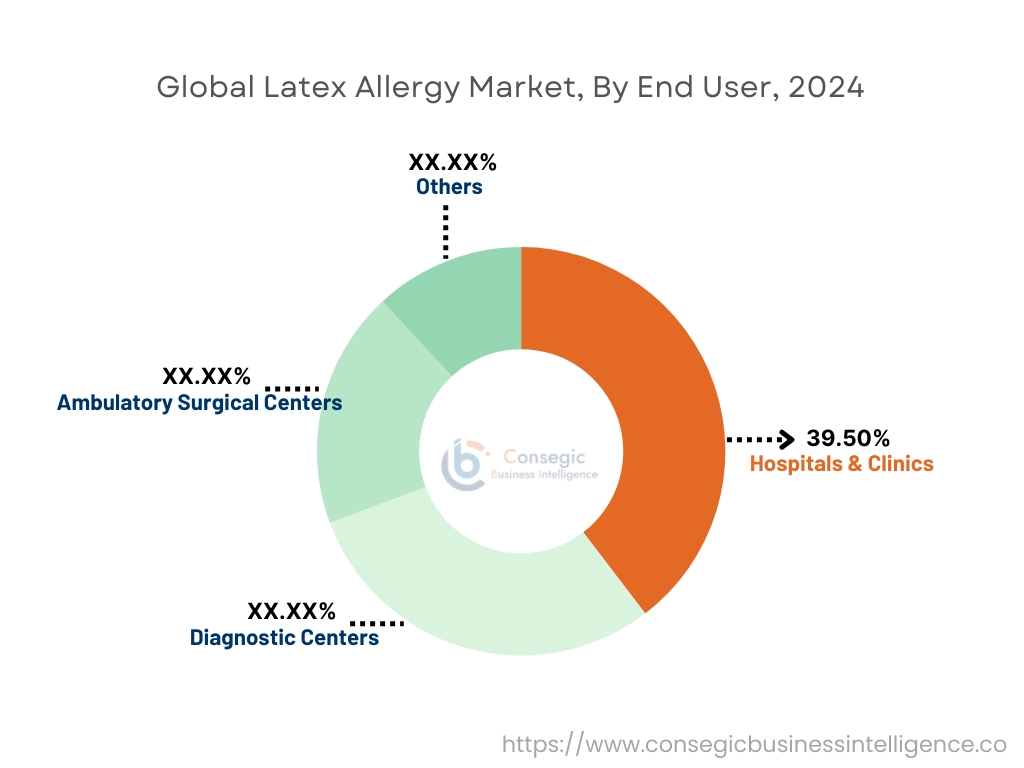
Based on end-user, the market is segmented into hospitals & clinics, diagnostic centers, ambulatory surgical centers, and others.
The hospitals & clinics segment accounted for the largest revenue share by 39.50% in 2024.
- Hospitals and clinics play a crucial role in diagnosing and managing latex allergies, especially in patients requiring immediate care.
- The availability of specialized medical staff and advanced diagnostic tools, combined with the ability to provide comprehensive allergy management, supports this segment's revenue dominance.
- Additionally, hospitals and clinics are the primary sites for administering emergency treatments, such as epinephrine injections, to those with severe reactions.
- The centralized role of hospitals in treating allergies solidifies their revenue share.
The diagnostic centers segment is anticipated to register the fastest CAGR during the forecast period.
- Diagnostic centers are increasingly adopting advanced allergy testing technologies to cater to the growing demand for precision diagnostics.
- The shift toward outpatient allergy testing, combined with rising investment in healthcare infrastructure, contributes to the trend of diagnostic centers.
- Improved accessibility and reduced waiting times for allergy testing are enhancing the segment’s appeal among patients.
- The growing awareness of latex allergies and the availability of specialized testing further fuel the trend of diagnostic centers.
- While technological advancements and increased accessibility make diagnostic centers the fastest-growing segment.
Regional Analysis:
The regional segment includes North America, Europe, Asia Pacific, Middle East and Africa, and Latin America.
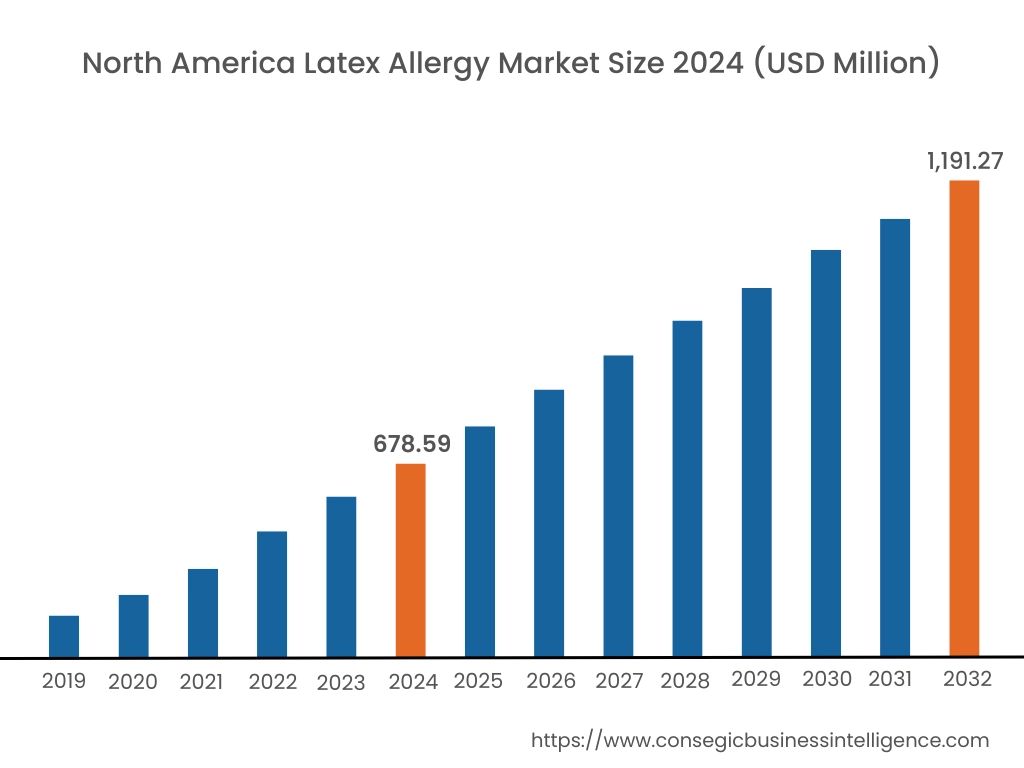
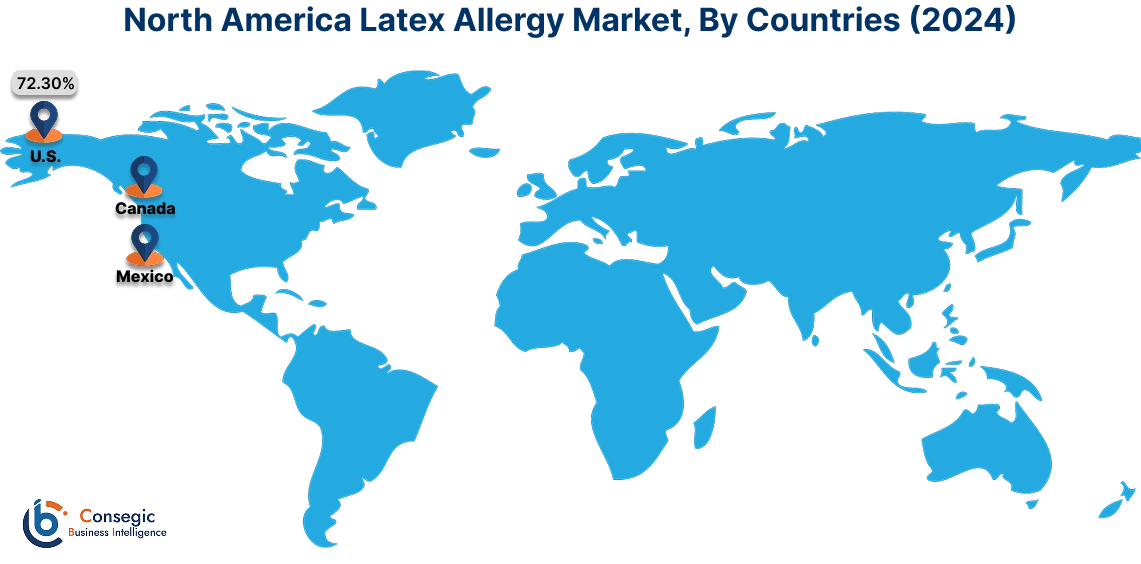
In 2024, North America was valued at USD 678.59 Million and is expected to reach USD 1,191.27 Million in 2032. In North America, the U.S. accounted for the highest share of 72.30% during the base year of 2024. North America holds the largest share of the latex allergy market. The high prevalence of latex allergies in both the United States and Canada contributes to this. Strict regulations surrounding the use of latex in medical and consumer products have driven the demand for latex-free alternatives. Increased awareness of latex allergies among healthcare professionals and patients further supports market growth. The growing adoption of latex-free gloves and medical devices in hospitals and clinics in this region positively impacts the market.
In Asia Pacific, the market is experiencing the fastest growth with a CAGR of 8.0% over the forecast period. The Asia-Pacific region is witnessing rising demand for latex-free products, especially in countries like Japan, China, and India. The awareness of latex allergies is expanding due to increasing cases of allergic reactions. However, the market remains underdeveloped in certain areas due to limited awareness and regulatory measures. In countries like Japan, strict regulations and a well-established healthcare system have led to a shift towards latex-free products. In India and China, market growth is constrained by a lack of awareness and infrastructure, although the rising middle-class population and healthcare improvements may contribute to future latex allergy market expansion.
Europe has a mature latex allergy market, particularly in countries like Germany, the UK, and France. The region benefits from strong healthcare regulations that limit latex exposure in medical settings. European governments have also implemented safety measures to reduce the risk of allergic reactions in healthcare workers and patients. Increased awareness about latex allergies in the general population, along with widespread adoption of latex-free medical devices and gloves, continues to drive the market in this region. However, the prevalence of latex allergies varies across countries, with some regions seeing higher rates than others.
The Middle East and Africa (MEA) region has a developing latex allergy market. In countries like Saudi Arabia and the UAE, rising awareness about latex allergies is pushing for the use of latex-free products in healthcare settings. However, the market is still in its nascent stage in many African nations. Limited access to healthcare infrastructure, combined with low awareness of latex allergy risks, restricts growth in certain parts of Africa. As healthcare standards improve and awareness campaigns spread, the market for latex allergy-related products is expected to expand in the coming years.
Latin America is experiencing gradual growth in the latex allergy market. Countries like Brazil, Argentina, and Mexico have begun to implement more regulations surrounding latex use in healthcare settings. Increased cases of latex allergies in healthcare professionals and patients have prompted the shift toward latex-free alternatives in hospitals and clinics. However, market growth is constrained by limited awareness in rural areas and the relatively high cost of latex-free products. Despite these challenges, improved healthcare access and education are expected to boost market potential in the region.
Top Key Players and Market Share Insights:
The Global Latex Allergy Market is highly competitive with major players providing products and services to the national and international markets. Key players are adopting several strategies in research and development (R&D), product innovation, and end-user launches to hold a strong position in the Global Latex Allergy Market. Key players in the Latex Allergy industry include-
- Cardinal Health, Inc. (United States)
- Ansell Limited (Australia)
- Aurelia Gloves (Malaysia)
- Dynarex Corporation (United States)
- Semperit AG Holding (Austria)
- Top Glove Corporation Bhd (Malaysia)
- Medline Industries, Inc. (United States)
- Hartalega Holdings Berhad (Malaysia)
- Rubberex Corporation (M) Berhad (Malaysia)
- Kossan Rubber Industries Bhd (Malaysia)
Recent Industry Developments :
Product Launches:
- In February 2024, the U.S. Food and Drug Administration (FDA) approved Xolair® (omalizumab) as the first and only medication for children and adults with one or more food allergies. While primarily indicated for food allergies, Xolair® has shown promise in reducing allergic reactions, including anaphylaxis, which may be beneficial for individuals with latex allergies.
Latex Allergy Market Report Insights :
| Report Attributes | Report Details |
| Study Timeline | 2019-2032 |
| Market Size in 2032 | USD 3,675.62 million |
| CAGR (2025-2032) | 7.6% |
| By Type of Allergy |
|
| By Product |
|
| By Diagnosis |
|
| By Treatment |
|
| By End-User |
|
| By Region |
|
| Key Players |
|
| North America | U.S. Canada Mexico |
| Europe | U.K. Germany France Spain Italy Russia Benelux Rest of Europe |
| APAC | China South Korea Japan India Australia ASEAN Rest of Asia-Pacific |
| Middle East and Africa | GCC Turkey South Africa Rest of MEA |
| LATAM | Brazil Argentina Chile Rest of LATAM |
| Report Coverage |
|
Key Questions Answered in the Report
How big is the Latex Allergy Market? −
In 2024, the Latex Allergy Market was USD 2,045.73 million.
What will be the potential market valuation for the Latex Allergy Market by 2032? +
In 2032, the market size of Latex Allergy Market is expected to reach USD 3,675.62 million.
What are the segments covered in the Latex Allergy Market report? +
The type of allergy, product, diagnosis, treatment, and end-user are the segments covered in this report.
Who are the major players in the Latex Allergy Market? +
Cardinal Health, Inc. (United States), Ansell Limited (Australia), Top Glove Corporation Bhd (Malaysia), Medline Industries, Inc. (United States), Hartalega Holdings Berhad (Malaysia), Rubberex Corporation (M) Berhad (Malaysia), Kossan Rubber Industries Bhd (Malaysia), Aurelia Gloves (Malaysia), Dynarex Corporation (United States), Semperit AG Holding (Austria) are the major players in the Latex Allergy market.
Overview
Reputation & Certifications


Our Services
- Market Intelligence & Forecasting
- Custom Research Solutions
- Market Entry Strategy
- Competitive Intelligence
- Customer Insights
- Industry Innovation Analysis
- Investment Advisory