Jump to Content
Linear Motion System Market - Size, Share, Industry Trends, and Forecasts (2026-2034)
Linear Motion System Market Size:
Linear Motion System Market size is estimated to reach over USD 21.61 Billion by 2034 from a value of USD 12.68 Billion in 2025 and is projected to grow by USD 13.23 Billion in 2026, growing at a CAGR of 5.6% from 2026 to 2034.
Linear Motion System Market Key Takeaways
- Growing adoption of industrial automation and smart manufacturing is driving market demand.
- Asia Pacific led the market in 2025, supported by rapid industrialization and manufacturing growth.
- Single-axis linear motion systems held the largest share, accounting for 63.15% of the market in 2025.
- Actuators dominated the component segment due to their critical role in motion control applications.
- Material handling equipment accounted for the largest application share, driven by warehouse automation.
- Bosch Rexroth, THK, HIWIN, NSK, and SCHNEEBERGER were among the leading market participants.
Linear Motion System Market Scope & Overview:
Linear motion systems are engineered to guide, support, and drive a load precisely along a straight line with high precision and low friction. The system mostly combines a stationary guiding element and a movable carriage for obtaining smooth, friction-minimized movement for automation and machinery. Moreover, it includes core components such as actuators, linear guides, ball screws, and bearings, among others. Additionally, the market is driven by factors such as the rapid adoption of industrial automation, advancements in robotics, and growing demand for precision engineering in manufacturing sector.

Linear Motion System Market Dynamics - (DRO) :
Market Drivers:
The rising adoption of industrial automation, robotics, and smart manufacturing is driving the linear motion system market
The market is experiencing significant growth, mainly driven by the expansion of industrial automation, robotics, and smart manufacturing, among others. As factories transition from traditional manual labor to completely automated ecosystems, the demand for precision, speed, and continuous operation is also increasing rapidly. Moreover, industrial robots, ranging from heavy-duty articulated welding arms to collaborative robots (cobots), rely significantly on linear motion assemblies like ball screws, linear guides, and electric actuators for attaining multi-axis movement and accurate positioning.
Furthermore, the global shift toward Industry 4.0 and smart manufacturing mandates high levels of predictability and digital integration. Modern manufacturing lines require machinery that is capable of executing complex, micro-level tracking tasks with minimal error. The above factors are further driving the adoption of linear motion solutions.
- For instance, in 2024, Xiaomi launched its completely automated smart factory in Beijing, China. The automated factory spans across 860,000 square feet, and it was developed to manufacture approximately 10 million smartphones each year without any human intervention.
Hence, the rising adoption of industrial automation in manufacturing facilities is driving the market.
Market Restraints:
High initial investment is restraining the linear motion system market growth
The high initial investment required for procurement and deployment of linear motion solutions is among the key factors restricting the market growth. The cost of implementing advanced linear motion setups, particularly high-precision sub-micron linear motors, multi-axis positioning tables, and automated electromechanical actuators, along with integrating them into existing systems, can be significantly high, which may cause financial barriers, mostly for smaller businesses or businesses operating on tighter budgets.
Additionally, linear motion setups can be quite complex to install and integrate, which further necessitates additional expenses on training personnel or hiring specialized experts for implementing and maintaining the system effectively. Thus, the above factors are hindering the market expansion.
Future Market Opportunities :
Rising application in semiconductor & electronics sector is expected to drive the linear motion system market opportunities
Semiconductor and electronics manufacturers rely considerably on high-precision linear guides, actuators, and direct-drive linear motors for wafer handling, photolithography, and microchip inspection. As microchips continue to scale down, the need for sub-micron positioning accuracy and rapid acceleration in chip fabrication plants is also increasing simultaneously. Moreover, the rising trend toward miniaturization in consumer electronics requires automated assembly lines utilizing agile and compact linear motion technologies for maintaining high throughput and reducing defect rates. Since linear motion solutions offer frictionless, repeatable movement, they play an essential role in improving output in modern, automated semiconductor manufacturing.
- For instance, according to the Semiconductor Industry Association, the global sales of semiconductors were valued at USD 791.7 billion in 2025, witnessing an increase of 25.6% in comparison to USD 630.5 billion in 2024.
Hence, according to the analysis, the rising application of linear motion solutions in semiconductor and electronics manufacturing is projected to boost the market during the forecast period.
Linear Motion System Market Segmental Analysis:
By Product Type:
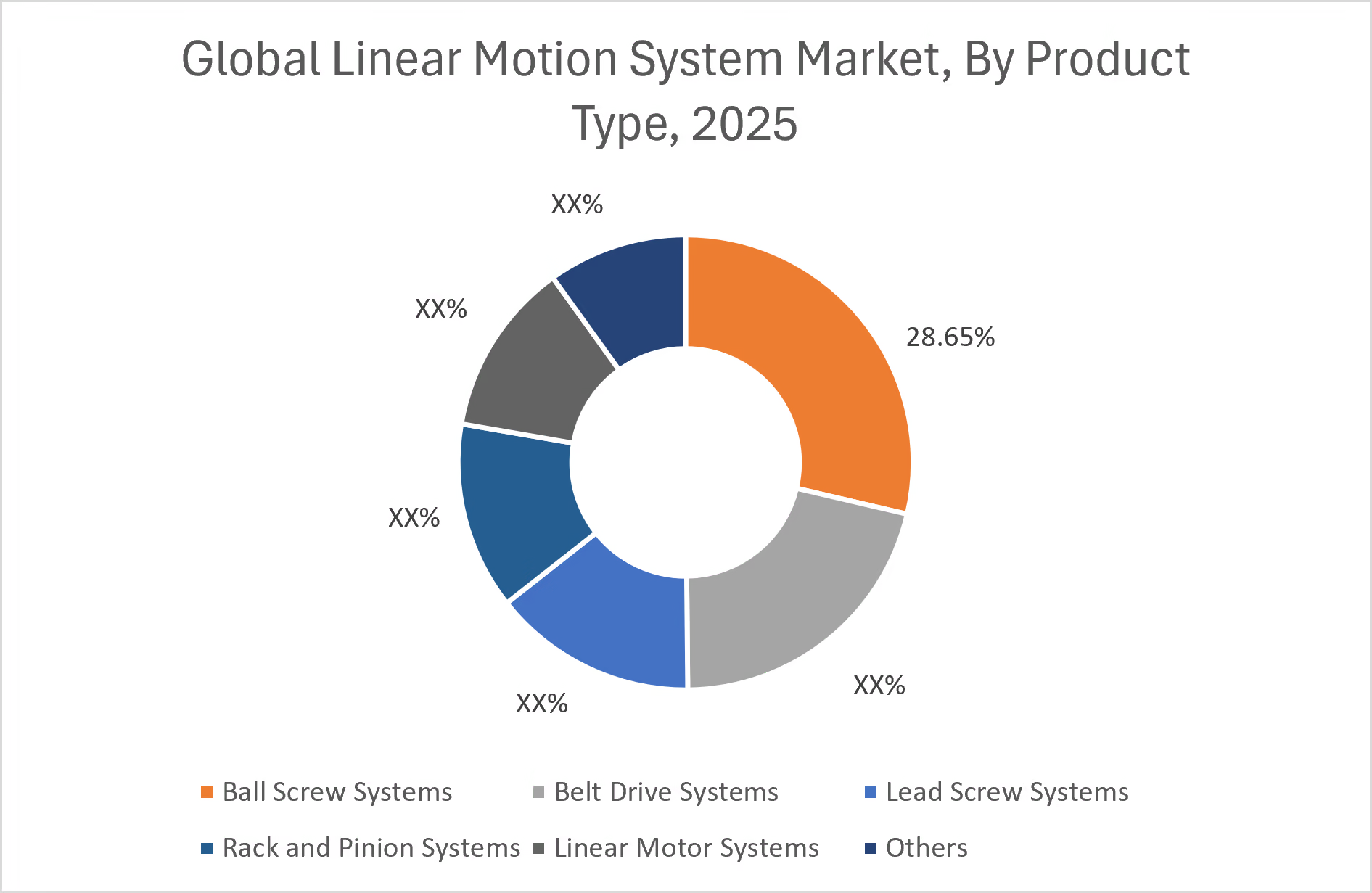
Based on product type, the market is segmented into ball screw systems, belt drive systems, lead screw systems, rack and pinion systems, linear motor systems, and others.
Trends in the product type:
- Also, factors including rising adoption of industrial automation, growing semiconductor and electronics sectors, along with a strong shift toward highly precise, energy-efficient manufacturing and advanced robotics, are driving the ball screw systems segment.
- The market is also driven by rising industrial automation integration, growing miniaturization of electronic devices, and rising adoption of linear motion solutions across manufacturing, packaging, and healthcare sectors.
The ball screw systems segment accounted for the largest revenue share of 28.65% in the market in 2025.
- A ball screw system is a high-precision mechanical actuator that is capable of converting rotary motion into linear motion.
- It operates using a threaded shaft and a specialized nut housing recirculating steel ball bearings, which considerably lowers friction while facilitating heavy load handling and micron-level accuracy.
- Moreover, ball screw systems are highly efficient and mostly used in CNC machines, robotics, and other industrial sectors, due to its superior precision, smooth operation, as well as load-bearing capacity.
- Also, factors including rising adoption of industrial automation, growing semiconductor and electronics sectors, along with a strong shift toward highly precise, energy-efficient manufacturing and advanced robotics, are driving the segment.
- According to the analysis, the above trends are further expanding the linear motion system market size.
The linear motor systems segment is anticipated to register the fastest CAGR during the forecast period.
- A linear motor system is an electromagnetic drive that is capable of generating straight-line motion directly, without relying on mechanical components such as gears, ball screws, or belts.
- This direct-drive design offers several benefits, including superior positioning accuracy, high speeds, zero backlash, and significantly reduced maintenance since there are no wear components.
- Also, linear motor systems are mostly used in semiconductor manufacturing, industrial automation, precision laser cutting, and other related applications.
- Further, factors including rising integration of industrial automation, growing miniaturization of electronic devices, and rising adoption of linear motion solutions across manufacturing, packaging, and healthcare sectors are propelling the market development.
- Hence, the above factors are expected to boost the market during the forecast period.
By System Configuration:
Based on the system configuration, the market is segmented into single-axis system and multi-axis system.
Trends in the system configuration:
- The multi-axis system segment is growing significantly, due to its ability to handle simultaneous x, y, and z movements required for intricate tasks in industries such as electronics, CNC machining, and aerospace, among others.
- Factors including the rising shift toward smart manufacturing, growing need for micro-level precision engineering, and significant investments in industrial automation are key trends driving the market.
The multi-axis system segment accounted for a significant revenue share in the linear motion system market share in 2025, and it is anticipated to register the fastest CAGR during the forecast period.
- A multi-axis linear motion solution combines two or more individual linear actuators or guides for facilitating movement in multiple directions, such as X-Y, X-Z, or X-Y-Z coordinates.
- Multi-axis systems allow machinery to execute complex, precise trajectories and are commonly used in industrial automation, robotics, and CNC machining applications, among others.
- Moreover, multi-axis systems offer various benefits including exceptional precision, high payload capacity, versatile motion profiles, and others.
- Further, the market growth is mainly driven by the rising shift toward smart manufacturing, growing need for micro-level precision engineering, along with significant investments in medical and automotive manufacturing sectors.
- According to the analysis, the aforementioned factors are further propelling the market.
By Operation Type:
Based on the operation type, the market is segmented into electromechanical/electric, pneumatic, hydraulic, and mechanical.
Trends in the operation type:
- The market is primarily driven by the growing demand for high-precision manufacturing, industrial automation, robotics, and the integration of smart, energy-efficient industrial control systems.
- There is a rapid shift from hydraulic and pneumatic platforms toward electromechanical drive architectures for attaining tighter positional repeatability, decreasing lifetime maintenance costs, while facilitating operational efficiency.
The electromechanical/electric segment accounted for the largest revenue in the market in 2025, and it is anticipated to register the fastest CAGR during the forecast period.
- Electromechanical/electric linear motion solutions primarily operate by converting the rotational energy of an electric motor into a straight-line mechanical force.
- This involves transferring the rotational energy through a mechanical drive component, like a lead screw, ball screw, or toothed belt, which then transforms the spinning motion into linear push-or-pull action for driving the carriage or load forward and backward.
- In addition, the market is mostly driven by the growing demand for high-precision manufacturing, industrial automation, robotics, and the integration of smart, energy-efficient industrial control systems.
- According to the analysis, the above factors are further propelling the market growth.
By End User:
Based on end user, the market is segmented into manufacturing & industrial automation, healthcare & laboratory equipment, electronics & semiconductor, e-commerce & logistics, packaging, aerospace & defense, and others.
Trends in the end user:
- The prevalence of favorable government initiatives for industrial automation is driving the manufacturing segment.
- Industrial facilities have witnessed a significant growth trend in utilization of linear motion solutions for optimizing industrial processes and facilitating precise, automated workflows, which is further driving the market.
The manufacturing & industrial automation segment accounted for the largest revenue share in the market in 2025, and it is anticipated to register a substantial CAGR during the forecast period.
- In manufacturing and automation, linear motion solutions play an important role in facilitating precise, automated workflows. They are used for driving CNC machines and 3D printers, positioning cutting tools and extruders with sub-millimeter accuracy, and other related applications.
- Moreover, in assembly lines, linear motion solutions are used to power pick-and-place robots and conveyor belts, which help in seamlessly transferring components among stations for decreasing cycle times, minimizing human error, and maximizing production throughput.
- Also, the segment dominance is attributed to the rising adoption of industrial automation systems in manufacturing factories for optimizing manufacturing processes and operations with minimal human intervention.
- Additionally, the increasing development of smart factories and technological advancements in manufacturing equipment such as artificial intelligence (AI) has further propelled the market development.
- According to the analysis, the rising developments associated with smart factories and increasing adoption of automation in manufacturing facilities are driving the market.
Linear Motion System Market Regional Analysis:
The regions covered are North America, Europe, Asia Pacific, Middle East and Africa, and Latin America.
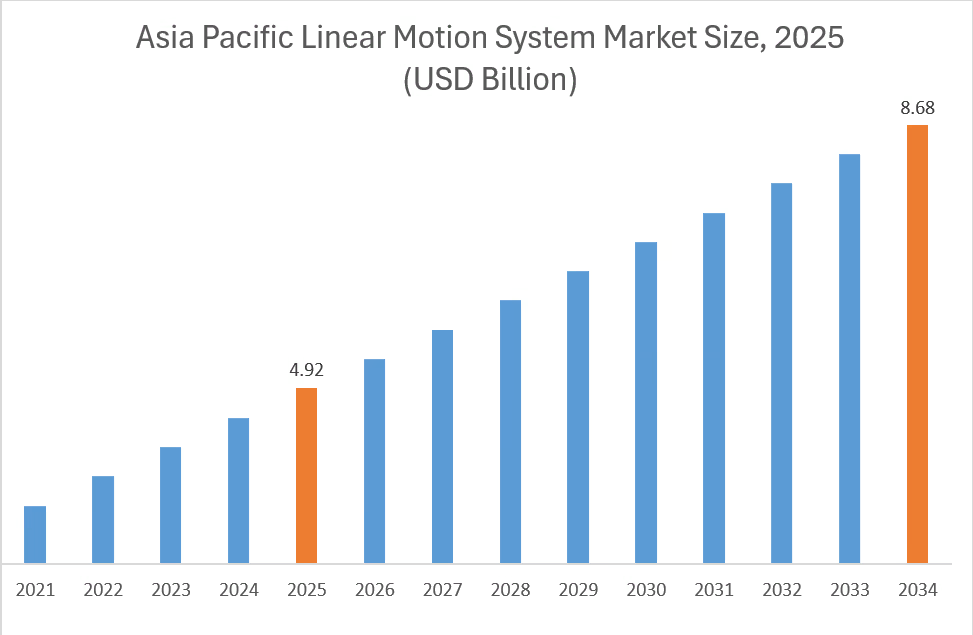
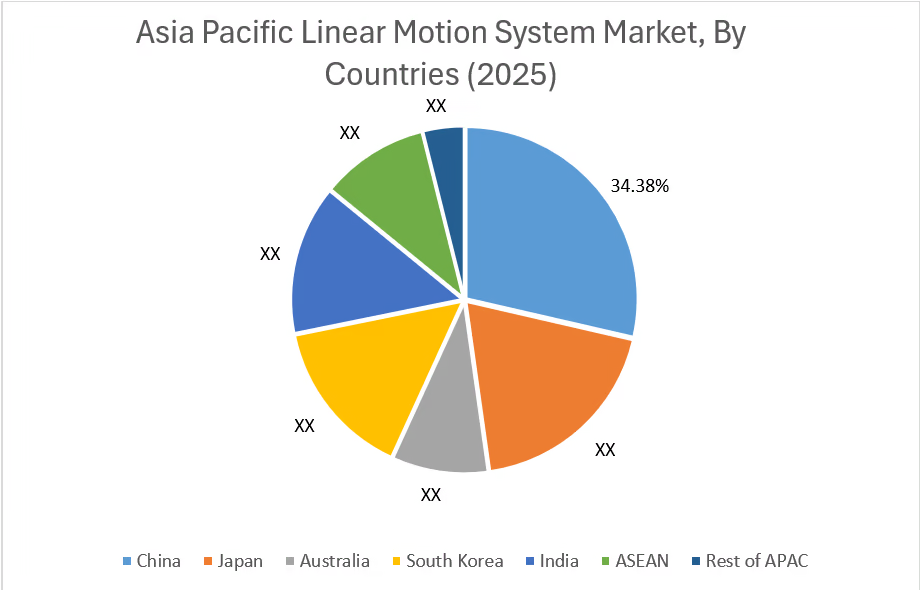
Asia Pacific region was valued at USD 4.92 Billion in 2025. Moreover, it is projected to grow by USD 5.15 Billion in 2026 and reach over USD 8.68 Billion by 2034. Out of this, China accounted for the maximum revenue share of 34.38%. As per the linear motion system market analysis, the adoption of linear motion solutions in the Asia-Pacific region is primarily driven by rapid industrialization and favorable factory automation policies in manufacturing hubs such as China, Japan, South Korea, and India, among others. Additionally, increasing advancements associated with smart factory solutions are further accelerating the market.
- For instance, in December 2023, Mitsubishi Electric India introduced its new smart manufacturing facility for advanced factory automation systems in the state of Maharashtra, India. The new manufacturing facility is optimized to deliver products with highest quality and reliability while strengthening its business in India and addressing the increasing need for advanced automation and smart manufacturing solutions. The above factors are further driving the market in the Asia-Pacific region.
North America is estimated to reach over USD 5.85 Billion by 2034 from a value of USD 3.45 Billion in 2025 and is projected to grow by USD 3.59 Billion in 2026. In North America, the market is mostly driven by expanding industrial automation, significant proliferation of robotics, and a booming electric vehicle (EV) sector, which requires highly precise assembly lines. Furthermore, strict green manufacturing policies and rapid incorporation of smart factory solutions are further contributing market demand.
- For instance, according to the International Federation of Robotics, industrial robot installations in the United States reached 38,000 units in 2025, representing an increase of 11% as compared to 2024. The above factors are expected to propel the market trends in North America during the forecast period.
Meanwhile, according to the regional analysis, factors including the widespread adoption of industrial automation, presence of advanced manufacturing hubs in automotive and aerospace, and the integration of Industry 4.0 technologies, are driving the market in Europe. Furthermore, according to the market analysis, the market in Latin America, Middle East, and African regions is expected to grow at a considerable rate due to factors such as increasing investments in the development and modernization of industrial manufacturing facilities and rising adoption of industrial automation solutions within factories.
Top Key Players & Market Share Insights:
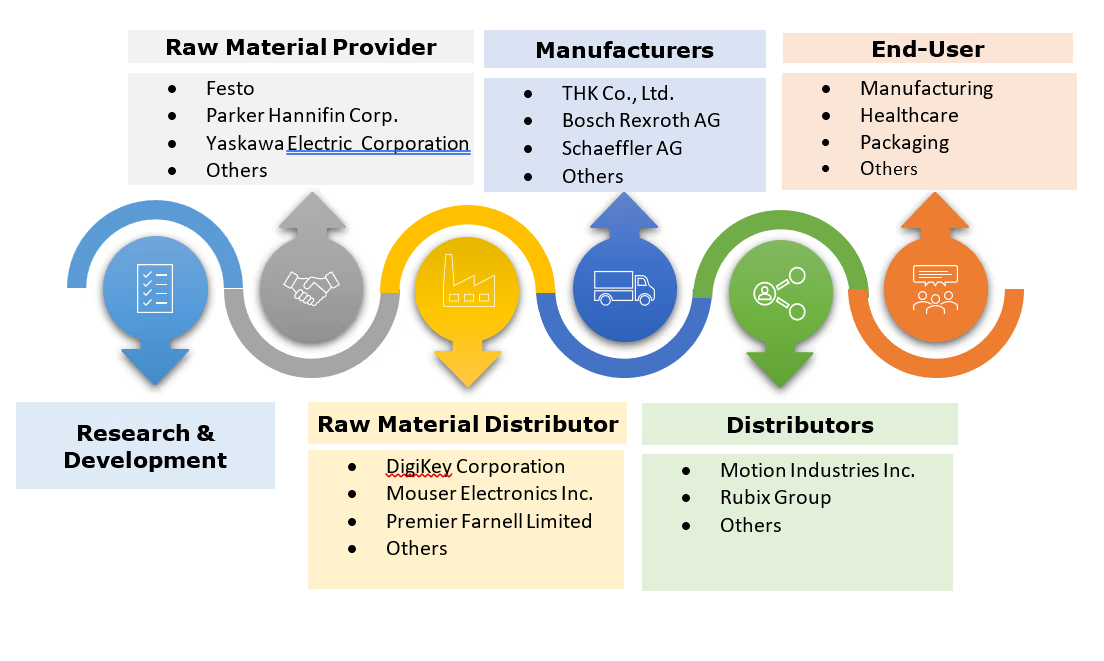
The global linear motion system market is highly competitive with major players providing solutions to the national and international markets. Key players are adopting several strategies in research and development (R&D), product innovation, and end-user launches to hold a strong position in the market. Key players in the linear motion system industry include-
- THK Co., Ltd. (Japan)
- Bosch Rexroth AG (Germany)
- HIWIN Technologies Corp. (Taiwan)
- NSK Ltd. (Japan)
- Schaeffler AG (Germany)
- Thomson Industries Inc. (United States)
- Rollon S.p.A. (Italy)
- SCHNEEBERGER Group (Switzerland)
- Rockwell Automation Inc. (United States)
- Precision Motion Industries Inc. (PMI Group) (Taiwan)
Linear Motion System Market Ecosysytem:
Recent Industry Developments :
Product Launches:
- In October 2024, Rollon expanded its high-performance linear motion portfolio by introducing new sizes for the E-SMART and R-SMART actuator lines. It also included the launch of the R-SMART-R, a compact unit featuring hardened prismatic rails designed for higher load capacities.
- In May 2023, NSK launched its AXIS series linear actuators, designed to deliver high-speed, high-precision motion. These actuators provide system designers with high-performance solutions optimized for ultra-precise linear positioning applications.
Acquisitions:
- In October 2023, The Timken Company completed the acquisition of Rosa Sistemi S.p.A., a European manufacturer specializing in linear bearings, customized motion systems, actuators, roller guideways, commercial ball guideways, and precision ball screws. This strategic move expanded Timken's reach into various sectors, particularly within industrial automation and machine tooling markets.
Petroleum Jelly Market Report Insights :
| Report Attributes | Report Details |
| Study Timeline | 2011-2034 |
| Market Size in 2034 | USD 21.61 Billion |
| CAGR (2026-2034) | 5.6% |
| By Product Type |
|
| By System Configuration |
|
| By Operation Type |
|
| By End User |
|
| By Region |
|
| Key Players |
|
| Report Coverage |
|
Key Questions Answered in the Report
How big is the linear motion system market? −
The market was valued at USD 12.68 Billion in 2025 and is projected to grow to USD 21.61 Billion by 2034.
Which is the fastest-growing region in the market? +
Asia-Pacific is the region experiencing the most rapid growth in the market.
What specific segmentation details are covered in the report? +
The report includes specific segmentation details for product type, system configuration, operation type, end user, and region.
Who are the major players in the market? +
The key participants in the market are THK Co., Ltd. (Japan), Bosch Rexroth AG (Germany), HIWIN Technologies Corp. (Taiwan), NSK Ltd. (Japan), Schaeffler AG (Germany), Thomson Industries Inc. (United States), Rollon S.p.A. (Italy), SCHNEEBERGER Group (Switzerland), Rockwell Automation Inc. (United States), Precision Motion Industries Inc. (PMI Group) (Taiwan), and others.
Overview
Reputation & Certifications


Our Services
- Market Intelligence & Forecasting
- Custom Research Solutions
- Market Entry Strategy
- Competitive Intelligence
- Customer Insights
- Industry Innovation Analysis
- Investment Advisory